
You are currently browsing the category archive for the ‘Amateur’ category.
If you are in Seattle this Friday, think about dropping in at the Books To Prisoners‘ Art Auction; CREATIVE RELEASE.
Heck, if you turn up with a paperback dictionary you get in for free. I have some inside information that the quality of art is high. Loads of lithographs and a bunch of Just Seeds prison-specific prints!


Over two million individuals are behind bars in U.S. prisons, living in isolation from their families and their communities. Prison/Culture surveys the poetry, performance, painting, photography & installations that each investigate the culture of incarceration as an integral part of the American experience.
As eagerly as politicians and contractors have constructed prisons, so too activists and artists have built a resistance. Nowhere are these two forces pushing against one another as forcefully as in California. The book, Prison/Culture, compiles the documents of a two year collaboration between San Francisco State University, Intersection for the Arts (one of San Francisco’s oldest art non-profits) and prison artists & outside activists across the US.

Mark Dean Johnson’s essay summarises the visual/cultural history of incarceration; from Gericault’s institutionalized mentally ill subjects and his paintings of severed heads as protest against capital punishment, to Goya’s prison interiors of the inquisition; from Alexander Gardner’s portrait of Lincoln’s assassin Lewis Payne (1865), to Otto Hagel’s portrait of Tom Mooney (1936); and from Ben Shahn’s murals against indifference to the conditions of immigrant workers (1932) to the work of Andy Warhol and David Hammons in the modern era.
Johnson guides this lineage to the Bay Area, describing how Michel Foucault’s book Discipline and Punish: The Birth of the Prison became the conversation topic of Bay Area coffeehouses and classrooms (Foucault began lecturing at UC Berkeley in 1979). The swell of interest in Foucault’s structuralism coincided with a grassroots expansion of prison art in the early 1980s.
For text, the editors of Prison/Culture made two canny and provocative choices: Angela Y. Davis and Mike Davis (no relation).
THE TEXT
Firstly, in a 2005 interview, America’s most notorious prison abolitionist Angela Davis sets out – in her most accessible terms – how our prison industrial complex serves primarily as a tactical response to the inadequate or absent social programs following the end of slavery. Abolition was successful in that it redefined law, but it failed to truly develop alternative, democratic structures for racial equality. Powerful stuff, yet even newcomers to Davis’ argument won’t be as shocked as they may expect to be. She’s that good.
Next up, Mike Davis’ 1995 essay ‘Hell Factories in the Field’ is a bittersweet ‘I-told-you-so’-inclusion. Davis has made a specialty of dealing with – in stark academic prose – disaster scenarios, race-based antagonism and the environmental rape of recent Californian history. When Davis witnessed the mid-nineties expansion of the prison industrial complex (or as Ruth Gilmore Wilson terms it ‘The Golden Gulag’) he foresaw prisons’ economic band-aid utility for depressed towns; foresaw the mere displacement of violence; foresaw the assault on fragile family ties; foresaw the unconstitutional prison overcrowding and predicted the collective collapse of moral responsibility.
Davis’ article focused on the then new California State Prison, Calipatria – and not in a dry way. Paragraphs are devoted to recounting the installation of the world’s only birdproof, ecologically sensitive death fence following impromptu electrocutions of migrating wildfowl. The editors note, as of 2008, Calipatria’s facility design of 2,208 beds was 193% over-capacity with 4,272 inmates. Where birds saw an improvement in their lot, prisoners certainly did not, have not.
THE ART
Contributors include some well-known names – RIGO, (here on PP) Sandow Birk, Deborah Luster and Richard Kamler whose works address incarceration, criminal profiling, wrongful conviction, prison labor, and the death penalty. The book also includes poetry by Amiri Baraka, Ericka Huggins, Luis Rodriguez, Sesshu Foster and others but I shall not comment on these wordsmiths (their work is beyond my purview) other than to say they are talented and politically in the right place.

Special mention must go out for Deborah Luster’s One Big Self project (more here). In my personal opinion, it is the single most important photographic survey of any US prison. It is certainly the most longitudinal. Over a five year period, Luster visited the farm-fields, woodsheds, rodeos and national holiday & Halloween events throughout Louisiana’s prisons. She became a loved and recognized figure among the prison population; she estimates she gave away 25,000 portraits to inmates. Luster’s conclusion? Even mass photography struggles to communicate the vast numbers of men and women behind bars.
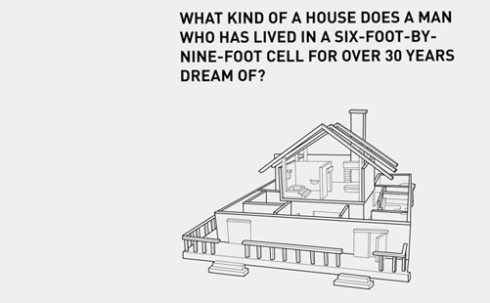
In 2003, artist Jackie Sumell collaborated with Herman Joshua Wallace (one of the Angola 3) on the design of his “Dream House”. The project The House That Herman Built is heartbreaking and bittersweet.
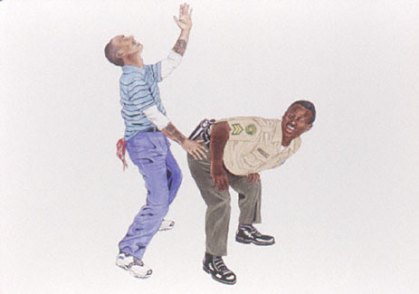
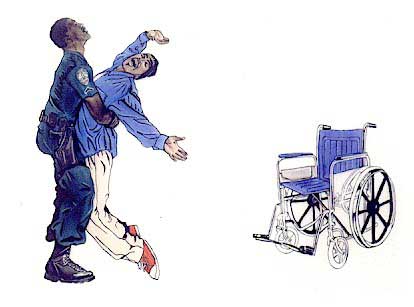
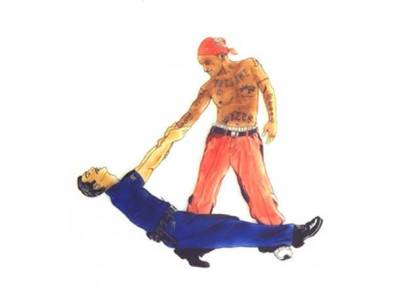
Alex Donis employs cunning and cutting humour for his series WAR. He sketches criminal “types” with figures of authority (policemen, prison guards) mid-dance, often bumping and grinding. He even conjures a kiss between Crips and Bloods gang members.
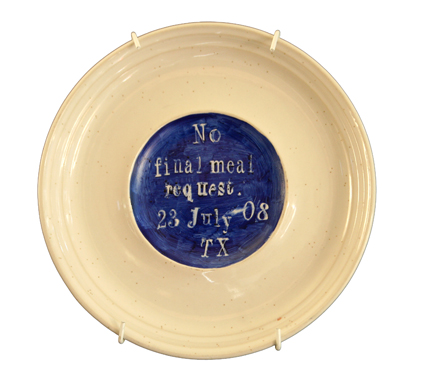
Also unexpected is the visual testimony of condemned mens’ last requested meals. For The Last Supper, Julie Green painstakingly painted porcelain plates with the last meals of nearly 400 executed men. Grayson Perry won the Turner Prize a few years ago, in large part due to his vases of abuse, bigotry and social ills. This clever use of regent materials has also been adopted by Penny Byrne for her Guantanamo Bay Souvenirs which sets up interesting parallels and a new turn for discourse between US homeland prisons and those used for the “Global War About Terror” (GWAT).

Relating to GWAT, Aaron Sandnes established a sound sculpture in which gallery visitors were subjected to the same pop songs used in Psych-ops by police and military interrogators.
Dread Scott‘s use of audio is intentionally to give silenced men a voice. (Scott has talked about the primacy of audio in his exhibition of prison portraits previously at Prison Photography).
Mabel Negrete collaborated with her brother incarcerated in Corcoran State Prison. She mapped out the floorplan of his cell as compared to her apartment bathroom. She then developed a dramatic dialogue in which she played both herself and her brother. (No images unfortunately.)
Traced – but essentially fictional – lines of structure are fitting for San Francisco, the city in which world-famous architect/installation artists Diller & Scofidio got their start with the architectural memories of the Capp Street Project. Negrete’s CV is extensive, she was instrumental in organising Wear Orange Day, a prisoner awareness action. Also check out her Sensible Housing Unit.

Cross-prison-wall collaborations are vital to the project as a whole; so much so, that without input from prisoners, the entire enterprise would fall short. Primarily, it is the men of the Arts in Corrections: San Quentin run by the William James Association who deliver acrylics and oils of optimistic colour and profound introspection. More here.
Collaboration as delivered in a multimedia and digital format comes by way of Sharon Daniel’s Public Secrets. Public Secrets “reconfigures the physical, psychological, and ideological spaces of the prison, allowing us to learn about life inside the prison along several thematic pathways and from multiple points of view.”

In closing, it is worth noting that San Quentin prison (only 12 miles north of San Francisco) has one of the few remaining prison arts programs in the state following 20 years of cut backs. The works in Prison/Culture challenge – as Deborah Cullinan & Kurt Daw, in their foreword, suggest – “traditional boundaries between inside and outside, between professional and amateur, between institutions and people” and, “by juxtaposing work by professional artists with artists who are working inside a prison, this book challenges us to rethink notions of community and culture.”
Prison/Culture is simultaneously a consolidation of achievement, a fortification of resources and celebration of resistance. This may be a book with a Californian focus, but it has national and international relevance. Succinct, well researched, egalitarian and lively. For me, Prison/Culture is the best collection of works by any US prison reform art community up until this point in history.
The resource list of over 80 organisations at the back of the book (page 92) is ESSENTIAL reference material for anyone looking to commit energies into prison art programs. All told, this book is a must read for those interested in the artistic landscape of our prison nation. It powerfully exposes the vast gulf between criminal justice and social justice in US society.
– – – – – – – – – – – – – – – –
Prison/Culture is published by City Lights, edited by Sharon E. Bliss, Kevin B. Chen, Steve Dickison, Mark Dean Johnson and Rebeka Rodriguez.
Read a Daily Kos review here, and view images from a 2009 exhibition here.
City Lights Celebrates the Release of Prison/Culture
On Thursday, May 6 at 7:00 pm, join Steve Dickison, Jack Hirschman, Ericka Huggins, and Rigo 23 for a reading and book release celebration at City Lights Books. Tune in to KQED Forum at 9:00 am PDT the morning of the event for an interview with the book’s editors and contributor Angela Davis.
– – – – – – – – – – – – – – – –
Images (from top): PRISON/CULTURE book front; Sandow Birk; Deborah Luster; Exhibition views of The House That Herman Built; Alex Donis; Alex Donis; Alex Donis; Julie Green; Julie Green; Ronnie Goodman, San Quentin inmate, displays his work; and ‘Public Secrets’ screenshot.

Time is of the essence today, so why not a quick look at a mugshot archive?
All these images are from HIDDEN FROM HISTORY. UNKNOWN NEW ORLEANIANS:
“The people grouped here may have had nothing in common except that their lives intersected with the municipality at least once. This exhibit brings them together in part to show how the city classified them. The documents and photographs here are therefore not representative of those New Orleanians who lived their lives quietly and within the law; they are necessarily skewed toward those who erred or strayed, who got caught or got in trouble, or, conversely, those who actively sought assistance from the city.”
The images were selected from the Louisiana Division/City Archives. My favourites here are those photographs in which intriguing, strong(?) communication persists.


– – –
The exhibit was curated by Emily Epstein Landau and funded in part by the Sexuality Research Fellowship Program (1999), a program of the Social Science Research Council, with funding from the Ford Foundation. Dr. Landau received her doctorate from Yale University in 2005. Her dissertation, “Spectacular Wickedness”: New Orleans, Prostitution, and the Politics of Sex, 1897-1917, is a history of Storyville, the famous red-light district. She will be teaching New Orleans history this Spring, as a visiting lecturer at the University of Maryland, College Park. She lives in Washington, DC.
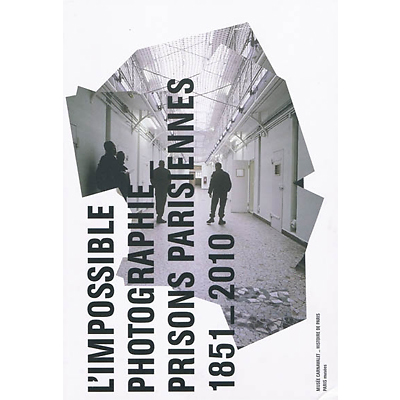
You should know by now that I am obsessed with the l’Impossible Photographie exhibition in Paris (here, here, here and here).
There is a paucity of information about the full line-up of photographers in the show, compounded by very few online images of those we do know about.
Brendan Seibel, the author of this review, and I have been exchanging emails and he has been filling me in.
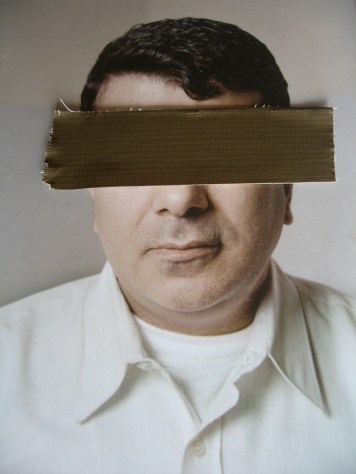
First of all, many of the photographs from contemporary shooters had faces intentionally covered. This is due to French privacy laws.
There were shots of juvenile detention for which the photographer intentionally obscured faces through shutter drag or by means of scratched glass or the people covering their faces.
Other photographers shooting adults had either empty rooms, shots of people from behind, or the photos were displayed with marking tape covering the faces. Marc Feustel of Eye Curious thought it was funny, or interesting at least- I found it pretty inexcusable, particularly given the subject matter of the exhibition. Impossible Photography indeed.
I am gobsmacked! I asked Brendan to clarify. He did:
When I say tape on the pictures I mean the glass pane, not the prints themselves. Which is why I assume there’s some gallery work behind this manner of obstruction.
What!? Art-handlers and/or curators took the decision to use gaffer tape to make anonymous the portrait sitters!? Why bother using the photographs at all if you plan to deface them?
To apply tape after the fact is either a fantastic dada-turn (by artist, curator or the two in partnership) or it is the most ham-fisted exhibiting practice in recent history.
You might as well stop caring which way is UP^. What would the Art Handling Olympians say?
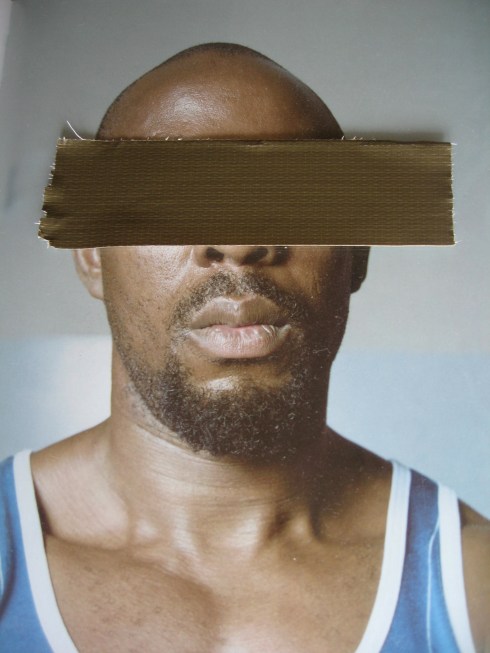
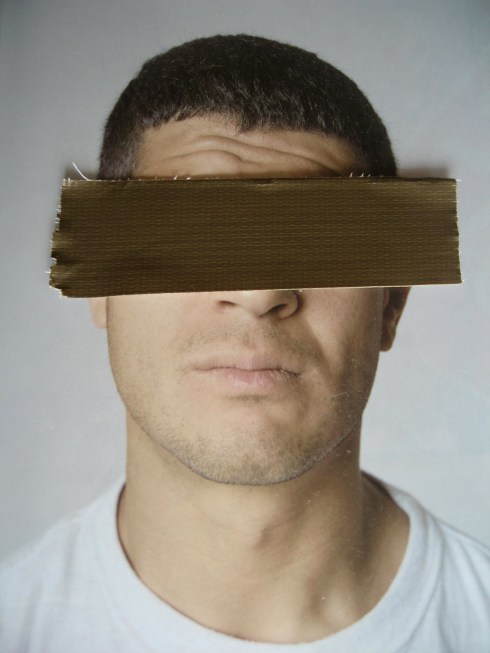
The three images above are not prints from the show.
They are illustrations I put together in my front room using a pane of glass, some gaffer tape and three portraits from Luigi Gariglio’s excellent book Portraits in Prisons.
Gariglio was not in the l’Impossible Photographie show.
It was either Beierle or Keijser (one of the Mrs. Deane halflings) who emailed and pointed out Simon Menner‘s photographic series Objects – 2010.

FAKE HEAD. Pillow, hat, paper, piece of Tetra Pak, hairs from a broom. @ Simon Menner
Typology is a trendy term that gets banded about easily these day but I have no better term for the straight photography of objects as these. Menner is the latest photographer in an ever-increasing line of prison tool and prison weapon typologists.
In 2005, Marc Steinmetz photographed the manufactured items of Santa Fu, Celle, Wolfenbuttel and Ludwigsburg prisons in Germany. (Featured on PP, July 2009)
Brett Yasko produced the independent book Shiv that features eleven prisoner-made weapons from the collection of Chris Kasabach and Vanessa Sica. The shivs were confiscated in the 1980s at Rahway – now known as East Jersey State Prison. Yasko’s photographs were presented in Design Observer’s feature Art of the Shiv.
Prior to 2008, Toño Vega Macotela was visiting Santa Martha Acatitla Prison, Mexico regularly and his photographs were showcased by Toxicocultura recently (via James).

Cooking Grill No.2 © Toño Vega Macotela

Pages of Brett Yasko's book 'Shiv'. © Brett Yasko

Multibladed Shiv. Image © Brett Yasko

Radio Receiver within Encyclopedia. © Marc Steinmetz, 2002

RADIO. Book, electronics (the title of the book translates “The Reputable Merchant”) © Simon Menner
The usual commentary for these types of typology is to admire the ingenuity and resourcefulness of the inmate. Notably, all four photographers have given “backstories” or contexts for the production and/or confiscation of the objects they’ve photographed. For example, Menner explains, “The objects presented here have all been seized in prison cells of the Berlin Tegel prison.” Menner also thanks the staff for allowing access. These extra details are essential if we are to avoid wonder and mere image-consumption.
These typological studies run the risk of serving politiicised positions; of becoming metaphors for human creativity or resistance.
(Worse still, the item and/or photograph is reduced to an objet d’Art.)
THE SOCIAL LIFE OF THINGS
Menner himself is concerned with how images and stories may or may not attach themselves, “What fascinates me here is the very old question of how much of the final object is already “inscribed” in its parts, even before its creation. And by asking this question I also ask a basic question on the nature of images. How much of a story is visible in the images, even before the story itself is unveiled?”
So what do you first think or ask when viewing these images? For me, I want to learn about the institutions, penology and prevailing criminal justice culture in which these inmates functioned:
With regard Yasko’s work – Why were so many shivs made at Rahway? And what led to two collectors acquiring them? With regard Menner and Steinmetz, what uses were dummy pistols and mobile phones put to inside those German prisons?
Fine art representations of these objects mustn’t be the end product in their object biographies. Narratives in the “Social Life of Things” do not end but morph.
The photographs of Yasko, Steinmetz, Macoleta and Menner impose new readings and establish new jumping off points for inquiry.

Device to hide a mobile phone. © Simon Menner

DUMMY PISTOL from blackened cardboard; found on June 23, 1988, in an inmate’s cell in Stammheim prison, Germany, after a fellow prisoner tipped off the jailers. The dummy was hidden in an empty milk pack and was most probably intended to be used for taking hostages in an escape attempt. @ Marc Steinmetz

It’s only fair to compare Obama’s 2009 outing with the big rabbit with George W. Bush’s 2008 appearance.

But sometimes pigment trumps pixels.

Painting by Dan Lacey

I just ran across these. They belong to a narrative of a science-fiction scenario that I am not familiar with.
Check out all of Lugonious‘ classic-toy futurescapes!


– – –
All this appreciation of Lego brings to mind Legofesto‘s more sinister, reality-based Lego sculptures of abuses at Abu Ghraib and Guantanamo – here, here, here and here.
Happy weekend!

“We never sat down, as far as I know, and came up with a grand strategy. Everything was very reactive. That’s how you get to a situation where you pick people up, send them into a netherworld and don’t say, ‘What are we going to do with them afterwards?’ “
Former senior US intelligence officer. (Source)

Mihail Kogalniceanu air base. Romania. @ 44.36043300, 28.49149700
Since 2001, the US has operated a program of rendition, illegal torture and operated a network of secret prisons and CIA “Black Sites”.
Men captured as part of the Bush and Obama administrations’ program were are interrogated, physically & psychologically beaten and denied human rights.
Images of these secret prisons are not common, but I’ve peppered this piece with a few just for the sake of the exercise.
At the top of this article is Mihail Kogalniceanu air base, Romania. It was used for “high-level” detainees from as early as 2005. Beneath is Kiejkuty Stare an illegal CIA prison just 20 miles away from Szymany airport, Poland. (source) It was used as early as 2005 and its function was confirmed in 2007. (source)
Khalid Sheikh Mohammed, “the mastermind of 9/11”, claims he was submitted to waterboarding 183 times over a one-month period. New evidence suggests he was interrogated in Poland. (More from Der Spiegel here and here).

Kiejkuty Stare
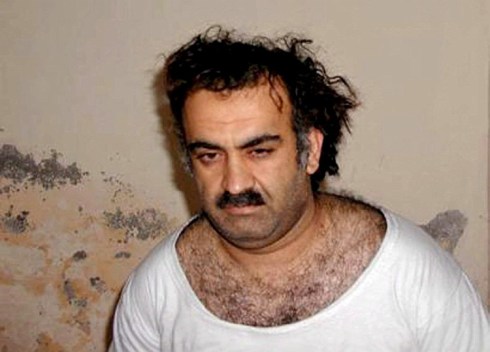
Khalid Shiekh Mohammed
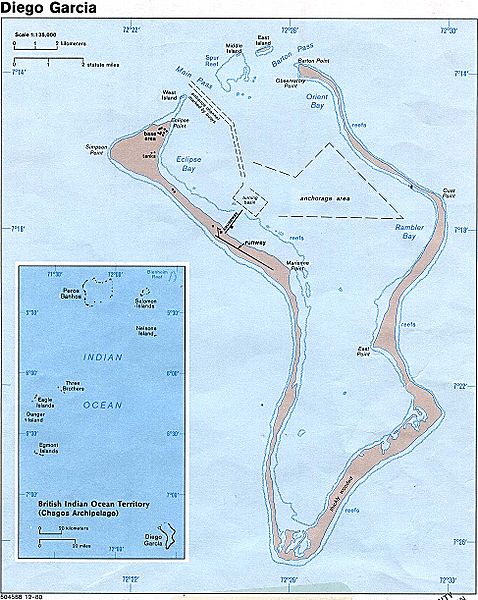
Diego Garcia Island, Indian Ocean, United Kingdom Territory. Rendition Flights Refuelled on the Island in 2002.
The UK Government provided infrastructural support for America’s extraordinary rendition program allowing rendition flights to refuel on Diego Garcia (above), a British territory in the Indian Ocean. (More here and here).
– – –
Below is the plan of a cell used during the 19 month illegal detention of Mohamed Farag Ahmad Bashmilah, a Yemeni national. Salon reports:
Bashmilah’s story also appears to show in clear terms that he was an innocent man. After 19 months of imprisonment and torment at the hands of the CIA, the agency released him with no explanation, just as he had been imprisoned in the first place. He faced no terrorism charges. He was given no lawyer. He saw no judge. He was simply released, his life shattered.
In 2007, Salon did a thorough job in describing his detention and its aftermath, even presenting plans based on Bashmilah’s descriptions of torture and interrogation rooms. No-one knows for certain where these cells were, but it is suspected they were within Afghanistan.
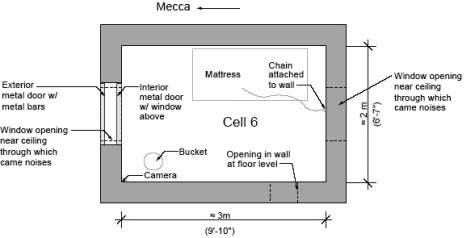
Exhibit I: Rendering of Mohamed Farag Ahmad Bashmilah's first cell in Afghanistan (based on Bashmilah's own drawings). Source: Salon.com
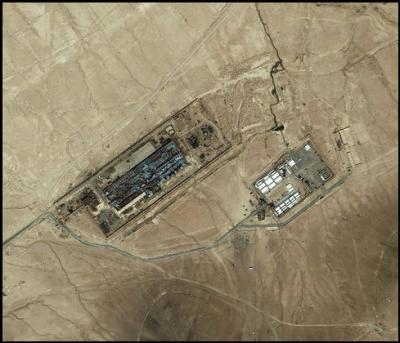
In Afghanistan, the largest CIA covert prison was code-named the Salt Pit, at center left above. (Space Imaging Middle East). Source: Washington Post
The most notorious Black Site in Afghanistan is referred to as ‘The Salt Pit’.
The Salt Pit brings us to Trevor Paglen‘s geography, photography and investigative academics, but first let me point out a couple more excellent resources.
When the details of rendition broke in 2007, Jane Mayer led the exposé with her book The Dark Side. Read a book review here and her extended New Yorker essay here.
FRONTLINE produced this astonishing interactive graphic showing all the illegal prisons and all the US aviation front-companies used for the rendition flights. That map is part of a larger presentation with interviews, time-lines and further resources.
More recently, Anand Gopal has revealed the US military’s still recent tactic against the Taliban in Afghanistan of by-night kidnappings. The result? The US has lost the support of the Afghan people toward the American project. Read America’s Secret Afghan Prisons here.
Just this month, Stephen Lendman summarised the January 26th UN Human Rights Council (HRC) report ‘Joint study on global practices in relation to secret detention in the context of countering terrorism’ which details practices by various countries “including America, by far the world’s worst offender in its war on terror.” The full report is here (Word) or here (pdf).
Lendman’s words The truth is shocking:
“Besides Guantanamo, Afghanistan and Iraq, HRC said the CIA runs scores of offshore secret prisons in over 66 countries worldwide for dissidents and alleged terrorists – in Egypt, Algeria, Jordan, Morocco, Syria, Libya, Tunisia, India, Pakistan, Russia, Uzbekistan, Sudan, Zimbabwe, Ethopia, Djibouti, Kenya, Poland, Romania, Bosnia, Kosovo, Thailand, Diego Garcia, and elsewhere.” (Source)
Onward. Now, Paglen …
TREVOR PAGLEN
The two images below are by Trevor Paglen. The first is the Salt Pit and the second is a military jail in Kabul. They are also his most ordinary of images … the only images he could capture in the circumstances.
Paglen isn’t primarily concerned with prisons; he is concerned with all the unseen activity of the military industrial complex – aviation companies, air strips, covert ops, air bases, Pentagon annual budget projections, spy satellites, shadow NASA reconnaissance agencies … the list goes on.
After meeting Emiliano Granado last Summer, he posted a good one-stop description of Paglen’s work. Granado also posted some good examples of Paglen’s Limit Telephotography and The Other Night Sky series. Check those out and then skip to Paglen’s lecture at the foot of this post.
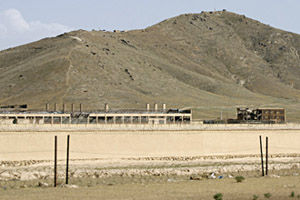
The Salt Pit, Shomali Plains Northeast of Kabul, Afghanistan. Trevor Paglen: The Salt Pit is located in an old brick factory a few miles northeast of Kabul, along an isolated back-road connecting Kabul to Bagram.

Black Site, Kabul, Afghanistan. Trevor Paglen: This site was brought to my attention by Afghan journalists and human rights activists in Kabul. The code name of this site remains unknown.
LECTURE
I have waited for a long time for an online presentation of Paglen’s oeuvre to which I could refer PP readers. (Thanks Alejandro!)
It’s quite the thrill to be brought in on Paglen’s sleuth work, as he walks us through the various public records used to piece together the rendition program. If you can spare an hour this weekend, you’ll be thankful for the education!
FORTHCOMING BOOK
Paglen’s work is to be published by Aperture in a book titled INVISIBLE. You can see Paglen and publisher Lesley Martin discussing the project here.

 Prison Photography