
You are currently browsing the category archive for the ‘Fine Art’ category.
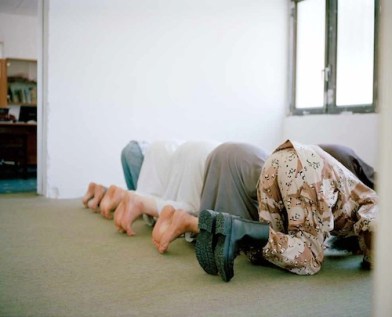
The Prison Governor of the Huda Foundation for prison and Reform, Misrata, prays with colleagues. © Louis Quail
Louis Quail makes a habit of going to zones that have been hit hard by human or natural emergency. He does so after said emergencies have tempered down and the world’s media has generally moved on. I celebrated his close and slow study of Haitians in May, 2010, a full four months after the devastating earthquake.
In the year since the end of the war, Quail has been in Libya. A small selection (seven) of his portraits were featured on the Guardian website yesterday. Quail has 25 images including candid, landscape and street shots on his website. The full body of work (I’ve viewed a PDF) comprises 25 interviews and 58 images.
Included in Quail’s series are three images from a prison.
“The model for the prison is an Islamic one where the prisoners are treated like their brothers, security is minimal with only one gate and a few guards. There is a strong sense of mutual respect and focus on Islam,” writes Quail.
Here I post two images and extended quotes that Quail recorded.
“We respect human rights here,” says a prison guard. “We repair them psychologically and think about how to make them good people – to turn them from fighters into civilians. Gadaffi taught them no respect. He told them they were better than other Libyans.”
“We want all prisons to be like this – if we don’t deal with the prisoners properly we will store up problems for the future – but it’s not popular with the government. It’s not a vote winner.”
“We are under-resourced at the moment. Our doctors and nurses are prisoners who have been trained by Medicine sans Frontiers and volunteers. We have 25 guards and access to 25 katibers outside, but even the prisoners tell us they will not run away because it’s much safer here for them here.”
But forgiveness and forward thinking is difficult when transition and immediate history has been so violent.
“We can’t deny there have been some human rights abuses, deaths in custody, torture in the revolutionary stages,” says a prison guard. “The families here in Misrata have seen their members killed and the girls raped. […] We have some mercenaries [in the prison] but to be honest, most died in the war. There was very little sympathy for them, there were many executions. They were from places like Darfur and Sudan, often on drugs or drunk. The doctors reported 700 cases of rape in Misrata, 132 of them on civilians aged between 12 and 15 years old.”
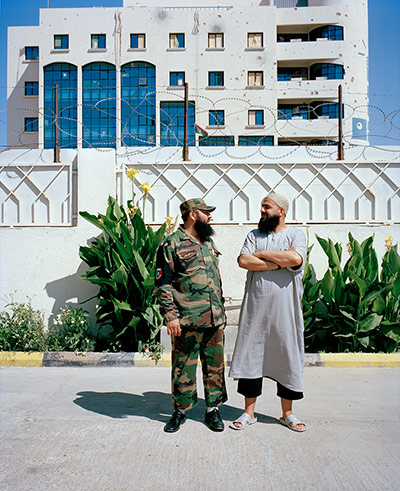
Omar, a previous Gadaffi militia member, talks to one of the prison guards at The Huda Foundation for Prison and Reform, in Misrata. © Louis Quail
“I was an elite fighter in Regiment 32 ran by Gadaffi’s son,” says Omar, a former Gadaffi loyalist. “In April 2011, I was fighting in Misrata, many people were dying and injured and I was shot in the legs, unable to move and was caught. It’s ok here. It’s very calm, they treat us like brothers. I have heard about other prisons where It’s not so good. After spending time here I no longer want to be a fighter, now we have to forgive each other and move on.”
Doug Lowell, from the series Seated
Eye On PDX is spreading its wings. It’s not migrating and flying the coop, but rather subdividing itself and doubling the product.
From beside a fire pit last month, I asked Blake Andrews if he wanted join the meandering inquiry into photographers here in Portland, OR. Blake hopped on board. The fact Blake lives in Eugene, two hours south, does not effect his credentials. He’s up here every other week to shoot, talk and gallery-hop. Besides, he knows everyone here that needs to be known; he lived in Portland years ago before it was post-Cool.
Eye On PDX is an ongoing series of profiles that feature a brief interview with a PDX photographer accompanied by a handful of photos.
Blake’s profile of Douglas Lowell expands Eye on PDX to B. And Blake is delivering awesome content that I simple can not. “Has a photograph ever made you cry?” Blake asks Doug. C’mon! Awesome.
Doug and Blake’s to-and-fro is lively and considered – the photobook as poetry and the importance of ideas over place. Read the full interview with Doug Lowell.
One point of clarification. When Blake says, “Pete will handle all of the photographers who are imprisoned felons and I will handle the rest,” he is having a lark. Any photographers I interview who work in Portland and happen to be felons will not be imprisoned.

For Three Strike, Northern Irish photographer Adam Patterson made portraits of men who had been sentenced to term-to-life sentences under Three Strikes Laws. The men have in common the fact all their releases were secured due to the work of the Stanford Three Strikes Project.
Patterson writes, “In 1997, William Anderson stole a dollar in loose change from a parked car. He was arrested and sentenced under California’s voter-approved “three strikes and you’re out” law. Mr Anderson’s two previous convictions of daylight residential burglary in 1985 now accounted for his first two strikes, allowing his petty theft from the car to trigger the hammer blow—the third strike. He was sentenced to 25 years to life in state prison. A number of states in the US have the three strikes law, under which criminals who persistently offend are given increasing penalties. Yet in California there remains one glaring difference that many believe is a catalyst for continued injustice. While the first two strikes must be “serious or violent” crimes, the third strike does not. This discrepancy has allowed criminal prosecutors to press for a variety of life-crippling sentences for the most minor of offences.”
Three Strike is four images.
VIDEO
Journalists Kelly Duane de la Vega and Katie Galloway‘s must-see multimedia documentary Three Strikes Of Injustice appeared on the New York Times website recently.
Three Strikes Of Injustice opens with an apology by Judge Howard Broadman, made to Shane Taylor. Broadman sentenced Taylor to 25-to-life for a non-violent offense fifteen years ago. It was Taylor’s third conviction. Taylor speaks from prison over the telephone and his family is interviewed. It’s very hard to disagree with Taylor’s tearful 19-year-old daughter who observes the absurdity of a 25-to-life sentence.
Duane and Galloway had long standing interest interest in prisons (they released Prison Town in 2007) but like Patterson was drawn to the work of the Stanford Three Strikes Project and specifically their 2010 study that showed that more than 4,000 inmates in California are serving life sentences for nonviolent offenses under the three-strikes law.
BIOGRAPHIES
Adam Patterson (b. 1982), received a postgraduate bursary in 2008 from the Royal Photographic Society to undertake a project on youth gang culture in London. He holds an MA in Photojournalism and Documentary Photography from the London College of Communication. He has worked with the BBC Panorama documentary team in Dubai, Chile and the UK and on documentary projects addressing issues such as the slave labor trade in Dubai and the rise of cheap heroin in Wales. He helped smuggle a digital camera to Chilean miner Edison Pena, who then photographed underground conditions while trapped during the Copiapó mining accident between August and October 2010,
– – – – – – – – – – – – – – – – – – – – – – – – – – – – – – – – – – – – –
Kelly Duane de la Vega and Katie Galloway received the best documentary screenplay award this year from the Writers Guild of America, West, and the Gotham Independent Film Award for best documentary last year, for their film Better This World.
Three Strikes Of Injustice was partly funded by David W. Mills, a Stanford law professor who supports Proposition 36 and has advocated reform of California’s three-strikes law.
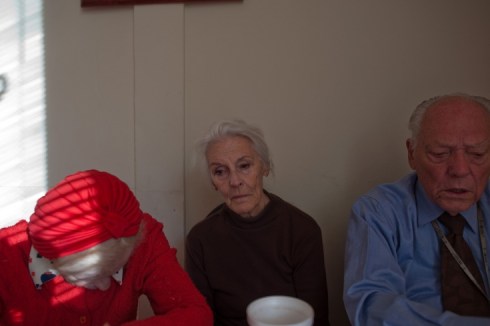
Jeanie, after crying over William’s depiction of women being “easily beguiled,” 2012. © Isadora Kosofsky
Sometimes it takes a while for great photography to percolate, for me at least. I’ve been aware of Isadora Kosofsky‘s documentary of Adina, Jeanie and Will – three seniors in a love triangle – for several months but spent some time with it yesterday.
Kosofsky’s series, titled The Three is potent and unique work full of surprise and bittersweet optimism. I’m not much like Adina, Jeanie and Will, but I am immediately interested in their story and emotions. They’re giving something a go which is less than ideal and it wears on them, but there are bright spots too. There’s a lot to mull over when considering who Kosofsky’s subjects are, where they’ve been and where they may be going.
It seems trite to suggest it, but by tapping the inconvenient messiness of emotion, Kosofsky’s work gets at some truth inherent to life. Truth, huh? Dangerous label when attached to photography.
Isadora Kosofsky is a Los Angeles-based documentary photographer. Her work can be seen here.
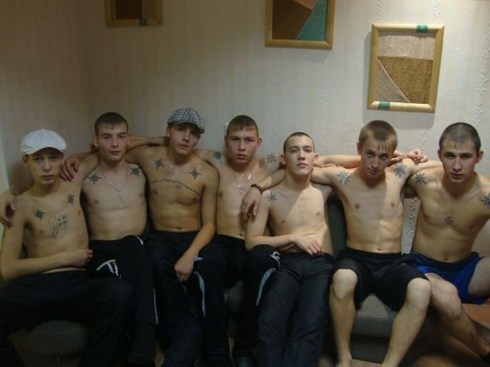
Young Russian Prisoners. Source.
Last week, TIME’s Lightbox published Michal Chelbin’s portraits from Russian and Ukrainian prisons.
Michal Chelbin‘s work includes adults and juveniles, but there is a strong persuasion in her work to consider youth and beginnings. Much of Chelbin’s past work depicts children who are fighters, gymnasts, miners or contemporary dancers – it as if they’ve been fast-tracked to adult lives of graft, competition and discipline. In that regard, her portraits of imprisoned children continues a theme and I’d argue we are not only presented with the seriousness of their confinement but also glimpse the awareness these children have of their deprivation.
On top of those winning elements (in terms of hooking the viewer) there is the obvious exotic; Chelbin communicates the exotic – and manipulates it too – with clear emphasis on, as Lightbox lists, “tropical wallpapers, lace-covered tables, furniture painted in glossy blues and greens […] floral house-dresses, cloth jackets and rubber sandals common to village life in the region. Religious icons seem as ubiquitous as tattoos.”
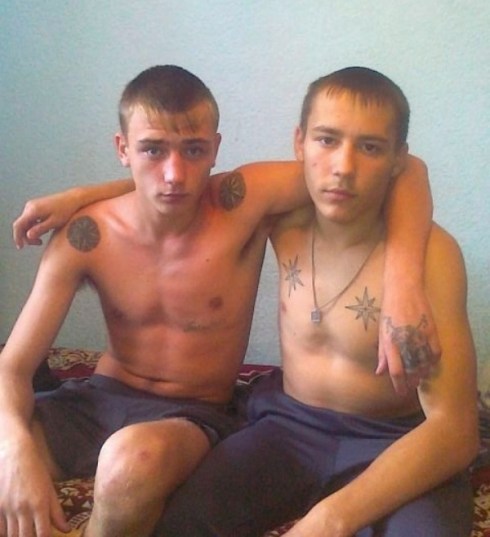
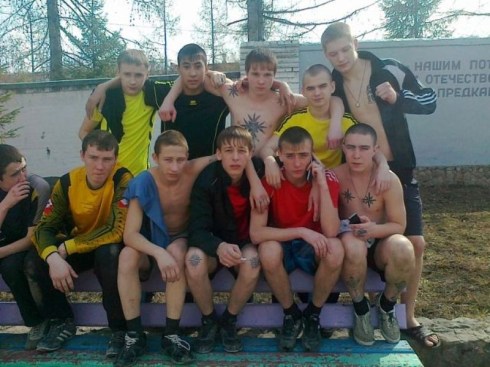
Fair enough. But let us not just subscribe to Chelbin’s heavily constructed view. A few months ago a friend sent me a link to the spuriously titled and information-vacant Young Gangstas. I think you’ll agree, the images catch the eye. First, because of their novelty and second because these are self-representations.
People aren’t going to be swayed toward feeling empathy for these posturing “gangstas” as they may for Chelbin’s maudlin subjects and even though Chelbin worked fast on the single days she had access to prisons it doesn’t mean she didn’t work fast to create a myth. In a previous conversation with Prison Photography, she described her approach:
“While I shoot almost all my work in Russia or the Ukraine, I feel that my interest is not social or geographical, but rather a mythological one. I return to these countries because they provide me with the visual contrasts that are the basic set up I am searching for – between old and new, odd and ordinary, as well as fantasy and reality. When I record a scene, my aim is to create a mixture of plain information and riddles so that not everything is resolved in the image.”
How different is this to the self-made camera phone photographs? In their naive posturing, and certainly in their tattoos, the young Russian prisoners are pushing their own mythology. One cannot know what the “photographer” holding the mobile phone had in mind, or if any of the subjects would expect their snaps to make it onto the web for a foreign audience.
If riddles are Chelbin’s game, and mystery her currency, maybe she’s found a match in these anonymous camera phone portraits? Forget about the gulf in aesthetic intent and you quickly realise there are as many unanswered questions, as many riddles about the cameras’ presence, and the photographer-subject relationships in the two bodies of work.
It might just be that Chelbin’s serves a much more palatable representation (for Western audiences). And that’s why her images are on a gallery wall right now.

Sergey, imprisoned for violence against women, juvenile prison, Russia © Michal Chelbin
Young Russian Prisoners. Source.

© Michal Chelbin
Young Russian Prisoners. Source.

The Day Nobody Died (detail), by Broomberg and Chanarin
SOURCE, the Belfast based contemporary photography magazine, has recently been considering how we can define (if at all) and think of conceptual photography.
The series WHAT IS CONCEPTUAL PHOTOGRAPHY is anchored by three well researched and neatly edited videos that canvas the opinions of artists, photographers, curators and critics.
I enjoyed learning about the work of John Hilliard in the first video. The surprise that conceptual photography – to which I will apply the adjectives non-figurative and self-referential – finds a welcome reception in art galleries and art festivals such as Documenta should be no surprise at all. People still expect representations of things in photography and as such representational photographs still dominate our visual culture, and especially our news culture.
The debate gets interesting is in the third video when it attaches itself to a specific body of work, The Day Nobody Died, by Broomberg and Chanarin.
In June of 2008, Broomberg and Chanarin traveled to Afghanistan to be embedded with British Army units on the front line in Helmand Province. Instead of making *traditional* photojournalistic images of the conflict, they rolled out seven metre sections of a roll of photographic paper and exposed it to the sun for 20 seconds. The Day Nobody Died is a refusal of photojournalism tropes and a question to audiences: what constitutes evidence in war, and in photography?
Broomberg and Chanarin make an effective challenge to the mechanisms at play in the embedding system – a system that routinely denies the public many accurate images of war, i.e. the wounded or dead soldier. Sean O’Hagan, photography critic for the Guardian, on the other hand, describes the project as an “arrogant” and “narcissistic” stunt.
Recommended viewing.
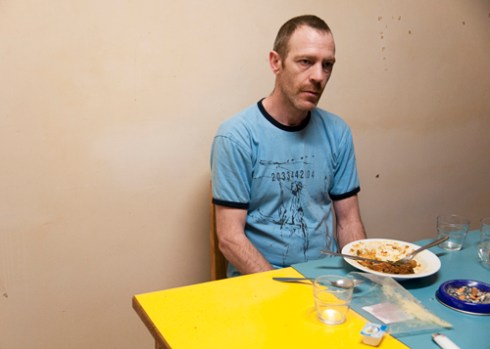
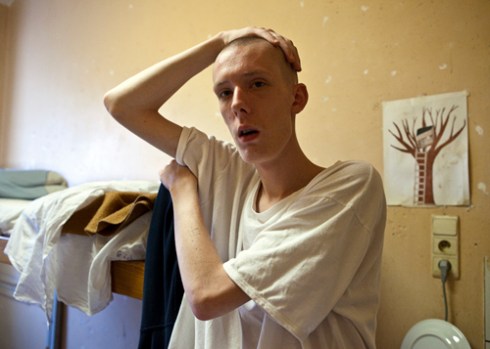
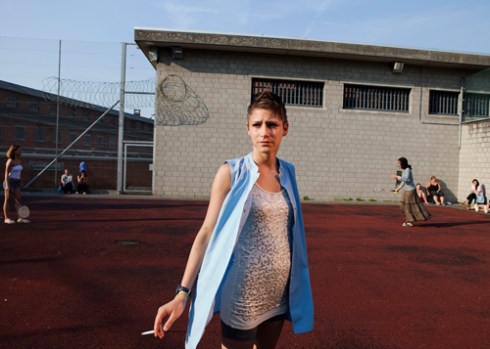
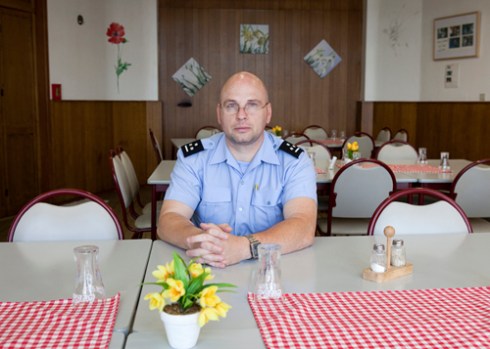
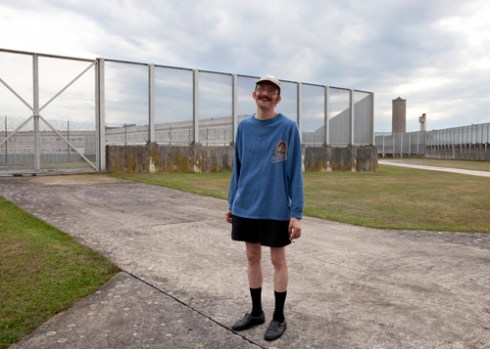
Laure Geerts and Sébastien van Malleghem, two members of the photo collective Caravane, have been photographing in Belgium’s prisons for a little under two years. They went to seven prisons including Marneffe, an open prison; Nivelles; Paifve, a prison for the mentally ill; and the now-demolished Verviers Prison.
The series is called Destination Carcerale.
This is the second of a two-parter; yesterday, I published Belgian Prison in Grayscale a Q&A with Sébastien van Malleghem. I know very little about Belgian prisons so I asked them both some questions.
Prison Photography: Why look at prisons?
Laure Geerts: I have always been interested in people, particularly people who live on the margins of society. I want to know more about their reality.
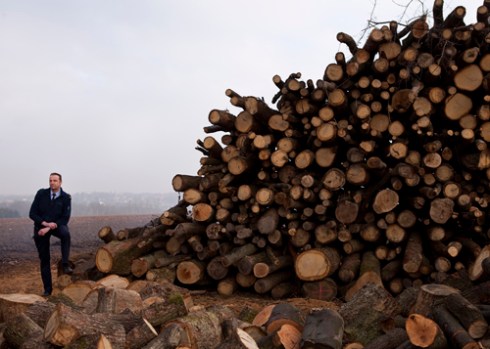
In Belgium, we hear news every week about prisons: overcrowding, unsanitary conditions, strikes, escapes and “famous” prisoners that no one wants to see released. It’s quite a hot topic but you don’t see much documentary on that. The known images are always the same press photo with doors, big keys, guardians and prisoners with the face hidden. I am interested about the psychological aspects of a men being kept between the walls.
So, it is not the problems related to the prison, but the human side, the life stories that interest me. The issue of the prison is complex. Each individual reacts very differently to the deprivation of liberty.

PP: Despite the vibrant colours, your photographs are quite still in a way. Does the prison move slow?
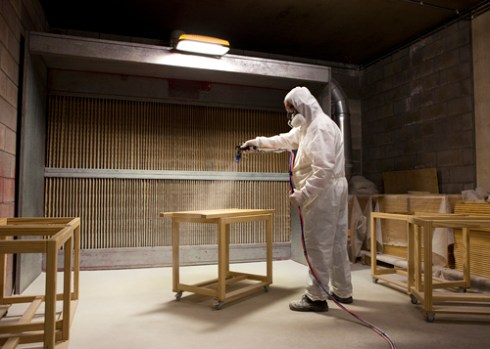
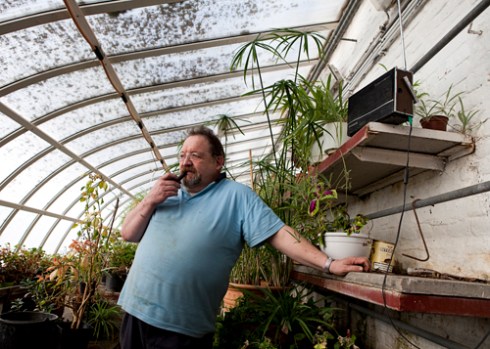
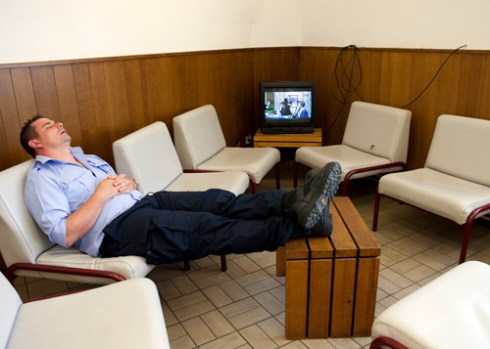
LG: Yes, the prison moves slow. Everything is regulated, organized, timed … everything turns around the schedule, daily or weekly tasks to perform. This leaves little room for spontaneity, freedom of movement. It is not possible to take meals or to wash when desired. Officers dictate the rhythm with calls, opening and closing doors, distributing meals and various movements to workshops, playground or visits. If the prisoners do not get a job or a training, they stay in cell watching television, sleeping or playing with video games. Many know drugs, depression, violence and isolation. Taking drugs and medicines allows them to escape their reality and keep calm.
PP: The look of many of your images suggest you had conversations about composition and positioning of your subjects, which could almost be considered a collaboration. Do you think of your work in those terms?
LG: The images, built my way, express the deprivation of movement & freedom, but even more the loneliness of the people. I must say, that when we arrived on a cell wing or in a working area, we explained our project and those who agreed to be photographed sign an authorization. That meant we spend a lot of time talking before taking pictures. I also recorded sounds of the prison and what the prisoners and staff are eager to tell me, to share. The images come before, during or after the discussion.
They do not pose especially. In any case, I do not direct them. I try to capture what they give to me. So they talk and I listen and sometimes everything is just in front my lens. An important thing for me is a trust. When trust is mutual, I feel comfortable and I feel free to take any picture. It’s funny because first I though it would be more difficult; I feel less comfortable in other contexts and working with other subjects in other communities.
PP: Why the collaboration with Sébastien?
LG: We’re part of the same collective of photographers, named Caravane. We wanted to work together on a topic. His interest in prisons is, of course, a logical continuation of his work on the police. He wanted to push the analysis one step further and investigate what happens to people in prison following an arrest.
I am interested in closed universes and masculine spaces. In prison, it is the human and psychological aspects of the prisoners that I wanted to see. How does a prisoner feel during his incarceration? What links remain with the outside world? How is the social network in that closed universe ? I do not remember if it was Sébastien or I that talked about it first, but it is true that rather than taking separate steps, we could join forces. The exchange of ideas and pictures enriches the subject.
Working in the same field, we ask for good organization and good understanding of each other. We meet the same people, we visit the same places, but at the end our images are very different. Sébastien works in black and white, when I need color in photography. Sometimes I can spend time with a person while Sébastien seeks more action with a small group else where. We do not shoot at the same time at all. Given our different personalities, some inmates will go more easily to one or the other. It is also rich to share our impressions directly or in the car the way home and then see the pictures chosen by each of us.

PP: What did the prisoners expect of your photography and presence?
LG: Those who wanted to talk do not hesitate to criticize the system, their living conditions, daily problems and the lack of care. They took advantage of our presence to be recognized and to have a voice. Some are rather pessimistic and do not believe that our work is useful.
PP: What did the staff expect of your photography and presence?
LG: Inside the jails, we meet as many inmates, officers and social workers. Officers guided us and they sometimes talked about their work. Often the staff do not want to tell us about their experience or appear on the photos. They are often more cautious than the prisoners themselves. Those who do not accept to talk seem to be afraid of criticism and think they are victims of the bad image prison-guards may have to the public.
For them, they are seen as gatekeepers who spend the day playing cards, drinking coffee and being bored. Their everyday life is not very fun; they are somehow locked up and must also undergo regular staff shortages and insecurity. Their role is facing many limitations. They end up closing their eyes to illegal practices lacking real methods of control. Some are even tempted by little traffics to win a bit more money at the end of the month. These ones avoid us, of course, but we hear and see many things.
PP: What are your attitudes towards prisons?
LG: As in our discussions with prisoners, staff and having visited seven prisons very different in size and operation, my impressions and feelings are quite mixed. Generally, the prisons did not help to make men and women better or ready for reintegration. There are too few efforts to work in depth with everyone, to help them realize the gravity of the act for which they were punished, and especially how not to reoffend.
Society believes that to enclose a human being and deprive him of freedom for a while will be a good lesson and he will get back on track. It is complex because each person has a personal story, each case is different and it is difficult to propose a single method. Given the rate of recidivism and what I’ve seen, the prison today is not the solution. I have met very few inmates confessing to realize they had taken a wrong path, and that every day they had a thought for their victims.
Some are determined to use this time to learn a maximum of things through trainings, education or reading books. Others also get back in touch with religion. It takes a more prominent place than outside. They take some time to focus on God, to discover or rediscover their faith and prayers. And when the family remains, this is an essential support for the inmate. Otherwise, for the majority of the prisoners it is for them only waiting, complaining and dealing to improve the daily life (drugs, food, gaming & phones).
There is not enough psychological attention, motivation and education to young people and many of them do not see a bright future. Rehabilitation is difficult and the label “prison” rather indelible.


PP: Have your attitudes changed during your time working on the project?
LG: Maybe yes. It’s interesting to hear stories of many different persons and to see so many different jails. I have talked a bit with families. It’s another piece of the subject, but quite important also.
PP: Anything else you’d like to add?
LG: I would like to add a few extracts from sound recordings (translated from French):
”Look at me right in the heart. A train line in the dark. I am neither inside nor outside. It is as if I walked a life without you. I’m jealous that you are there in the country. I’m here all alone with four walls. All this time should make you forget you love me. I think about you all the time. I cry for love and boredom your face there in my head you’re very pretty nicely this is adorable. I rage and I write to you darling who are there with your great happiness when I get out of my hell but you know I love you so I would not want to seem sad but I have no sorrows not have you next to me.”
— Poem by a patient of the psychiatric prison.
“What is the most beautiful thing, the most comfortable? It is having a place in the heart of your mom. No? You’ll always get the support of your mom. Always.”
— Patient of the psychiatric prison.
”I would say there are cheaters and non cheaters, I am one of the non cheaters. In my head, I’m just a kid.”
— Patient of the psychiatric prison.
“It’s been 6 months since I arrived here. I have 69 months in total. When I have served 2/3 of my sentence, I will have 24 months until release. Otherwise, here, it goes rather well. I’m training in mathematics, computer science, French and cooking. We have two hours of yard per day. We can go to church here. I am a Catholic. I am 25 years old, this is my 4th time in prison. Here you can go to the gym, there is also table tennis, football, otherwise watch television. Most of the time, we remain locked in the cell. I have not told my parents. As this is the fourth time I do not want my parents to come here again. The first time they came often. I am at war with my father-in-law so I did not phone when I returned back here. The only people who are aware, it is two or three friends of mine and as they have a criminal record, they have no right to come here to visit me in prison. I’m all alone, but I came here with a friend.
I keep the spirit, even having no visits. I do not need to see my family to feel good. As I know they think of me, I am okay. It is not too hard either. The guards are friendly. I get on well with them, we laugh often. Keep up, we must say to ourselves everything okay, and we do some sport. Two years will pass quickly, I think.
Otherwise, I’m doing two or three small trainings: cooking, accounting so that when I get out I’ll try to find a job. Otherwise, I’m doing the paperwork to get an apartment . I wrote several letters, called a few places and now I’m waiting for answers.
We try to get released as soon as possible with the right conditions. I do not want to repeat the same mistakes that I made in other prisons. In other prisons, I was doing nothing I was just waiting for my pain, I got free and then I started again the bad things. Now, I have a longer sentence to do, I’ll take the time to think about what I want out for that I would not come back here again. I’m 25, I go out of here for my 27 years. I need to stop my bullshit. Otherwise, it will not be okay for my future. I want to have a wife, children and all. So I try to reinsert correctly. “
— Young prisoner in Nivelles.
“There are so many things that are officially banned in prison. There are things that are prohibited with reason, and things without reason. Forbidden things, but they are more than tolerated and demonstrate the terrible hypocrisy of the system. This is what disgusts me in prison. Here in this department, it is not very much prison. We have the doors open. We have a good comfort in our cell. I’ve lived outside with less comfort than this. Here we have everything. I have two hot plates, fridge & TV. But that gives us what? We have nothing. We are not punished, it’s true. You can live 50 years like that, we have everything we need.
That’s the hypocrisy of the system, we are put aside for a number of years. We are totally and ridiculously useless. We serve no purpose to the system, we cost money to the system. The system is not protected as when we go out, we are worse than when we got in. I’ve been in prison since 1995. I’ve seen a lot happen. I escaped. I’ve never seen anyone or very few people who amend and become nice sheep because they have been in prison. I think the system is hypocritical. Drugs are prohibited, but it is more than tolerated. Many guards – though they’d never admit it – prefer to see people smoking a joint to avoid problems. The drugs enter. I know a lot of people that do not touch any drugs outside, not even a joint or alcohol. But here they are down with hard drugs. They are not drug addicts that fall in jail but the prison can makes them addicts. Drugs are is much easier to find here than outside. “
— Prisoner in Verviers.
“What I have noticed in jail is that different social relationships we can have in jail, it creates a psychology. Most people are always stuck together, and it becomes a group. And this group has the same psychology. They all have the same social links and that’s what creates people who still hold the same discourse: officers are bad, the state is the bastard and we are the victims. And it is those people who are getting out, come back, leave, and so on.
The officers are now trained to be more social with prisoners. Before they were executioners. You have those who do not care about the prisoners, you have those who are serious and those without emotion, that do the job to get their money. “
— Young prisoner in Ittre.
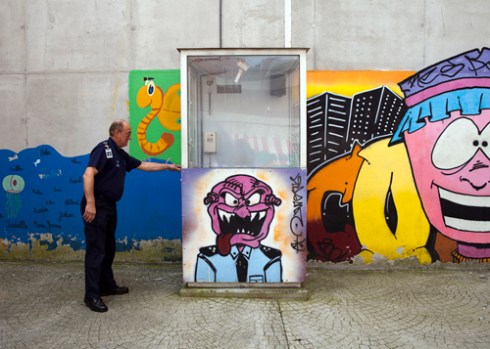
BIOGRAPHY
Laure Geerts (b. 1978, Belgium) is a founding member of Belgian photo collective, Caravane. Laure studied commercial sciences in Brussels, before moving into photography in 2006 to study at the Contrast photography studio. She went from spinning images to making and challenging them and found it easier to approach strangers and subjects she’d not before encountered. Laure has exhibited at group shows in Cork, Paris, Brussels, Lille, Liege, and Bamako in Mali.
Follow Laure on Twitter and Caravane Collectif on Facebook.
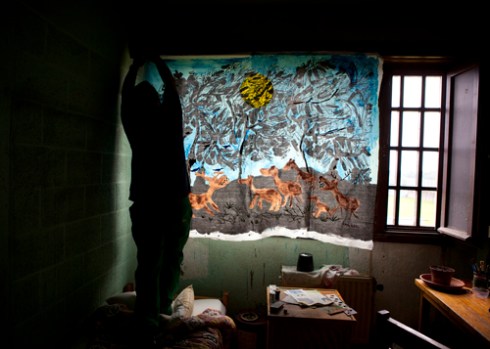

In the kitchen of his Brooklyn home, Ruiz flicks through his “portfolio” of prison images.
Stefan Ruiz has made photographs inside San Quentin State Prison, Soledad Prison and the notorious maximum-security Pelican Bay State Prison. His photography from within California’s prisons was not accomplished by conventional methods; at no time was Ruiz on press assignment; making documentary work or running a photography workshop.
Ruiz worked for seven years as an art instructor at San Quentin, during which time he regularly made photographic records of individual artworks. He took some portraits of his students on the side. He got inside Pelican Bay as a court-appointed photographer making photographs for use as trial evidence.
It’s a bit of a family affair. Ruiz’s mother, a professor at UC Santa Cruz, was teaching art at Soledad. Ruiz had studied Islamic art in West Africa and went to deliver a talk to Muslim prisoners at Soledad. He delivered the same lecture later at San Quentin, at which time he was introduced to the art program coordinated by the William James Association.
Ruiz’s father is a criminal defense attorney, who in the mid nineties represented a prisoner at Pelican Bay. Ruiz was the case-for-defense’s chosen photographer, documenting conditions the of client’s confinement.
In addition to his photography, Ruiz made sketches, collected his students’ artwork, and acquired objects typical of prison culture. When he showed me a photograph of a DIY prison tattoo gun, I asked, “Is that something an inmate showed you or is it something that had been confiscated?”
“It’s something I have,” Ruiz replied.
The first photos Ruiz made inside were portraits of Soledad prison-artists holding their work. He took six rolls of film. At the age of 23, Ruiz began teaching art at San Quentin. One of his students had been a student of his mother’s at Soledad years prior. Prison-art hangs in Ruiz’ house and he has collected mug-shots for years.
In the mid-nineties, Ruiz cobbled together a photo “notebook” of his pictures of people and vernacular art. He keeps it in an old Fujifilm box bound with packing tape. “I used to take this with me everywhere; it was my portfolio.”
From humble and organic beginnings, Ruiz is now one of the most respected portrait and editorial photographers in America. Until recently he had never spoken about his experiences in California’s prisons. We sat down in his kitchen to unpack his memories and his homebrew portfolio.
Q&A
PP: Your mother introduced you to prison-life?
SR: My mother organized exhibitions of the prisoners’ artwork. I helped out by taking photos of the artwork and making slides of their work. Some of that would go to William James Association to help them appeal for funding or for entry into competitions. That’s how I got cameras into the prison at first. Whenever I took a camera into a prison it was legal, and it was generally to photograph some type of art object.
PP: Of your prison work, it is your portraits that are known, however minimally, in the public sphere. I wasn’t aware of them until you were featured on VICE TV’s Picture Perfect.
SR: There are more photographs than just portraits. I taught at San Quentin for so long, and my boss had such a good relationship with the officials that gave access, that we were allowed to do quite a few things.
The first portraits I did were of the guys in my mother’s art class at Soledad who were to be involved in an exhibition. The way we were allowed to make portraits was to say, since they couldn’t make it to their show, their portrait would.
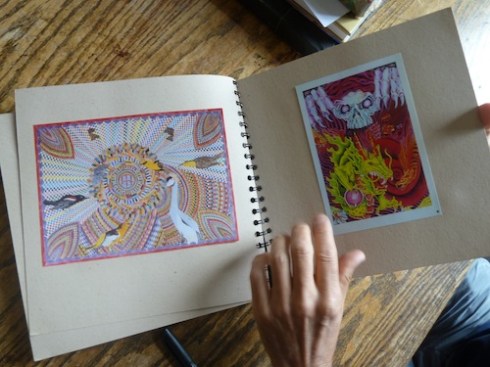
Prisoner art

Prisoner art
PP: Describe the art program.
SR: My boss played bass and the main emphasis of the art class was music but there were two visual artists who taught and I was one. The other was Patrick Maloney, who I guess is still teaching there. Patrick would also teach on Death Row. Sometimes, I would fill for him or accompany him on Death Row.
PP: How did you find working on death row?
SR: You move along the tiers and talk [through bars] to students individually, whereas on the mainline they come out their cells and they come to you.
There are two different sections of death row. In the first, there are a couple of tiers of just death row inmates. You’d need the key to get on the tier, and then you’d go from cell to cell, depending on who was part of the program. There might be three or four guys on a single tier. They had to buy their own supplies but through William James we also gave them supplies. Mostly you’d spend time talking to them. Each day, they might get half an hour outside their cell.
In the other section, the prisoners could leave their cells and go to a common space with some tables. There you could have two or three people in the class. That seemed like a better place to be on death row. The tiers are quite dark. Five tiers. And the other side is just open. One of our students was executed. He had killed a shopkeeper and his wife robbing a store in Los Angeles. He was a good student.
PP: Your mother was a professor at Santa Cruz, teaching art classes at Soledad. Those two institutions have a long and significant relationship going back to the protests and counter culture of the late sixties, Black Pantherism, and the book Soledad Prison: University of the Poor (1975) which was a collaboration between UCSC students and prisoners at Soledad.
PP: You gave a talk to Muslim students at Soledad, then to Muslim students at San Quentin and then you began in the art program. That trajectory explains your path but not your motivations. Why did you decide that leading arts education with prisoners was something you wanted to commit to multiple times a week, and eventually over seven years.
SR: Because it is interesting. I have to say; I think I learnt more from them than they learnt from me.
My father is a lawyer in criminal defense and labor law. His family is Mexican and he’s pretty liberal, so I grew up with that element too. Teaching art in prison was an activity that brought together both sides of my family.
PP: A context in which prison teaching is not a radical act?
SR: My mother was more or less a hippie. My father couldn’t really be one, he was just trying to assimilate, but he was definitely liberal. Growing up in Northern California at that time it was more of a norm than not to be on the left. To do things such as teaching in prison was not considered wild. There was no whole movement about victims’ rights as there is now.
Fair enough. There’s a lot of bad people in prison and some people who deserve to be there but …
When I was a kid, my parents were involved in a free school. We grew up in the country growing organic food. That was way before the trends of today. We composted everything; we weren’t allowed to have plastic bags for lunch. We had wax paper and baked our own bread.
The thing is the prison was interesting to me. At San Quentin they allowed me to take keys. The room where I taught art used to be a laundry room. There was a bunch of people that got murdered there, I guess in the seventies or eighties so they closed it down and eventually opened it up as an art room.
There was never a guard in our room. It was two levels but we would teach on the lower level. The closest guard was in what we would call the max-shack – a checkpoint, probably about 30 yards outside the door. I was really young when I was teaching there and a lot of the guys were way bigger than me. It was interesting to learn how to navigate that. There were anywhere from 5 to 15 people in my class. 15 would be a little bit hectic. Often we’d just get someone from the yard and have him come and sit. Students who wanted could draw him, and if not, they could work on other projects.
PP: Were any of them reluctant to paint or draw other prisoners? My experience teaching art in prison was that collectively they decided it was “suspect”, for want of a better term, to spend the time and energy painting another prisoner. Most of them made portraits of wives, girlfriends or children in a devotional way so to paint another prisoner made no sense to them and was in fact considered strange. They felt other prisoners would misconstrue it as a gesture of adoration or romantic attraction to the subject and that is something most guys wanted to avoid.
SR: No, most of them were into it. They didn’t have to do it but one thing is that since cameras aren’t allowed in prison you can make money if you can draw well, by drawing portraits, usually by copying photographs of prisoners’ family members. If you’re good you can make money. It’s like a throwback to an era before the camera; I can draw fairly realistically and that kind of saved me when I was in there because …
PP: … there’s a lot of respect attached to that ability.
SR: Yes. They’d give me a lot of shit and then we’d start drawing and it’d be fine. I generally had quite a few lifers in the class, because they are the ones who are more serious – eventually they decide to try and use their time. Young guys, who were only in for a little while, might joke around. The older guys kept the class in order.
PP: At what other times did you use your camera?
SR: There’s some really famous murals in San Quentin. I photographed them all.
PP: Was that the San Quentin administration that asked you to do that, or was it William James or was it self-initiated?
SR: My boss, Aida de Arteaga and I, decided it was a good thing to do. There are four dining halls. It used to be one huge one but it was divided because they were worried about riots. Three walls. Six sides on which the murals were painted. A Mexican-American inmate who had been busted, I think, for selling heroin painted the murals in the fifties. When I was still there, he came back to San Quentin, for the first time since his incarceration.

Photos from the San Quentin Prison dining halls. One of Ruiz’ students stands in front of the famous murals.
PP: In Photographs Not Taken you close with a bittersweet statement in which you said while you managed to take photos you still thought about the ones you weren’t allowed to take in such a “visually rich environment.” Did the staff or inmates think of their environment as visually rich?
SR: Obviously, most of the prisoners wanted to be out of there. I’m sure quite a few of the guards would like to have taken photos. Some did. Various guards had cameras for different reasons.
PP: What reasons?
SR: To photograph events. I photographed some of those too. We had concerts in the main yard, which is pretty impressive at San Quentin when you are down there with all the inmates. One time we had Ice Cube come in. On that billing, they had a white performer, a Hispanic performer and Ice Cube was the black performer. The administration has to play it like that.
Ice Cube performed in one of the dining halls and that was pretty crazy. You could see the guards were quite nervous. Some of the inmates were getting fired up. I don’t think they had another concert like that.
The prison liked the art program quite a lot and there were some guards who were supportive of our classes. Guards will either make things easy or hard for you. Basically, I think we were lucky for a lot of the time; we had people who were kind, trusted us, let us do more.
The thing about being there for so long is that you got know people fairly well. Especially being in a classroom when you’re with students for three or four hours at a time just drawing and talking. The thing that struck me was that I had a few guys who were lifers and had been in for 20 to 25 years; that’s a pretty crazy concept, especially now given all the changes that have happened, specifically with technology. I am sure – unless they were using them with their jobs within the prison – none of them had used a computer.
PP: Did you ever think there was an opportunity for you to do a photography workshop?
SR: The administration didn’t want us to do that at all. Even toward the end, they started to question me taking drawings out of the prison because many of them were realistic to the point that you could identify people in the drawings!
PP: What did the administration think of the portraits you did manage to take?
SR: They didn’t see most of them. They had signed-off on me doing photography, but they didn’t necessarily see the photographs. We got releases form the guys too. Guards might follow me round for a while, but I can take photos for days and bore the shit out of anyone. [Laughs].
I’ve probably got one of the best [records of the murals]. They were done on 4×5. I even did some on 8×10. I got in there at different times. Once, I’d used a Linhof 617 lens and camera on a commercial job, then I got access and so I used it in the prison.
PP: Did I hear that the Smithsonian has come to some sort of agreement, where by if and when San Quentin is demolished, they’ll remove and preserve the murals?
SR: They’ve been saying that for years, but I don’t know. The murals depict the history of California. The prisoners love the cable-car because the perspective is right so as you walk around it works.

“This guy before he took his shirt off warned me that his tattoos were considered some of the most racist in the prison. There’s the SS helmet skeletons.” Tattoos read ‘100% Honky’ and ‘Aryan’.

Ruiz used a chalkboard as a backdrop, “I liked the color and I liked the reference to education.” Some prisoners shaved their heads ready for the shoot. “They knew I was bringing in the camera so they prepared,” says Ruiz.
PP: It seems like the prison administration’s policy toward camera use was ad hoc?
SR: I photographed in Pelican Bay and Tehachapi, but I actually did that through a court order. My father was representing a prisoner who the CDC said was one of the heads of the Northern Mexican mafia and that he was ordering murders from his cell in Pelican Bay.
In Pelican Bay I had to use the prison’s cameras; they wouldn’t let me take in any of my own equipment, except film. This was 1995. They held on to the film, processed it, and then gave everything to me, negatives and all. The images are a bit … the lenses were a bit crazy. It’s not what I would’ve used but it was fine.
In Tehachapi, I got to use one camera and one lens. Both were mine.
PP: What was your brief for the court order?
SR: I had to photograph the cells and so the reason these photos are joined together is that they only allowed me the one lens.
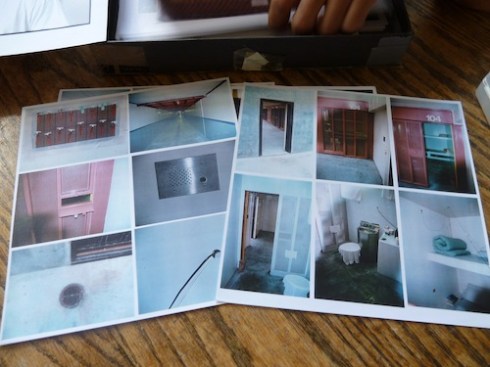
Ruiz photographs of Pelican Bay State Prison, CA made in 1995 for use as court evidence.

4/4/95, Pelican Bay – “The defendant was in one of these cells.”
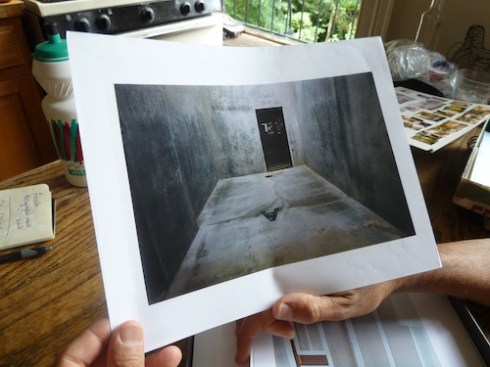
“Pelican Bay is obviously freaky.”
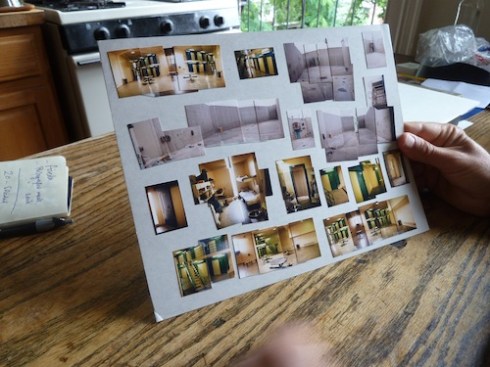
“This is the yard at Tehachapi. This is a common area, these are the cells.”
PP: It’s because of the connection through your father that you got the court ordered gig?
SR: As a defense attorney, he was allowed to bring in his own photographer. As an art teacher, I’d actually spent more time inside of prisons than my father had. Normally, he would only go to a visiting room where he would talk to his client. Whereas, I used to go on tiers, I went in cells. There were times at San Quentin when I was totally unsupervised and there were times it felt a little freaky.
PP: Were any limits placed or pre-agreements made by the courts on your photographs to limit their circulation, or are they just yours?
SR: They’re just mine.
PP: Is there a reason why you’ve not shared them widely yet?
SR: There are some that I considered might be a bit sensitive and I didn’t want to get my boss into trouble in any way. The photographs from Pelican Bay and Tehachapi are fine. The ones from San Quentin; she’d help me get the camera in. We had an understanding. I wasn’t going to screw her over.
It’s more important for me to be cool with her than it is to profit from the photos. I’ve done fine with photography without having ever shown these. I probably could’ve done a book with these and with some of the writing and artwork I have a long time ago, but I’ve never been about just promoting myself at all costs without taking others into consideration.
By now, enough time has passed. I’m going through everything. I think I have enough for a book. I have boxes of stuff that just accumulated.
PP: How did all of this work and exposure across three Californian prisons inform the rest of your career?
SR: I always knew I was going to do art. I didn’t know I was going to do photography. I always thought I’d be a painter. The thing that I learned? I learnt that if I couldn’t take any photos, I would collect things!
I took my portfolio everywhere. I got jobs off of the stuff but I never let it out of my hands. You’re the first person to have photographed it, with the exception of the VICE crew who put it in their video. I’m okay with that now. I always guarded it.
I met the guys who were doing COLORS magazine in the late nineties and it definitely influenced them. It influenced their ‘Prison’ issue (June, 2002). I was actually supposed to go to Gaza for COLORS, but the Israelis had bombed the prison right before I was due to leave, so the trip was cancelled. So, I’ve definitely used this stuff to my advantage.
PP: Did you ever give prints to the prisoners?
SR: I’d give them stuff but we kept it low key because I didn’t want any trouble for the program.
PP: Did the guys you taught appreciate that San Quentin had more programs than most prisons?
SR: They liked San Quentin. It’s an old prison. It has a lot of nooks and crannies. There are weird things that go on there that you wouldn’t get in a modern prison.
There was the old hospital built in the 19th century and out of brick. It was structurally unsound after the earthquake and left empty. They’d let certain prisoners go in there at their own risk. The deputy warden or someone in authority allowed one of my students to set up an art studio in there. And he had it for a couple of years! You wouldn’t get that at a lot of other places.
PP: Your photographs form a weird mix.
SR: I’ve always thought it was valid because it was about what I could get and how I could get it.

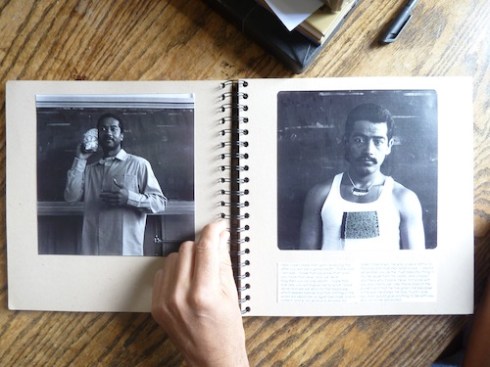
Soledad prisoners.
PP: Do you think prison systems in the U.S. are racist?
SR: If 11% of California’s population is Black but then at least 36% of the prison population is Black something’s not proportional. That says something about this society. Obviously the system can be racist, but it is also classist. You have a hell of a lot more poor people in prison than you do wealthy people and that’s because wealthy people can afford lawyers.
There weren’t many well educated guys in my classes. They’re obviously smart guys who could do all sorts but they weren’t well educated. I had a blonde white guy who I asked him to read something one time, not even thinking that he didn’t know how to read. It was a horrible thing for him and, of course, for me. I didn’t expect it at all. After that he started taking some of the high school classes and learnt to read.
Prisons are a control thing. [Upon release] if you have people who can’t travel, can’t get housing and can’t vote you can keep a whole population controlled. You can keep a whole population one little step away from being thrown straight back into prison.
PP: So the prison system is failing?
SR: I definitely think some people should be in prison.
There was a child molester who was quite collectible. People like to collect his art. He creeped me out. He made drawings of the kids he had killed from newspaper clippings. I took photographs of them, but I didn’t know that’s what they were until he explained them to me later. He had a scrapbook and the first 20 pages were pictures of Hillary Clinton smiling and then after that it was all these pictures of kids. Innocent pictures – many of them from National Geographic, but when you know what he was about, it’s pretty disturbing.
There’s some fucked up people in the world.
But I also saw, all the time, guys in prison for stupid drugs convictions and I think that is just a waste. The three strikes law was foolish. Keeping someone in prison, which at the time cost something like $30,000 – I’m sure it’s more now – is just a waste of money. You can give people education with that money to help them get better jobs.
I used to go to the visitor center a lot. You’d see the damage being done when families would come up from Los Angeles for the day. Wives would go in and the kids would stay in the guesthouse for the day. The separation of families when they have to travel so far [to where loved ones are imprisoned] is harsh.
Obviously, I believe in education over other things. Otherwise, I wouldn’t have done what I did.

Stefan Ruiz
Ruiz was born in San Francisco, and studied painting and sculpture at the University of California (Santa Cruz) and the Accademia di Belle Arti (Venice, Italy). He took up photography while in West Africa, documenting Islam’s influence on traditional West African art. He taught art at San Quentin State Prison from 1992-1998, and began to work professionally as a photographer in 1994. He has worked editorially for magazines including Colors (for whom he was Creative Director, 2003-04), The New York Times Magazine, L’uomo Vogue, Wallpaper*, The Guardian Weekend, Telegraph Magazine and Rolling Stone. His award winning advertising campaigns include Caterpillar, Camper, Diesel, Air France and Costume National.

 Prison Photography