
You are currently browsing the category archive for the ‘Institutional’ category.
In photography Cornell Capa has huge renown. In prisons, Attica has a huge renown. It is therefore, expected that I’d transcribe Capa’s testimony to the McKay Commission (New York State Special Commission on Attica) Hearings.
After the text I shall offer my opinion.
TEXT
Cornell Capa: I was asked eventually by Arthur [Liman, Counsel] if I would want to look at Attica for the reasons that he mentioned, that photography and a photographer may have something to contribute …
As a human being and a photographer, my personal and professional and civic feeling was to look into it and – as my professional life is involved in understanding human condition – try to perceive what it is all about.
I think photography can serve a most useful role in an investigation and that’s exactly what I consented to do.
I [have] submitted 26 photographs which I will be showing to the commission and I have submitted equally a very short written statement and captions for the photographs.
I would like to really just read my written statement and following that as the photographs go by, I will do the captioning job for them.
At Attica: A Photographic Report.
Recently I spent three days at Attica, having been asked by the McKay commission to take a look at the institution and bring back my visual report.
During the visits to Attica I was, at all times, accompanied by a correction officer and a member of the Commission staff; all persons recognizable in these photographs consented to be photographed.
My photographs and their captions constitute my report for the commission. There is just a little more to add.
A feeling of nervous expectation seems to pervade Attica. Everybody is waiting the result of the work of the Commission’s investigations on the causes of the explosion which occurred there six months ago, and their recommendations for the future avoidance of such a tragedy in the future. Both sides, inmates and guards expect some new things to evolve from the findings – some kind of miracle which will transform the institution into a place where the Biblical lion and lamb will better live together peacefully.
The only hitch: each side has its very own view of the meaning of peaceful and better coexistence, and how to achieve it.
From the outside, Attica situated in the rolling farmland in western New York, has a Disneyland-like appearance, especially at night.
Attica’s inmates are all locked in their cells from approximately 5pm until 7am the next morning. Officers on the night shift make lonely rounds checking the count six times a night.
All movement in Attica is limited by locks. At night the duty officer must carry with him all the keys he will need on his nightly round of inspection
Confined to their 4 x 9 cells, inmates may talk to one another across the cellblocks and play music instruments until 8pm.
Locked in a cell a mirror is an inmates eyes to the rest of his gallery, and whenever something happens, the mirrors appear as if on cue.
After 8pm talking and noise are not permitted. There is little to do until lights out at 11pm except read, write letters or listen to one of the three channels of the prison radio which plays music, sports and the audio portion of TV shows.
In E Block, Attica’s medium security prison with the maximum-security walls, a small group of inmates in special programs are permitted to remain at night in the blocks day room to watch television, play cards or talk.
Corrections officers on the day shift leave homes in the town of Attica and surrounding communities and report for roll calls at 7am, 9.20am, 3pm and 11pm to receive their assignments.
These are the guns and smoke parts etc, what [sic] they keep in the armory for emergency use only.
These are the keys, which they use, the whole system is based on keys. This is just a very small selection of all the keys that open all the doors in Attica
On signal the cells open and inmates in each company line up in two’s to be escorted down one of the endless corridors to the mess hall for breakfast
In his daily movements throughout the institution, an inmate must pass through several times through ‘Times Square’ where the corridors leading from the four main cell blocks converge and gates point in four directions.
Many inmates spend up to five hours a day working in one of the prison industries, the largest of which is a large metal shop, where inmates build steel cabinets and office furniture for state institutions.
For a few hours each day, inmates are allowed to go into their cellblock’s yard for outdoor recreation
The sports facilities, always limited, have been even more curtailed since September. For most inmates the yard means walking around and around or standing around.
The only opportunity for most inmates to watch TV is outside in the yard. Due to the winter climate and the meager daytime TV schedules, few are interested.
While some are out in the yard, others return to their cellblocks. In some areas there are improvised meeting rooms where a few inmates can pursue simple hobbies and handicrafts.
For the rest it is back to the cells to pass the hours until supper. The site of disembodied hands outside the bars playing cards is not unusual here.
Some play chess but the opponent remains unseen.
There is so much idle time; one of the most common activities is preparing legal paper for appeals and writs.
9.30 to 3.30 every day are visiting hours. Those inmates whose families live nearby or who can afford the long journey to Attica may receive a visit. Visits take place in a large room, under the watch of officers and a wire screen separates the inmates from his visitor.
An inmate’s personal touch, often his own creation, is the difference between one cell and another.
One of the statewide changes since the riot is the creation of inmate liaison committees at each institution.
The committee at Attica was elected last month, has adopted a constitution and has begun the task of drawing up projected reforms.
Although life at Attica is again becoming routine, grim reminders of what happened there are everywhere.
This is the round State Shop in damaged condition beyond repair.
Two of the cells blocks were destroyed beyond repair and are still unoccupied. D Block yard on which the eyes of the world were focused for four days last September is deserted now. The trench is filled in but remains visible like a scar reminding one of the great illness which fell upon Attica seven months ago.
[END]
_____________________________________________________
Capa’s review is a rather bland description of everyday life in the prison. This comes as quite a disappointment; I had expected a rousing polemic against the unsuitable conditions of mammoth prisons and their effect on the will of man.
These words seem particularly tame when one considers the magnitude, violence and precendence Attica has in the history of prison resistance. The words are detached from the extremely graphic photographs [WARNING] documenting the riot and its bloody remnants. Capa’s words are the epitome of obsolescence.
Attica was a disaster.
Capa’s words fall short of the strength needed to describe the institution six months on from disaster.
I encourage you all to browse Attica Revisited an encyclopaedic resource of official papers, oral history video and photography.

Cornell Capa, to some extent, lived in the shadow of his older brother Robert. I guess, it is easy for complacent men to adore the still and fallen martyr than to keep apace with a passionate and piqued practitioner. Cornell’s and Robert’s legends are one; Cornell ceaselessly fought his brother’s corner authenticity debate surrounding The Falling Soldier.
Cornell’s indebtedness to his brother was fateful and self-imposed:
Disappointingly, it is only in extended surveys of Cornell Capa’s career that mention of his fifties photojournalism in Central and Southern America arises. Otherwise, Cornell is celebrated for his political journalism and particularly his campaign coverage of Adlai E. Stevenson, Jack and Bobby Kennedy. Cornell’s photographs from Latin America are often neglected, even demoted.

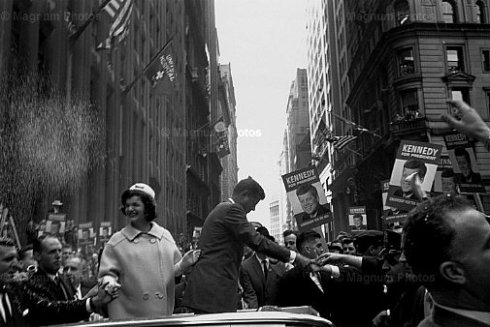
The Kennedys were the foci of American progressive attitudes, and so, in the sixties, Cornell documented the concerned politician. Cornell was (not in a negative way) passive and the sixties were not formative. It was in the fifties that he actively worked to define the persona, the ideal: ‘The Concerned Photographer’.
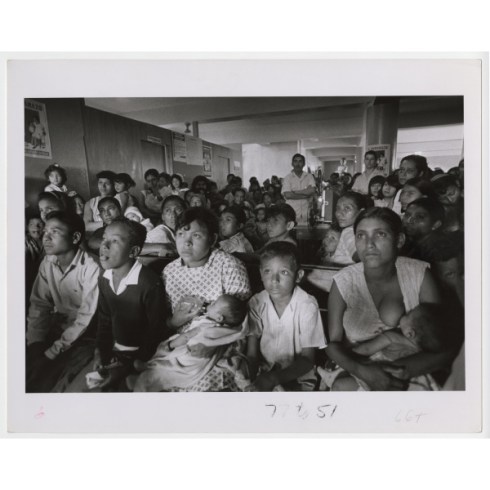
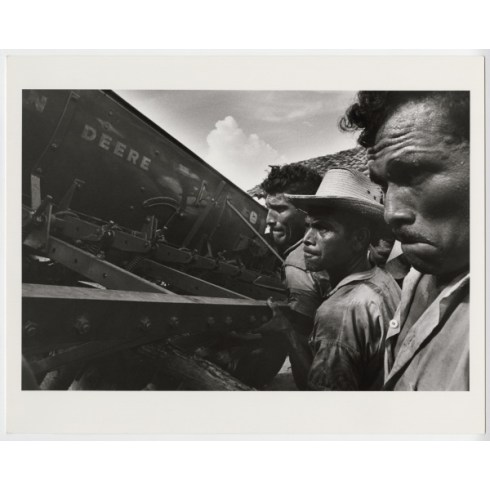
Cornell’s work in Latin America:
In 1956, Cornell was in Nicaragua reporting on the assassination of President Anastasio Somoza García. Somoza was shot by a young Nicaraguan poet; the murder only disrupting slightly the Somoza dynasty that lasted until the revolution of 1979 (that’s where Susan Meiselas picks up).
In the aftermath of the assassination over 1,000 “dissidents” were rounded up. The murder was used as an excuse and means to suppress many, despite the act being that of one man.


I have no knowledge of what happened to these men after Cornell photographed them and I am sure you haven’t the patience for speculative-art-historio-speak.
I do wonder … if having witnessed revolution, early democracies, military juntas, coups, communism, social movements, grand narratives and oppression in various forms, if Cornell picked his subjects with discernment back in the United States.
As early as 1954 Cornell was working on a story for Life about the education of developmentally disabled children and young adults. Up and to that point in time, the subject had been regarded by most American magazines as taboo. The feature was a breakthrough.
In 1966, in memorial to his brother, Robert, and out of his “professed growing anxiety about the diminishing relevance of photojournalism in light of the increasing presence of film footage on television news” Cornell founded the Fund for Concerned Photography. In 1974, this ideal found a bricks and mortar home on 5th Ave & 94th Street in New York: The International Center for Photography.

This institutional limbo that eventually gave rise to one of the world’s most important photography organisations was not a quiet period for Cornell. In 1972, he was commissioned to Attica, NY, to document visually the conditions of the prison. Capa presented his evidence to the McKay report (PDF, Part 1, pages 8-14) the body investigating the cause of the unrest. Cornell narrates his personal observations while showing his photographs to the commission.


At a time when, the photojournalist community seems to have crises of confidence and purpose at an alarming rate, it would be wise to embrace his spirit in full recognition his slow accumulation of remarkable accomplishments.
Rest In Peace, Cornell.

PHOTO CREDITS.
Robert F. Kennedy campaigning in Elmira, New York, September 1964. Accession#: CI.9685
New York City. 1960. Senator John F. KENNEDY and his wife, Jackie, campaigning for the presidency. NYC19480 (CAC1960014 W00020/XX). Copyright Cornell Capa C/Magnum Photos
Three men pushing John Deere machine, Honduras, 1970-73. Accession#: CI.3746
Watching family planning instructional film at Las Crucitas clinic, Tegucigalpa, Honduras], 1970-73. Accession#: CI.8544
Political dissidents arrested after the assassination of Nicaraguan dictator, Anastasio Somoza, Managua, Nicaragua, September 1956. The LIFE Magazine Collection. Accession#: 2009.20.13
NICARAGUA. Managua. 1956. Some of the one thousand political dissidents who were arrested after the assassination of Nicaraguan dictator Anastasio Somoza. NYC19539 (CAC1956012 W00004/09). Copyright Cornell Capa/Magnum Photos
Prisoners escorted from one area to another, Attica Correctional Facility, Attica, New York, March 1972 (printed 2008). Accession#: CI.9693
Two men walking around prison courtyard, Attica Correctional Facility, Attica, New York, March 1972. Accession#: CI.9689
Inmates playing chess from prison cells, Attica Correctional Facility, Attica, New York, March 1972. Accession#: CI.9688
Man on scooter carrying coffin, northeastern Brazil, 1962. Accession#: CI.8921
All photos courtesy of The Robert Capa and Cornell Capa Archive, Promised Gift of Cornell Capa, International Center of Photography. (Except for ‘The Concerned Photographer’ book cover; the Jack Kennedy photograph; & the second Nicaragua prison photograph.)

Manchester Evening News published a right-objectionable story that’s probably going to get some blood boiling. Thanks to Steve Silberman for alerting me to this via his virtuoso twitter feed (fine editorial nous).
In America there are gangsta’s, crack heads and wild kids. In Britain there are thugs, scallies and pill-poppers – these are broad categories and don’t describe much, but my effort is to say that the two countries have different types of criminal. It is my feeling that the extreme inequalities of American cities breed a certain type of hardened criminal, whereas Britain’s subtler inequalities breed a certain type of hardened idiot.
Few violent offenders have a sociological grasp on why they’ve made the choices they have and often their bare-faced contempt is hard for most folk to stomach. Kane Barratt is a case in point.
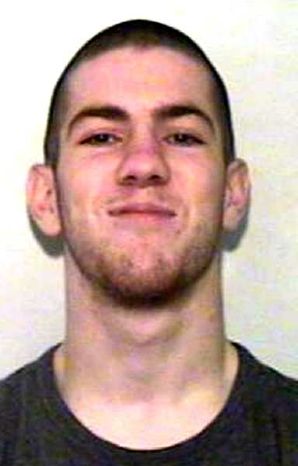
This week, after recent sentencing for 5 and a half years, Barratt used a mobile phone to update his Facebook profile from his cell. He changed his staus, chatted with friends and posted two photos. After the Manchester Evening News told the Ministry of Justice about Barratt’s activity the page disappeared from Facebook. The phone was later confiscated.
I don’t want to glorify Barratt’s actions; he is a violent offender who wielded a machete and held it to his victim’s throats. Barratt shows no remorse only bravado in his Facebook antics. Paul Dillon, Barratt’s last victim pondered, probably quite accurately, “He’ll probably come away from this with all his mates thinking he’s some kind of hero.”
That said, Prison Photography‘s charge is to discuss all modes of photographic production within sites of incarceration: “If a camera is within prison walls we should always be asking; How did it get there? What are/were the motives? What are the responses? (Prison Photography ‘About’ page)
Well, Barratt’s camera phone got there because it was not confiscated . One presumes he wasn’t searched at a key moment. I’d suggest the motive was to stay in touch with his friends outside, take the piss (to a degree) and generally showboat when oversight was lax. Predictably, victims and authorities were left aggrieved, offended and embarrassed.
In Britain, as in America, mobile (cell) phone use is banned behind bars. Wired with the aid of Andrew Hetherington recently ran an article on the smuggling and underground economy of cell phones in California. As did Newsweek. I theorised that prisoners strategic adoption of cellphones is the most serious threat AND damaging maneouver to decades of prison management policy. Mobile communications render obsolete much of the advantages brought to controlling prison populations by segregation.
I teach at a Washington State prison and I am generally disheartened by the lack of access prisoners have to books. By law, state departments of corrections must provide access to libraries, but opening hours and actual physical access (within the institutional regimen) are not consistent. Even when prisoners can get to the library, nearly all learning is self directed. Prisons offer GED programs but only one prison in Washington State (Monroe) offers college courses. I believe only one prison in California (San Quentin) offers college courses.
Nowadays, access to a computer is as essential as access to a library for learning. So, while I understand the need to confiscate phones, I don’t want to see all internet connectivity denied. Ideally, internet would be available to prisoners without compromising security. Social networking would certainly be ruled out.

But even if correctional departments could tailor their own prison firewalls, the structure of Web2.0 – and its embedded networking functions – would still allow manipulation by the minority of seditious prisoners. The likelihood of widespread internet access in US prisons is very small.
This situation alone is cause for some chagrin. If one accepts that computers and networks are essential components of contemporary life then their absence within sites of incarceration forges yet another chasm between the life inside and the life of anticipated release.
But then again, in a week when I had glue sticks confiscated on entering the prison, speculation on the provision of internet in prisons is far from the realities of prison life and, regretably, far from relevant …

Reading the Goethe-Institut Fashion Scene article about Haeftling designers in Berlin, I thought it was an Onion style send up. “Prisoner chic” sounds like something straight out of satire, but I guess I was snoozing when this hit the news wires in 2003.
Haeftling (translated as ‘Prisoner’) employs inmates across Europe to manufacture clothing and housewares inspired (they say) by prison life, “The garments are highly functional and have a classic and timeless cut. Only high-grade, rugged fabrics are used in manufacturing.”
Well, whatever you say. I actually don’t mind how they market it, I am just pleased they support prison reform, the abolition of the death penalty, political prisoners rights and a philosophy of rehabilitative justice.

Haeftling Tray
But let’s not kid ourselves. This project was borne of commercial interests. “It began in the JVA (Justizvollzugsanstalt/prison) Tegel and developed into an international undertaking. More and more prisons have joined and today production is even taking place elsewhere in Europe. One Bavarian prison supplies honey from its own two colonies of bees; a prison in Switzerland even has its own vineyard and exports its own red (Pinot Noir) and white wine (Müller Turgau).” (source)
Karola Schoewe, Haeftling’s PR & communications manager says, “On the whole, the prisons are all very helpful,” says “There are some prisons that have very good production capacities for making homeware.”
Schoewe then marries the business speak to social responsibility speak, “Through its production, Haeftling is creating measures that help to support rehabilitation processes.”

Haeftling Espresso
Without seeing Haeftling’s account-books or sitting in on a board meeting, I have no way to tell if resources and profits are divvied up in a way that benefits prisoners more then in the state run prison industries. This was the situation in July 2003
(Author’s Note: €12.50 is substantial pay compared to American prisons.)
Prison industries are a divisive issue. For some they are the perfect use of prisoners’ time and energies developing job skills, work community & self-esteem. To others prison industries are a modern slave labor exploiting societies’ self-created incarcerated class.
Both viewpoints have legitimacy, but the first makes a prior assumption that could be misleading – that work programs are the only means to provide skills, community or self-worth. Education does this too.
But educating someone instead of putting them to work is going to cost a prison authority rather than generate it wealth.

Generally, I am unnerved by the disconnect between the reality of incarceration and its representation to consumers,
Then again, Klaus-Dieter Blank, of Berlin’s Tegel Prison states the success of the label’s online store has meant that people are beginning to understand “what goes on behind the walls”. Haeftling features on the Tegel Prison website.
Is there too much space here for consumers to create their own version of prison life? What is included and/or played down in the minds of consumers? Are they being coerced and sold a disingenuous view along with that ‘rugged’ product?

"Justiz 82" Scratchy Blanket. Haeftling Product
We can assess this a number of ways – rehabilitative worth, public awareness worth, benefits to state finances, tax-payer savings, external benefits of development in social entrepreneurship.
But essentially, we must ask, “Does this enterprise help reduce prison populations by reducing recidivism? It MUST be compared to other rehabilitative programs. The purpose of prisons the world over should be to create societies where prisons are no longer necessary.
How do you judge this type of enterprise?
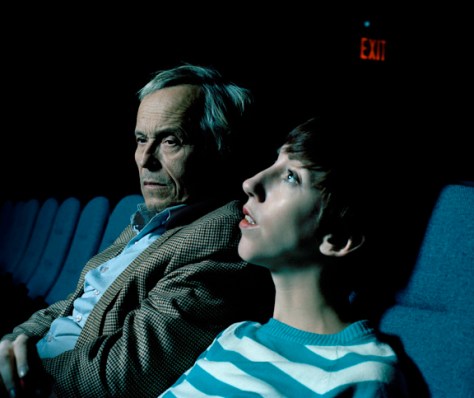
Tina Schula, from the 'Ratline' series
Harlan Erskine contacted me this weekend.
At the moment there are some MFA exhibitions at the blockbuster schools. Before you read this look over Daniel Shea’s neat run down of SVA, Columbia & Yale photography grads.
As concerns Harlan’s graduating class at the SVA, here’s five picks:
Carlos Alvarez Montero for his street portraits, but more so for his meld of youth, friends & skating.
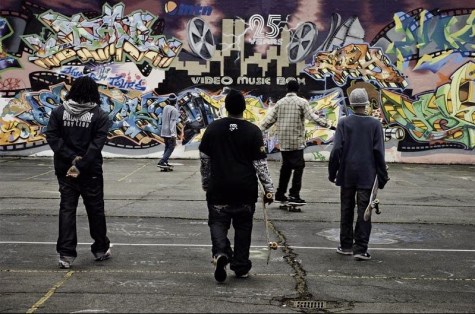
Carlos Alvarez Montero, from the 'Harlem Shuffle' series
Maureen R. Drennan for her sophisticated restraint down at a marijuana farm.

Maureen R. Drennan
Jessica Bruah because I think she takes a lot of shots and edits well. You don’t just “come across” the subjects Bruah photographs.

Jessica Bruah
Scott Houston for a harsh, harsh and close view of meth and people … together. And for proof in the argument that captions are essential; providing caring and careful context for image.

Scott Houston
Tina Schula gets a double shout out for two weird series. Ratlines (very top) is creepy & suspenseful. Oskar’s Sister (below) is playful, offensive & menacing.
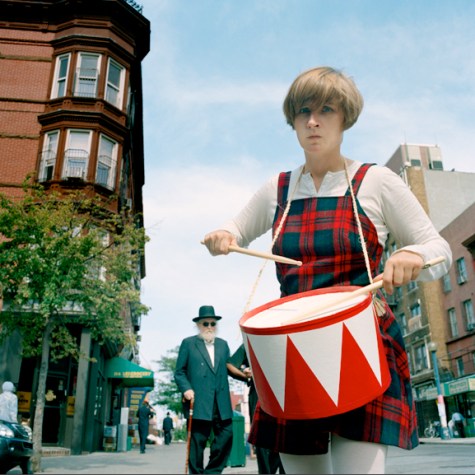
Tina Schula, from the 'Oskar's Sister' series
I don’t envy Chris Parks. If, according to him, he was never in the military (which I believe), then he got a pretty rough ride when stepping back on US soil. This week, the busiest and best free newspaper about went with The Accidental AWOL, a story on Chris Parks.

Chris Parks by Kelly O. in the Stranger
The interesting thing about Parks’ story is his processing through multiple legal stages and sites. He was held by other state agencies until he could be accommodated at Fort Knox military base and was then just dumped into the daily military procedures that keep recruits actively docile. And he’s in that until the military realise they’ve lost much of the pertinent information to the case.
In italics below I have quoted author Jonah Spangenthal-Lee directly, but added my own subheaders.
Charlotte Douglas International Airport, NC (Time Detained: “Several Hours”)
Parks had been heading back to Seattle after a trip through Central America with a group of friends. As he passed through customs at Charlotte Douglas International Airport in North Carolina, agents from the Department of Homeland Security, pulled Parks out of line, handcuffed him, and detained him for several hours before taking him to the Mecklenburg County Jail without a word as to why.
Mecklenburg County Jail (One Week)
Parks spent a week in the county jail. After two days, he found out why: At customs, a computerized database had flagged Parks as an AWOL U.S. Army soldier who’d been missing since 2002. Because of his “fugitive” status, he would eventually be transferred to the personnel control facility at Fort Knox. The problem: Parks says he was never in the army.
“Years ago, I signed up to enlist in the army,” Parks said. “Before I actually flew out to basic training, I talked to my recruiter and explained to him I didn’t want to go.” He was just out of Freeman High School in Rockford, Washington—a suburb of Spokane—at the time and had been drawn in by the offer of a $10,000 signing bonus. But ultimately, he says, “All I wanted to do was just snowboard and screw around and be a kid for a while.”
Fort Knox’s personnel control facility (Two Weeks)
Parks was sent to Fort Knox’s personnel control facility, where his head was shaved and he was issued fatigues and a blanket, given a bunk, and instructed not to talk to any of the women in the facility or other soldiers on the base. “I basically had to play army,” Parks says. “You have to fall in and stand in line. I had no idea what the hell I was doing.”
After a total of three weeks, Parks was released with little explanation. And after three weeks of procedural but unjust detention due to bureaucratic failings, the military are still going to send Parks the bill for his flightfrom Charlotte to Fort Knox! And his head was shaved …

David Simonton contacted me and shared his long term project at the former Polk Youth Center in Raleigh. After thoughtful discussions David and I decided upon a pairing of articles.
In this post, Part One, David talks about the background to the project and his objectives in the work.
I also chose a selection of David’s prints to showcase and offer comment. At the bottom is a thumbnail-pop-out-gallery with all the pictures in one place.
…and, in a few weeks, Part Two will dissect the atypically rich and varied visual-history of the Polk Youth Center.
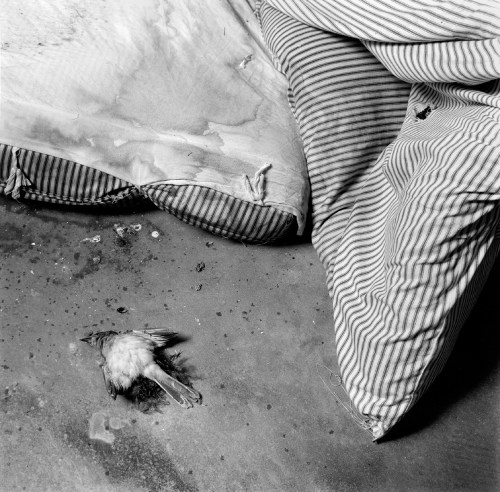
David Simonton’s Commentary (PP’s Subheaders)
Photographing Disused Architectures of Citizen Management
In the late-1980’s I was one of a number of photographers working on Ellis Island, the former Immigration Station in New York Harbor, documenting the progress of the restoration of the facility (reopened to the public in 1990).
The project was called “The Ellis Island Project: Documentation/Interpretation.” I was living in New Jersey at the time, and traveled to the island to photograph twice a week for nine months. During this period I was also pursuing my personal projects.

Opportunist Photographer
In 1989, I moved to North Carolina
The “Old” Polk Youth Center/Prison, Raleigh which has a long and storied history, closed in 1997 when a modern facility (which the “Old Polk,” most assuredly, was NOT) opened in Butner, NC. The inmates were transferred to Butner in November of that same year.
Living nearby, I could hardly resist the opportunity to photograph there. So before any “No Trespassing” signs were posted, I went and photographed the site. The doors (cell doors, some of them) to many of the buildings were wide open!
“Old” Polk Youth Center – a euphemism if ever there was one – was located on land directly adjacent to the North Carolina Museum of Art in West Raleigh, near the State Fairgrounds.
The prison buildings were razed in 2003. But before that occurred, the prison was essentially abandoned until the land (along with the buildings on it) was transferred to the museum.
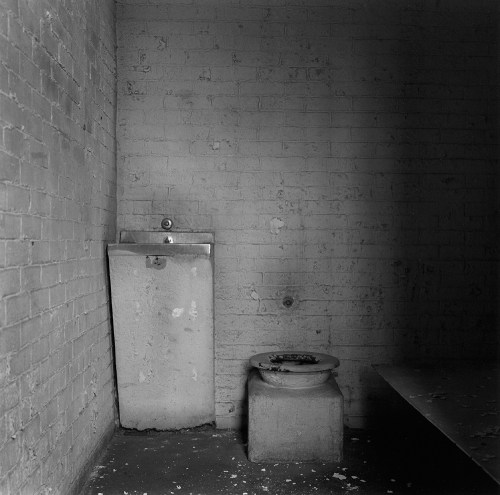
Official Photographer
During the mid-nineties, I exhibited my personal, interpretive work from Ellis Island – 90 images – at a gallery in Raleigh. Huston Paschal, a curator at the state art museum, attended the exhibition.
Unaware that I had already photographed there, Huston Paschal invited me to document the site, which was now in the museum’s hands. In late-2000 the invitation was formalized with a commission. I continued working on the project (even after the commission had lapsed) until the buildings came down, the ground leveled and grass planted.
My involvement was always with an empty site, when the prison was closed and inmates transferred. I photographed a long-abandoned facility: empty buildings, empty cellblocks and overgrown grounds.

Simonton: “Art for art’s sake”
As an art photographer (an unfortunate, nearly pretentious-sounding term, even if it’s the category my work falls into), my goal is to make interesting pictures; interesting in-and-of themselves, so that THEY are worth looking at, repeatedly.
What’s depicted is not unimportant, but it’s of secondary importance; this is my approach to my own picture making. The fact that my “subject” was a prison is happenstance – I photograph all kinds of abandoned structures. I also photograph the smalls town North Carolina (day and night) and photograph landscapes. An interesting photograph is always my intent, even when what it depicts is not itself inherently interesting … or beautiful.

Art and Documentary converge.
The Polk project was a “documentary” project, but not in the strict sense of it being wholly objective. My pictures describe the place I saw, and, if not the place I “saw”, then the place I thought and felt.
The project is not a comprehensive cataloging of the site either; rather, the pictures reflect my response to it during the passage of several years. They inform history by showing the place as it was in those waning years, after being – at long last – set aside as a relic; finally to be torn down and planted over and – with still more time – forgotten.
Polk Youth Center was located in a heavily populated area, which was not the case when it was built. Improvements were rarely made because, why spend money on any improvements if the facility was about to be moved or closed? – as were the recurrent promises for decades.
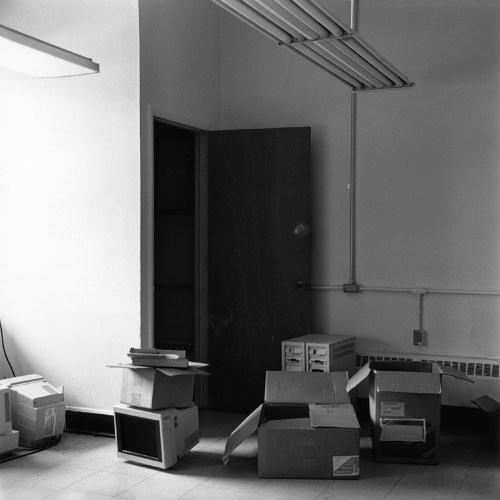
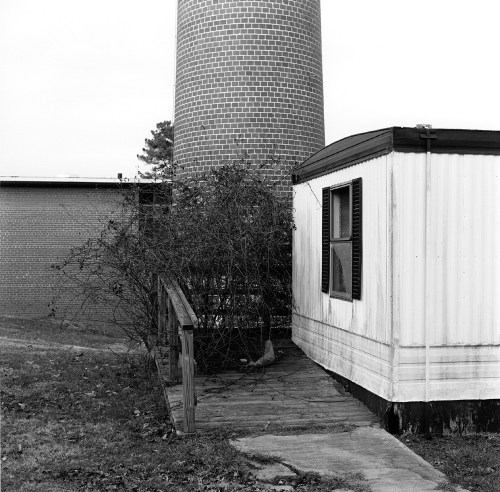
Institutional Narratives
I was not aware of the prison or the prison sites history until after I had completed my work; which may be just as well, since it was difficult enough to find beauty in such a physically “unbeautiful” place.
Had I been mindful of the ugly history of the old Polk Youth Center – riots, rape and other forms of violence in its final years, – I may have had a harder time photographing.

Prison Photography’s Commentary
Simonton’s three years at Polk yielded a varied portfolio. In editing the selection (from 100+ images to these 16) images distinguished themselves for very different reasons. If the lens wasn’t pointed at something crumbling, it was pointing at something overgrown and grown over.
Some images (Steep Steps) are flattened and exposed matter-of-factly, whereas others (Laundry Bin) luxuriate in silvery sheen.
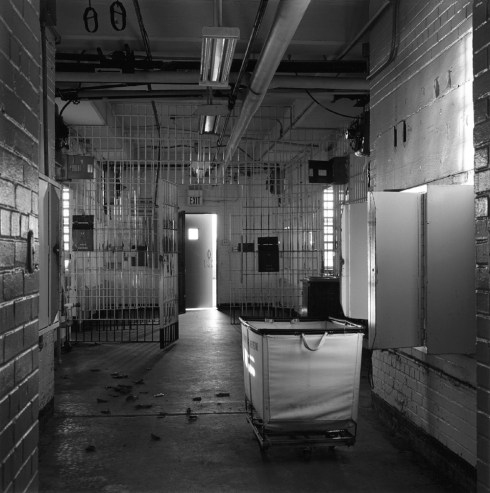
I choose one pairing here of the same view in different season; Simonton took many pairings so to secure the evidence of time in his series. Apparently, the chimney was a signature of Raleigh’s landscape.


It is in the different states of dilapidation that one finds a visual allusions. Simonton’s photograph of the teeth counterpoise the dental ephemera in Edmund Clark’s photography of a functioning geriatric UK prison wing. When given the opportunity, Simonton ties the fragility of the body to the decay of the site.
Other recalls. Simonton’s cavernous grimed up cells, the expired bird, the textural friction between hard concrete and friable life are not too dissimilar to Roger Ballen. The reflected dormitory of cacophonous bed frames is a Moholy-Nagy-informed dark-fantasia march of welded steel.
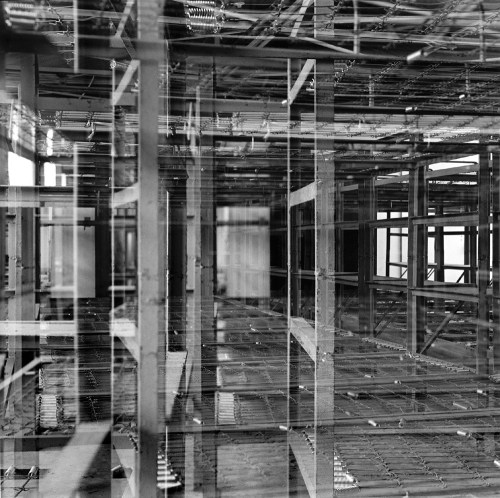
Only a few of Simonton’s images describe the site as one of incarceration. Few of the normal visual clues are available; no visible bars on windows, no holding cages. This could as easily be a disused YMCA or summer camp.
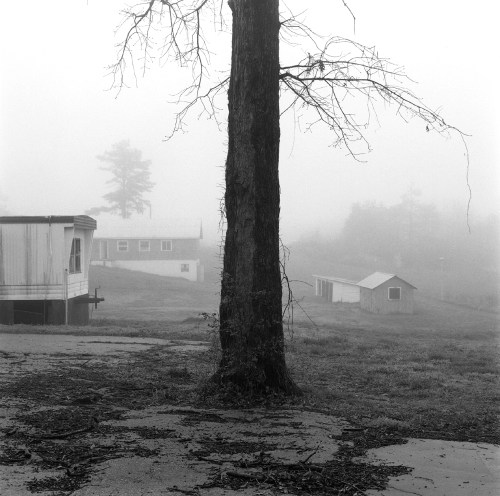
For Prison Photography, the real interest in Simonton’s work comes when it is positioned in a wider context of the site. David provided me with background info and some press clippings which whetted my appetite. Further research was rewarded with an unusual series of photographic manoeuvers sequentially on this site through its various guises. All of this I will cover in Part Two.
Closure & Erasure
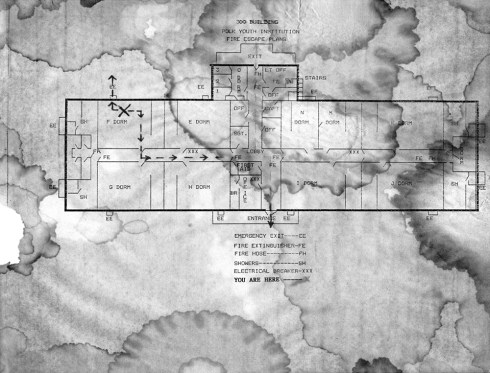
The photo of the evacuation plan below touches upon that procedural rigour that has cycled at the site of the former Youth Polk Center. The image at the very bottom (as well as being Simonton’s favourite) is a fine accompaniment to the evacuation plan.
Both images bear evidence of water blistering, bubbling and staining its way through materials. These evocations are “Art for Art’s sake” but they are also poetic closures, historical records and proof that in the absence of human interference erasure sets in rapidly.

David Simonton has been a photographer for 40 years and has been photographing North Carolina for the past 20 years. An adjunct instructor of photography at Peace College in Raleigh, David often chooses to focus on the more rural parts of the state. His series “Photographs from North Carolina” features black-and-white photographs from the 345 North Carolina towns he has visited. He has completed commissions for the North Carolina Museum of Art and the United Arts Council of Raleigh and Wake County. He has had work in solo and group exhibitions throughout the United States, and his photographs are in the permanent collection of the North Carolina Museum of Art. David was awarded a visual artist fellowship from the North Carolina Arts Council in 2001. (via)


View other images at David Simonton’s website. Indyweek have written on his work previously.
Thank you to David Simonton for reaching out. Thanks for the time spent over questions and for your collaboration. Pleasure working with you.
In the interests of full disclosure, DuckRabbit and Prison Photography have become virtually-close these past couple of months, beginning with an acknowledged shared politic, via encouraging support, to a mention in DuckRabbit’s announcement of a daring competition that I feel I had only a small part to do with.

I am not advertising DuckRabbit’s $1,000 competition for brevity’s sake. I am promoting it because:
a) Stan Banos had an excellent point in the first instance
b) DuckRabbit has not been shy to challenge inequalities before (including MSF – opening dialogue, discussing visual ethics and celebrating consequent positive representations on MSF’s photoblog)
c) PDN, with an all-white 25 juror panel has a valid charge of passive racism to answer.
d) I think it is a ballsy move, and I want to see what comes of it.
Up for the debate?
FOR $1,000 YOU MUST;
“Come to PDN’s defense and answer the question, ‘What possible, plausible excuse could exist for an all white jury from a publication of such influence?’”

 Prison Photography