
You are currently browsing the category archive for the ‘Institutional’ category.
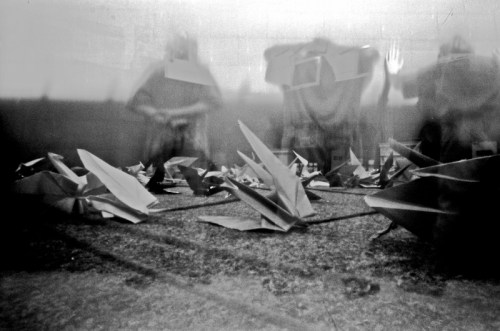
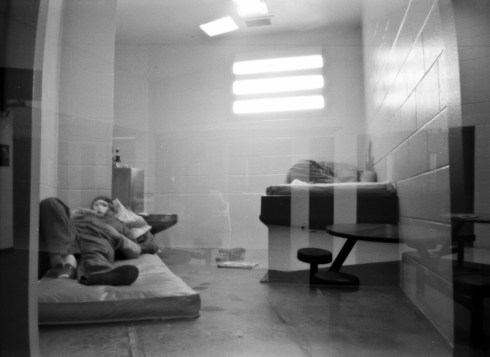
These images are the result of a collaboration between photographer Steve Davis and the girls of Remann Hall Juvenile Detention Center, Tacoma, Washington State in the US.
Davis was forced to think of the camera as a tool for different ends, essentially rehabilitative ends. For legal reasons and the protection of minors, Davis and his female students were not allowed to photograph each others faces. It became an exercise in performance as much as photography.
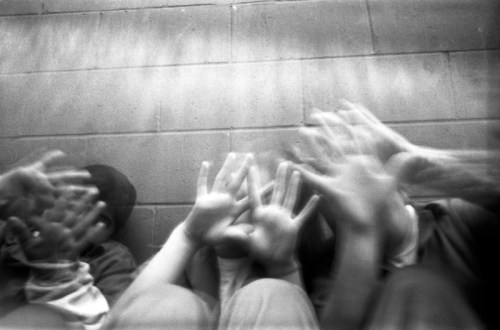
We see portraits of the girls with plaster masks, heads in their hands. The girls limbs outstretched made use of evasive gesture. The long exposures of pinhole photography resulted in conveniently blurred results.



PINHOLE PHOTOGRAPHY vs ROTE DOCUMENTARY MOTIFS
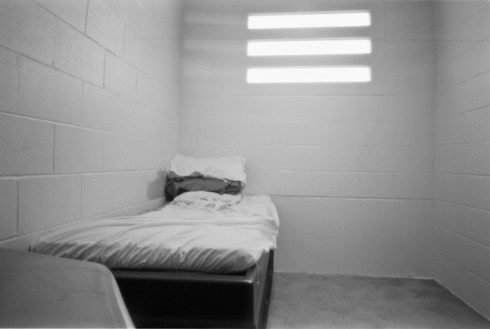
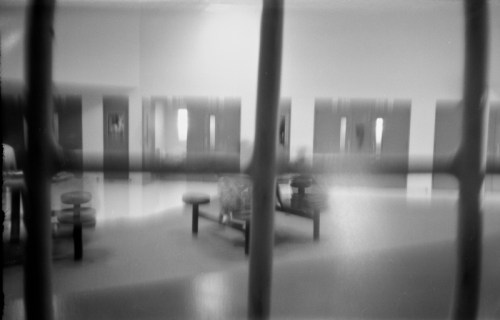
Photography in sites of incarceration often depicts amorphous, vanishing forms within stark cubes; it is usually black & white, and often from peep-hole or serving-hatch vantage points. When this vocabulary is used and repeated by photojournalists, visual fatigue follows fast.
Heterogeneous architecture doesn’t help the documentary photographer. Limited and repetitious visual cues make it tough to work in prisons. Images, shot through doors, by visitors only on cell-wings by special permission, are dislocating and sad indictments of systems that fail the majority of wards in their custody.
I celebrate all photography shining a light on the inequities of prison life. Having said that, very occasionally – only very occasionally, do I wish a “prison photographer” had expanded, waited or edited a prison photography project a little longer … but I do wish it.
Photojournalism & documentary photography have taken a battering from within and been asked some serious reflective questions. I don’t want to accuse photographers of complacency. To the contrary, my complaints are aimed at prison systems that so rarely allow the camera and photographer to engage with daily life of the institution.
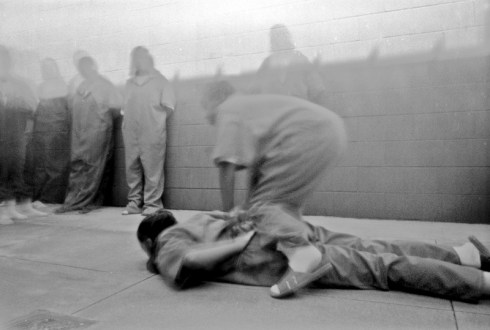
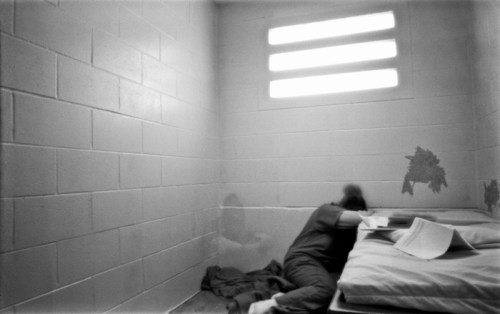

Therefore, I stake two positions on the issue of motif/cliché. First, repeated clichés have developed in the practice of photography in prisons. Second, prison populations have had little or nothing to do with the creation, continuation or reading of these clichés.
As a general criticism, I would say photographers in prisons struggle to achieve original work. But, prisoner-photographers – whose experience differs vastly from pro-photographers, custodians and visitors – cannot be held to that same criticism.
WHEN THE PRISONER CONTROLS THE CAMERA
These images by the girls at Remann Hall are distinguished from the majority of prison documentary photography, because the inmate is holding the camera. When an inmate repeats a motif it is not a cliché.
These are images of all they’ve got; concrete floors, small recreation boxes, steel bars, plastic mattresses and chrome furniture … all the while lit brightly by fluorescent bulbs and slat windows. These aren’t images taken for art-careerism, journalism or state identification. These are documents of a rarefied moment when, for a while – in the lives of these girls – procedures of the County and State took back seat.
When a member from within a community represents the community, the representation is above certain criteria of criticism. A prison pinhole photography workshop has very different intentions than any media outlet. Cliche is not a problem here; it is a catalyst.
The simulation and reclamation of visual cliche (in this case the obfuscated hunched detainee) is doubly interesting. Why the frequent use of the foetal position? Why did the girls choose this vulnerable pose to represent themselves? Was it on advice? Was it mimicry? Was it part of a role they view for themselves? Why don’t they stand? Emotionally, what do they own?
As in evidence in some images, one hopes that some of these girls are friends. This selection of shots share a single predominant common denominator; the psychological brutality of cinder block spaces of confinement. Companionship seems like a small mercy in those types of space.


These photographs should knock you off your chair. I am in doleful astonishment. In the absence of faces, how powerful and essential are hands?
For now, consider how visual and institutional regimes square up.

Since the original publication of these images, they have been viewed tens of thousands of times. More than any other photographer – famous or not – these images by anonymous teenage girls have been by far the most popular ever featured on Prison Photography. That appetite shows that when prisons and struggle and creativity are presented in a meaningful way, images can be used as a segue into wider discussion of the underlying issues.
The Remann Hall project was done as a part of the education department program at the Museum of Glass in partnership with Pierce County Juvenile Court. This comment sums up the importance but also the fiscal fragility of these arts based initiatives:
“The Remann Hall project was an incredible project, which culminated in an outdoor installation at the museum and many of the participants coming to volunteer and participate in education programs at the museum after they were released. It was one of the many incredible programs I was lucky enough to be part of there. A book of poetry, artwork (and I think some of the photos in that link) was produced as well. The whole program was a great model for how arts organizations can do meaningful outreach in their communities. Unfortunately, the program was cut one year before the planned completion, due to budget concerns.”
[My bolding]
Credit: Bruce Jackson
NY Times LENS Blog
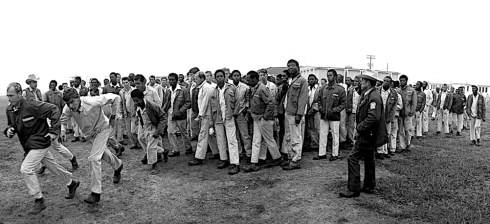
Here, there and everywhere people are celebrating the New York Times’ LENS Blog as a messianic gift for the photophile. I was therefore happy to see that less than two weeks in LENS is featuring Bruce Jackson’s wide angle documentary work from Arkansas Prison in the early 1970s
Bruce Jackson should be a familiar name as it was he that rescued, scanned and shared the enigmatic Arkansas Prison Mugshot series, Mirrors.
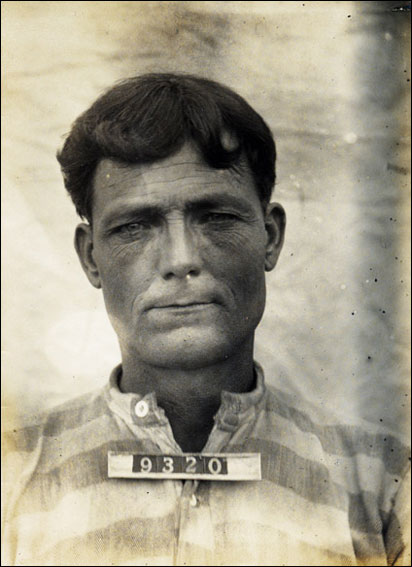
Found and presented by Bruce Jackson. Arkansas State Prisoner Portrait
June 100 Eyes Issue
Over at 100 Eyes, Andy Levin from insists that “Whatever ones perspective, be it victim, civil rights activist or cop, there is one shared idea – something needs to change.”
The June edition of 100 Eyes, titled, America Behind Bars features the work of Dominic Bracco, Jerome Brunet, Darcy Padilla, Jenn Ackerman and Tim Gruber – all very talented and committed photographers.
As editor, Andy Levin, concludes, the genre of prison photography (or to be less aggrandizing) simply the practice of photography within sites of incarceration is often a difficult and thankless task;
The photographers who have contributed to “America Behind Bars” have worked against overwhelming odds to bring back powerful images of American prisons. One can’t simply walk into a prison with a camera. This kind of photography requires long negotiations and often a warden who has the vision and concern to allow a photographer into his jail.
Wonderful exposure for the most pressing of social issues in America today.
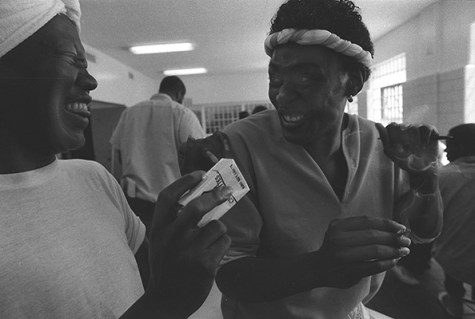
Darcy Padilla. From AIDS in Prison Series.
Prison Photography began its project in September 2008 with a celebration of Darcy Padilla’s portrait of former San Quentin Public Communications Officer, Vernell Crittendon.
In February, I was gob-smacked by Jerome Brunet’s Riding Shotgun with Texas Sheriffs.
I’d like to feature here two very separate projects. If you’ll allow me, I want to overview Matej Kren’s Book Cell and think of the book literally as a sculptural physical constraint. At the same time, I’d like to introduce Herman Spector’s program of bibliotherapy at San Quentin Prison and frame the book as a pedagogical tool for control.
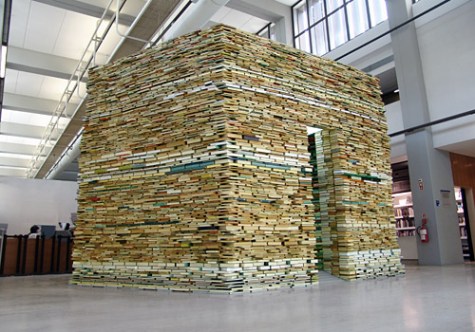
For his 2006 installation of Book Cell at the CAMJAP in Prague, Matej Kren stated:
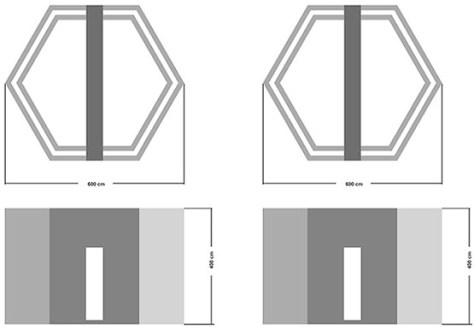
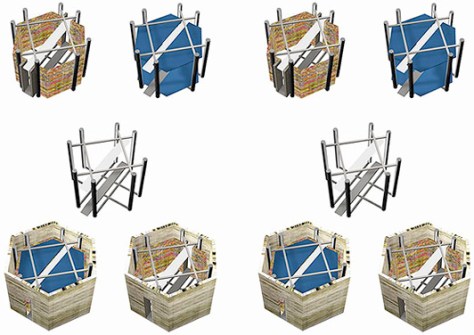
The Book Cell Project repeats the recurring procedure, in the work of this artist, of piling up thousands of books, creating an architectonic structure where we are invited to step inside.
The memory and knowledge accumulated in the books gathered, closed and inaccessible, diverse and precious will be potentially recovered in the end, when all of the books can return to their function of being read, but meanwhile they will have been worked on as sculpting matter and as the spirit of the place where the artist intends to hold us: an hexagonal enclosure with a passage defined by mirrors that assure the vertigo of a fall, the ad infinitum fragmentation, the panic of spatial disorientation characteristic of a virtual infinity.

The fact that these structures are made from the library/archive of the hosting institution makes me shudder. CAMJAP claims a pride in this making the structures site specific.
Prague is a great literary city and the absurdity of being confined by books would be appreciated by Kafka, and yet Krens offers us a way out that Kafka never would. He intends that books return to use and are reborn into cultural thought.
Kren’s literal use of bound knowledge in the fortification of space calls to mind other powerful (if less poetic) uses of books in controlling inmate populations. I’m thinking specifically of Herman Spector’s program of Bibliotherapy at San Quentin State Prison
From 1947 until 1968, Herman Spector was employed as senior librarian at San Quentin. He put in place a meticulous, long-term program offering 7-days-a-week library access and a choice from over 33,000 titles. By the end of his tenure he stated (not estimated, for he knew every book checked out) that 3,096,377 books had circulated through his system. His project drove up prisoner literacy and had inmates reading 98 books/year.
The project sounds nothing but positive and indeed it brought about much self improvement. But, remember this was a grand experiment with a captive audience and Spector had total control over the reading lists – and latterly, the outward correspondence and writing by San Quentin inmates. Spector employed censorship as readily as he conducted reading groups and assigned classic texts.
Five years ago I was fortunate to meet Eric Cummins, whose book The Rise and Fall of California’s Radical Prison Movement details Spector’s manipulations at San Quentin (Chapter Two: Bibliotherapy & Civil Death). It is the most thorough examination of that great experiment. Cummins writes:
‘Books, for Spector, were the “deathless weapons of progress” by which prisoners could be “paroled into the custody of their better selves … by feeding on hallowed thoughts.” And, “The hermitage of a small, dank cell,” Spector wrote, “if provided with books, can yield a rich harvest of sheer delight and practical values.“‘ (Page 26)
‘Though the prison’s official censor was the associate warden for care and treatment, the actual work fell to Spector. Except for mail, which was read in the cell blocks or the mail room, the senior librarian censored all writings by inmates that left the prison and decided what publications would be purchased for the library.‘ (Page 24)

‘Spector stated his own censorship policy as follows: “Those which emphasise morbid or antisocial attitudes, behaviour, or disrespect for religion or government or other undesirable materials are not purchased.” Like most other librarians of the treatment era, Spector gave little thought to the danger of political, class or cultural bias implicit in his prison censorship policies, and he wasted no time worrying that denying prisoners law books might be unfair or even unconstitutional. Books that gave inmates access to the law were to be confiscated at the gates. Books that criticised church or state were seditious.‘ (Pages 25/26)
It wasn’t only reading that was controlled and owned; writing too:
‘The reduced civil status of prisoners was reaffirmed in 1941 in a section of the penal code titled “Civil Death,” penal code 2600-2601. As a consequence of the Civil Death statute, the California Department of Corrections regarded all writing produced by state prisoners as state property, just as a chair or table made in the prison industries belonged to the state.‘ (Page 25)

Almost constantly throughout his tenure, Spector was at odds with the prison administration who were either unable to grasp, or unwilling to endorse, his aggressive methods of control. When Spector left his post over 25 years of meticulous notes and records were destroyed.
Bibliotherapy and censorship, as Cummin’s concludes, ‘separated prisoners from the power of their own words. Even so, the underlying assumptions of bibliotherapy would soon have a tremendous influence on the lives of certain of the brightest of San Quentin’s inmates, for they would take the notion of reform through reading and writin, the foundation of Herman Spector’s faith, as their own first principle … turning the notion of civil death on its head, reconnecting themsleves to the power of words previously denied them.‘ (Pages 31/32)
Conclusion
Spector’s project founded,at San Quentin, a tradition of literacy that would engender the works of Caryl Chessman, Eldridge Cleaver and the expanded political prison writing movement of the 1970’s. In some ways, the approaches of autodidactism and self determination of the Black Panthers began with the obsessive endeavours of the eccentric biblio-evangelist Herman Spector.

Guantanamo © Chris Maluszynski/Agence VU

Guantanamo Map http://www.cubafutour.de/Karte%20Guantanamo%20Provinz.jpg

Guantanamo Bay Tents. Courtesy of The Department of Defense Visual Information Center
I am very happy with the way Prison Photography is progressing. I have done interviews with some outstanding photographers and artists. I have offered opinion where I think there’s something to be said. The most satisfying work on the blog is that contributed by guest bloggers, comment-makers and interviewees. Photographers have contacted me and I have been eager to comment upon their work.
But, there is one audience I never anticipated – The Google Image Search Audience. I get many hits for searches on Guantanamo, Guantanamo video, Iraq prison, Abu Ghraib, Abu Ghraib Images of Prisoners, etc, etc – which is strange because these are topics that many people have grappled over with more proficiency and depth than I am likely to.
It is obvious that there is a need for fast access to images of America’s sites of torture and incarceration, namely Abu Ghraib and Guantanamo. I certainly don’t wish to fuse the two institutional histories so I shall deal only with Guantanamo Bay.
Louie Palu
Walrus Magazine. 8 of Palu’s photographs and accompanying article.
The Atlantic. 6 of Palu’s photographs.
Private galleries. Palu’s Photoshelter profile offers three separate galleries, but they’re password protected. Contact the photographer directly.
NPR Interview. Palu offered insight into his experience and impressions of Guantanamo.
Christopher Sims
Mother Jones. 15 images of daily life outside of the prison complex.
Civilian Arts Project. 25 images of a bizarrely serene Guantanamo Naval Base.
BBC, The Other Side of Guantanamo. Article about Sims’ series.
Daylight Magazine. 4 minute audio of Sims’ experiences on project.
Chris Maluszynski
Agence VU/Moment. Twenty-six images exhibited. Likely more on file at the agency.
Cesar Vera
Guantanamo Prison. 18 Black & White images. 3 Colour.
Joint Task Force (JTF)
Many of the photographs shown in the press over the last few years were taken by members of the Navy’s own Joint Task Force. When press photographers visited the JTF vetted all images before release.
Boston Globe. 30 Hi-Res images.
Repeat of above selection. 20 Hi-Res images selected.
JTF Photo Galleries. 22 months (July 2007 – May 2009). Hundreds of images. Official photography.
Miami Herald
Description of the 8 different camps at Guantanamo
Explanation of the Legal contexts: Key defendants, the judges, the defense and prosecution counsel.
Cursory look at Art influenced by Guantanamo
Magnum
Bruce Gilden. Guantanamo Bay. Enemy Combatant Camps, 2003
Paolo Pellegrin. Guantanamo Detainees, 2006
Stuart Franklin’s work Cuba, 2003, included images from Guantanamo and you’ll need to search the Magnum website for images.
McClatchy
An eight-month McClatchy investigation of the detention system created after the Sept. 11 terrorist attacks has found that the U.S. imprisoned innocent men, subjected them to abuse, stripped them of their legal rights and allowed Islamic militants to turn the prison camp at Guantanamo Bay, Cuba into a school for jihad.
Intro. Text and 11 minute video.
Photos. Detainees held at Guantanamo Bay
Photos. Faces of Guantanamo Detainees. Part one.
Photos. Faces of Guantanamo Detainees. Part two.
Photos. Detainees held in Afghanistan.
Eyeballing
Comprehensive overview of base using Google Maps, official photographs. Details structures, uses and topography of naval base.
Camp America, Camp Delta, Camp V and Administrative & Court building.
Camp X-ray and construction of later detention camps.
Associated Press
Images of facilities and interiors of various detention blocks and camps.
Stars & Stripes “The Independent News Source for the U.S. Military Community”
Work at Guantanamo
Education at Guantanamo
Recreation at Guantanamo
Artistic Turns
David Hicks. Virtual Guantanamo Cell
Penny Byrne. Porcelain Guantanamo Detainee Figurines
Gregor Schneider. 21 Cells, Bondi Beach, Australia
Legofesto. Guantanamo reconfigured with Lego men and Lego pieces and Wired Interview
Flickr – Protest Images
Amnesty International. Guantanamo Protests
Various Photographers. 100 Days to Close Guantanamo and End Torture.
James M. Thorne. Protest images.
Miscellaneous Media
Prisoners of War. 2004 article by the San Francisco Gray Panthers with images of US airforce transporting detainees and early 2003 images of Camp X-Ray.
BBC. Life in a Guantanamo Cell

Rendition. Photographer Unknown
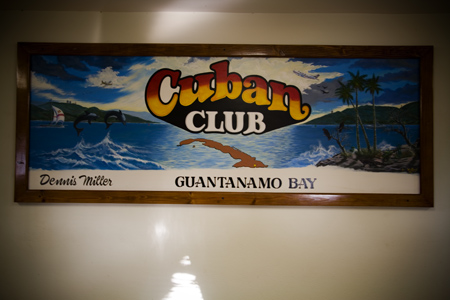
© Cesar Vera

Guantanamo Bay Navel Base with a New Commander-in-Chief. Photographer Unknown. http://www.obamalouverture.com/f39/guantanamo-bay-switch-bush-photo-obama.html
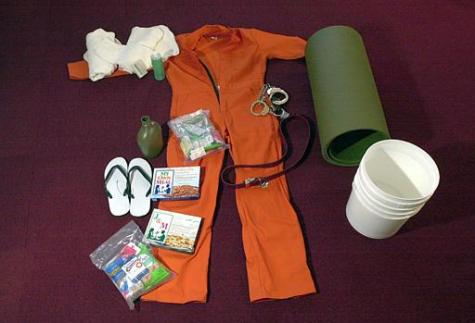
The standard issue of clothing, sleeping mat, food, sandles, canteen, soap, and buckets for detainees of Camp X-Ray is pictured in Camp X-Ray at the U.S. Navy Base at Guantanamo Bay, Cuba, on Wednesday, Feb. 20, 2002. © Tomas van Houtryve/AP Photo
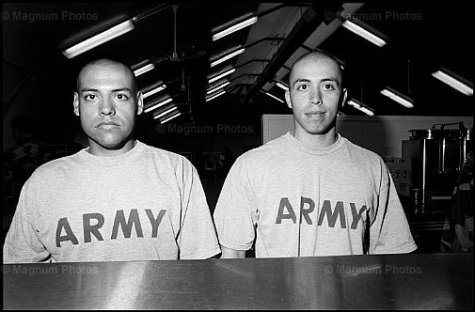
CUBA. Guantanamo Bay. 2003. Soldiers wait for their meals before a prayer breakfast at Camp America. Photo: Bruce Gilden/Magnum
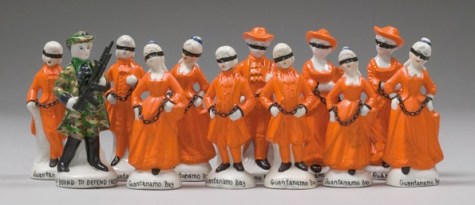
Penny Byrne Guantanamo Bay Souvenirs 2007, vintage figurines, metal chains, epoxy resin, plastic, re-touching medium, powder pigments, 14 x 32 x 10 cm.
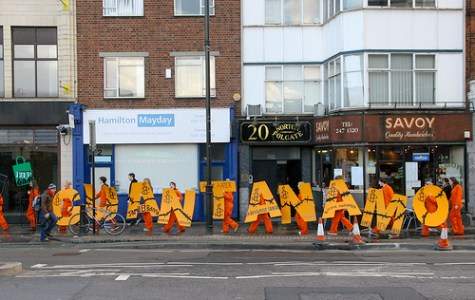
Photo: Jon McClean. http://www.flickr.com/photos/jonmclean/410055117/
IF YOU HAVE ANY RESOURCES TO SUGGEST,
PLEASE CONTACT ME AND I’LL ADD THEM TO THIS LIST.
Note: This one’s off topic, but I’ll be coming back with prison related visual critique sooner than you can say “Jack Lemon”.
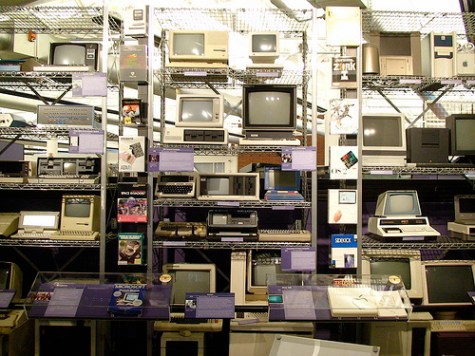
The Computer History museum in Mountain View, California. Credit: David Glover
How do museums and galleries use online media to promote themselves?
I have been required to think about “The Museum” and it’s engagement with public and web2.0 audiences recently. If you look about you’ll find really good uses and catastrophic uses of web2.0 by museums and galleries alike. I don’t want to beat up on small galleries for their ill-advised, tweeting non-personas nor criticise lackadaisical irregular blog posting; both of these activities are for the intern. I’d really complain if I thought someone was getting paid to stumble through blog posts and ideas after a full day educating outreach audiences.
I do think the MoMA and San Francisco MoMA are fair game though.
Let’s start with the good.
MoMA: A delicate, understated film-short, with good production values. Some might argue it’s over sentimental and panders to arty self obsessions, but the MoMA is the beacon of an art world, art market and art-as-brand that has Western obsessions about the object at its core. I’ll allow it to veil this truth and remould it as individual yearning.
Click on the image below to view the video at The Contact Sheet blog.

Still from MoMA's promotional video "I See"
And now, to the bad.
SFMoMA: Apparently inspired by the White House launch of Obama coverage on Flickr, the San Francisco MoMA launched its own stalking eye upon director Neal Benezra. They call it Director Cam.

Benezra at press preview, being interviewed by Don Sanchez for ABC7, in the SFMoMA rooftop sculpture garden.
Now, I am all for transparency, informality, familiarity and all that, and, to be fair, SFMoMA has done this reasonably well with its other Flickr sets (although I’d prefer less high-society party coverage and more high-school outreach coverage).
However, Director Cam just rubs me the wrong way. I don’t want to see the privileged folk of the museum-world lording over its institutions, I want to see public audiences getting knee deep in collections & archives and mixing it up a bit. I want to see Flickr used as a means to entice people into the museum not as a mirror for already existing (and exclusive) engagements.

Neal talking with Exhibitions Design Manager / Chief Preparator Kent Roberts. With Chuck Schwab, chairman of the board of trustees (center) and Catherine Kuuskraa (right). In the background on the left wall you can just slightly see the new bridge commission, by Rosana Castrillo-Diaz.
BLDGBLOG (via Twitter) this week called for an alternative narrative of the built environment.
As I understood this, it is a theoretical proposal that would include interviews and testimonies of electricians, security guards and the fixers that keep the nuts and bolts in place while arty self-obsessed types flit about amid well-maintained frameworks.
After the white-collar fraudulent dismantling of the city, there is no better time to call for an alternative version of urbanity. A blue-collar city narrative.
With these thoughts looming, it is not Benezra that interests me, rather Kent Roberts, Exhibitions Design Manager and Chief Preparator at SFMoMA. Bring on ‘Museum Preparator Cam’!
All of this throws up more unanswered questions about the role of new media in the operations of museums and galleries. Fortunately, I recently discovered Nina Simon’s Museum 2.0 blog which provides some riposte.
___________________________________________________________
Images. Computer History Museum by David Glover. As well as his Computer History Museum Set, you should check out his Byte Back Set.
Of all the accounts, of all the testimonies, of all the confused interactions, bumbling application of draconian laws – THIS ONE takes the biscuit.

Hammersmith Police Station. Photo Credit: George. http://picasaweb.google.com/george.sapnatech/GeorgeeeeUKTrip04#5124127843534510386
Edward Denison was photographing the Hammersmith Police Station for a book about McMorran & Whitby, one in a series about post-war British architects jointed supported by the Royal Institute of British Architects, The Twentieth Century Society and English Heritage. Denison knew the law:
The laws of this free and democratic country permit members of the public to photograph any building, as long as the photographer is standing on a public right of way when taking the photograph. I know this because a very professional and courteous member of the City of London Police explained it to me when I was photographing its headquarters at 37 Wood Street (completed in 1966) and the extension to the Central Criminal Courts on Old Bailey (completed in 1972), both designed by the architectural firm McMorran & Whitby.
He was also conscious of others’ needs for explanation:
Although I am not legally obliged to do so, as a matter of courtesy I always (if possible) seek to explain what I am doing to the occupants of any building I am photographing before I leave. At Hammersmith, I went to the reception located inside the public entrance, to be met by two quizzical officers.
Denison goes on to explain that the officers told him he couldn’t photograph. He told them he could and they acquiesced with the retort “For now.” Shortly before leaving Denison crossed the road to take a picture of an architectural detail. At this point two officers ran down the street, commanding him to cease photographing and then detained him for 45 minutes despite his full credentials, letters of recommendation and helpful explanation of his project and sponsors. Only after word was received that his name wasn’t on the suspected terroist list was he free to leave, albeit with a completed 5090(X) form.

Busted! Credit: Phil Clements. An example of a 5090(X) form. http://www.flickr.com/photos/71492355@N00/3151511295/in/pool-police_form_5090x/
A little irony is that the architect, McMorran, is Denison’s grandfather. Denison already had architectural plans and elevations in his possession. He knew the building better than any officer inside! Denison is as exasperated as the rest of us with a robotic police force that acts upon its role play training and not the evidence at hand in a particular situation:
But do the police really need to be trained to recognise that in the age of the mobile-phone camera (or indeed Google Earth), a man with a camera, a wide-angle lens and a fold-up bicycle openly taking photographs of a police station makes an unlikely suspect?
From reading Denison’s account, it seems he (like many others) needed to experience harassment to fully comprehend the erosion of civil liberties in the UK; to crystalise the meaning and consequences of the Prevention of Terrorism Act upon the average citizen.
Denison ends with a statement that brings home the difference between his innocuous activities and those of the past:
Real terrorists do what the Irish Republican Army did to McMorran & Whitby’s Central Criminal Court on 8 March 1973, only months after it had been opened – detonate a massive car-bomb right outside what John Betjeman called this “splendid fortress of the law”. The building survived intact. Donald McMorran had designed Hammersmith Police Station to withstand aerial bombardment, in anticipation of another kind of war.

Hammersmith Police Station, together with the plans already in Edward Denison's possession
In the past Hammersmith Police Station has veered from proactive engagement to utter neglect of the public. With officers on the street inconsistently enacting ludicrous law, it seems the Metropolitan police force – as a whole – is as schizophrenic.
___________________________________________________
For fun, you can view a 5090(X) forms Set at Flickr.
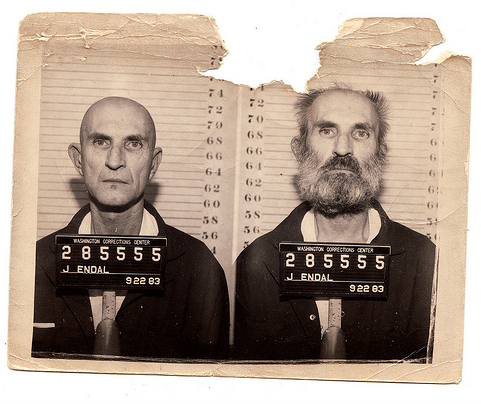
Torn Shorn, Misc. Set. Courtesy of Least Wanted aka Mark Michaelson. http://www.flickr.com/photos/leastwanted/sets/72157605201939008/
Another nod for Blake Andrews. Although not planned, it is welcome, as I think he tries keeps the blogophotosphere fresh, trying new stuff from his hideout in Portland.
Earlier this week I featured Blake’s Brief History of the U.S. Passport Photograph. An artist/collector with hundreds of Passport and ID Photographs, named Least Wanted, followed up with Blake to get the word out on his sprawling collection.
Also earlier this week, I put up a piece about the JUSTICE Art Installation in Bridewell Police Station, London. Coincidentally, one of the artists for the JUSTICE exhibition exhibition was Mark Michaelson, aka Least Wanted. It seems like a small-internet-triangle-of-providence presented itself this morning and it is up to me to draw the hypotenuese …

Head Gear, Misc. Set. Courtesy of Least Wanted aka Mark Michaelson. http://www.flickr.com/photos/leastwanted/sets/72157605201939008/
Least Wanted collects, groups and displays a huge collection of I.D. photos on Flickr. In addition to passport shots, it includes medical photographs, badge I.D. photos and other documentary ephemera. Prison Photography is interested in the majority of the collection: Mugshots.
Least Wanted’s sets are a mad enough curatorial project to keep me going for months. For now, I’ll just echo Blake’s sentiment and point you in the direction of Michaelson’s epic archive.

Austin Old Timer, Misc. Set. Courtesy of Least Wanted aka Mark Michaelson. http://www.flickr.com/photos/leastwanted/sets/72157605201939008/
The three images used in this article were drawn from Least Wanted’s misc. Set
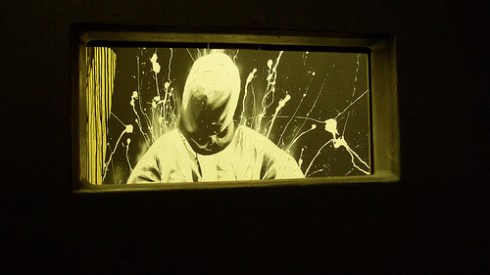
I found this via Wooster Collective who provide good daily visual feeds.
Info from the JUSTICE Flickr set. All images from JUSTICE Flickr set.
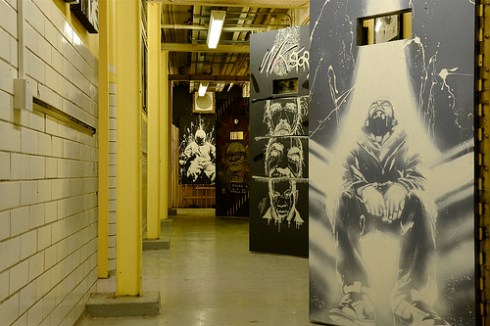
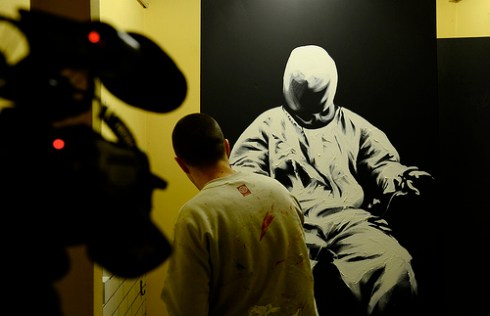
JUSTICE, a concept show based on themes of Law and Order, is the hard endeavours of 5 artists; C215, Dan23, Bruno Leyval, Least Wanted and MC1984.
Traveling to Bristol from France and New York to build JUSTICE, featuring site specific installations, photography, prints, stencils and a range of new original work.
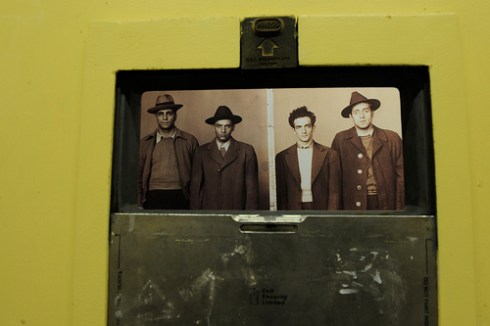
All the artists have a strong collective interest in the plights of minority cultures, human rights, freedom, homelessness and the vacuous subject of law and order, and Justice will display the combined aesthetic of these interests placed within the oppressive environment of Bridewell Police Station’s cells.

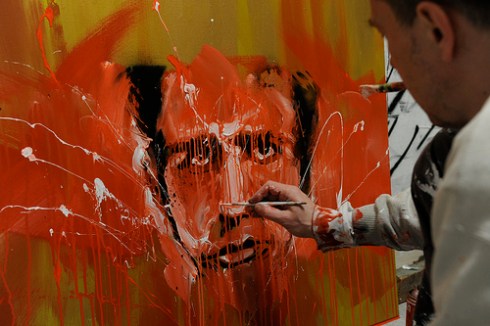
As well as the Old Bridewell Police Cells, the show was at The Long Arm Gallery, Bridewell Street, Bristol, BS1 3PY.


 Prison Photography
