
You are currently browsing the category archive for the ‘Institutional’ category.

THE VISUAL CULTURE OF PRISON RESISTANCE
Liz Pelly‘s conversation with Josh MacPhee in The Media is a wonderful read. It coincided with MacPhee and his cohort’s incredible exhibition of prisoner made protest materials going all the way back to the early seventies.
MacPhee urges us to dismantle the idea that prisons are separate from outside society. Crucially, he’s not making, in the first instance, a moral point about how we’re all the same, prisoners and all. MacPhee makes an observation of the structural characteristics of the prison system.
“It’s getting harder and harder to hold up the pretense that prison is somehow distinct from the rest of society,” says MacPhee. “When there’s this many people going in and out all of the time, there’s no way that our lives out here don’t leak into there, and that their lives in there don’t leak out into the rest of society. The idea that these are completely separate realms needs to be dismantled.”
Of course, once the structural facts of the system are revealed, the moral point that we are all one-and-the-same, prisoners and all, is indisputable.
I contacted Pelly and asked if I could republish the conversation. It originally appeared as Inside/Out: On Prison Justice, Art of the Incarcerated, and Interference Archive’s New Show in Issue #44 of The Media (October 10, 2014). It is a privilege to feature Pelly and MacPhee’s interview in full here on the blog.
A LITTLE BACKGROUND
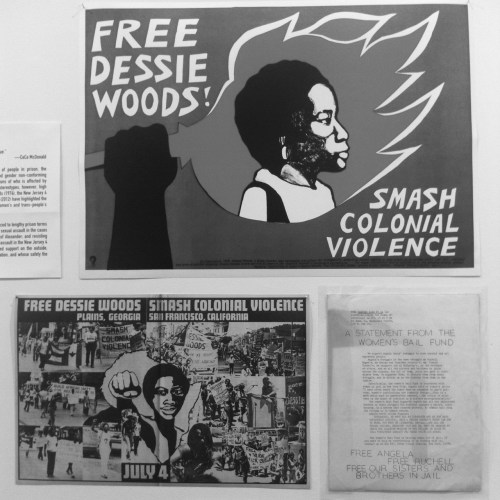
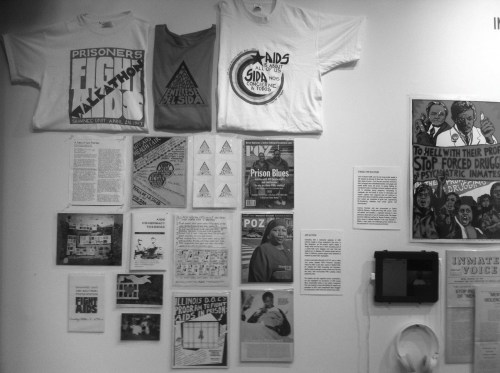
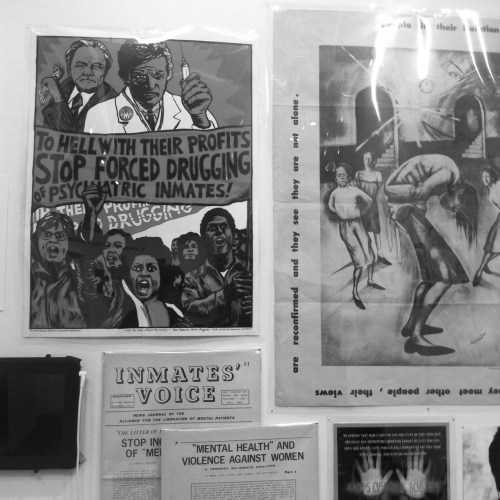
Between September 11th and November 16, 2014, Interference Archive exhibited, Self-Determination Inside/Out: Prison Movements Reshaping Society a look back at the visual and material culture of prisoner-led political movements.
Organized by Molly Fair, Josh MacPhee, Anika Paris, Laura Whitehorn, and Ryan Wong, Self-Determination Inside/Out includes sections on the work of incarcerated AIDS educators, the experiences of women and queer prisoners, prison and control unit prisons. The exhibition features prison newsletters, pamphlets, video and audio interviews, prints, photography (!!!) and magazine covers — starting with materials created during the 1971 Attica Rebellion, a massive prisoner uprising in upstate New York, and concluding with work made by current political prisoners, the show highlights moments of self-organization within the prison industrial complex.
You can buy a booklet and a poster for the exhibition.
Interference Archive is a volunteer-run archive in Gowanus, Brooklyn, dedicated to preserving cultural ephemera related to social movements.

Inside/Out: On Prison Justice, Art of the Incarcerated, and Interference Archive’s New Show
Liz Pelly (LP): What initially inspired the creation of Interference Archive, which mostly houses ephemeral material like posters, t-shirts, and newsletters?
Josh MacPhee (JM): For the different people involved, there are different answers of course. For me, I grew up making this stuff through DIY music, cultural stuff, politics. Through the act of doing, I started collecting it. Flyers, t-shirts, buttons, the ephemera that gets produced by people who are organizing. It was a combination of wanting to understand the history of what I was doing and then at the same time, I was getting really interested in this idea of how people make art and culture in the context of trying to their lives. It’s distinct from art that’s produced purely in the realm of self expression, and the art that tends circulate within the contemporary art world.
This kind of material gets lost. It’s often not clearly authored. Institutions that deal with art don’t quite know what to do with it. Since it’s so political, places like history museums don’t know what to do with it either. It sort of falls through the cracks. But we can see during times like Occupy, or Tahrir Square in Egypt, or with the Maidan in the Ukraine, that this is the stuff of life, [created] when transformation starts to happen. When people have their arms shoulder deep into the constructions of representations of a new world, and the way they want things to be articulated.
For me, doing an archive was a way to say, “just because these moments come and go, and movements have ebbs and flows, doesn’t mean that once the peak has been reached that this material isn’t still valuable to us, to where we’ve come from and therefore where we are going.”
LP: That said, how do you think this sort of exhibit in particular shines light on the experiences of prisoners?
JM: There were five of us who organized this exhibition, and most of us have been engaged with issues around prisons in different ways, whether having been formerly incarcerated, or working with prison activism programs. As far as I know, nothing like this has ever been done before.
We live in a moment where over two million people are in prison. It’s getting harder and harder to hold up the pretense that prison is somehow distinct from the rest of society. When there’s this many people going in and out all of the time, there’s no way that our lives out here don’t leak into there, and that their lives in there don’t leak out into the rest of society. The idea that these are completely separate realms needs to be dismantled.
We thought it was important to marshal primary source material to show that people aren’t just objects of repression or study or someone else’s activism. But they have done immense amounts of organizing inside themselves. Often times that organizing takes place at the same time, or sometimes even ahead of, what people were doing on the outside. Some of the focus we have on organizing around AIDS and AIDS education in prison was really fascinating and important because it shows how people that had the least access to medical care were doing in some cases the most organizing in order to try to deal with a problem that at the time the government was not even acknowledging existed.
LP: Can you tell me more about your own experiences with prison reform activism?
JM: I first learned about how the prison system functions in the early 1990s. It just sort of blew my mind that there was a whole world of people who largely because of race and class were basically being warehoused. And that, at the time, it was completely absent from the radar of public In the 90s, the only thing discussed in relationship to prisons and criminal justice was this sort of “tough on crime” thing. There was no acknowledgment that a massive increase of the prison population going on, and that it wasn’t actually working. And that the system that decided who went in and out was so manifestly unjust, random often.
That sent me on a path of doing organizing around prison issues. I started in Ohio, and then did some work in Colorado, and then in Chicago. A lot of the organizing I did was around Control Unit Prisons, basically trying to stop solitary confinement. [Organizing around] these men and women who were spending twenty-three-and-a-half or twenty-four hours a day alone in their cells, and the psychological damage that causes and how it basically goes against international conventions of torture, yet it’s completely commonplace in this country.
LP: Over the past year, there has been lot of in the news about the racist criminal justice system. It’s an apt time for Self-Determination Inside/Out: Prison Movements Reshaping Society. But obviously there is a lot of history of racism in the criminal justice system that this brings to light. Were you inspired to put this together because of recent events, or has this exhibit been in the works longer?
JM: We worked on the exhibition for 6 months. As a space, as an institution, one of our goals is to take this material that’s perceived as marginal and present it in ways that will allow it to be in its own context, but also to actually show that it’s not marginal. Our primary audience is not people who already necessarily agree with everything that would be in this exhibition. We are conscious of, and trying to take advantage of, a moment.
The question becomes, how do we push [the discussion] farther? If we say mass incarceration is not okay, at what point is incarceration okay? If 2 million people in cages is not acceptable, is 1.9 million people in acceptable? Or 1.8? Once you start asking those questions it opens up the space to say, “this whole system is just absolutely corrupt.”
Mass incarceration accomplishes a number of things, none of which are its stated goals. It accomplishes deeply suppressing working class communities of color. That’s never been articulated as what the prison system is supposed to do. It’s just clear that that’s what it does. It clearly is completely ineffectual at actually dealing with crime.
LP: What are some underreported sides to the prison industrial complex that you hope this exhibit brings to light?
JM: The fastest growing portion of the prison population for years now has been women.
Increasingly there is a real gendered aspect of being able to look at how the criminal justice system works. Increasingly it’s used to enforce gender binaries. It’s a brutal system for queer and trans people that get sucked up into it. People are doing a lot of organizing around it now, but until recently, it was assumed if you were gender non-conforming, they have to choose where to put you, and then once they chose a men or a women’s prison, then almost immediately you’d get sent to solitary confinement. You’d do your sentence out in solitary confinement, in complete isolation, because the system is not prepared to deal with gender non-conformity. You are being punished because your very existence challenges the bureaucratic way the system works.
It’s really clear that women who refuse to be abused, who fight back against abusers, almost always get pulled into the criminal justice system. So we have things like Trayvon Martin being shot, and Zimmerman getting off. But any woman that stops an attack from an abuser is inevitably going to do time because that’s just absolutely taboo.

LP: What were the biggest challenges to getting this exhibit together?
JM: Each exhibition has unique challenges and obstacles, and then there are ones that are sort of similar across the board. For this exhibition, was just that cultural material produced by incarcerated people is hard to access. A lot of it is made in prison and then just never leaves prison.
In general, one of the challenges for all of the exhibitions, is that unless we do something that’s very focused, inevitably there’s so much stuff it’s hard to know when to say “okay we’ve got enough” or to know when to draw the lines. It’s hard to know when to accept that you’re never going to have all of the stuff that you wish you could, that you’re never going to be able to tell the whole story, that maybe even the idea that you’re going to tell some sort of master narrative is questionable in its own right.
When you’re representing things that are so deeply underrepresented, people get attached to wanting their part of the story told, because it’s been marginal or silenced for so long. It makes it really hard to make those choices, because you don’t want anyone else to continue to feel [that way].
We are collecting material from movements that are marginal. Even though they often have extremely deep impacts, rarely is that impact known or visible when they’re most active. It’s kind of like an extra kick in the face when your ideas become commonplace 10 or 20 years later and you’re still written out of the history even though you’re the ones who came up with the ideas.
LP: What do you hope, in general, visitors learn from Self-Determination: Inside/Out?
JM: On the one hand, I hope this contributes to a shift [towards] the idea that prisons are maybe not the answer to the problems that they claim to be. And that locking people in cages is not actually accomplishing what we’re being told it is.
On another level, that incarcerated people are not just objects. They’re loved ones and family members and neighbors and community members. The thing that primarily defines someone as a human being is not whether or not they’re in prison. That people that happen to find themselves in prison, many for reasons that are and then also at the same time many for doing reprehensible things, doesn’t make them not human. It doesn’t mean they don’t have the same desires, life goals, and relationships that everyone else has. And as such, the way that they conceive themselves and their world is part of, needs to be part of, any movement for social transformation.
THE PEOPLE
The Interference Archive is a collection of posters, flyers, publications, photographs, books, t-shirts, buttons, moving images, audio recordings, and other materials, made by participants of social movements throughout past decades. It is an archive “from below” — collectively run space, powered by people, and with open stacks accessible to all. The Interference Archive explores the relationship between cultural production and social movements. It provides public exhibitions, a study and social center, talks, screenings, publications, workshops, and an online presence, with an aim to preserve and honor histories and material culture that are often marginalized in mainstream institutions. It is at 131 8th Street, #4 , Brooklyn, NY 11215 (2 blocks from F/G/R trains at 4th Ave/9th Street).
Josh MacPhee is an artist, curator and activist living in Brooklyn, NY. MacPhee is one of the founder of the Just Seeds Artists’ Cooperative, which organizes, creates and distributes radical art. MacPhee is the author of Stencil Pirates: A Global Study of the Street Stencil, which is dedicated to stencil street art. He co-edited Realizing the Impossible: Art Against Authority, Reproduce and Revolt and the upcoming Paper Politics: Socially Engaged Printmaking Today. In 2001 he co-organized the Department of Space and Land Reclamation in Chicago with Emily Forman and Nato Thompson. In 2008 he co-curated the exhibition Signs of Change: Social Movement Cultures 1960’s to Now with Dara Greenwald.
Liz Pelly is a freelance writer and editor based in Brooklyn, NY. I lives and works at the all-ages collectively-run art space The Silent Barn, where she books (and sometimes plays) shows. She and her friends run the ad-free bi-weekly online newspaper The Media.
The Media is a webpaper covering alternative arts, culture, music, news, and grassroots activism. With contributors often embedded in the communities they cover, The Media aims to bridge the gap between underground presses and mainstream media. Crucially, it is AD-FREE and simply designed. “At a moment marked by short attention spans, decentralized click-bait articles, and newspapers in flux, rethinking the aesthetics of our news websites feels just as crucial as re-imagining their content,” says The Media. “We want our content to resonate on its own merit, free of frivolity and flash, and grounded by a homepage that’s striking in its radical simplicity.”

After stints at Haverford College, PA; Scripps, CA; and Rutgers, NJ, my first solo-curated effort Prison Obscura is all grown up and headed to New York.
It’ll be showing at Parsons The New School of Design February 5th – April 17th:
Specifically, it’s at the Sheila C. Johnson Design Center, located at 2 West 13th Street, New York, NY 10011.
On Thursday, February 5th at 5:45 p.m, I’ll be doing a curator’s talk. The opening reception follows 6:30–8:30 p.m. It’d be great to see you there.
Here’s the Parsons blurb:
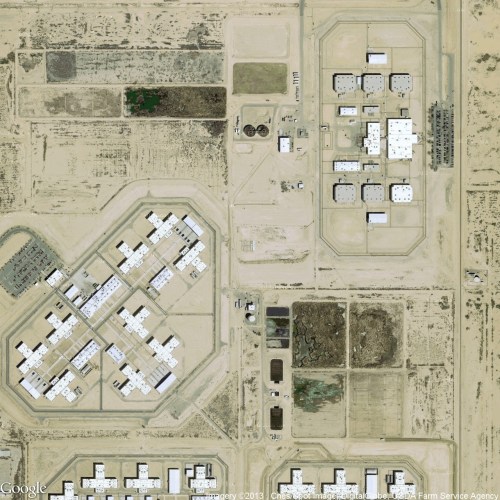
The works in Prison Obscura vary from aerial views of prison complexes to intimate portraits of incarcerated individuals. Artist Josh Begley and musician Paul Rucker use imaging technology to depict the sheer size of the prison industrial complex, which houses 2.3 million Americans in more than 6000 prisons, jails and detention facilities at a cost of $70 billion per year; Steve Davis led workshops for incarcerated juvenile in Washington State to reveal their daily lives; Kristen S. Wilkins collaborates with female prisoners on portraits with the aim to compete against the mugshots used for both news and entertainment in mainstream media; Robert Gumpert presents a nine-year project pairing portraits and audio recordings of prisoners from San Francisco jails; Mark Strandquist uses imagery to provide a window into the histories, realities and desires of some incarcerated Americans; and Alyse Emdur illuminates moments of self-representations with collected portraits of prisoners and their families taken in prison visiting rooms as well as her own photographs of murals in situ on visiting room walls, and a mural by members of the Restorative Justice and Mural Arts Programs at the State Correctional Institution in Graterford, PA. Also, included are images presented as evidence during the landmark Brown v. Plata case, a class action lawsuit that which went all the way to the Supreme Court of the United States, where it was ruled that every prisoner in the California State prison system was suffering cruel and unusual punishment due to overcrowded facilities and the failure by the state to provide adequate physical and mental healthcare.
Parsons has scheduled a grip of programming while the show is on the walls:
Mid-day discussion with curator Pete Brook and Tim Raphael, Director, The Center for Migration and the Global City, Rutgers University-Newark.
Wednesday, February 4, 12:00–1:30 p.m.
Co-hosted with the Humanities Action Lab.
These Images Won’t Tell You What You Want: Collaborative Photography and Social Justice.
Friday, February 27, 6:00 p.m.
A talk by Mark Strandquist.
Windows from Prison
Saturday, February 28
A workshop led by Mark Strandquist. More information about participation will be available on the website.
Visualizing Carceral Space
Thursday, March 12, 6:00 p.m.
A talk by Josh Begley.
Please spread the word. Here’s a bunch of images for your use.
PARTNERS
At The New School, Prison Obscura connects to Humanities Action Lab (HAL) Global Dialogues on Incarceration, an interdisciplinary hub that brings together a range of university-wide, national, and global partnerships to foster public engagement on America’s prison system.
Prison Obscura is a traveling exhibition made possible with the support of the John B. Hurford ‘60 Center for the Arts and Humanities and Cantor Fitzgerald Gallery at Haverford College, Haverford, PA.


TORTURE REVELATIONS
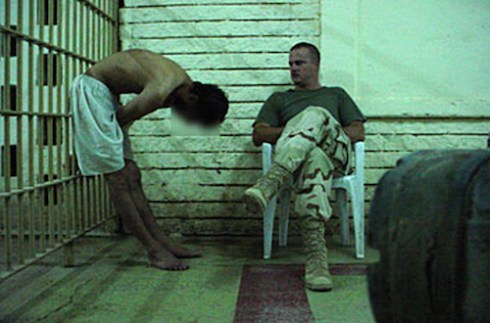
It was a double whammy this week. Everyone noticed the 6,000 page report into CIA torture. Many won’t know that today was the day that Justice Department attorneys presented the Obama administrations rationale for suppressing over 2,100 photos and videos of torture by American military personnel in Iraq, and Afghanistan.
Since 2009, the Obama administration has argued that releasing them would inflame anti-American sentiment abroad and place Americans at risk. Federal Judge Alvin Hellerstein of the United States District Court for the Southern District of New York is not so easily convinced and wants the government to explain, photograph by photograph, how each might pose a threat to national security. The fight to release these photos dates to 2004, when the American Civil Liberties Union filed a Freedom of Information Act request.
David Levi Strauss has tracked these developments from the very beginning. Several chapters in his new book is Words Not Spent Today Buy Smaller Images Tomorrow (Aperture, 2014) deal directly with the war over control of torture photos.
CONVERSATION
Strauss and I, for WIRED talked about state secrets, how the brain is wired, the political power of images and whether or not photos of Osama Bin Laden’s corpse actually exist.
WIRED: Why has the release of 2,000-plus remaining images and videos made by US military personnel in Abu Ghraib not been resolved?
Strauss: Because of the effectiveness of the images. They became the symbol of the change in US policy to include torture. Images are very powerful. That’s why the US government has become very afraid of the effects of these images worldwide.
The other amazing thing about the Abu Ghraib images was that they crossed the boundary between private and public. That is unusual. It changed things for photojournalism, for the military, certainly, and for the public at large. Prior to the release of the Abu Ghraib images, the military was handing out cameras to soldiers so that they could use photos to stay in touch with their families, and to be used operationally.
Read the full conversation: The War Over the US Government’s Unreleased Torture Pictures.
–
[All images for this Prison Photography post via Salon]


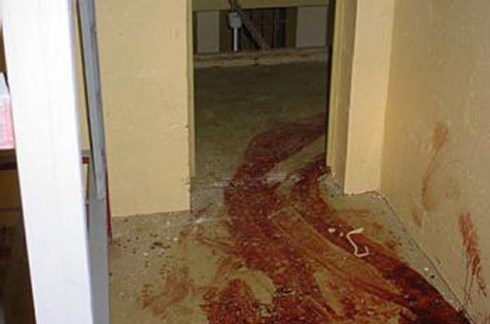

The banality of the design is on full display. The windowed room is where lethal chemicals are stored and used. Courtesy of the California Department of Rehabilitation and Corrections.
In 2006, the State of California approved a plan to construct a new execution chamber at San Quentin Prison. This week, The Avery Review published an article by Raphael Sperry titled Death by Design: An Execution Chamber at San Quentin State Prison which breaks down the budgeting, the politics and the design wrapped up in the contentious project. Not to mention the secrecy surrounding many details. Just as we’ve learnt about supply chains of chemicals for new drug “cocktails” being used by States to murder people, so too Sperry takes an in-depth look at the manufacturers behind the apparatus of death. It’s a wonderful, informed and terrifying breakdown of what we do to deliver “justice.” It’s a lovely foil to my past lyrics on the aqua green aesthetics of murder at San Quentin and it reveals the absurdity of the death penalty, the most vicious and foolishly symbolic of punishments.
“The Lethal Injection Chamber is a project that teeters on the edge of visibility and invisibility,” writes Sperry. It’s a project all about sight — political oversight, design based upon sight-lines for both executioner and witnesses. Sperry’s insights are chilling and revelatory. Below, I’ve selected the parts that intrigued me most, but you really should head over to The Avery Review to read the piece in full.
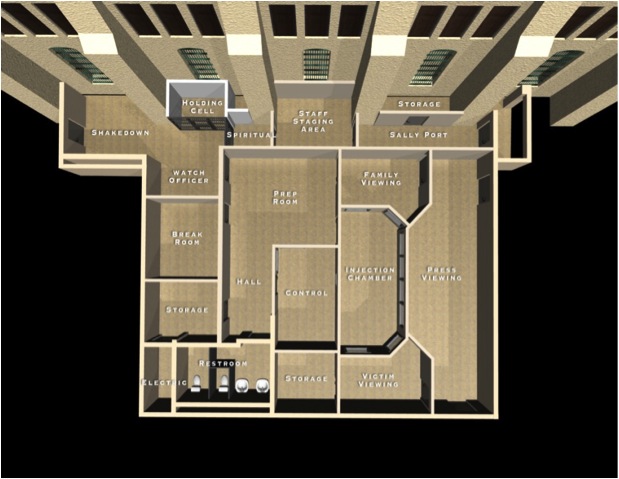
CAD Model for San Quentin Lethal Injection Facility. Courtesy of the California Department of Rehabilitation and Corrections.
DEATH BY DESIGN
Painted sheetrock walls, resilient flooring, vinyl cove base, and fluorescent lighting are used in a thoroughly predictable and pedestrian manner, much like a dentist’s office in a strip mall. The buttresses of the adjacent prison housing block, which a more creative designer might have incorporated, are instead covered by new framing; a storage room is used to occupy one of these irregular alcoves. But there is more to this design than meets the eye. Sometimes the banal is not ordinary.
The all-new facility for lethal injection provides more workspace around the body of the condemned man, an adjacent secure workspace and chemical storage room, and separated viewing areas for the various categories of observers. […] Bureaucratic skullduggery initially led to an unrealistically low project budget of $399,000: just under the $400,000 requirement to request legislative authorization of the project.7 Perhaps some secret executive-branch projects stay secret; in this case the state legislature found out about the project, causing further delays (they weren’t happy about having been hoodwinked) and an eventual approved budget increase to over $850,000. This included the use of inmate labor provided by the California Department of Rehabilitation and Corrections (CDCR) vocational training program.
The general layout of the suite of rooms was borrowed from previously completed projects in other states. Unlike in other states, where death chamber design materials are generally only available when they have been released in response to lawsuits, the final project was presented on a tour that included the federal judge presiding in the case, reporters, and a press release that included output of the CAD model used to design the project (now no longer available). Still, when I made a public request for the identity of the architect(s) and engineer(s) responsible for the project, CDCR would not provide an answer.
The Lethal Injection Chamber is a project that teeters on the edge of visibility and invisibility. CDCR exercised unusual control of the project budget in order to try to keep the project invisible. Yet a floor plan of the design proposal eventually became part of the court record submitted by CDCR to prove the constitutionality of the new facility, making it permanently available to the public. Newspapers published photos of the competed chamber and ancillary spaces and developed infographics of the layout. Nevertheless, today it is an incredibly difficult space for members of the public to visit unless they are part of the highly specified group of participants in or observers of an execution.
Perhaps in the same spirit, or perhaps because of the general obsession with the control of sight lines in prison environments, visibility within the Lethal Injection Room itself is carefully controlled. Witnessing the death of the condemned man is a central component of the execution ritual, with prescribed access for family members of the condemned man, family members of the victim, prison staff, and witnesses to verify that vengeance has been earned for the aggrieved public. Accordingly, the execution room is something of a fishbowl, surrounded on all sides by windows, including a band of wall-to-wall glazing for the public witness and media viewing room. However, mirrored glass is used along the line where the victim’s family might see the inmate’s family: a line that crosses the body of the condemned man, as the two families are positioned at opposite ends of the room just as they are presumed to be of opposite sympathies regarding the murder. Although it is not uncommon for the family of the victim in capital cases to object to the execution of the perpetrator, either out of a generalized objection to killing or after personal reconciliation, the plan denies the opportunity for this kind of potentially healing contact between families. Just as positions of state-driven authority are fixed in a courtroom, with a jury one level up and the judge above them, the dichotomous relations of innocent and guilty inherent in the finality of the death penalty are fixed around the body of the condemned man.
[…]
The death penalty debate, especially in California, now hangs on a tenuous balance between the desire for revenge (an “eye for an eye”) and revulsion at the spectacle of suffering driven by our own blood lust (with a subtext of racism). CDCR—the department charged with conducting executions, and the owner of the chamber in architectural parlance—would clearly prefer to go about its business and has a long history of avoiding public oversight (unsuccessfully in this case), but continuing the death penalty is subject to judgment by a California electorate that is trending toward abolition. Part of the design’s banality (and its low-budget, medical undertones) may be intended to visually deescalate the death penalty debate in order to perpetuate the status quo. But perhaps even the CDCR embodies the same unresolved questions about execution that continue to reverberate in ballot referendums, courtrooms, and public debates. The bland nature of the execution chamber may also indicate a lack of investment in the procedure’s future, a realization that this is no permanent edifice but rather a set of rooms that may be demolished or at least renovated for some other purpose before long.
RAPHAEL SPERRY
Raphael Sperry is an architect and green building consultant, President of Architects, Designers, Planners for Social Responsibility, and Adjunct Professor at California College of the Arts where he teaches the course “Rights, Power, and Design.” He is writing a book on architecture and human rights.
THE AVERY REVIEW
The Avery Review is a new online journal dedicated to thinking about books, buildings, and other architectural media. It’s aim is to explore the broader implications of a given object of discourse (whether text, film, exhibition, building, project, or urban environment) and to test and expand the reviewer’s own intellectual commitments.

The Lethal Injection Facility is the windowless box adjacent to the older, still functional cell block. The CMU exterior walls predate the interior renovations for the new death chamber.
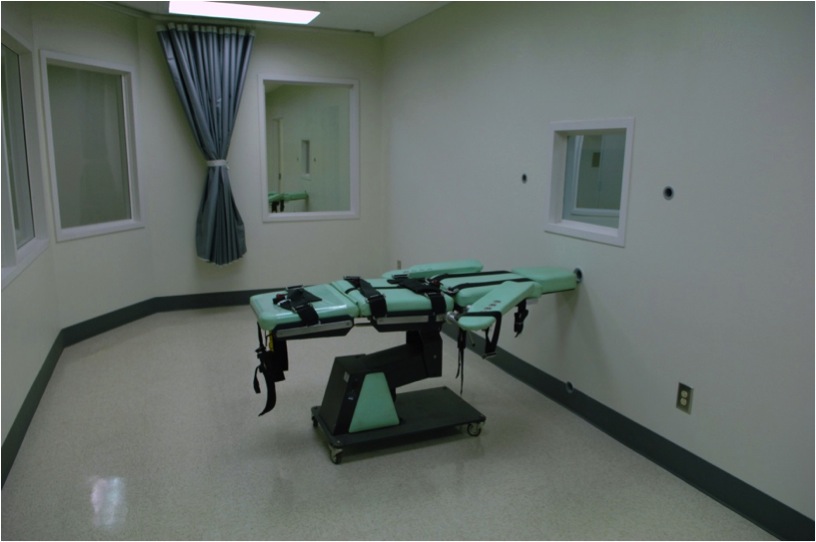
Injection Room. Window and hose ports to Infusion Control Room at right, mirrored window for victim family viewing in center, public witness / media gallery on extreme left. Courtesy of the California Department of Rehabilitation and Corrections.
ADPSR
This is the last week you have to catch the ADPSR-created exhibition Sentenced: Architecture & Human Rights at UC Berkeley’s College of Environmental Design.

Pursuant to my recent conversation with Beth Nakamura, I feel it necessary to focus on particular aspect of Oregon’s prison system on which she and Bryan Denson reported. The Blue Room.
Inside the Intensive Management Unit (IMU) at Oregon’s Snake River Correctional Institution, Nakamura photographed the Blue Room, a space in which prisoners watch videos of nature. Nakamura’s photographs and Denson’s words is the first news reporting on this fringe behavioural management method.
Firstly, why does the Blue Room exist? Prisoners in solitary are completely deprived of nature. In the IMU at Snake River, they are locked in their cell for 23 hours and 20 minutes every day. Prisoners’ only time outside of their windowless cell is 40 minutes in a concrete pen with high walls and a metal grate between they and the sky. IMU, the hole, SHU, the cooler, the box, solitary, call it what you like, extreme isolation makes men mad. Solitary is psychological torture. Neuroscience proves as much. Solitary is deprivation made physical.
The working hypothesis of the Blue Room is that exposure to video recorded scenes of nature will calm prisoners. It began operation in April 2013.
Let’s just pause right there and consider what is happening here. Let’s consider the carceral logic and policies from which the Blue Room has emerged. The state has decided to isolate prisoners in bare cells, with only artificial light, in a state of near total sensory deprivation, for 23 in every 24 hours. Let’s not speculate why prisoners are isolated; I’m less interested in what behaviours land a prisoner in the harshest custody conditions, and more interested in if and how those custody conditions improve or exacerbate existing problems and/or create new problems.
There are many employees of the state — such as Capt. Randy Gilbertson, who oversees the IMU at Snake River — who acknowledge that solitary destroys one’s sense of self. In his article, Denson quotes Gilbertson:
“I’ve seen over the years how an inmate will come into the facility, and they’ll almost appear to be completely normal,” Gilbertson said. “After a phase of isolation, those guys – especially those guys with mental health issues – tend to decompensate. They break down and go a different route. And it brings out a whole different person in them.”
Nearly two-thirds of the 200+ men in Snake River’s IMU suffer moderate to severe mental illness. Solitary makes them more prone to violence.
In the past 25 years, states across the U.S. have built, staffed and populated Supermax prisons that specialise in abuse. Once in operation, even well-meaning employees and mental health care-givers can’t change the structure therein; their primary function is to limit the damage of the rigid, brutalising environment.
If we really wanted to provide prisoners with some nature, we could open a gate and let them go sit out in the yard for the afternoon! Put a window in their cell?! Give them exercise options beyond the standard “dog-pen.” But no. From within a carceral logic that says controlled bodies stay within the walls, ludicrous makeshift responses such as the Blue Room emerge.
When I first learned of the Blue Room’s existence, I immediately thought to the scene from the film A Clockwork Orange in which the character Alex has his eyes pinned open and is forced to view “scenes of ultra-violence.” The notion that psychological ills can be rectified by the sights and sounds of projected montages, for me, is the domain of fiction. What would Stanley Kubrick make of this private screening room? Or Anthony Burgess, for that matter? Would they conclude that Snake River prison is as dystopic as the near-future-Britain they created in novel and cinema?
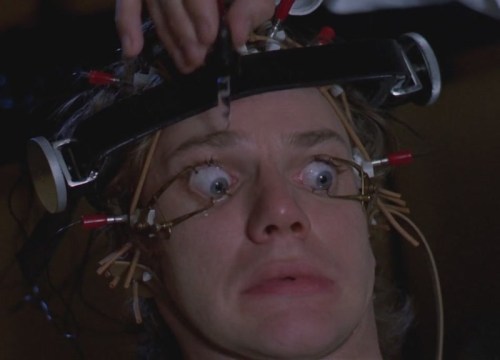
Film still, from A Clockwork Orange (1971), by Stanley Kubrick.
My first question about the Blue Room is not does it work? Rather, I have to wonder, why does it need to exist? What conditions of social order and disciplinary regime give rise to its “need” and justification?
The Blue Room is a pilot program drawing upon lesser-tested theories in eco-psychology. Denson explains that it came into being through a series of conversations.
In a 2010 TED talk, biologist Nalini Nadkarni talked generally about how nature can be used to rehabilitate and prisoners with jobs skills. At the time, I thought Nadkarni’s implementation of programs to identify moss species and raise endangered frogs as part of the Prison Sustainability Project was fantastic. I still do. Laudable initiatives. (I’ve talked about Nadkarni-started projects here and here on the blog before).
During her TED talk, Nadkarni mentioned she was thinking about installing large-scale murals of nature in the Supermax facilities of Washington. The Washington DOC was supportive but the correctional officers were opposed and the idea was shelved. Then, in late 2012, a Snake River corrections officer named Kevin Karpati watched the TED talk. Karpati emailed the link to Mark Nooth, the prison’s superintendent. Nooth, in turn, emailed the link to Capt. Randy Gilbertson, who oversees the IMU. Gilbertson contacted Nadkarni and asked if it could work.
This is where I wish to acknowledge that the people involved in instituting the Blue Room are making — from within a very restrictive law enforcement environment — efforts to improve the lot of prisoners. They have initiated the Blue Room as a response to severe deficiencies in the system. They cannot change the penal codes and administrative laws, but they can change the available practices within the walls. The Blue Room is an attempt to restore positive sensory input within a facility that routinely denies such inputs.
Nadkarni said she hoped it would work but had no evidence. All agreed that the only way to know was to test the hypothesis. An interior exercise room was converted to a screening room with projector and two chairs.
Nadkarni, along with National Gepgraphic documentary-maker Tierney Thys sourced nature videos. Many came from the NatGeo archives: Big Sur, New Zealand, Costa Rica, mountains, rivers, forest, tropical beaches, underwater reefs, roaring fires and a couple dozen other videos.
[Previously, I’ve written about bibliotherapy (the calculated use of reading lists to spur prisoners’ self-directed correction of “deviance”) in San Quentin Prison in the 1950s. The videotherapy at play in the Blue Room could be interpreted as a modern day equivalent. Words replaced by images?]
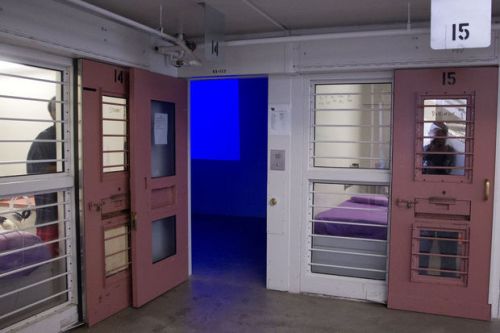


Denson reports that early anecdotes and observations suggest that the Blue Room can have a calming effect. “Lance Schnacker, a researcher for the Oregon Youth Authority, studied the disciplinary records of Snake River’s IMU inmates in the year before, and the year after, the Blue Room opened,” writes Denson. “He calculated that those who didn’t get the unique therapy posted more referrals for disciplinary infractions, while those allowed to use the Blue Room showed a slight dip. Schnacker cautioned that these data were preliminary, but promising.”
Should we be surprised? Give prisoners any small amount of added agency and the opportunity to take-in stimulus that breaks the norm and the monotony then, I’d argue, we would observe a change in behaviour. And most likely, toward the positive. Again, I am left to wonder why prison administrations are initiating small-scale projects such as the Blue Room, instead of taking a step back and recognising that the institutional logic which returns to solitary time-and-time again is the more fundamental issue to address.
Nadkarni, Thys, Schnacker and eco-psychologist Patricia H. Hasbach are set work with Snake River staffers to observe prisoners, conduct surveys and correlate results to existing mental health files. They hope to be able to determine to what degree exactly the Blue Room calms prisoners.
However, determining whether the Blue Room does or does not reduce suicidal or violent tendencies is a red herring. The study misses the point. Whether prisoners see 20-minute long reels of guppy fish and seaweed, or not, doesn’t alter the fact that solitary confinement makes people lose their minds. Why are we interested in mitigating the effects of a barbarous facility when we should be dismantling the walls of the facility altogether?
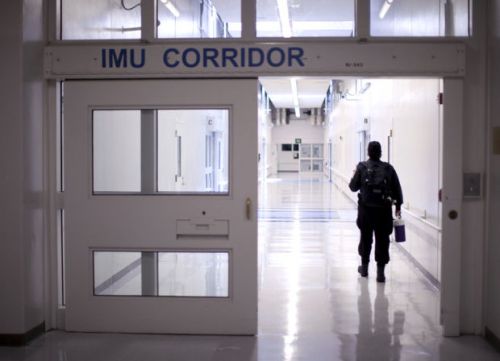
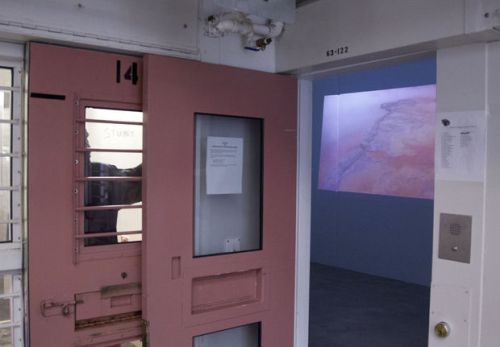
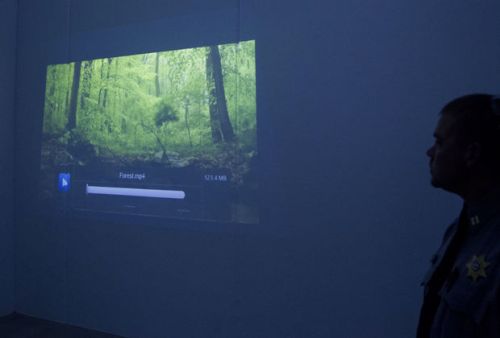
All images: Beth Nakamura
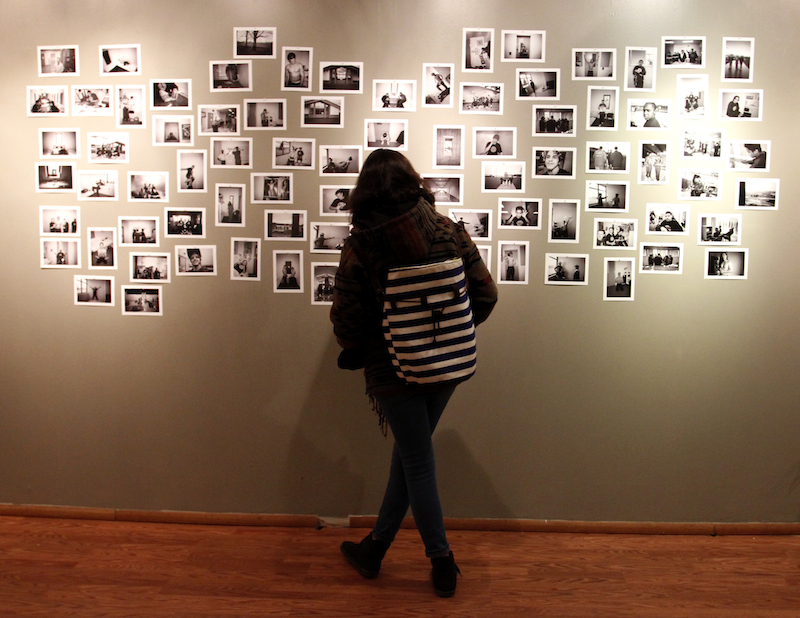
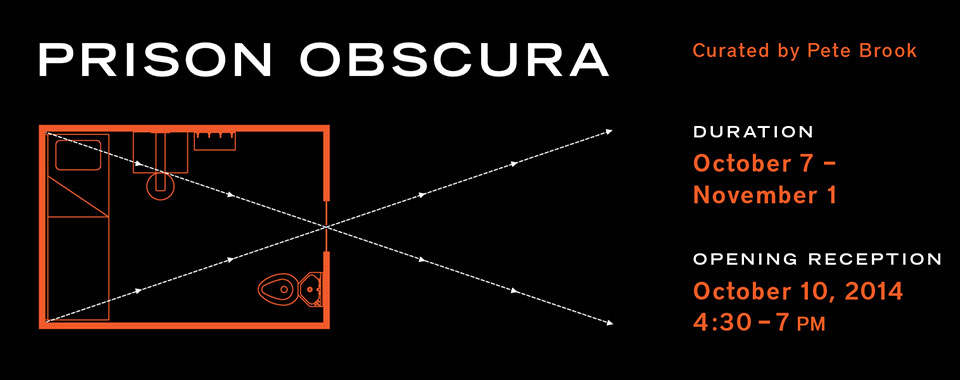
Prison Obscura continues to travel. If you’re in or around New Jersey then you should know a version (a tighter edit) of Prison Obscura is currently on show at Alfa Arts Gallery in downtown New Brunswick. The show runs until November 1st.
The official opening was last Friday (10th) and coincided with the Marking Time: Prison Arts & Activism Conference at Rutgers University and hosted by the Institute for Research on Women (IRW). To give you a taster of the presentation, below are some snaps taken by staff at Alfa Arts Gallery. But not before a few notes of thanks …
GRATITUDE
I’d like to thank Alfa Art Gallery-owners Chris Kourtev and the entire Kourtev family for generously giving over their space for three weeks to house the show. Thanks to Nicole Fleetwood, Sarah Tobias and all the staff at IRW involved in bringing Prison Obscura to NJ. Thanks for a wonderful conference too!
I’d also like to extend my thanks once more to Matthew Callinan, Associate Director of Cantor Fitzgerald Gallery at Haverford. Matthew continues to make sure the logistics for each venue are taken care of and, in this case, gave up an entire Sunday to drive from Philadelphia and install the show. Thanks to the staff at John B. Hurford Center for Arts & Humanities at Haverford, who continue to support the exhibition.
For more information about the exhibition, visit the Prison Obscura website.



© Ruddy Roye
PDX Design Week wrapped up last weekend. Before I moved out of the city, I was asked to do a guest post for the PDXDW blog. I don’t know much about design, so I wrote about photographers that are making good use of emerging technologies or commenting on our brave new world dominated by emerging and automated technologies.
Thanks to Taryn Cowart for her assistance getting it published.
With some line-editing, I crosspost the listicle below.

PHOTOGRAPHY’S BEST
Good photography is good vibes. Often, even bad photography is good vibes. The world needs Seflies, SnapChat cheekiness, cat GIFs, and Doge bombs. However, sometimes, we have to search out the good stuff. We need to look around and ask what’s at stake. Frankly, there’s not a lot resting on your cellphone pictures — they’re not changing the world. When the technologies and file formats with which they were made are obsolete, no-one will care if your phone snaps are lost forever. Least of all you?
When we talk about art, journalism and photography we should be able to single projects out and to define worth. Some creative endeavors are world-changing. I want to give a nod to photographers and artists working with images who inform us about the world and some of its urgent issues. As users and consumers, I want to believe we can leverage rapid publishing and sharing for political and social improvement.
BEST USE OF INSTAGRAM
Ruddy Roye was the first photographer to really stake his style on the meaningful caption. He ditched the hashtags and asked real people some real questions. Based in New York most of his portraits are of people in his neighborhood and jollies around the Big Apple. His feed drips with humanity and reveals stories you couldn’t imagine. This is the REAL Humans OF New York! Also, I like to credit Roye for landing the fatal blow to the snarky #TLDR hashtag.

© EverydayAfrica
SECOND BEST USE OF INSTAGRAM
Peter DiCampo and fellow journalist Austin Merrill (both white American) set up the Everyday Africa after years of reporting from the continent and witnessing nothing but sensational and scary images of war, tragedy and the like. What about the normal everyday stuff? In an attempt to make the most of boring daily things, DiCampo and a wide cadre of collaborator quickly put together a simple, illuminating, sometimes colorful, and intimate Instagram feed. It’s political but not difficult. Okay, so it’s a free-for-all that promotes aesthetically ordinary pictures, but I’ll take neoliberal relativism over neocolonialist manipulation every day of the week.
EverydayAfrica spurned dozens of loose collective of photographers who set up EverydayMiddleEast, EverydayAsia, EverydayIran and even EverydayBronx. Instagram sponsored an Everyday “Summit” at the 2014 Photoville Festival and ponied up cash to fly in contributors from all corners of the globe. These guys are much better IG-movement than the creepy Christians making VSCO lifestyle shots to pair with their #blessed affirmations and bible quotes.
Watch out though: EverydayUSA has some of the best photojournalists under it’s belt. Photo-industry-folk reckon EverydayUSA will soon eclipse all the other accounts, at which point the whole Everyday movement may have announced its death. Get on this young movement while it’s still fresh and focused on countries other than the one you live in.

© Mishka Henner
BEST USE OF GOOGLE EARTH
If there’s a controversial topic Mishka Henner hasn’t produced a body of work on, he’s probably in his studio, right now, making it. From censorship, to prostitution in the Mediterranean, from military bases to big-ag food production, from war to big oil, Henner doesn’t shy away from tough topics. His skill is to do so without really leaving his studio. Henner is one of the cleverest, canniest and hardest working artists dealing with Google and the machine age of image-making.
He winds people up with his methods that are anathema to photo-purists but what else is there to do with available imagery if not to capture, ‘shop and frame it in political terms. Google is the all seeing eye that doesn’t care.
© Tomas Van Houtryve
BEST USE OF PERSONAL DRONES
The Bureau of Investigative Journalism estimates American operated drones have killed between 2,296 and 3,718 people, as many as 957 of them civilians. That’s a whole lot of killing.
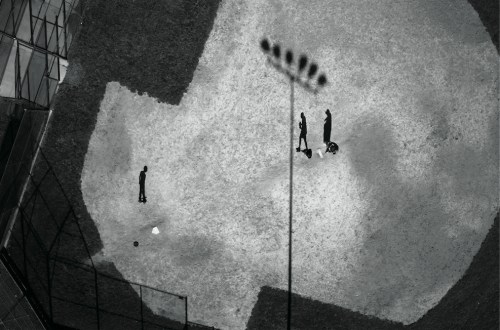
The program of U.S. airstrikes which began in 2002, but was only publicly acknowledged in 2012 is a remote war driven by a remote technology. Belgian photographer Tomas Van Houtryve decided the best way to grab Americans’ attention to the issue was to show them how drone attacks would appear in America.
There’s no shortage of projects about drones to get us thinking about the issue. John Vigg has his Google surveilled drone research labs and airports; Jamie Bridle traced a drone shadow in Washington D.C. last year and launched Dronestagram to populate social media sites with satellite views of drone strike sites; Trevor Paglen has photographed drones at distance; and Raphaella Dallaporta took a drone to Afghanistan under the guise of an archaeological survey.
Most recently Not A Bug Splat made a splash. Cheeky and powerful the project installed massive portraits of children in regions subject to U.S. drone strikes, with the intent of pricking the conscience of remote U.S. drone operators stationed in Nevada about to bring the hammer of destruction down on that Waziristan village.

Screenshot of Josh Begley’s Prison Map
BEST USE OF SURVEILLANCE IMAGERY AGAINST THE SYSTEM
Data artist Josh Begley specializing in scraping images from publicly available sources. He then creates App and websites to publish the info and produce push notifications you can’t avoid.
For his project Prison Map, Begley took the GPS coordinates of every prison, jail and immigration detention center in America and fed them into a Google Maps API code he had modified. He ran the script and it spat out more than 5,300 satellite images — one for every locked facility in the U.S. The prison population in this country has grown 500% in the past 30 years. One in every one hundred adults is behind bars and most of them are poor people. The recurrent patterns of brutally functional architecture within Prison Map are staggering. We’ve been building prisons in high desert and rural backwaters. Begley makes the Prison Industrial Complex (PIC) visible once more.
Likewise, for his project Profiling Is, Begley snagged the NYPD’s surveillance shots of business and residences in the NY boroughs which were under monitoring.
He doesn’t stop there. Begley’s App MetaData alerts users to U.S. drone strikes in Pakistan, Yemen, Afghanistan and elsewhere. This didn’t happen until the conclusion of a merrigoround of negotiation with the “apolitical” Apple. Begley finally got his drone strike App approved when he removed all mention the word drone! Now, you can get next-day updates of Obama’s largely-ignored drone war on Afghanistan, Pakistan, and Yemen straight to your smartphone.

© Mari Bastashevski
BEST USE OF PHOTOGRAPHY, MUCK-RAKING AND INVESTIGATIVE NOUS
Mari Bastashevski skirts a fine line between journalist, artist, researcher, photographer and tourist to dig up the personalities and money makers in the international arms trade. Here’s the feature I did for WIRED a while back. Her ongoing project State Business is devastating inasmuch it reveals how pervasive and complicit most nations are in making billions on the slaughter of humans.The US, the UK, Croatia, Azerbaijan, Georgia; Bastashevski’s following of the money takes us all over the place … sometimes even to the carport on the Facebook pages of international arms dealers.

BEST MAKING SENSE OF SURVEILLANCE
If you can’t beat ‘em join ‘em. In 2002, after Hasan Elahi was mistaken for someone on the terror watch list and detained for hours at Detroit airport, he decided he’d save the authorities the bother and monitor himself. Caustic, direct, creepy and amusing, Elahi photographed everything he did, ate, shit, saw and worked on. He also GPS tracked his every move on a live web map. The project is titled Tracking Transcience. One of the by-products of the self-monitoring is the creation of a typology of toilets. Taking sousveillance to another level and entertaining thousands while he does it. Brill.

© MigraZoom. A migrant on a cargo train traveling from Arriaga, Chiapas to Ixtepec, Oaxaca. After crossing the Mexican-Guatemalan border and traveling to Arriaga, migrants hitch a ride on top of cargo trains to Ixtepec. This trip takes about 12 hours. In addition to the risk of falling off the train (amputations and death are common), gangs frequently extort migrants, charging them $100 to ride. They face threats of being thrown off the train, kidnapped, raped or trafficked if they do not pay.
REALEST VIEWS OF IMMIGRATION
There’s some great fine art projects out there about the U.S./Mexican border. Probably, the stand out is David Taylor’s Working The Line, which documents the militarization of the border. But it can be criticised for being to distant and tends to rest on the creaking aesthetic mores of American landscape photography. If we want to see what is really going on during the tough journey’s into North America, we should pay attention to MigraZoom, a project by Spanish-born photographer Encarni Pindado which puts disposable cameras in the hands of economic migrants during their perilous treks northward.

© David Taylor
Another beautifully shot and more unexpected treatment of new arrivals is Gabriele Stabile’s Refugee Hotel which documents approved asylum seekers’ first nights in America at four hotels adjacent to four hub airports through which new refugee migrants arrive. Respectful documentation that is pregnant with uncertainty.
Taylor’s work is currently on show at the amazing ‘Covert Operations’ at Scottsdale Museum of Contemporary Art.
BEST USE OF INTERNET FOR DISCUSSION
Photographer Hank Willis Thomas is a prolific force. One of his most recent projects Question Bridge is a platform for black males to ask other black males questions about black identity. Participants do so through video and provide answers similarly. Access is easy, involvement free, connections priceless and it works well in exhibition format too. The murder of Michael Brown in Ferguson is the latest incident to demonstrate to the entire nation our shared need to face racial inequality int he country. Willis Thomas is doing his bit.
© Lindsay Lochman and Barbara Ciurej
BEST COMMENTARY ON MECHANICAL AGE FOOD PRODUCTION
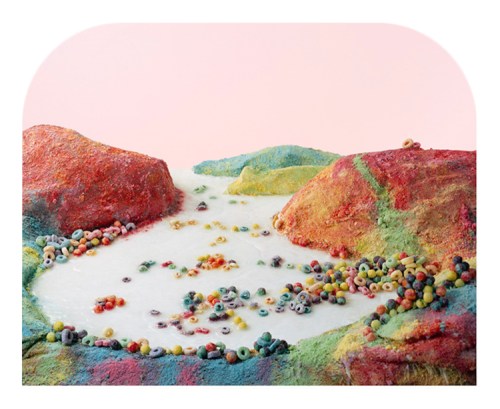
With Ag Gag laws becoming ever more common, clever responses to imaging industrial food production must be inventive. Lindsay Lochman & Barbara Ciurej rip on the much-mythologized West and specifically on the hero-worship of Carleton Watkins by constructing sugar-coated and corn-fed diorama reconstruction of Watkins’ landscapes with shitty foodstuffs.
Will Potter ain’t a photographer but he’s putting imagery to good ends. Potter, a TED Fellow, has been reporting on the crack down on environmental activists under homeland security legislation that was designed to tackle terrorist. Instead of chasing bombchuckers, our law enforcement is going after tree huggers. The title of Potter’s book, Green Is The New Red, say its all. Routinely, it has been eco-activists who’ve brought us the shocking footage from inside factory farms. Potter, continuing the tradition of expose, wants to fly drones over feedlots and take advantage of laws being slow to be written. Again, we seeing the convergence of technologies and activist peel back the layers of obscurity purposefully put over our shady business practices in years past.
© Donna Ferrato
VIOLENCE AGAINST WOMEN
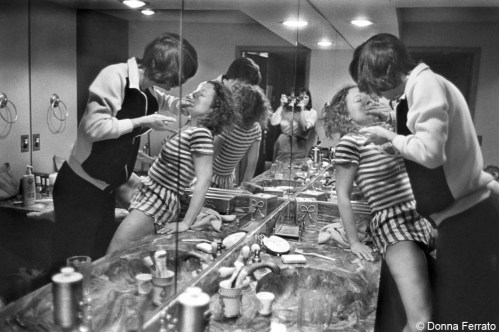
The greatest photography work being done to reveal the entrapped, terrorized lives of those victim to domestic violence, is done — perhaps not unsurprisingly by female photographers. Donna Ferrato has trained a lens on the topic for decades. Recently, young gun Sara Naomi Lewkowicz captured similar images to Ferrato as an intimate witness to partner abuse. The parallels were saddening proving that this is a strand of violent psychology we just are not dealing with effectively. To be frank, the issue isn’t being imaged enough; intimate partner abuse remains hidden behind closed doors.
Paula Bronstein was one of the earliest and most direct photographers to document the survivors of acid attacks in Asia. If we’re to mention women’s rights abroad we have to look at the work of Stephanie Sinclair, whose multiyear project Too Young To Wed is pitch perfect. Quiet, weighty, tragic and polychrome portraits of child brides throughout the world. Sinclair’s had help from all the major distributors and grant makers to cast the net of her survey far and wide. The transmedia project is about as good as it gets in terms of audience engagement tactics too.
© Jim Goldberg
BEST COMMENTS ON WEALTH INEQUALITY
It’s difficult to name a stand out photographer who has taken on the wealth gap in a resonant way. It sounds strange to say but maybe cash is difficult to shoot? This apparent lack is consistent with other art forms though. If Occupy taught us one thing, some issues are designed for public performance, demonstration, walking and protest signs. Think of music, for comparison. In the sixties musicians such as Joe Strummer and Nina Simone emerged with brilliant anger toward social injustice. Despite public disgust made visible in anti-Iraq-war protests and Occupy, there’s not a protest song from the 21st century of note. Perhaps music isn’t the format for anger or the wealth gap either?
Don’t worry, I’m not being a pessimist here. Violent dismay certainly exists. I’m just not convinced art is the realm where we see the most direct political action. Gone are the days of the great labor photographers such as Lewis Hine and Jacob Riis. Inequality was laid bare in the photojournalism of the civil rights era (Ernest Cole, Charles Moore, Danny Lyon) and while those reportages were about money and opportunity they weren’t primarily about the markets. Check out the work of Gregory Halpern for your modern day Milton Rogovin.
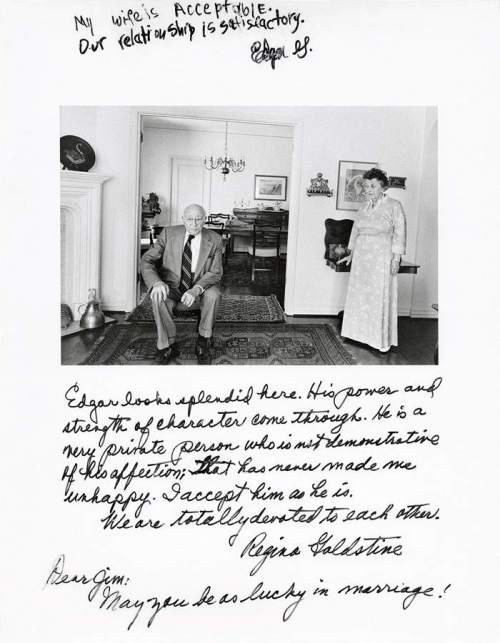
The most indelible and forthright description of wealth inequality is Jim Goldberg’s Rich and Poor, which remains the high point and the tone at which aspiring photographers should aim.
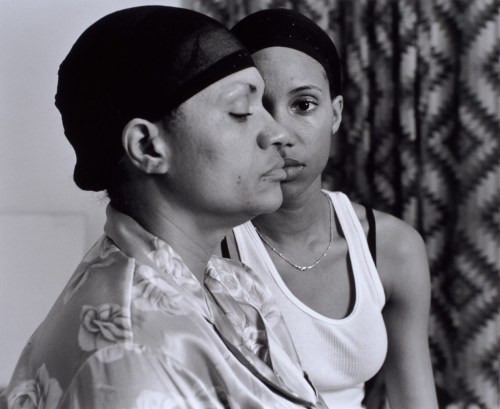
Dang, that’s been a lot of men’s names. I think it right to end with LaToya Ruby Frazier’s name then. She, better than anyone currently making work, ties together class, race, income, post-industrial America, public health, personal health, family and environmental hazard with her generational survey of the women in her family and her home town of Braddock, PA, in The Notion OF Family.
© La Toya Ruby Frazier

“Tex Johnson, 60” by Ron Levine, courtesy of the artist.
Later this week, I’ll be attending the inaugural prison arts and activism conference, Marking Time.
Hosted by the Institute for Research on Women at Rutgers, and across multiple venues, the event brings together an incredibly committed and skilled cohort of practitioners throughout many disciplines — from dance to yoga, from occupational health to sculpture, and from film making to social work.
I’ll be moderating a panel discussion Imagery and Prisons: Engaging and Persuading Audiences, with Gregory Sale, Lorenzo Steele, Jr., and Mark Strandquist on Wednesday afternoon. In addition, a version of Prison Obscura will be on show at the Alfa Art Gallery in downtown New Brunswick.
To emphasise the breadth and depth of expertise I’ve copied out the schedule below. I have made bold and linked the names of artists, activists and academics’ names with whose work I am already familiar … and admire.
I pepper the post with artworks made by photographic artists attending Marking Time.
Marking Time runs 8th-10th Oct. Registration for the conferecne is free.
See you in New Brunswick this Wednesday?!?!

“Allen and Tanasha, 1998.” Family album. Courtesy of the Fleetwood family.
WEDNESDAY 8TH OCT.
Session 1: 9: 30 – 10:45 am
PANEL: Creative Arts and Occupational Health (ZLD)
Susan Connor and Susanne Pitak Davis (Rutgers University Correctional Healthcare) “Finding Meaning Thru Art”
Karen Anne Melendez (Rutgers University Correctional Healthcare) “The Concert Performance with Adult Females in Correctional Health Care”
Moderator: Michael Rockland (Rutgers-New Brunswick)
WORKSHOP: Steps Taken: Footprints in the Cell (NBL)
Rachel Hoppenstein (Temple University)
Ann Marie Mantey (Temple University)
Session 2: 11:00 – 12:15 pm
PANEL: Law, News, and Art (ZLD)
Regina Austin (Penn Law School)
Ann Schwartzman (Pennsylvania Prison Society)
Tom Isler (Journalist/Filmaker)
Moderator: Tehama Lopez
WORKSHOP: Utilizing Dance as a Social Tool: Dance Making with Women in Prison (NBL)
Meredith-Lyn Avey (Avodah Dance)
Julie Gayer Kris (Avodah Dance)
LUNCH: 12:15 – 1:15 pm
Session 3: 1:15 – 2:30 pm
PANEL: Imagery and Prisons: Engaging and Persuading Audiences (ZLD)
Gregory Sale (Artist)
Lorenzo Steele, Jr. (Founder, Behind these Prison Walls)
Mark Strandquist (Artist)
Moderator: Pete Brook (Freelance Writer/Curator)
PRESENTATION: The Political and Educational Possibilities of Exhibitions (NBL)
David Adler (Independent Curator)
Sean Kelley (Eastern State Penitentiary)
Rickie Solinger (Independent Curator)
Session 4 2:45 – 4:00 pm
PANEL: About Time (ZLD)
Damon Locks (Prison and Neighborhood Arts Project)
Erica R. Meiners (Northeastern Illinois University/Prison and Neighborhood Arts Project)
Sarah Ross (School of the Art Institute of Chicago/ Prison + Neighborhood Arts Project)
Fereshteh Toosi (Columbia College Chicago)
Moderator: Donna Gustafson (Rutgers-New Brunswick)
PANEL: Best Practices: Arts, Prisons and Community Engagement (NBL)
Robyn Buseman (City of Philadelphia Mural Arts Program)
Shani Jamila (Artist, Cultural Worker, Human Rights Advocate)
Kyes Stevens (Alabama Prison Arts and Education Project)
EVENING EVENTS
4:00 – 5:00 pm Artist Talk: Jesse Krimes (ZLD)
5:00– 5:45 pm Welcome Reception (ZL)
7:30 – 9:00 pm Opening Keynote: Reginald Dwayne Betts (KC)
Welcome Remarks: IRW Director Nicole Fleetwood
Introduction of Keynote: Dean Shadd Maruna, School of Criminal Justice – Rutgers, Newark

“Exercise Cages, New Mexico” by Dana Greene, courtesy of the artist.

“That Renown New Mexico Light” by Dana Greene, courtesy of the artist.
THURSDAY OCTOBER 9TH
Session 1: 9: 30 – 10:45 am
PANEL: Theater in Prisons (ZLD)
Wende Ballew (Reforming Arts Incorporated, Georgia) “Theatre of the Oppressed in Women’s Prisons: Highly Beneficial, Yet Hated”
Lisa Biggs (Michigan State University) “Demeter’s Daughters: Reconsidering the Role of the Performing Arts in Incarcerated Women’s Rehabilitation”
Karen Davis (Texas A&M) “Rituals that Rehabilitate: Learning Community from Shakespeare Behind Bars”
Bruce Levitt and Nicholas Fesette (Cornell University) “Where the Walls Contain Everything: The Birth and Growth of a Prison Theatre Group”
Moderator: Elin Diamond (Rutgers-New Brunswick)
PANEL: Prison Architecture, Space and Place (NBL)
Svetlana Djuric (Activist) and Nevena Dutina (Independent Scholar) “Living Prison”
Maria Gaspar (Artist) “The 96 Acres Project”
Vanessa Massaro, (Bucknell) “It’s a revolving door”: Rethinking the Borders of Carceral Spaces”
Moderator: Matthew B. Ferguson (Rutgers-New Brunswick)
Session 2 11:00 – 12:15 pm
PRESENTATION: Sustaining Engagement through Art: The US and Mexico (ZLD)
Phyllis Kornfeld (Independent Art Teacher, Author, Activist, Curator) “Thirty Years Teaching Art in Prison: Into the Unknown and Why We Need to Go There”
Marisa Belausteguigoitia (UNAM) “Mural Painting in Mexican Carceral Institutions”
WORKSHOP: The Arts: Essential Tools for Working with Women and Families impacted by Incarceration (NBL)
Kathy Borteck-Gersten (The Judy Dworin Performance Project)
Judy Dworin (The Judy Dworin Performance Project)
Joseph Lea (The Judy Dworin Performance Project)
Kathy Wyatt (The Judy Dworin Performance Project)
LUNCH: 12:15 pm – 1:15 pm
Session 3 1:15 – 2:30 pm
PRESENTATION: Visualizing Bodies/Space: A Performative Picture of Justice System-Involved Girls & Women in Miami, FL (ZLD)
Nereida Garcia Ferraz (Artist/Women on the Rise!)
Jillian Hernandez (University of California-San Diego/Women on the Rise!)
Anya Wallace (Penn State University/Women on the Rise!)
Moderator: Ferris Olin (Rutgers-New Brunswick)
PANEL: 25 Years of the Creative Prison Arts Project: Connecting Incarcerated Artists with the University of Michigan Community (NBL)
Reuben Kenyatta (Independent Artist)
Ashley Lucas (University of Michigan)
Janie Paul (University of Michigan)
PRESENTATION: The Art of Surviving in Solitary Confinement (RAL)
Bonnie Kerness (American Friends Service Committee Prison Watch Program)
Ojore Lutalo (American Friends Service Committee Prison Watch Program)

“Theda Rice, 77” by Ron Levine, courtesy of the artist.
Session 4 2:45 – 4:00 pm
PANEL: Restorative Arts and Aging in Prison (ZLD)
Aileen Hongo (Educator/Activist)
Anne Katz (University of Southern California)
Ron Levine (Artist)
WORKSHOP: The SwallowTale Project: Creative Writing for Incarcerated Women (NBL)
Angel Clark (Photographer/Filmmaker)
Bianca Spriggs (Artist/Poet)
Session 5 4:15 – 5:30 pm
PANEL: Resisting Guantanamo through Art and Law (ZLD)
Aliya Hana Hussain (Center for Constitutional Rights)
Matthew Daloisio (Witness against Torture)
Aaron Hughes (Independent Artist)
Moderator: Joshua Colangelo-Bryan (Dorsey & Whitney LLP)
WORKSHOP: Bar None: The Possibilities and Limitations of Theater Arts in Prison (NBL)
Max Forman-Mullin (Bar None Theater Company)
Julia Taylor (Bar None Theater Company)
EVENING EVENTS
5:45 – 6:45 pm Reception (NBL)
7:00 – 9:00 pm: Artist Talks: Russell Craig, Deborah Luster, Dean Gillispie, Jared Owen (AAG)

“Self Portrait” by Russell Craig, acrylic on cloth, 2014, courtesy of the artist.

“LCIW, St. Gabriel, Louisiana, Zelphea Adams” from One Big Self: Prisoners of Louisiana, by Deborah Luster, courtesy of the artist.
FRIDAY OCTOBER 10TH
Session 1: 9: 30 – 10:45 am
PANEL: Prison Lit (ZLD)
Helen Lee (University of North Carolina at Chapel Hill) “Eldridge Cleaver’s SOUL ON ICE: A Rhetoric of Confrontation in Prison Writing”
Suzanne Uzzilia (CUNY Graduate Center) “Lolita’s Legacy: The Mutual Imprisonment of Lolita Lebrón and Irene Vilar”
Carolina Villalba (University of Miami) “Radical Motherhood: Redressing the Imprisoned Body in Assata Shakur’s Assata: An Autobiography”
Moderator: Monica Ríos (Rutgers-New Brunswick)
PANEL: Photographic Education Program at Penitentiary Centers in Venezuela: From the Lleca to the Cohue (ZMM)
Helena Acosta (Independent Curator)
Violette Bule (Photographer)
Moderator: Katie Mccollough (Rutgers-New Brunswick)
PANEL: Narrating Injustice: Youth and Mass Incarceration (BSF)
Sean Saifa M. Wall (Independent Artist) “Letters to an Unborn Son”
Richard Mora and Mary Christianakis (Occidental College) “(Re)writing Identities: Past, Present, and Future Narratives of Young People in Juvenile Detention Facilities”
Beth Ohlsson (Independent Educator) “Reaching through the Cracks: Connecting Incarcerated Parents with their Children through Story”
Moderator: Annie Fukushima (Rutgers-New Brunswick)
Session 2 11:00 – 12:15 pm
PANEL: Gender, Sexuality, and Systemic Injustices (ZLD)
Michelle Handelman (Filmmaker, Fashion Institute of Technology) “Beware the Lily Law: Tales of Transgender Inmates”
Tracy Huling (Prison Public Memory Project) “‘She was incorrigible…’ Building Public Memory About A Girl’s Prison”
Carol Jacobsen (University of Michigan) “For Dear Life: Visual and Political Strategies for Freedom and Human Rights of Incarcerated Women”
Moderator: Simone A. James Alexander (Seton Hall University)

“Beware the Lily Law” by Michelle Handelman, high-definition video, sound, Installation at Eastern State Penitentiary, Philadelphia. Photo credit: Laure Leber, 2014.
PANEL: Life Sentences: Memoir-Writing as Arts and Activism in a Maximum Security Women’s Prison (ZMM)
Courtney Polidori (Rowan University)
Michele Lise Tarter (The College of New Jersey)
Samantha Zimbler (Oxford University Press)
Moderator: Fakhri Haghani (Rutgers-New Brunswick)
PANEL: The Politics of Imprisonment (BSF)
Dana Greene (New Mexico State University) “Carceral Frontier: The Borderlands of New Mexico’s Prisons”
Marge Parsons (Prisoners Revolutionary Literature Fund) “Free the Spirit from Its Cell”
Jackie Sumell (Independent Artist) “The House That Herman Built”
Treacy Ziegler (Independent Artist) “Light and Shadow in a Prison Cell”
Moderator: Angus Gillespie (Rutgers-New Brunswick)
LUNCH: 12:15 pm – 1:15 pm
Session 3 1:15 – 2:30 pm
PRESENTATION: Shakespeare in Prison (ZLD)
Tom Magill (Educational Shakespeare Company Ltd)
Curt Tofteland (Shakespeare Behind Bars)
PANEL: Building Effective Prison Arts Programs (ZMM)
Laurie Brooks (William James Association) “California Prison Arts: A Quantitative Evaluation”
Jeff Greene (Prison Arts Program at Community Partners in Action) “Beyond Stereotype: Building & Supporting Extraordinary Arts Programs in Prison”
Becky Mer (California Appellate Project/Prison Arts Coalition) “National Prison Arts Networking in the US: Lessons from the Prison Arts Coalition”
Moderator: Lee Bernstein
PANEL: Genre and Aesthetics in Prisons (BSF)
T.J. Desch Obi (Baruch College, CUNY) “Honor and the Aesthetics of Agon in Jailhouse Rock”
Anoop Mirpuri (Portland State University) “Genre and the Aesthetics of Prison Abolition”
Jon-Christian Suggs (John Jay College, CUNY) “Behind the Red Door: Real and Fictional Communism in Prison”
Ronak K. Kapadia (University of Illinois at Chicago) “US Military Imprisonment and the Sensorial Life of Empire”
Moderator: Jed Murr
Session 4 2:45 – 4:00 pm
PANEL: Twenty Years of Teaching Visual and Literary Arts in a Maximum-Security Prison (ZLD)
Rachel M. Simon (Marymount Manhattan College in Bedford Hills Correctional Facility)
Duston Spear (Marymount Manhattan College in Bedford Hills Correctional Facility)
WORKSHOP: Alternatives to Violence Workshops in Prison: Liminal Performances of Community and/as Activism (ZMM)
Chad Dell (Monmouth University)
Johanna Foster (Monmouth University)
Eleanor Novek (Monmouth University)
Deanna Shoemaker (Monmouth University)
WORKSHOP: More Than a Rap Sheet: The Real Stories of Incarcerated Women (BSF)
Amanda Edgar (Family Crisis Services)
Jen LaChance Sibley (Family Crisis Services)
Jenny Stasio (Family Crisis Services)
CLOSING REMARKS (ZLD): 4:00 – 4:30 pm
OPENING RECEPTION FOR PRISON OBSCURA (AAG):4:30 – 6:30 pm
EVENING EVENTS: 7:00 – 9:30 pm (SH)
Tales from the Cell, Mountainview Program
The Peculiar Patriot, Liza Jessie Peterson
Women on Our Own, acapella group of formerly incarcerated musicians
Films to be shown all day on October 9 & 10 at the Ruth Dill Johnson Crockett Building, 162 Ryders Lane (Douglass Campus), schedule to be determined.
—————————————————-
Key for venue codes:
AAG: ALFA ART GALLERY
BSF: BLOUSTEIN SCHOOL FORUM
KC: KIRKPATRICK CHAPEL
NBL: NEW BRUNSWICK PUBLIC LIBRARY COMMUNITY ROOM
RAL: RUTGERS ART LIBRARY
SH: SCOTT HALL
ZL: ZIMMERLI MUSEUM LOBBY
ZLD: ZIMMERLI MUSEUM LOWER DODGE GALLERY
ZMM: ZIMMERLI MUSEUM MULTIMAX ROOM
——————————————————-

 Prison Photography