
You are currently browsing the category archive for the ‘Interview’ category.

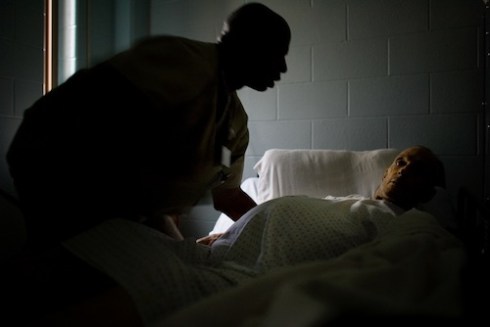
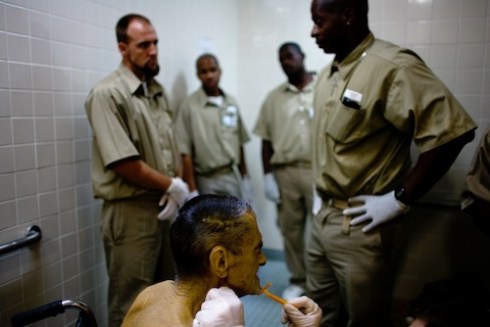
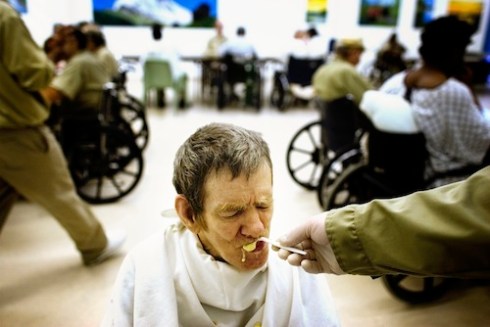
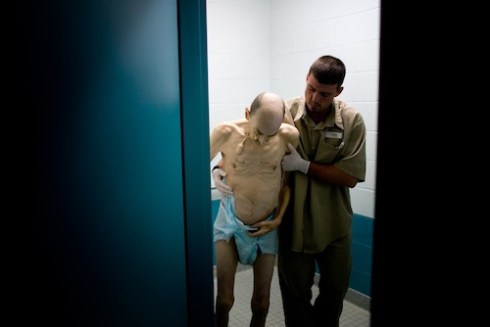
In 2008, Tim Gruber embedded at the Kentucky State Reformatory to photograph in the geriatric wing designated for elderly and terminally ill patients. The result is Served Out, a photography and multimedia project. Here, I featured six images included in the PPOTR/Cruel and Unusual exhibition, but you should check out Tim and Jenn’s website for more stellar images.
Both Tim and his wife Jenn Ackerman worked in KSR the same summer. Tim is unequivocal: their access was down to then-Warden Larry Chandler’s good grace and good sense. Chandler wanted people to see how their tax dollars were spent and understood photography as part of the transparency he insisted on for the institution. KSR even gave weekly tours of its facilities.
Tim and Jenn, after brief training, were given staff-badges and were free to go about their work in the prison. They moved down to La Grange, KY for the summer to make the project and it wasn’t easy; Tim blogged some of the challenges (one, two, three, four, five.)
When we spoke last October, Gruber was in discussion with the ACLU. Last month, his images were used to illustrate the ACLU’s latest report ‘At America’s Expense: The Mass Incarceration of the Elderly‘ (Tim’s announcement.)
Of course, the common knowledge of the problems of incarcerating the elderly shaped our discussion. From the ACLU report:
Over the last 25 years, state corrections spending grew by 674%, substantially outpacing the growth of other government spending, and becoming the fourth-largest category of state spending. […] It costs $34,135 per year to house an average prisoner, but it costs $68,270 per year to house a prisoner age 50 and older. to put that number into context, the average American household makes about $40,000 a year in income.
In 1981, there were 8,853 state and federal prisoners age 55 and older. today, that number stands at 124,900, and experts project that by 2030 this number will be over 400,000, amounting to over one-third of prisoners in the United states. in other words, the elderly prison population is expected to increase by 4,400% over this fifty-year time span. this astronomical projection does not even include prisoners ages 50-54, for which data over time is harder to access.
The U.S. keeps elderly men and women locked up despite an abundance of evidence demonstrating that recidivism drops dramatically with age. For example, in new York, only 7% of prisoners released from prison at ages 50-64 returned to prison for new convictions within three years. that number drops to 4% for prisoners age 65 and older.
But, also, Tim and I talked about the emotions and first-hand experiences statistics don’t capture – the need for alternative imagery of prisoners and their humanity; what it was like to work on the wings, sit with the men and witness death (“Tears would overwhelm me”); compassionate release, prisoner-volunteer medical assistants and how Tim’s imagery may effect change.
LISTEN TO OUR CONVERSATION AT THE PRISON PHOTOGRAPHY PODBEAN PAGE


Police stop teenagers for ID and when one can’t produce it he is put in a police van and driven away. The other has to call his mother who didn’t answer. The police were about to haul him away when his brother showed up and presented ID. © Nina Berman
STOP AND FRISK
The controversial Stop & Frisk procedures of the New York Police Department (NYPD) have been enacted for decades, but due to a phenomenal rise in figures over the past decade, the issue has recently become a hot news topic.
Civil rights advocates point out that Stop & Frisks are disproportionately experienced by minorities. The New York Civil Liberties Union (NYCLU) published a report: NYPD Stop-and-Frisk Activity in 2011/2012.
In 2002, the NYPD made 97,296 stops. In 2011, there were 685,724 stops. Not all stops result in frisks. Of the 381,704 frisks, 330,638 (89.2%) were of blacks and Latinos. By contrast, only 27,341 frisks (7.4%) were of whites.
The NYCLU reports:
“Young Black and Latino men were the targets of a hugely disproportionate number of stops. Though they account for only 4.7% of the city, black and Latino males between the ages of 14 and 24 accounted for 41.6% of stops in 2011.” …
“The number of stops of young black men exceeded the entire city population of young black men (168,126 as compared to 158,406). Ninety percent of young black and Latino men stopped were innocent.” …
“The 2011 data are striking in what they reveal about the large percentages of blacks and Latinos being stopped in precincts that have substantial percentages of white residents. For instance, the population of the 17th Precinct, which covers the East Side of Manhattan, has the lowest percentage of black and Latino residents in the city at 7.8%, yet 71.4% of those stopped in the precinct were black or Latino.“
In total, during the 10 years of the Bloomberg administration, there have been over 4,000,000 stops in New York city. The 524,873 extra stops in 2011 (as compared to 2002) recovered only 176 more guns.
In 2011, of the 381,704 frisks, 330,638 (89.2%) were of blacks and Latinos. By contrast, only 27,341 frisks (7.4%) were of whites.
Blacks and Latinos were more likely to be frisked and, among those frisked, are far less likely to be found with a weapon.
The New York Times reported last month that the NYPD has abused Stop & Frisk policies in recent years but others say the NYPD has – with officers’ routine street stops of minorities – been abusing its powers for decades.
Battle lines have been drawn. In May, NYCLU filed a lawsuit“challenging the NYPD’s unlawful practice of detaining, questioning and searching innocent New Yorkers – particularly blacks, Latinos and other non-whites.” In a counter attack, Mayor Bloomberg has called the NYCLU “dangerously wrong” and dismisses them as “no better than the NRA” for opposing the Stop & Frisk.
The Guardian just published data visualisation of NYC Stop & Frisk.
PHOTOGRAPHER’S INTEREST PIQUED
New York-based photographer Nina Berman has recently taken on the challenge of photographing this sprawling, all-encompassing issue. In the early stages of the project, she has published her forays in a couple (one and two) blog posts.
I realise this is a long conversation (possibly the longest I’ve ever published on Prison Photography) but it’s an important topic emerging in the popular consciousness right now.
Nina and I discuss how to make images of police activities and civil disobedience; talk about Nina’s motivations; pay attention to individual and group activists; and consider why attitudes about Stop & Frisk vary so wildly in the context of such controversial and stark statistics.
CONVERSATION
Why has this become a big issue recently?
Stop & Frisk has been a big issue for a long time in New York’s communities of colour. If you live in predominantly white community in New York you wouldn’t notice it because most white people are not stopped and frisked.
I think it’s a noticeable issue now because the numbers have got so high. There’s been some lawsuits and activist agitation so it has become more talked about. We’ve also seen connections made with other police aggressiveness and killings of unarmed black and brown men.
Is this just in NYC or is this indicative of issues at a national level?
It’s a national issue. A legal aid attorney, who lives in D.C., told me some months ago, that it was her feeling that it was worse in D.C. There is just a super-intense activist community here in New York who have just made it a central issue. And then there’s been lawsuits by the NYCLU and that has helped propel it into news reports. But I’ve been following it since November 2011 – at that time there was very little conversation about it. Now, it’s in the national press nearly every day.
How did it fall on to your radar?
I heard about it two years ago, either through a NYCLU or a Center for Constitutional Rights listserv. I read about lawsuits that have been put in against the NYPD. I thought that’s a huge number [of police stops]; what’s that all about?
Later, I saw a couple Stop & Frisks happen in the Bronx and it was just shocking. I started to follow some activists, who are just so dedicated; they are doing stuff everyday. The more I learned about it, the more I saw the connection between Stop & Frisks and what people are now calling the New Jim Crow; it’s not just the physical violation and potential humiliation of being stopped and searched but all the disenfranchisement that come as a result of that. That aspect has been missing in a lot of the news reports.
For instance, you may be stopped and the police officer may ask you for ID, and you may not have ID. As far as I know, there’s no ID law in New York city, but they may say, “You’re trespassing here,” and then you get a trespassing summons, or if you talk back to the officer, and ask ‘”Why are you stopping me?” you could get a disorderly conduct ticket and summons to court.
These are the kind of things that pile up. I’d like to see compiled statistics in New York city on how many disorderly conduct summons are given out, to whom they are given, and where they are given.
You said that you had witnessed a couple of Stop & Frisks?
I was in the Bronx on another project and I didn’t have my camera out. I saw a man riding a bicycle and a cop stopped him in the middle of the street. He stayed on his bicycle and he just immediately put his arms out in the air, like he knew precisely what position to assume. That’s a whole other thing that interests me; how body language for some people according to their race is a normalized gesture. For white people gestures [associated with Stop & Frisk] would be abnormal gestures.
Last summer, I saw a guy – he looked like he was 17 or 18 years old – in the Bronx and two plain-clothed cops came out and pushed him against a wall and stripped him of everything. It was intense.

What are the figures for stop and searches over the years?
Up to 700,000 in 2011. How many of those stops are also searches is unclear. Each year since 2002, stops have gone steadily up. If you calculate it for 2011, it is more than one a minute!* It is beyond comprehension.
What are the attitudes of the people in these communities who are effected?
There’s one guy in East Harlem I’ve come to know rather well. He’s been stopped and frisked his whole life and has never thought anything of it. One day, he saw his stepson stopped and searched. A light went off in his head; “What is going on here?” In another instance, his stepson was stopped and he was able to record the audio of the stop and the stuff the cops were saying was so abusive. After that, the father decided to get involved in civil disobedience and he’s out there every day involved in jail support, court support and rallying at precincts too. Many of the activists have been arrested.
Where have you been making photographs?
Outside precincts mostly; in Harlem, the Bronx, and Police Plaza downtown. Also, courthouses; mainly the Bronx criminal courthouse, the Manhattan criminal court house.
In the midst of the project, there was a police killing of a young man named Ramarley Graham. So the Stop & Frisk opposition got connected to issues around unwarranted police killings. They see it as part of the same racial profiling issue.
And the impact?
The impact has only been because of enormous amount of pressure – it’s kind of astonishing that you can have an impact at the grassroots level. Walking while Black [is the issue.] Jumaane Williams, a city councilman has stepped up and said, “I got stop and frisked, and I’m a councilman.”
The protestors I have met want an entire new style of policing; the police are not being seen as protectors, but as aggressors. Also, as part of some system – through these stops, this harassment, these summons, these stops – it just keeps people down.
If you speak to some of the parents, their concern is, “Okay, so my kid gets stopped 5 or 6 times for some bullshit thing and let’s see what happens when you seek college loan money. That’s the real fear. One of the fears. I guess the real fear is that a cop might kill your son. If he moves his hand the wrong way or something.
The Department of Justice (DOJ) is just beginning inquiries. The NYPD is not really backing down. As of a month or so ago, Mayor Bloomberg and NYPD Commissioner Ray Kelly were saying ‘This is terrific.’
Michelle Alexander’s characterization of this documenting and disciplining on the streets as well as in the prisons as “The New Jim Crow.” It seems these rapidly rising figures of Stop & Frisk support her arguments. That this racial profiling begins on the street makes the larger, national issue even more terrifying and pernicious. A lot of the time people think it is locked facilities that control populations so vigorously, but here’s evidence that racism begins in free society. Would you agree?
One of my first experiences was photographing some boys who were walking back from the gym in the Bronx. They were stopped, taken to the precinct and their mothers were called. They came to the precinct and the mothers started getting upset. The police wouldn’t let the mothers see them. One of the boys was charged with disorderly conduct because he talked back to the cops and one the mothers said. “That’s it, I sending my kid to the South. I have to protect him from the NYPD.” I learned that there’s this whole reverse migration that goes on when a boy hits his teenage years. Families in New York – and this is not the fist time I’ve heard this – want to send their boys back south to live with relative and to protect them from the NYPD! That blew my mind.
Why has the NYPD taken on this policy which is clearly flawed but also a public relations disaster?
Well, so far it hasn’t been a public relations disaster; not until this year. What kicked it off was a very visible civil disobedience action by Professor Cornell West and a bunch of other in front of the Harlem police precinct. That was the first step. Why the NYPD is doing it? I don’t know if it a money maker which would be an interesting things to find out. All these summonses carry fines.
I personally think New York city has too many cops; it is the most heavily policed city in North America. There’s 40,000 cops so they have to do something. The other factor – and this is what people say on the streets – they are too afraid to go after real gangsters so they hit up these people that are doing nothing, so they can show they are meeting quotas.

Law enforcement says there’s some good in the policy – that gang-bangers don’t bring guns on to the street, because they’re afraid of being stopped; so it is kind of a *preventative* policy.
But statistics (see graph above) don’t really support that argument.
Plus, it’s clogged up the entire court system, the holding cells. Say you’re stopped at 3pm and given a disorderly conduct summons, you may not get to the precinct till 10 o’clock at night … and then they might send you to central booking. Can you imagine what that’d do to a kid, or to anyone? If you’re on a job that says, ‘If you don’t show up you get fired [you loose your job].’ These are real stories; they are not just hypotheticals.
This is what Michelle Alexander would refer to as your way into the system.
What usually happens during a Stop & Frisk?
Legally, if a police officer stops you, you don’t have to say a word. There’s all sorts of “know your rights” trainings all over the city now. And there’s CopWatch groups. Neighborhood people are going out in teams in the community and just watching them.
What you’re supposed to do is ask, “Officer, am I under arrest?” and if the officer says no, you’re supposed to walk away. Does it usually happen like that? No. You’re scared when someone comes up to you. You say something. Each Stop & Frisk handles very differently.
If you refuse to answer questions that might cause problems.
They may throw some charge. They could say you’re obstructing justice. They’re supposed to stop you if they suspect you of something. They’re only supposes to frisk you if they suspect you are carrying a weapon.
I think this policy is going to change. I think there has been a tremendous amount of change. I don’t know what they will then do with all these police officers!?
It used to be when a municipality had budget troubles they’d think about dropping the number of cops. They don’t think that any more. It’s an untouchable.
If they pulled this stuff on 57th Street, Park Avenue or Madison Avenue, can you imagine what would happen? Could you imagine someone walking out of Barney’s New York and the NYPD stopping and frisking the person?
The NYPD does it in neighborhoods where people aren’t going to say anything.
What the most egregious case you’ve learnt about?
In my video, a young man speaks. He’s in his twenties. What was he pulled in for? He was in the subway with his girlfriend going downtown. and his girlfriends sister swiped him through on the subway. He was busted for soliciting. They claimed he asked someone to swipe him through. Well, it’s not illegal to swipe someone through. He spent a whole day in the system because of that. You see some subway stations heavy with police officers. Why? Because they have so much crime? I don’t think so.
Tell us about the groups you’ve been working with and following.
There’s a fluid group of people whop aren’t connected through any specific structure. They find each other at events. Or, someone has a problem and knows one person and they reach out to the group. The group I’ve been following is called Stop Stop & Frisk and it is a mix of Black, Hispanic and White people from Bronx, Manhattan, Brooklyn. They plan to go Staten Island, where there’s lots of problems as well.
Opponents are a mix of working class and middle class, some social workers, legal aid workers, some students and some activists. Wherever there’s some action happening they’ll try to show up and show support. There was recently an action at Lehman High School in the Bronx. Kids were being harassed; it’s a very liquid surge of people who are interested. Go to any neighborhood that is predominantly Black or Hispanic and you’ll find people working on this issue.
The NYCLU has been on the forefront of the opposition?
Yes, and there’s been different organizations that have coalesced. There’s the Police Reform Organizing Project (PROP). There is not one central group and that’s what it so amazing about it. People are waking up at the same time and saying, ‘Hey our neighborhood doesn’t have to be like this.’
How do you plan to pursue the story visually? It’s difficult, no?
I can certainly stake out more Stop & Frisks, and I’d like to do that. There’s also newly emerging surveillance infrastructure. The NYPD will roll these watch-towers into neighborhoods and watch certain places. I’d like to find a way to photograph this landscape that is constantly surveyed. You just have to figure out where these things are because they are moving all the time. And then I’m quite drawn to the mothers – the mothers who feel like they are going to lose their sons.
What do you think about this Pete?
Often material that gets to the heart of the matter is not the photography done by the well-meaning documentary photographers, but the images captured by the surveillance or official cameras. Look at the photos in the appendix of the Supreme Court ruling on the Plata vs. Brown case. The ruling established that overcrowding in California prisons led to preventable deaths, and therefore the conditions of detention for approximately 160,000 inmates was – is – cruel and unusual. Those photos were all taken by the California Department of Corrections itself.
Consider the Collateral Damage wikileaks video; it was US Army footage. The Abu Ghraib images were not taken by a journalist. Many of the photos that are central to expose are taken by those on the inside. It’s very difficult for an outsider to get that sort of access necessary.
So, I am interested in these movable NYPD watch towers. I never knew they existed.
They used them during Occupy. What Happened When I Tried to Get Some Answers About the Creepy NYPD Watchtower Monitoring OWS was a great story by Nick Turse about his encounters with the cops manning the occupy towers. Pete, you’re talking about the Prison Industrial Complex, and there’s is the Military Industrial Complex … well, this is the Homeland Security Industrial Complex. There’s money for new toys and they have to use it. They train police forces on them and they pull them out in every situation.
BUT if you’re in a residential neighborhood and you see one of these watchtowers for a few days, you wonder who’s doing the watching? Am I being watched? Maybe the person behind me is threatening? Is that what’s happening? Or am I being violated? Photographically, it’s not that easy to figure out how to cover these issues, but it’s not impossible. I think you just have to be clever; push yourself further. I feel pretty proud of myself for making the start I have, because you don’t see one photographer touching these things. I’m not patting myself on the back about this but I like the idea of engaging with these communities and the city I live in. I feel that’s important.
A couple of years ago, Fred Ritchin encouraged me to move away from purely historical survey of photography in prisons and think about how the strategies and apparatus of discipline and management developed in prisons have been implemented across free society – corporate parks, high-rise surveillance, riot and protest policing.
Your work from Homeland was subtle in how it connected Americans with the hardware for war and surveillance.
I’ve though of just parking myself in front of central booking in Bronx, in front of the courthouse. I was there for a while the other day when a cop was indicted for the killing of a young boy and I saw kid after kid being walked i n there in handcuffs. I foe want to actually photograph those numbers – and maybe you do that; it takes a day, a week, month – how many pictures can I actually make of Black kids in handcuffs? I’d make thousands.
The challenge is that so much of this you can’t see; you’re prevented from seeing. There is a former prosecutor who has become a big opponent of Stop & Frisk. He says the conditions inside the Manhattan holding cells are worse than anything he’s ever seen in his life, and that they’re designed to make you feel like an animal intentionally.
Criticism of holding cells doesn’t surprise. City jails have a more transient population. There’s a general rule of thumb that the shorter the amount of time someone stays in a cell, the less care they’ll take care of it.
Wouldn’t it be amazing to get a look inside a booking cell. Lawyers don’t even see a booking cell. I’ve thought about getting myself arrested just so I could see it and experience it for myself.
Don’t do that, Nina.
No, I don’t think so. But, it has entered my mind more than once. You see the activists who are doing it more and more. They want to get arrested. They’re so caught up in it. They want the reminder of how fucked up things are.
You said earlier that the courts and booking stations were getting backlogged, possibly because of the civil disobedience also?
Yes, apparently. Frivolous charges are clogging the system. Bobby Constantino, a former [and disillusioned] prosecutor from Boston, writes The Crown blog. He moved to New York, got himself arrested in a civil disobedience action and wrote a whole description of his arrest and booking.
Why have you ventured into video?
I realized the stories people were saying were important and they’d be really hard to capture in just stills. And to give my audience a sense of the cat-and-mouse game played out on the streets. Standing in front of a precinct screaming at police officers? People don’t just do that. People have to get to some sense of rage just to do that.
It would be interesting to speak to the District Attorney (DA) that deals with those cases and see how many cases are brought forward and how many get dropped. Often a DA doesn’t want to waste time and resources on petty charges, especially if the courts are stretched.
The thing is, a cop’s quota is still met as long as he writes the ticket. It’s not based on whether or not it goes through the court. For the cop, he doesn’t care if the case is dropped or not and this is where the reporting needs to come in. The Times, Wall Street Journal, Reuters, Daily News; there needs to be a second level of reporting [from those outlets].
What is the infrastructure driving all of this? It’s not just Michael Bloomberg and Ray Kelly saying this is a crime fighting technique. What are the contradictions? If I was an investigative reporter, that’s what I’d be looking into.
Say you have a couple of disorderly conduct summons against you and you don’t show up to court, you’re going to have a warrant against you! Then you have a record … a real record. It’ll be interesting to see how many people come out for the daily marches. Everyday, more people sign on and it could end up being thousands and thousands of people.
Where do you feel you are at with your coverage of this issue?
I like the video I’ve made and I can certainly go more on it. But how do you photograph racial profiling? Or, furthermore the impulse to racial profile? If you look at some of these situations, in particular police killings – which I think of as the result of racial profiling – the cops are operating with one world view and the communities with another. They’re gulfs apart.
– – – – – –
*There are 525949 minutes in a year. Therefore, in 2011, the NYPD stopped someone every 45 seconds.
– – – – – –
NINA BERMAN
Nina Berman is a documentary photographer with a primary interest in the American political and social landscape. She is the author of two monographs Purple Hearts – Back from Iraq and Homeland, both examining war and militarism. Her work has been recognized with awards in art and journalism from the New York Foundation for the Arts, the World Press Photo Foundation, the Open Society Institute Documentary Fund and Hasselblad among others. She has participated in more than 70 solo and group exhibitions including the Whitney Museum of American Art 2010 Biennial, the Milano Triennale, 2010 and Dublin Contemporary 2011. Her work has been featured on CBS, CNN, PBS, ABC, BBC and reviewed in the New York Times, Aperture, Art in America, Afterimage, TIME, American Photo and Photoworks. She is a member of the NOOR photo collective and is an Associate Professor at the Columbia University Graduate School of Journalism. Berman lives in New York City.

Nigel Poor (left) and Doug Dertinger (right).
The intersection of photography and prisons doesn’t always manifest as a photographer pointing his or her lens at incarcerated people.
Photography – or more specifically the discussion of it and associated issues – can enter relationships, education, exchange. Both the practice and theory of photography can be taught and learned within prisons.
Last September, Nigel Poor, Associate Professor of Photography at California State University, Sacramento contacted me to tell me about her volunteer role teaching the History of Photography at San Quentin State Prison. I was blown away. Never before had I come across a photo history class taught behind bars. Immediately, I made arrangements to meet Nigel and her co-teacher and fellow CSUS professor Doug Dertinger.
As faculty, Poor and Dertinger adapted their existing CSUS syllabus, covering photography from 1970 to the present. However, the California Department of Corrections understandably wanted veto power over slides presented during the course.
Depictions of drugs, violence, sex, children, nudity are problematic for prison administrations … “Which is about 95% of photography,” points out Poor.
Poor and Dertinger were helped out by the experience of Jody Lewen, director of the Prison University Project at San Quentin. Lewen is insistent that PUP teachers do not self-censor, but respectfully present their preferred teaching material and allow the burden – and justification – for any censorship to fall upon the prison administration.
The interaction, therefore, was unorthodox but successful: Poor presented her entire 12 week course to Scott Kernan, Under Secretary to the CDCr (now retired) and to Mike Martel, the then Warden at San Quentin … in two hours!
Of the entire course, only four images were deemed unsuitable, a surprising but pleasing result that Poor describes as “a triumph.”
With Poor focusing on portraits and Dertinger focusing on land use and media, they quickly schooled their students in line, formal composition and leapt from there into sophisticated readings of images.
“I told them the photograph is like a crime scene,” says Poor, “and it is ours from which to draw evidence.”
Poor and Dertinger talk about what a life-affirming experience teaching inside proved to be; about how the men in San Quentin were the “most present students” they’ve ever taught; how invigorating it is to have a passion that isn’t only about oneself; and about the responsibility to educate people in free society about the potential of incarcerated people, a “veiled population.”
“They were ready to travel,” says Dertinger of the students’ willingness to unleash their own emotions and imagination upon photographs read.
Interestingly, the idea that the photograph was not – is not – a reflection of truth was disconcerting for the many of the students. Obviously, the reliability, or not, of narrative and testimony may have had a more profound effect on the reality of their lives as compared to others not subject to the criminal justice system. If you can’t use the language of truth and reality when discussing photography (popularly considered to be objective), then can you use those concepts when discussing your own life?
We end the conversation on a high note: One of the students wrote a comparative analysis of Richard Misrach’s Drive-In Theatre, Las Vegas and one of Hiroshi Sugimoto’s Theatres. He wrote a 9-page essay during a four-week solitary confinement stint. He concluded Misrach’s work is about space; Sugimoto’s about time.
So impressed were Poor and Dertinger they got the essay into Misrach’s hands … and he read the essay to an audience of 2,500 at the November Pop-Up Magazine Event in San Francisco.
LISTEN TO OUR CONVERSATION AT THE PRISON PHOTOGRAPHY PODBEAN PAGE

© Richard Misrach. Drive-In Theatre, Las Vegas, 1987

© Hiroshi Sugimoto

Last year, in the article Photographing the Prostitutes of Italy’s Backroads: Google Street View vs. Boots on the Ground, I compared the work of artists Mishka Henner and Paolo Patrizi both of whom were making images of prostitution on the back roads of Spain and Italy.
I argued that the photographs by Patrizi, due to their physical and emotional proximity had more relevance. Patrizi actually went to the roadside locations whereas Henner, making use of Google Street View, had not.
Around the same time, Joerg Colberg posted some thoughts about Henner’s No Man’s Land.
Shortly thereafter, Mishka Henner emailed me and mounted an impassioned defense of his work. Henner felt he had been “thrown to the cyber-lions.” Not wanting to see anyone with his or her nose bent, I offered Henner a platform on Prison Photography for right of reply.
CONVERSATION
PB: What was your issue with the commentary on No Man’s Land?
MH: There’s a section of the photo community judging No Man’s Land according to a pretty narrow set of criteria. So narrow they’re avoiding one of the elephants in the room, which is what role is left for the street photographer in the age of Google Street View? Comparing No Man’s Land to other projects on sex workers could be interesting but the way it’s done here is resulting in a pretty narrow discussion about whether it’s valid, ethical or just sensationalistic. I don’t see how that helps move documentary forwards. All the projects you mention, including mine, assert themselves as documents of a social reality. But in your discussion, this is secondary to how they make you feel and Colberg even argues Patrizi’s approach makes you care. My motivation isn’t to make you feel or to care – it’s to make you think.
MH: No Man’s Land uses existing cameras, online interest groups, and one of the subjects interwoven in the history of photography. And I think the ability to combine these elements says something about the cultural and technological age we live in. In some photographic circles, that’s the way it’s being discussed and I’m surprised Colberg and yourself have dismissed it in favour of more reactionary arguments that seem to hark back to what I see as a conservative and nostalgic view of the medium.
PB: Well, if preference for boots on the ground and a suspicion of a GSV project is reactionary, then okay. Why did you use GSV for No Man’s Land? Are you opposed to documentary work?
MH: This is documentary work, how can it not be? And what’s this suspicion of GSV? Would you have been suspicious of Eugene Atget walking the streets with his camera? I’m sure many were at the time but that suspicion seems ridiculous now. And your response is reactionary because it validates and dismisses work according to quite spurious and nebulous criteria. What does it matter if I released the shutter or not? A social reality has been captured by a remote device taking billions of pictures no one else ever looked at or collected in this way before. You’re only seeing this record because I’ve put it together. The project is about the scale of a social issue, not about trying to convince a viewer that they should have pity for individual subjects. Yet in these circles, the latter uncritically dwarfs the former as though it’s the only valid approach.
MH: Paolo Patrizi’s A Disquieting Intimacy is evidently an accomplished visual body of work, as is Txema Salvans’ The Waiting Game but to argue they offer a deeper insight into the plight of sex workers is, I think, generous to say the least.
MH: The assumption underlying much of the critiques of No Man’s Land (in particular Alan Chin’s) is that there’s no research and it’s a lazy, sensationalistic account of something fabricated. But what if I told you it was researched and took months to produce; what basis would there be then for dismissing it? Doesn’t research inform 90% of every documentary photographer’s work (it did mine, maybe I wasn’t doing it right)?
What’s left unsaid in these critiques is that No Man’s Land doesn’t fit a rather narrow and conservative view of what one community believes photography should be. The fact we’re drowning in images and that new visions of photography are coming to light are a scary prospect to that community, hence the reactionary and defensive responses. But there’s more to these responses than simply validating boots on the ground. You’re prioritising a particular way of seeing and rejecting another that happens to be absolutely contemporary.
PB: I think we can agree Patrizi is accomplished. I was deliberately lyrical in my description of his work and I meant it when I was personally moved by Patrizi’s work. That is a personal response.
MH: That’s fine, but what does Patrizi tell us that is missing from No Man’s Land? Is the isolation and loneliness of a feral roadside existence and the domestication of liminal spaces really that much more evident in one body of work than the other? Surprisingly – given your sympathy for Patrizi’s’ approach – even the women’s anonymity is matched in each project. No captions, no locations, no names, and no personal stories. Just a well-researched introductory text that refers in general terms to the women’s experiences. I think you’re viewing the work through rose-tinted spectacles.
PB: I can’t argue with your point about anonymity. There may be an element of gravitating toward [Patrizi’s] familiar methods. This might be because reading the images resultant of those methods is safe for the audience; they find it more easily accessible, possibly even instructive in how they should react?
MH: Working in documentary for many years, I can’t deny I aimed for these lofty aspirations. But I now consider the burden of sympathy expected from a narrow language of documentary to be a distracting filter in the expression of much more complex realities. Pity has a long and well-established aesthetic and I just don’t buy it anymore. In themselves the facts are terrible and I don’t need a sublime image to be convinced of that. In the context of representing street prostitution, striving for the sublime seems a far more perverse goal to me than using Street View and much more difficult to defend.
MH: Alan Chin’s comments surprised me because I wouldn’t expect such a knee-jerk reaction from an apparently concerned photographer. But his work is a type of documentary that I’m reacting against; a kind of parachute voyeurism soaked in a language of pity that reduces complex international and domestic scenarios into pornographic scenes of destruction and drama. It’s the very oxygen the dumb hegemonic narrative of terror thrives on and I reject it. Why you would pick his critique of my work is beyond me – we’re ships passing in the night.
PB: I quoted Chin because he and I were already been in discussion with others about the many photo-GSV projects. He represented a particularly strong opposition to all the GSV projects including No Man’s Land.
MH:No Man’s Land is disturbing, I agree. And it troubles and inspires me in equal measure that I can even make a body of work like it today. But it isn’t just about these women, it’s also about the visual technologies at our disposal and how by combining them with certain data sets (in this case, geographic locations logged and shared by men all around the world), an alternative form of documentary can emerge that makes use of all this new material to represent a current situation. It appeals to me because it doesn’t evoke what I think of as the tired devices of pity and the sublime to get its point across.
PB: It’s not that I don’t like No Man’s Land, but I prefer Patrizi’s A Disquieting Intimacy; it is close(r) and it is technically very competent work. There’s plenty of art/documentary photography that doesn’t impress me as much as Patrizi’s does. A clumsy photographer could’ve dealt with the topics of migration and the sex industry poorly. I don’t think Patrizi did.
MH: I don’t know what you mean by clumsy. If by clumsy you mean a photographer who shows us what they see as opposed to what they think others want to see then bring it on, I’d love to see more of that. No Man’s Land might seem cold and distant, it might even appear to be easy (it isn’t), but it’s rooted in an absolutely present condition. What you consider to be its weakness – its inability to get close to the photographic subject, its struggle to evoke pity – is what I consider to be its strength.
PB: The detachment is the problem for all concerned. People may be using your work as a scapegoat. This would be an accusation that I could, partly, aim at myself. Does your work reference the frustration of isolation and deadened imagination in a networked world?
MH: At first, I reacted strongly to your description of my work as anemic but now I think it’s a pretty good description of the work. And it’s an accurate word for describing what I think of as the technological experience today, our dependence on it and its consequences.
PB: Consequences?
MH: I know, like most working photographers, that for all the fantasies of a life spent outdoors, much of a photographer’s workload happens online. And if you’re a freelancer, the industry demands that you’re glued to the web. It’s not the way I’d like it to be; it just happens to be the world I’m living in. And anyone reading this online on your blog is likely to share that reality. So it seems natural and honest that as an artist, I have to explore that reality rather than deny its existence.
PB: For audiences to grasp that you’re dealing – with equal gravity – two very different concerns of photography (the subject and then also contemporary technologies) opens up a space for confusion. Not your problem necessarily, but possibly the root of the backlash among the audience.
MH: Well, it’s surprising to me that few critics have actually discussed the work in relation to the context in which it was produced, i.e. as a photo-book. If even the critics are judging photo-books and photographs by their appearance on their computer screens, then I rest my case.
PB: What difference does the book format make to your expected reactions to the body of work?
MH: For one thing the book takes the work away from the online realm and demands a different reading. That in itself transforms it and turns it into a permanent record. Otherwise I’d just leave the work on-screen. I recently produced a second volume and intend to release a third and then a fourth, continuing for as long as the material exists.
PB: On some levels, people’s reactions to your work seem strange. If people are so affronted, they should want to change society and not your images?
MH: Too often, I find that beautifully crafted images of tragedy and trauma have become the safe comfort zones to which our consciences retreat. It’s something people have come to expect and it doesn’t sit easily with me. When I think of No Man’s Land, I keep returning to Oscar Wilde’s preface to The Picture of Dorian Gray:
No artist has ethical sympathies.
An ethical sympathy in an artist is an unpardonable mannerism of style.
All art is at once surface and symbol.
Those who go beneath the surface do so at their peril.
Those who read the symbol do so at their peril.
It is the spectator, and not life, that art really mirrors.
Diversity of opinion about a work of art shows that the work is new, complex and vital.
When critics disagree the artist is in accord with himself.
– – – – – – – – – – – – –
No Man’s Land will be on show – from May 3rd until 27th – at Blue Sky Gallery, 122 NW 8th Avenue, Portland, OR 97209. Tuesday – Sunday, 12-5 pm.

Image: Rupert Ganzer
California has more prisoners serving life than any other state.
Life Support Alliance (LSA) has identified a group of prisoners – the life-term prisoners – who have increasingly become subject to Kafkaesque procedure in California justice. LSA advocates on behalf of these life-term prisoners and educates the public on the invisible cycle of parole denial.
CONTEXT
There are four types of sentences handed down to California prisoners; the death sentence (execution), life without parole (never released), determinate sentences of a fixed period (3,5,10 years for example), and indeterminate sentences (5 to life, 12 to life, 20 to life). It is in this last category that life-term prisoners fall. If they are ever to win release they must serve the minimum term first and then convince a parole board that they are suitable for release. Suitability means not being a public threat.
In California there are 22,000 men and women on indeterminate term-life sentences. The average number of years served by a prisoner serving a life sentence with the possibility of parole is 20 years. For all these prisoners release is dependent on the Board of Parole Hearings.
GAIL BROWN ON THE CALIFORNIA PAROLE SYSTEM
The Board of Parole Hearings is not a neutral group however, and it is susceptible to political influence. New appointees to the board are made by the Governor. During our conversation, Gail Brown, Founder of Life Support Alliance talks about how the parole grant rate under Governor Gray Davis was 0%. During the tenures of Schwarzenegger and current Governor Jerry Brown, the figure rose as high as 20% and now sits at 18%. This increase is partly due to a more sensible approach to criminal justice, but also down to the economic crunch and to the fact that the governorship is likely to be Brown’s final job in public office; he doesn’t have to bow to powerful *tough-on-crime* lobby groups. Incidentally, California is one of only 3 states in which the governor has veto power over the board of parole hearings.
LISTEN TO OUR CONVERSATION ON THE PRISON PHOTOGRAPHY PODBEAN PAGE
We should listen to Gail Brown. Her proposals will save every CA taxpayer money, forge progressive and forgiving attitudes, and force a return to legal procedure that means thousands of prisoners won’t be held in limbo, or worse, denied release because politicians don’t want to have prisoners – perceived as public safety hazards – released on their watch. (For a lesson in the damage a discharged prisoner can do in the worst circumstances to a political career, read up on Willie Horton and Al Gore.)
It also makes good common sense to release term-life prisoners. They are aging or aged. Costs to house an adult prisoner nearly double from $50,000/year to $98,000 when a prisoner turns 55. When they pass the age of 65, the cost triples to $150,000. The majority of these costs are medical care (which in CA was ruled as cruel and unusual in any case.)
As well as reducing costs, Gail Brown points out that aged prisoners have grown out of transgressive behaviours and are statistically the safest population to release.
In December 2011, the Stanford Criminal Justice Center released the first rigorous empirical study of prisoners serving life sentences with the possibility of parole in California called, “Life After Limbo: An Examination of Parole Release for Prisoners Serving Life Sentences with the Possibility of Parole in California.”
The report found that California has laws enacted through the three branches of government often contradict one another.
In 2008, Marsy’s Law (also known as Proposition 9) gave victims additional rights to participate in parole hearings and the law greatly extended the time between hearings once a lifer is denied parole by the Board.
That same year, the California Supreme Court ruled in the Lawrence Decision that while the commitment offense is probative, in and of itself, it cannot serve as the sole reason to deny parole. The relevant standard for the Board to use in considering whether to release an inmate serving a life sentence with the possibility of parole is whether the prisoner is a current threat to public safety.
To further complicate matters, newly proposed legislation – SB 391 – would authorize the Parole Board to base its decision to deny parole solely upon the circumstances of the commitment offense. That would directly overrule the California Supreme Court opinion.
THE LAST WORD
More than statistics, costs and legal definitions, Brown wants us to heal as a society and look toward restorative justice and not rely on state agencies to enact vengeance within unseen penal institutions. As much as we are all potential victims of crime, we are all potential activists against the cycles of punitive violence that persist in broken prison systems.
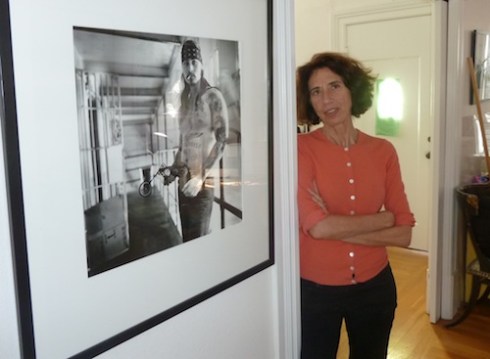
There were two categories of interviewees I planned to connect with during PPOTR – photographers and prison reformers. I didn’t expect to meet many individuals who satisfied both definitions. Ruth Morgan does.
Morgan became director of Community Works, a restorative justice arts program in the San Francisco Bay Area in 1994. Prior to that, she was director of the Jail Arts Program, in the San Francisco County Jail system (1980-1994).
It should be noted that the county jail system is entirely different to the state prison system and operate under separate jurisdictions. County jails hold shorter term inmates.
For three remarkable years, Morgan and her colleague Barbara Yaley had free reign of San Quentin State Prison to interview and photograph the men. In 1979, it was the sympathetic Warden George Sumner who provided Morgan and Yaley access. In 1981, a new Warden at San Quentin abruptly cut-off access.
“I think there were a few reasons [we were successful],” explains Morgan. “Despite the fact I was a young woman, I had a big 2-and-a-quarter camera and a tripod and so they took me seriously. That helped us get the portraits and the stories we did.”
The San Quentin News (Vol. I.II, Issue 11, June, 1982) reported on Morgan and Yaley’s activities. The story Photo-Documentary Team Captures Essence of SQ can be read on page 3 of this PDF version of the newspaper.
Ruth and I talk about how the demographics of prison populations remain the same; her original attraction to the topic; the use of her photographs in the important Toussaint v. McCarthy case (1984) brought by the Prison Law Office against poor conditions in segregation cells of four Northern California prisons; why she never published the photos of men on San Quentin’s Death Row; and the emergence, funding for, and power of restorative justice.
LISTEN TO THE DISCUSSION WITH RUTH MORGAN ON THE PRISON PHOTOGRAPHY PODBEAN PAGE
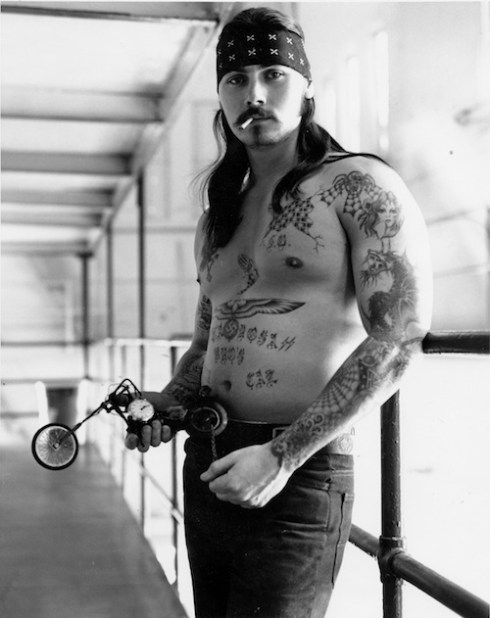
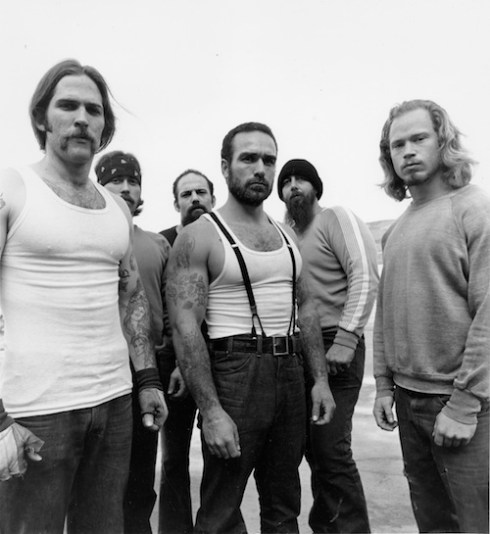


In 2005, Alyse Emdur unearthed a photograph (above) of her visiting her older brother in prison. She recalls, even as a 5 year old, her confusion and discomfit with the tropical beach scene to her back.
To Alyse, these garishly coloured corners of the prison visiting rooms are analogous with commercial photo portrait studios, “If you weren’t familiar with prisons, you might think these were prom photos or made in community centres. They’re very ambiguous,” says Alyse.

Fascinated by the obscure and closeted mural works in prisons across the U.S., Alyse meditated upon them in her MFA grad show (she even commissioned a prison artist to paint a mural on parachute canvas). She is now bringing hundreds of authentic American prison visiting room portraits from her Prison Landscapes project together in a book to be released later this year.
Alyse contacted over 300 prisoners via prison penpal and dating websites. Just over 150 agreed to be part of the project.
In the past, I’ve argued that visiting room portraits may constitute the largest type of American vernacular photography not seen by the majority public. I’ve also noted how companies will manipulate these portraits and, at the request of the owner, photoshop out the prison environment. Photoshop “services” such as these are the post-production equivalent of the denial existent in the original works.
If these idyllic landscapes are about escape it might not just be in an emotional sense, “They are a security feature,” says Alyse. “The backdrops are there to control the type of imagery that is being exported out of the institution. To be specific, the administration doesn’t want images of the inside of the prison to circulate outside of the prison because the thinking is that those images could help an inmate escape. That’s what makes these images slippery and interesting; they also create an escape for the poser and for the [family member] who receives the photo.”
How or why does this discussion matter? Well, essentially these are images about control. Cameras are considered a security hazard by prison authorities. Prisoners have no opportunity to self-represent (bar some very exceptional prison photo workshops). After their mugshot, these visiting room portraits are the only chance America’s 2.3 million prisoners have to achieve something that approximates self-representation. These are highly mediated images and they are often a performance that belies the hardship of prison life.
Alyse and I talk about the regionalism of the backdrop murals; the dearth of research on this quirky and hidden aspect of American visual culture; and Alyse notes how the artistry of mural painting is disappearing as acrylic and enamel paint is replaced by large photo-printed screens.
LISTEN TO OUR DISCUSSION ON THE PRISON PHOTOGRAPHY PODBEAN PAGE


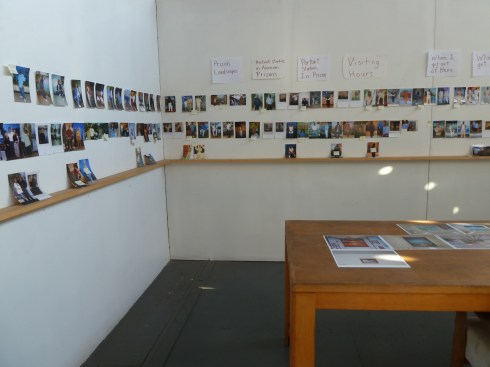

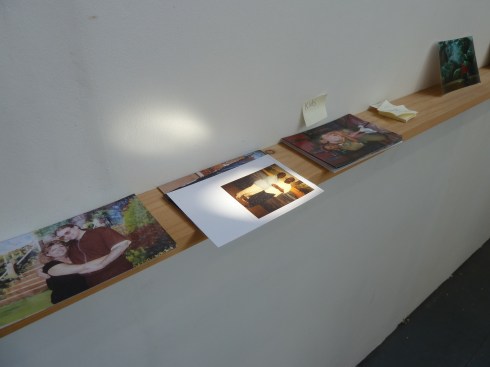
Alyse Emdur (b. NJ, USA 1983) works with photography, video, research, social engagement, and drawing. Her work has been exhibited at Printed Matter and the Lambent Foundation in New York; the University of Texas Visual Arts Center in Austin; Bezalel University in Tel Aviv, Israel; the Lab in San Francisco; La Montagne Gallery in Boston; Laura Bartlett Gallery in London, England; Spacibar in Oslo, Norway; In Situ in Paris, France, and Kunststichting Artis in Hertogenbosch, Netherlands.
In Spring 2012, a book of her project Prison Landscapes will be published by Four Corners Books (London).
Download an interview with Niels Van Tomme published in the Fall 2011 Issue of Art Papers Magazine, here (PDF)
Download an excerpt of Prison Landscapes published in Issue 37 of Cabinet Magazine, here (PDF)
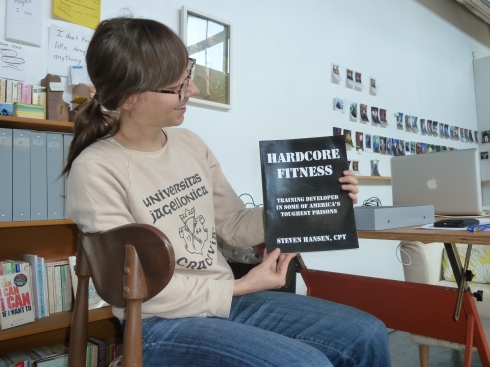

16 year old boy in King County Juvenile Detention Center, Seattle.
With a stack of cash and a full paid year of leave what choices would a photographer make?
Richard Ross decided to use his award-winning photography skills and decades of access-negotiating experience to visit and document America’s juvenile detention facilities. Now, by giving his images away for free, he’s passing on his good fortune and helping decision-makers build better policy.
Thanks to a years sabbatical from the University of California and the award of a Guggenheim fellowship, Ross was freed of time and money pressures and over a five-year period, visit more than 350 facilities in 30+ states and interviewed approximately 1,000 children. He hopes Juvenile-In-Justice will change the national debate.
Ross has partnered with the Anne E. Casey Foundation, but it’s not an exclusive relationship; he is open and willing to share his archive with any group working to improve transparency in the system and improve the confinement conditions for our nations incarcerated youth.
In our interview, Ross talks about some of the differences in management he observed across counties and states; describes the trauma experienced by many detained children; explains that sometimes the simplest solutions are best; and expounds on how we are quick to give-up on children who have – for the most part – not seen any benefits of our perceived social contract.
LISTEN TO OUR CONVERSATION ON THE PRISON PHOTOGRAPHY PODBEAN PAGE.
Visit the dedicated website Juvenile-In-Justice for regular updates and transcribed interviews with many of the children in Ross’ photographs.
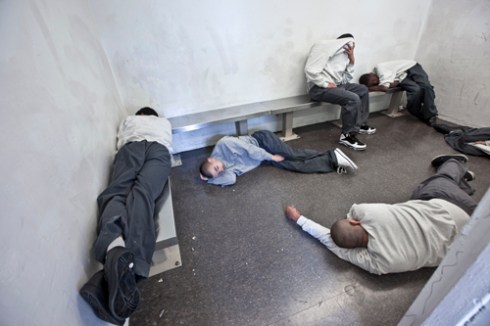
Los Padrinos Juvenile Hall. Downey, California.
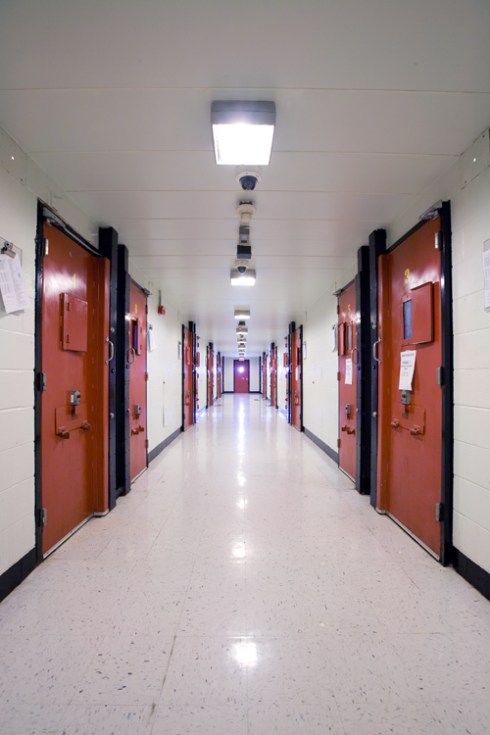
Giddings State School, Giddings, TX. Maximum security. Pictured: hallway of isolation cells, essentially maximum security within maximum security.

Orleans Parish Prison (OPP), New Orleans, Louisiana. The air-conditioning was not working when Ross visited and there was a fight the previous night. As a result T.V., cards and dominoes privilege have been taken away. The OPP, managed by Sheriff Marlin Gusman, houses about 23 juvenile boys. They live two to each cell. The cells at their narrowest measure 6-feet in width.
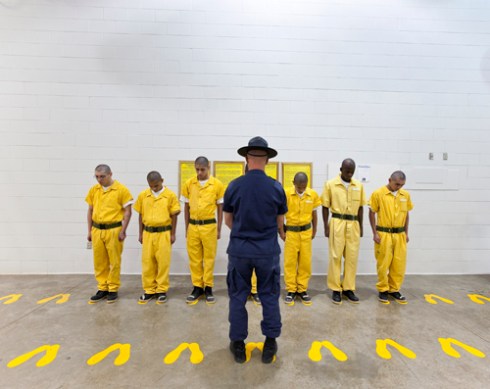
Orientation Training Phase (OTP), part of Youth Offender System (YOS) Facility in Pueblo, Colorado. OTP performs intake and assessment of convicted children. OTP operates like a boot camp. All of the children at OTP have juvenile sentences with adult sentences hanging, meaning that if they fail in the eyes of the authority they will have to serve their adult sentence. For example, a child could be there serving a two year juvenile sentence with 15 years hanging.

A twelve-year old in his cell where the window has been boarded up from the outside, at the Harrison County Juvenile Detention Center in Biloxi, Mississippi. The facility is operated by Mississippi Security Police, a private company. In 1982, a fire killed 27 prisoners. There is currently a lawsuit against the authorities which forced them to reduce their population. They must now maintain an 8:1 inmate to staff ratio.

Dorm room six of the Hale Ho’omalu Juvenile Hall in Honolulu, Hawaii. Built in the 1950s, the facility was under federal indictment until a replacement facility could be constructed and occupied in early 2010. This boy who has been in and out of foster care all his life, has been here at Hale Ho’omalu for one week. He committed residential burglary in 7th grade and has since repeatedly violated with petty actions like missing meetings or truancy. His father was deported to the Philippines and his mother is a drug-user. The only person who visits him is his YMCA drug counselor.
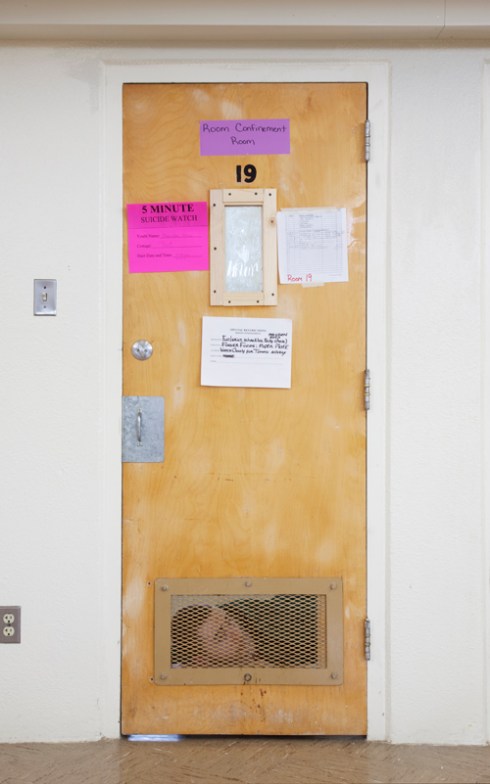

The Caldwell Southwest Idaho Juvenile Detention Center detains children between the ages of 11-17 years old. When Ross visited, six girls were in detention for the following offenses – two for runaway/curfew violations; lewd and licivious conduct, molestation abuse; controlled substance; trafficking methamphetamine; burglary and marijuana
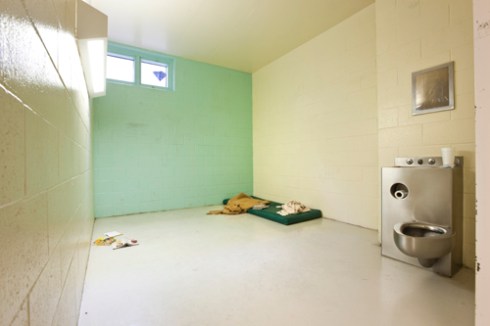
Under 24-hour observation, this 15 year old boy on the mental health wing of the King County Juvenile Detention Center, Seattle, WA is checked on every 15 minutes.

Restraint chair for self-abusive juveniles at the Mendota Juvenile Treatment Center in Madison, WI houses 29 children and is usually always at full capacity. The average stay for the emotionally and mentally disturbed juveniles, some of which are self-abusive or suicidal, is eight months. Children must be released at age 18, sometimes with no transition options available to them.

View of camera monitoring the isolation room at the St. Louis Detention Center, St. Louis, MO. The facility is run by the Department of Youth Services. When Ross visited only 35 of the 137 beds were occupied. The population had decreased significantly because of the embrace of the principles of the Juvenile Detention Alternatives Initiative and the leadership of Judge Edwards.

All images © Richard Ross

 Prison Photography