
You are currently browsing the category archive for the ‘Photojournalism’ category.

Puppies Behind Bars, Photo: Joyce Dopkeen/The New York Times
NPR’s Fresh Air featured the Puppies Behind Bars project yesterday. They train young dogs for two primary purposes – seeing-eye/guide dogs and bomb-sniffing canines.
Here’s a New York Times article and photo essay from June 2008.
This post is to salve the disappointment of thousands of visitors to Prison Photography that are tempted by the post titled View Inside Guantanamo: Video only to find that the Guardian’s rights to the three minute “tour” video have expired.

There exists a bristling irony in the Guardian’s curt and formal explanation of circumstance: the erasure of evidence based upon ‘rights’ pertaining to the command is an insulting reminder of the powerlessness of detainees whose lives are manipulated at will.
Paradoxically, in this case, it is the denied party that is the apologist for the US military’s enforced expiration and unavailability of material. It seems the controlled release of this footage has been trumped by its controlled withdrawal.

As a worthy (and non-governmental) alternative, Magnum offers Paolo Pellegrin’s 11 minute slideshow ‘Guantanamo‘. There are a few interesting things about this piece none of which are the actual photographs. The prints are steeped in morbid detachment and the unsurprising truth that the photographer was also controlled throughout this military prison.
The slideshow’s early description of Guantanamo as a small American town is sinister; the edited audio interviews of former UK detainees, family members, detainee lawyer and psychologist are very successful. The follow-up portraits of former detainees that Pellegrin later completed in Afghanistan are very strong.


All photos copyright of Paolo Pellegrin/Magnum Photos
Please, refer to my earlier post, for a comprehensive directory of photographic resources for Guantanamo including Bruce Gilden’s subtle flash-bulb mockery of Guantanamo’s rank and file. (Search within Magnum archives as deep-linking is impossible).

Fabio Cuttica‘s 2006 photo essay in Nerve from the Buen Pastor (Good Shepherd) Prison, Bogota was brought to my attention via industry-insider Rachel Hulin’s A Photography Blog. She describes a well-rude awakening.
If you can get past this description from Hulin’s subconscious, I encourage you to think about the merits of this particular pageant. Despite the obvious interest from media (who are unlikely to refuse such a unique/titillating story) the benefit here seems to be predominantly for the women of the institution.


The pageant in is honour of the Virgin Mercedes, the patron saint of prisoners. Ada Calhoun – in the intro for the Nerve photo essay – hams up the language to sensationalise the event, but I don’t think there is a need. Cuttica’s photographs are brimming with the fun, the nerves, ecstasy and community of the event.
It is obviously novel day. It would seem to me that the opportunity to celebrate femininity and to express notions of beauty normally obscured by the institution would be a welcome relief for many female prisoners; I hope its a hell of a lot of fun.
But, this is a curious contradiction to how I usually feel about beauty pageants. I generally consider beauty contests as shallow, if not ridiculous. They make a whole lot of noise over very trivial matters. To my mind, a beauty contestant on stage is as pathetic as a dog in a sweater; cringe-worthy, vulnerable and compromised.
I suppose an answer lies in who has the power and the organising authority. I may be wrong, but I presume the women of Buen Pastor prison have a huge investment in the pageant – supporting their friends, stage preparations, making costumes and accommodating guests to the prison on their day.
This is, of course, in contrast to the usual female beauty contestant who is likely genderised by her community, normalised into swimsuit & high heels at an early age and conditioned to not question the strange gaze of a town’s older (men) folk.


Fabio Cuttica resides in Bogota, Colombia. His work is distributed by Contrasto & Redux agencies. He has worked across Latin America, recently winning acknowledgment from the College Photographer of the Year for his work documenting the La Maria & their struggle for land rights in the Cauca Region of Colombia. In 2008, Cuttica was honorably mentioned at the National Press Photographer Association’s Best of Photojournalism Awards for his extended essay about gang violence in Barrio Petare, Caracas, Venezuala. He has also worked on assignment for GEO about the Basque Region of Spain and covered the traditional family life and weaving in Valledupar, Colombia.

Jenn Ackerman
Larry Chandler, Warden of Kentucky State Reformatory, La Grange, KY
Jenn Ackerman

This year, more than 700,000 people will be released from prisons and jails in the U.S. and more than half of them suffer from some form of mental illness. (Source)
A few months ago I wrote to Jenn Ackerman, praised her Trapped project and of course offered to promote it. I wanted to get at her stories behind the images – namely do an interview. Jenn, however, is as good a promoter as she is a photographer.
The list of questions I wrote out while eating my chili-verde burrito on Wednesday are made largely redundant by her blog post “Trapped: Questions Answered”. Her photography and multimedia is so strong that it also speaks for itself. There is a painful truth in her work; more questions than answers.
I have plenty material to give you a thorough summary of Jenn’s work.


Firstly, allow me to give a run down of the current situation of mental health care provision in America’s prisons and jails.
A 2006 report by the U.S. Department of Justice shows that the number of Americans with mental illnesses incarcerated in the nation’s prisons and jails is disproportionately high. Almost 555,000 people with mental illness are incarcerated while fewer than 55,000 are being treated in designated mental health hospitals. That is inadequate provision.
555,000 represents, at the very least, 16% of inmate populations of state and local jails. I would contend the figure is higher – well above 20% – but this is only my personal belief.
If these numbers are not shocking enough, one must consider the pressures the prison system – in and of itself – exerts on the mental health well-being of those incarcerated by consequence of the increased reliance on solitary confinement to control populations, unqualified staff (especially in private prisons), overcrowding, institutional violence, lack of volunteer programming and engagement (in remote facilities) and the inadequate/unconstitutional general health care provided in states such as Ohio and California. California Department of Corrections has been the subject of a high profile federal lawsuit for the short comings to provide suitable care. (Incidentally, the $1.9b figure quoted in the linked article used to be $6b, until Schwarzenegger rejected it … and there is a serious threat it will be nothing if California cannot sort out its budget disaster).
In prison systems with such endemic problems, it is those who have no way to advocate for themselves who suffer most. Jails have effectively become America’s defacto mental institutions; they house a larger volume of mentally ill people than all other programs combined.
Against this backdrop, Ackerman went to work.

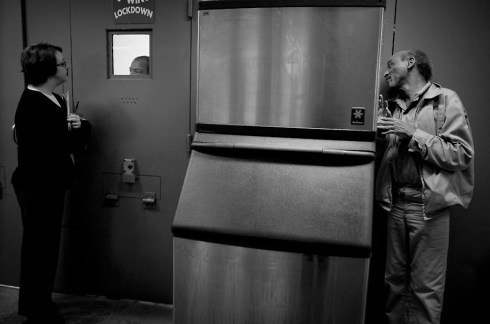
Prison Photography is keen to unveil the means by which photographers, anyone, can gain access to prisons to engage with the “invisibles” of society. In that spirit I quote Jenn;
How did you get access to this story?
I had done a lot of research and had decided on the story I wanted to tell when going to talk to the warden. I always feel that a an in-person visit is more beneficial. — I can better express my passion and excitement for this story. I had called a couple of prisons days before I called the Kentucky State Reformatory and to no surprise they didn’t respond to my messages. But then I came across a wing that was dedicated to mental illness in a prison. Warden Chandler answered on the second ring. This caught me off guard but got it together enough to tell him what I wanted to do. He said I had a lot of work to do before I could start on the project but that he might be interested. I sent a proposal days later and asked to come visit the reformatory to talk to him in person.
How did the warden and officials respond to the project?
I didn’t know how they would respond at first. But I also knew that the warden and everyone involved wanted this story to be told. I was very honest with everyone from the beginning. I told them that I knew that they were doing something to acknowledge mental illness in prisons which hasn’t happened in every state but that I also knew that the program was not perfect. I told them that was going to be my approach. So from the beginning they knew that I was not going to make them look bad but also wasn’t trying to say that they have the final answer to this issue. But I visited the warden the day before I published it on my site to get his reaction. He loved it and thanked me for creating an honest portrayal of the mental illness in prisons. I told him that was the best compliment I could ever get.
There can be no doubt that Jenn was lucky to find Warden Chandler who was so sympathetic to her objective and realised the importance of the project.


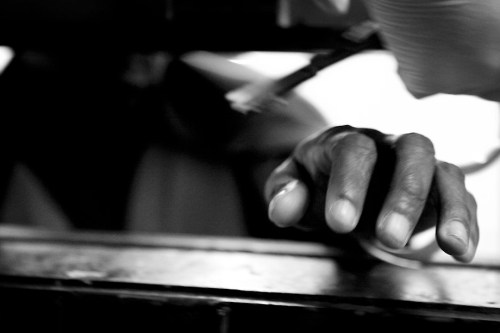
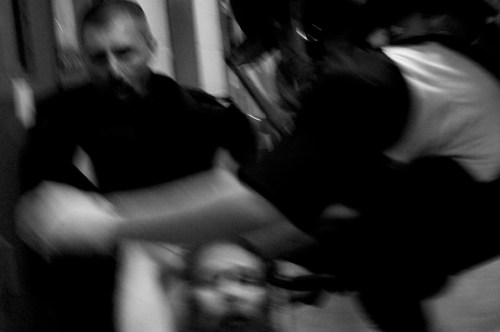
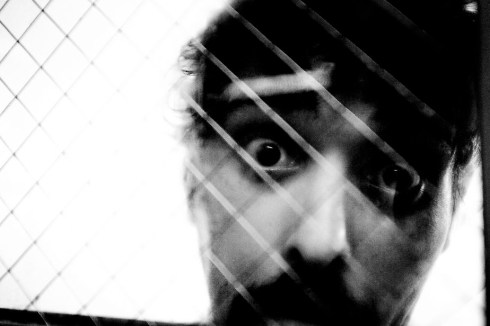
Jenn has explained that she spent a total of 10 weeks on the project, including 10 days of still and video shooting. Her time commitment is reflected in the comprehensive coverage. Trapped is a dark bubbling cloud of stories and troubling images that are weft with human emotion, the occasional reprieve but predominantly the collision of lives – lives that orbit tormented psyches that a punitive world of reinforced doors & service hatches cannot soothe.
Jenn’s commitment is epic. Besides the Trapped feature film, Jenn breaks the project into a series of presentations. Firstly, the In Their Corner short about the inmate watch. Secondly, In Their Minds a series of seven film shorts allowing individual inmates camera time to represent themselves. Trapped is segmented into six photography galleries; each one a captivating photo-essay in its own right. I cannot over-emphasise the sensitive depth with which Jenn has documented the incidents on the Correctional Psychiatric Treatment Unit (CPTU) at the Kentucky State Reformatory. Jenn also provides an extended essay about her own response to the CPTU environment.

Jenn interviews for 25 minutes at Multimedia shooter. The audio is wobbly and distorted but the information is valuable. Check out from 21 mins. onward to learn of the administration’s response.
Trapped: Mental Illness Inside America’s Prisons has deservedly received acclaim from burn magazine, 100 Eyes, Verve Photo, the White House News Photographers Association (honorable mention), Inge Morath Foundation and CPoY. Jenn recently won an internship at the New York Times.
Jenn credits her students for much of her inspiration. Check out Jenn’s class website for more details.

Cornell Capa, to some extent, lived in the shadow of his older brother Robert. I guess, it is easy for complacent men to adore the still and fallen martyr than to keep apace with a passionate and piqued practitioner. Cornell’s and Robert’s legends are one; Cornell ceaselessly fought his brother’s corner authenticity debate surrounding The Falling Soldier.
Cornell’s indebtedness to his brother was fateful and self-imposed:
Disappointingly, it is only in extended surveys of Cornell Capa’s career that mention of his fifties photojournalism in Central and Southern America arises. Otherwise, Cornell is celebrated for his political journalism and particularly his campaign coverage of Adlai E. Stevenson, Jack and Bobby Kennedy. Cornell’s photographs from Latin America are often neglected, even demoted.

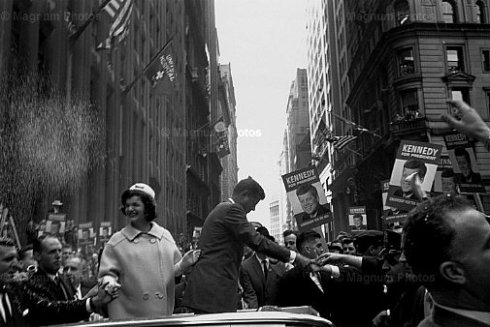
The Kennedys were the foci of American progressive attitudes, and so, in the sixties, Cornell documented the concerned politician. Cornell was (not in a negative way) passive and the sixties were not formative. It was in the fifties that he actively worked to define the persona, the ideal: ‘The Concerned Photographer’.
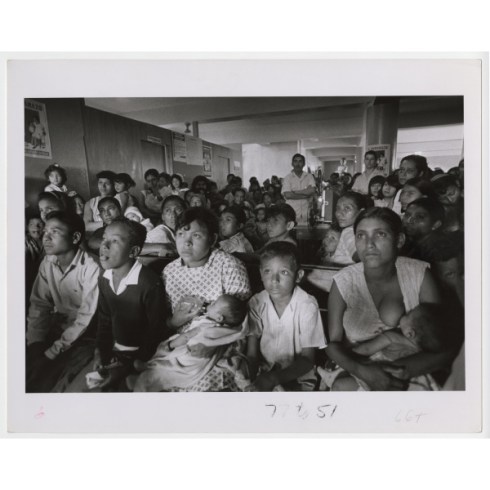
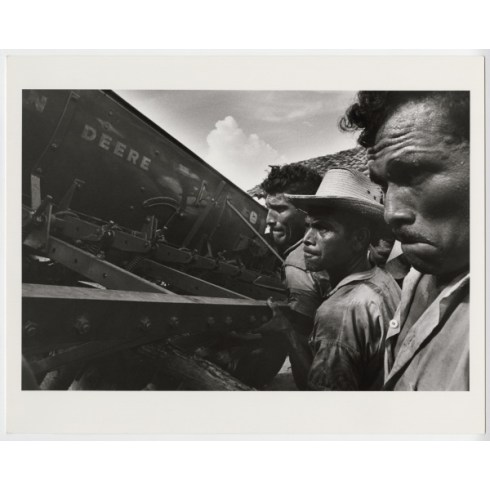
Cornell’s work in Latin America:
In 1956, Cornell was in Nicaragua reporting on the assassination of President Anastasio Somoza García. Somoza was shot by a young Nicaraguan poet; the murder only disrupting slightly the Somoza dynasty that lasted until the revolution of 1979 (that’s where Susan Meiselas picks up).
In the aftermath of the assassination over 1,000 “dissidents” were rounded up. The murder was used as an excuse and means to suppress many, despite the act being that of one man.


I have no knowledge of what happened to these men after Cornell photographed them and I am sure you haven’t the patience for speculative-art-historio-speak.
I do wonder … if having witnessed revolution, early democracies, military juntas, coups, communism, social movements, grand narratives and oppression in various forms, if Cornell picked his subjects with discernment back in the United States.
As early as 1954 Cornell was working on a story for Life about the education of developmentally disabled children and young adults. Up and to that point in time, the subject had been regarded by most American magazines as taboo. The feature was a breakthrough.
In 1966, in memorial to his brother, Robert, and out of his “professed growing anxiety about the diminishing relevance of photojournalism in light of the increasing presence of film footage on television news” Cornell founded the Fund for Concerned Photography. In 1974, this ideal found a bricks and mortar home on 5th Ave & 94th Street in New York: The International Center for Photography.

This institutional limbo that eventually gave rise to one of the world’s most important photography organisations was not a quiet period for Cornell. In 1972, he was commissioned to Attica, NY, to document visually the conditions of the prison. Capa presented his evidence to the McKay report (PDF, Part 1, pages 8-14) the body investigating the cause of the unrest. Cornell narrates his personal observations while showing his photographs to the commission.


At a time when, the photojournalist community seems to have crises of confidence and purpose at an alarming rate, it would be wise to embrace his spirit in full recognition his slow accumulation of remarkable accomplishments.
Rest In Peace, Cornell.

PHOTO CREDITS.
Robert F. Kennedy campaigning in Elmira, New York, September 1964. Accession#: CI.9685
New York City. 1960. Senator John F. KENNEDY and his wife, Jackie, campaigning for the presidency. NYC19480 (CAC1960014 W00020/XX). Copyright Cornell Capa C/Magnum Photos
Three men pushing John Deere machine, Honduras, 1970-73. Accession#: CI.3746
Watching family planning instructional film at Las Crucitas clinic, Tegucigalpa, Honduras], 1970-73. Accession#: CI.8544
Political dissidents arrested after the assassination of Nicaraguan dictator, Anastasio Somoza, Managua, Nicaragua, September 1956. The LIFE Magazine Collection. Accession#: 2009.20.13
NICARAGUA. Managua. 1956. Some of the one thousand political dissidents who were arrested after the assassination of Nicaraguan dictator Anastasio Somoza. NYC19539 (CAC1956012 W00004/09). Copyright Cornell Capa/Magnum Photos
Prisoners escorted from one area to another, Attica Correctional Facility, Attica, New York, March 1972 (printed 2008). Accession#: CI.9693
Two men walking around prison courtyard, Attica Correctional Facility, Attica, New York, March 1972. Accession#: CI.9689
Inmates playing chess from prison cells, Attica Correctional Facility, Attica, New York, March 1972. Accession#: CI.9688
Man on scooter carrying coffin, northeastern Brazil, 1962. Accession#: CI.8921
All photos courtesy of The Robert Capa and Cornell Capa Archive, Promised Gift of Cornell Capa, International Center of Photography. (Except for ‘The Concerned Photographer’ book cover; the Jack Kennedy photograph; & the second Nicaragua prison photograph.)

Copyright: Angela Shoemaker
Angela Shoemaker, visual journalist and graduate of The School of Visual Communication at Ohio University, informs us, “Ohio Reformatory for Women (ORW) nursery, one of four such programs in the U.S., offers a unique opportunity for female inmates to keep their babies while serving out their prison sentences.”
Angela has also produced Prison Nursery: Keeping Mothers and Babies Together in an audio slideshow format Prison Nursery.
In the interests of full disclosure, DuckRabbit and Prison Photography have become virtually-close these past couple of months, beginning with an acknowledged shared politic, via encouraging support, to a mention in DuckRabbit’s announcement of a daring competition that I feel I had only a small part to do with.

I am not advertising DuckRabbit’s $1,000 competition for brevity’s sake. I am promoting it because:
a) Stan Banos had an excellent point in the first instance
b) DuckRabbit has not been shy to challenge inequalities before (including MSF – opening dialogue, discussing visual ethics and celebrating consequent positive representations on MSF’s photoblog)
c) PDN, with an all-white 25 juror panel has a valid charge of passive racism to answer.
d) I think it is a ballsy move, and I want to see what comes of it.
Up for the debate?
FOR $1,000 YOU MUST;
“Come to PDN’s defense and answer the question, ‘What possible, plausible excuse could exist for an all white jury from a publication of such influence?’”
A few things emerging today to which I’d like to doff my cap.
Lenscratch
Aline Smithson at Lenscratch, rumoured to be in Santa Fe (Good Luck, Aline), celebrated all Lori Waselchuk’s documentary work; Waterlines, one project of many projects wrapped up in Louisiana, and Grace Before Dying community portrait of the Prison Hospice at the Louisiana State Penitentiary (Angola).

Lock Down Visit. Lori Waselchuk
Lori, a member of the New Orleans Photo Alliance, launched her project Grace Before Dying April 3rd at the Louisiana State Prison Museum in conjunction with the Louisiana-Mississippi Hospice and Palliative Care Organization (LMHPCO), the Louisiana State Prison Museum, and helped along with a Distribution Grant from the Documentary Photography Project of the Open Society Institute and Moonshine Studio.
The issues of age and health in prisons – together and in isolation – have been reasonably well covered. But, Waselchuk succeeds where so many others fail (with the exception of Edmund Clark) in really communicating the infirmity and vulnerability of the inmates
Fraction offered a good summary, as does Waselchuk’s Alma Mater. Critical Mass has the best gallery of Grace Before Dying
Bint PhotoBooks on Internet
Bint PhotoBooks on Internet got to grips with Martin Roemers‘ Relics of the Cold War which includes a Valencia orange room within a Stasi Prison. Roemers goes tête-à-tête with the Fuchs brothers in the communist-archaeology-photo genre.

Germany, East Berlin. Visitor-room in former Stasi prison Hohenschoenhausen. Political prisoners were held in this prison. Martin Roemers
Unrelated to prisons, I am also a fan of Roemers’ Lourdes Pilgrims series.
Subjectify
Subjectify grapples with the latent appropriation of images since the 2004 release of Abu Ghraib photographs.
much has been written about the ways in which war photography often echoes iconic religious imagery. but i have been wondering how, in turn, the iconography of the new war and torture photography is also influencing fine art photographers today?
Subjectify offers Jessica Somer‘s work ‘Origin’ from the Bend So Not to Break series as a case in point. I drew some interest along with disbelief and derision when I skirted the issue regarding Ballen and the torture aesthetic.

Origin. Jessica Somers
I believe artists biggest problem is to work away from viewers natural tendency to superimpose meaning so easily. I think Somers is safe. She’s got a style that stands on its own – it doesn’t get drowned out by media noise or green gloves.
AN Other
Yusuf Sayman‘s work on individuals going through Re-entry programs after long term prison sentences presented itself in the Independent‘s bizarre and confused “Britain’s Best Crime Photography” competition.
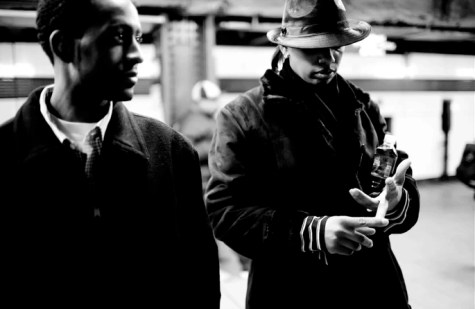
Starlene from the Free Again: Starlene series. Yusuf Sayman
Starlene Patterson is one of three former prisoners, Sayman has collaborated with after prison release for the Free Again series. Starlene is at college to qualify as a Social worker. “People need help.”
Starlene has written a book, Up Against the Wall. She says, “My book has a message. There’s a lot of young people who need guidance and they my not have that. If my book can help one [of those children] than I’ve achieved.”
Non-prison related I like Sayman’s Henry’s World series.

 Prison Photography