
You are currently browsing the category archive for the ‘Prison Non-Photography’ category.

Poster created by the Students for a Democratic Society (SDS) advocating support of prison rebellions, and the abolishment of alleged racist prison terror. Source: Wisconsin Historical Society
The most famous prison rebellion in American history began in the early hours of September 9th, 1971.
I’ve written about the Attica Prison Uprising before, mainly in relation to Cornell Capa’s involvement in the general politics of prisons and his testimony during the inquiry that followed the riot.
I wanted to share an image of this poster and ask you if you can imagine this type of visual being used today. It wouldn’t happen. Universities are less and less incubators for radical action; prison issues are rarely incorporated into overarching critiques of capitalism; and, sad to say, solidarity and Socialist motifs are derided in today’s media culture of garish graphics, breasts, comments of misdirection and ridiculous 24-hr coverage.
Not wanting to end on a down note, these groups are working against our society of excessive, blaring infotainment. Check them out.

Diagram showing the typical parts of a PLC used for door-control systems. Image courtesy of Teague Newman
“Vulnerabilities in electronic systems that control prison doors could allow hackers or others to spring prisoners from their jail cells, according to researchers,” writes Kim Zetter for Wired.com
According to security consultant and engineer John Strauchs, the same weaknesses that the Stuxnet superworm used to sabotage centrifuges at a nuclear plant in Iran exist in America’s prisons.
Strauchs plans demonstrate an exploit against the systems at the DefCon hacker conference which began in Las Vegas yesterday.
Zetter:
“Strauchs, who says he engineered or consulted on electronic security systems in more than 100 prisons, courthouses and police stations throughout the U.S. — including eight maximum-security prisons — says the prisons use programmable logic controllers to control locks on cells and other facility doors and gates. PLCs are the same devices that Stuxnet exploited to attack centrifuges in Iran.”
THE BACKGROUND
In one of modern politics’ most outrageous adoptions of Doublespeak, Governor Arnold Schwarzenegger – in 2004 – renamed the California Department of Corrections the California Department of Corrections and Rehabilitation.* You can see videos – here and here and here – of the press conference announcing not only a change in name, but a supposed change in the management philosophy of the CDCr.
At that time, legal challenges were being made over the adequacy of healthcare. Following the 2004 criticisms and despite the 2004 promises, consistent constitutional healthcare was not provided to the prison population of California.
The CDCr failed to deliver on both medical care and meaningful rehabilitation. To prove the emptiness of the rhetoric we can look to John Gramlich’s report for the PEW Center’s Stateline last month. Gramlich made the point, that shortly after Schwarzenegger’s rebranding the “administration cut funding for prison rehabilitation programs by about 40 percent.”
THE PUSHBACK
It’s just as well for you and I, a diligent group of California citizens have for 17 years challenged the claim on the CDC acronym and since 2004 reclaimed entirely the discarded California Department of Corrections name. The CDC works to put right misleading messages, empty words and muddy communication.

Founded in 1994, the California Department of Corrections (CDC) describes itself as “a private correctional facility that protects the public through the secure management, discipline, and rehabilitation of California’s advertising.”
Above is the CDC’s latest correction of fact and assault on complacency. From their website:
The California Department of Corrections (CDC) has unveiled a new campaign of bus shelter ads to celebrate America’s assassination of Osama bin Laden.
Released prior to July 4th, a total of ten ads in MUNI bus shelters throughout San Francisco were apprehended, rehabilitated and discharged without incident. The ten liberated ads represent each year in the long decade spanning the declaration of the War on Terror by President Bush and the eventual demise of al-Qaeda’s elusive leader.
Joining in celebration with millions of US civilians after the demise of bin Laden, the red, white and blue advertisements not only pay patriotic tribute to our country, but also celebrate the unsung history of American assassinations.
The rehabilitated advertisements are currently at liberty and seem to have successfully readjusted to public life. However, these ads will remain under surveillance by department staff to prevent recidivism and any potential lapse into prior criminal behavior.
You gotta love direct action. View more works here.
* You may have noticed I always refer to the Golden State’s prison system as CDCr; using a lowercase “r” is an simple text-based slight but it makes the point.
(Via the ever-wonderful Just Seeds Blog.)
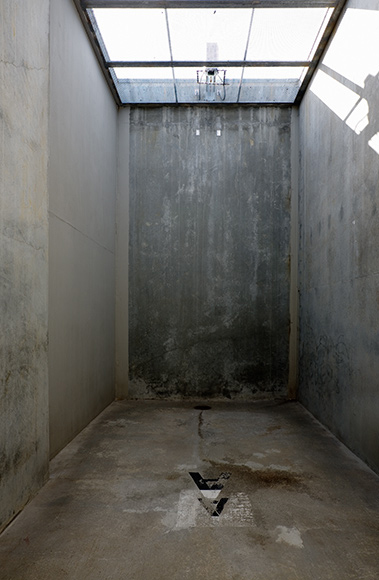
© Richard Ross
Pelican Bay State Prison in Crescent City, California is one of the most oppressive regimes of the U.S. prison system. It was designed to control and isolate the growing gang affiliations within California prisons following the CDCR’s massive expansion throughout the 1980s. It opened in 1989 and established THE model for maximum security prisons in states across the U.S.
Pelican Bay Prison specialises in solitary confinement. When photographer Richard Ross documented prisons as part of his Architecture of Authority project he went to Abu Ghraib, Guantanamo Bay and Pelican Bay.
The most segregated inmates spend 22 and half hours in a cell barely larger then your bedrooms or bathrooms. For the other 1 and a half hours they occupy a concrete pen for “exercise.”
Pelican Bay is notorious for it’s history of violence and despair. It is also, according to Christian Parenti, a boon for small town economics.
It is a god-forsaken hole.
The most isolated prisoners have put together a strike plan. Yes, they have demands, but more than that they want to make a point about the inhumane and invisible conditions they inhabit. Yes, many of them have committed heinous crimes but cooping them up like dogs serves only to increase tension, anger and danger.
BACKGROUND AND DEMANDS
Prisoners in the Security Housing Unit (SHU) at Pelican Bay State Prison have called for an indefinite hunger strike as of July 1, 2011 to protest the cruel and inhumane conditions of their imprisonment. The hunger strike was organized by prisoners in an unusual show of racial unity. The prisoners developed five core demands.
California Prison Focus supports these prisoners and their very reasonable demands, and calls on Governor Jerry Brown, CDCR Secretary Matthew Cate, and Pelican Bay State Prison Warden Greg Lewis to implement these changes. California Prison Focus has also joined “Prisoner Hunger Strike Solidarity,” a coalition of grassroots human rights activist groups in the Bay Area supporting the demands of the prisoners participating in the hunger strike.
Briefly the five core demands of the prisoners are:
1. Eliminate group punishments. Instead, practice individual accountability. When an individual prisoner breaks a rule, the prison often punishes a whole group of prisoners of the same race. This policy has been applied to keep prisoners in the SHU indefinitely and to make conditions increasingly harsh.
2. Abolish the debriefing policy and modify active/inactive gang status criteria. Prisoners are accused of being active or inactive participants of prison gangs using false or highly dubious evidence, and are then sent to longterm isolation (SHU). They can escape these tortuous conditions only if they “debrief,” that is, provide information on gang activity. Debriefing produces false information (wrongly landing other prisoners in SHU, in an endless cycle) and can endanger the lives of debriefing prisoners and their families.
3. Comply with the recommendations of the US Commission on Safety and Abuse in Prisons (2006) regarding an end to longterm solitary confinement. This bipartisan commission specifically recommended to “make segregation a last resort” and “end conditions of isolation.” Yet as of May 18, 2011, California kept 3,259 prisoners in SHUs and hundreds more in Administrative Segregation waiting for a SHU cell to open up. Some prisoners have been kept in isolation for more than thirty years.
4. Provide adequate food. Prisoners report unsanitary conditions and small quantities of food that do not conform to prison regulations. There is no accountability or independent quality control of meals.
5. Expand and provide constructive programs and privileges for indefinite SHU inmates. The hunger strikers are pressing for opportunities “to engage in self-help treatment, education, religious and other productive activities…” Currently these opportunities are routinely denied, even if the prisoners want to pay for correspondence courses themselves. Examples of privileges the prisoners want are: one phone call per week, and permission to have sweatsuits and watch caps. (Often warm clothing is denied, though the cells and exercise cage can be bitterly cold.) All of the privileges mentioned in the demands are already allowed at other SuperMax prisons (in the federal prison system and other states).
The Pelican Bay hunger strikers have support form the other SuperMax in California Corcoran Bay Prison.

A public flogging in Delaware in the early 1900s. Ullstein Bild, The Granger Collection.
For the Chronicle of Higher Education, Peter Moskos justifies the title of his new book, and explains why In Defense of Flogging is really about our bloated failed prison system:
The opening gambit of the book is surprisingly simple: If you were sentenced to five years in prison but had the option of receiving lashes instead, what would you choose? You would probably pick flogging. Wouldn’t we all?
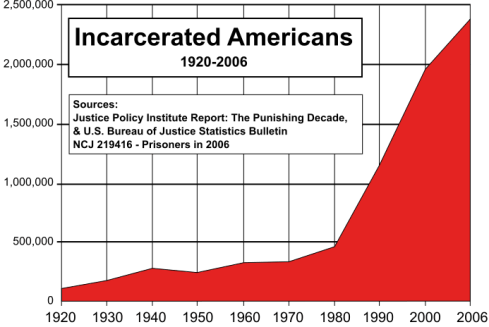
My defense of flogging […] is meant to be provocative, but only because something extreme is needed to shatter the status quo. We are in denial about the brutality of the uniquely American invention of mass incarceration. In 1970, before the war on drugs and a plethora of get-tough laws increased sentence lengths and the number of nonviolent offenders in prison, 338,000 Americans were incarcerated. There was even hope that prisons would simply fade into the dustbin of history. That didn’t happen.
Some time in the past few decades we’ve lost the concept of justice in a free society. Historically, even though great efforts were made to keep “outsiders” and the “undeserving” poor off public welfare rolls, society’s undesirables—the destitute, the disabled, the insane, and of course criminals—were still considered part of the community. The proverbial village idiot may have been mocked, beat up, and abused, but there was no doubt he was the village’s idiot. Some combination of religious charity, public duty, and family obligation provided (certainly not always adequately) for society’s least wanted. Exile was a punishment of last resort, and a severe one at that. To be banished from the community was in some ways the ultimate punishment. And prisons, whether or not this was our intention, brought back banishment and exile, effectively creating a disposable class of people to be locked away and discarded. True evil happens in secret, when the masses of “decent” folks can’t or don’t want to see it happen.
(My bolding)
Particularly with the last paragraph, I couldn’t agree more.
It’s a question I’m asked time and time again. I have many reasons. I’ve said before I think prisons in the United States are a human rights abuse. That statement could launch a thousand debates.
Ultimately, I come back to the stats. Mass incarceration is a man made problem. It is more about bad laws and bad policy than it was ever about crime.

 Prison Photography