
You are currently browsing the category archive for the ‘Prison Non-Photography’ category.
… or put another way, the apparently unassailable problem that is Guantanamo only amounts to 2% of the actual problem.

This is only one of the many astounding facts I learnt from following the Guardian’s Slow Torture series.
I particularly valued this half hour podcast in which an expert panel of legal professionals discuss the cyclical, “odious” and often ludicrous procedures for trials based on ‘secret evidence’. Clive Stafford Smith has many valuable things to say about American legal protocols. He has represented detainees at Guantanamo Bay and says that, in the overwhelming majority of cases, ‘secret evidence’ used against terrorism suspects does not stand up to judicial scrutiny.
The majority of the Slow Torture series looks at British ‘secret evidence’ trials, how it affects the lives of terror suspects and the consequent erosion of Britain’s legal reputation:
The UK government’s powers to impose restrictions on terror suspects – without a trial – amounting to virtual house arrest have been condemned as draconian by civil liberties campaigners. In a series of five films, actors read the personal testimonies of those detained under Britain’s secret evidence laws and campaigners and human rights lawyers debate the issues raised.
Basically, the same problems embroiled in the acquisition and control of “sensitive” evidence exist on both sides of the Atlantic and are ultimately putting our societies at more of a long-term risk.
Photography alone is worthless. Interviews, think-pieces, investigation, theatre, video, debate, political fight and direct action make issues reality.
What are we to do with our Gitmo preoccupations when the real problem has been moved to Bagram, Afghanistan by President Obama?
“Those walls aren’t there just to keep me in, but to keep you out.”
Tyrone W. (Prisoner and student)
Providing meaningful education in sites of incarceration is a difficult task. How do educators get inside the walls?

Inmates taking an Adult Basic Education class at the Norco prison include Paul Rodriguez (left), Jobentino Romero (front), Felipe Ramos (right) and Marco Tielve (back). Chronicle photo by Michael Macor Photo: Michael Macor / SFC
In 1994, the Clinton Administration withdrew Pell Grants and thus all funding for college education in US prisons. Prisoners were deemed unworthy of tertiary education. The disaster of this legislation (law was amended to omit prison populations) immediately impacted the prospects for tens of thousands of men and women, but also it crippled America’s critical thinking and cultural landscape.
With the stroke of the president’s pen, education – a cornerstone of the American dream narrative – was denied to a stipulated group by popular consensus. It was, and remains, discrimination defined.
Since that time, any college courses taught within US prisons have been supported entirely by non-profit organisations, brave foundation funding, volunteer hours and volunteer skills.
With this in mind, I’d like to bring to your attention some of the venerable organisations providing education despite innumerable legal and practical obstacles.
Prison Education Organisations
Recently, I took on a teaching role at Washington State Reformatory, one of four facilities at the Monroe Correctional Complex, WA. I teach in the University Behind Bars project, one of the programs run by the Prisoners Education Network (PEN).

PEN is a fledgling organisation that has just taken on an expanded curriculum, new teachers and a two year strategic plan for sustainable growth. It is the only college education provided to any inmates in the state of Washington.
In order to inform our growth we’ve been scrutinising other education programs across the United States.

Temple University, Philadelphia runs the Inside Looking Out program which pairs prisoners with students as peers to develop educational goals. For background, view this video by Tiffany Kimmel which describes the work at Oregon State Penitentiary.

The Prison University Project at San Quentin is the model program for the state of California.

John Jay College, New York runs the Prison Reentry Institute.

Boston University administers the Prison Education Program.

Bard College operates the Bard Prison Initiative.
Faith-based group Partakers in Massachusetts calls for sponsors to support its College Behind Bars program.

And, last but not least, is the business oriented Prison Entrepreneurship Program (PEP) in Texas.
If you have a spare hour watch PEP’s director Catherine Rohr talk about the inspiration provided by the students and how they overturned her prior apathy and self-confessed ignorance to the needs of prisoners.
These are a mere selection. I’d be very happy to hear of more prison education programs from any corner of the US and beyond
Onward.
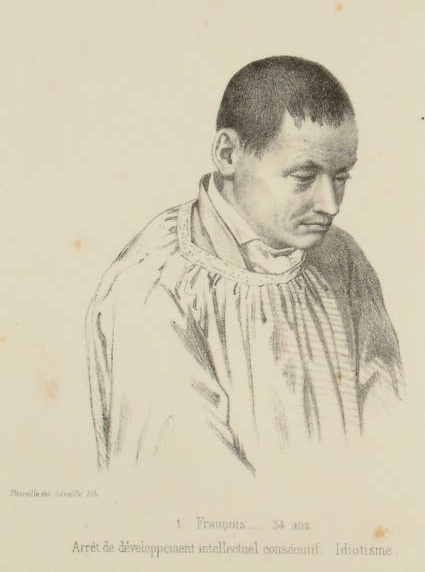
"Francois. 34 ans. Arret de Developpement intellectuel conscentif. Idiotisme." From ‘Traites des Degenerescences', by Morel (1857)

Green Hill, 2000 (C) Steve Davis
A couple of comments that have blown me away in the last 24 hours.
Convergence
From Patrick McInerney;
The similarity between Steve’s photographs and the scientific studies of psychiatric inmates the mid nineteenth century asylums is striking. (For a particularly good example see pictures of psychiatric inmates in Benedict Augustin Morel’s 1857 ‘Traites des Degenerescences: physiques, intellectuelles et morales de l’espèce Humaine’
And its interesting that they have a similar effect today as the early images did in the past, i.e. they encourage us to read the prisoner’s “true” character in their faces, with all the difficulty that incurs. It was obviously not Steve’s intent to mimic 19th c. scientists but maybe its quite understandable he feels that the style has become a bit jaded … it has after all been around for some time!
Steve was jaded not only by the limits of the portrait to communicate but also by the disconnected agendas viewer brought to his works, “People respond to these portraits for their own reasons. A lot of the reasons have nothing to do with prison justice. Some of them like pictures of handsome young boys; they like to see beautiful people, or vulnerable people, whatever. That started to blow my mind after a while.”
It is a serious issue within photography that we are all lazy viewers. The less curious and less open we are, the more likely we are to fall back on pleasing, self-affirming bias.
Memory
Three months ago I posted some images of the Prison Ship/Torture Museum, The Success

Wooden Coffin / Wooden Maiden / Iron Maiden?
Today, I received this;
I believe it was around 1944 that a prison ship, maybe it was The Success came to Cleveland Ohio at Lake Erie. I remember seeing the torture devices and one sticks in my mind to this day. I was told it was called the ‘Iron Maiden’, but your photos call it the ‘Wooden Coffin’.
Although I saw it as a child the memory stays with me to this day.
Age following age has propagated its own fascination with the macabre and majority-assigned human defect. From “scientific” research to childhood memory the will to understand difference has played out (and continues to play out) the shifting – and ultimately false – parameters of normal.
Troy West, Angola Inmate
Louisiana has the highest incarceration rate per capita of all US states. over 1,100 per 100,000 – that’s more than 1 in a 100. Angola (Louisiana State Penitentiary) is the mother of all prisons, carrying a weighty reputation and weightier history.
Only Georgia has a rate above 1 in a 100, as Louisiana does. The other Southern states make up the top five (Texas, Alabama and Mississippi).
These stats are due in most the more frequent sentencing of men to life without parole. The disproportionately high rate of prisoners who die within Southern prisons as compared to other state institutions makes for a very different culture.
Many photographers including Damon Winter and Lori Waselchuk have focused on the unique aspects of Angola culture. The rodeo is well known, the hospice less so, but least well known may be the football league.
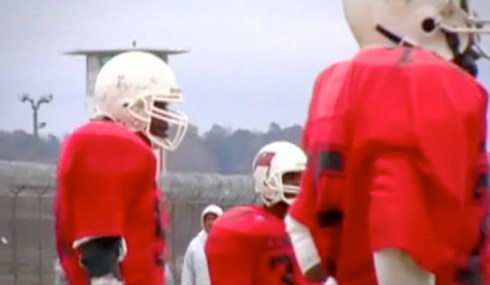

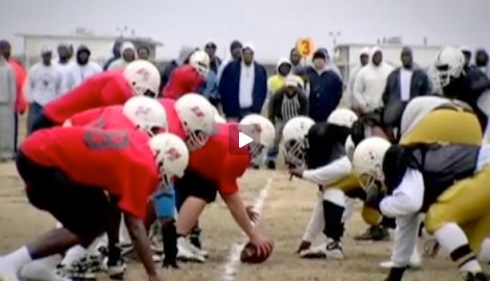
I have noted before the value of sports in prison, and Angola Prison Football a film-short by Charlie Gruet supports my position.
In it, Angola warden Burl Cain states his philosophy, “Good food, good medicine, good play and good pray. Lose any of those elements and you’ll have violence in your prison, but you would in your home. You think about it.”
The inmates back up the third point. It’s a well done documentary and to think that over 70% of the men in the film won’t ever get out just blows my mind. (Source: 2008 LSP Report).
Watch closely from 4.03 onward.
My call on Friday for more information on Civil War era prisons bore an unexpected rich harvest. A single reply but an absolutely riveting one.
Imagined Prisons responded with this:
These images are fascinating and haunting, and the idea of the modern prison as “a permanent abstraction of earlier jails” is a compelling one.
As for the carceral spaces – makeshift and otherwise – of the Civil War, some authorities have cited Lincoln’s suspension of habeas corpus rights as a precedent for the Bush Administration’s policies in today’s war prisons. E.E. Hale’s classic short novella, “The Man without a Country,” written in response to Lincoln’s controversial move, tells the story of a man sentenced to spend the rest of his life aboard U.S. Navy ships, in the extralegal zone outside the boundaries of the nation-state.
You might also be interested in this poem by Herman Melville, from the 1866 volume “Battle-Pieces, and Aspects of the War”:
In the Prison Pen
Listless he eyes the palisades
And sentries in the glare;
‘Tis barren as a pelican-beach–
But his world is ended there.
Nothing to do; and vacant hands
Bring on the idiot-pain;
He tries to think–to recollect,
But the blur is on his brain.
Around him swarm the plaining ghosts
Like those on Virgil’s shore–
A wilderness of faces dim,
And pale ones gashed and hoar.
A smiting sun. No shed, no tree;
He totters to his lair–
A den that sick hands dug in earth
Ere famine wasted there,
Or, dropping in his place, he swoons,
Walled in by throngs that press,
Till forth from the throngs they bear him dead–
Dead in his meagreness.
Imagined Prisons is the accompanying website for the book The Prison and the American Imagination, by Caleb Smith, which will appear from Yale University Press in September of 2009.

The Prison and the American Imagination, by Caleb Smith. Yale University Press, September 2009
The book examines the history of the U.S. prison system and its imaginative life in nineteenth – and twentieth – century culture. Caleb Smith argues that the dehumanization inherent in captivity has always been at the heart of American civil society.
Imagined Prisons is a forum for conversation about the book and the questions it raises;
What a significant new resource with which to reassess the prison within America’s cultural landscape. Prison Photography, too, is attempting (admittedly ham-handedly on occasion) to define the current representation/consumption of prison imagery within our society.
May I suggest that books such as Caleb Smith’s and sites such as mine exist because sites of incarceration – “dark places” – have been over-zealously operated by controlling minorities and not adequately discussed by the at-large majority?

I took some flak for questioning America’s Day of Independence celebrations. I suggested that flag-waving is sometimes an empty exercise and distracts society from scrutiny of serious problems.
To support the point, I stated some positions:
America is the only Western nation in the world to execute human beings.
America has 1 in 30 adults locked up in prisons (4 times the amount of any other Western state).
America’s middle class has fled to the banality of the suburbs and hung its public school systems out to dry.
America has 50 million medically uninsured people, including 11 million children.
America has embraced the privatisation of prisons and stockholders profit from the incarceration of men, women and children.
America’s drug war is in fact a war on the lower classes, who are predominantly minority groups.
As if on cue, these three things have fallen into my lap in the intervening 72 hours.
Schools
The Economist reports on the US’ private school sector; a sector totally unaffected by the recession. Amanda Uhry of Manhattan Private Schools Advisors speaks brutality and unabashedly about the robustness of the private school sector. It’s success is based on fear, individualism, constant educational benchmarks set from the earliest of grade levels, and a severe lack of imagination; “America has fallen far, far behind other nations in providing public education”.
Prisons
I hope most Americans would prefer not to be number one in this country-by-country comparison.

And, just in case you’re wondering, the US is 4th most frequent executioner of its citizens. The other countries making up the top five are the often vilified and demonised China, Iran, Saudi Arabia and Pakistan.
Hospitals
My family in the UK is an average bunch. Nevertheless, three of the five of us have required major surgery (all three more than once). The NHS provided – in every case – timely and impeccable care. Taxes aren’t a burden, they are peace of mind.
As John Pilger puts it, “The way the National Health Service is represented in the United States is truly scandalous. That word ‘Socialist’ is pulled out; it’s kind of infantile almost. Well, if Socialist is taking away the fear of being denied health care, then yes it is.”
We are all agreed: Michael Jackson’s death is a sad event. Firstly because he was young, secondly because he runs through our cultural DNA and thirdly because we never really managed to fully understand him.
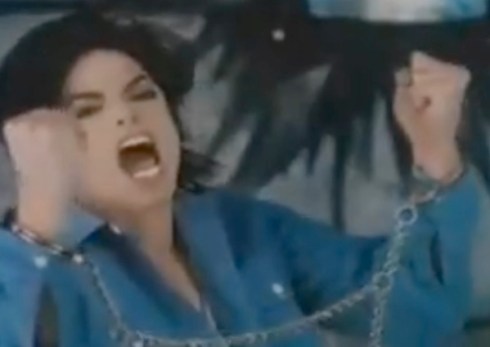
Jackson’s life and work were wrapped up in the confuddling of race and the obliteration of its prerequisites for discussion. I am not talking only about his self-manipulated skin colour. I am talking about the fact he was accused of antisemitism for contested lyrics in the 1996 release They Don’t Really Care About Us and the fact he was accused of exploiting the poor of Rio de Janeiro for its music video.
This song is only one time Jackson was simultaneously cast as victim and perpetrator by the media and public all making use of his eccentricity to grind their own agendas.
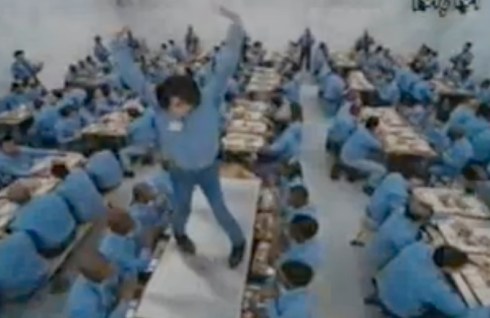
The controversy led Jackson (for the only time in his career) to film a second video for one of his songs, taking his crotch grabs off the favela streets and into the prison chow hall. One or both of the versions was banned by MTV – I am not quite sure, but it doesn’t matter.
Jackson threw enough contorted imagery at these two videos to satisfy a life’s worth of political action. The prison version is a montage of famous photojournalist and media images; death, natural disaster, street brutality, Vietnam napalm, hate crimes, Rodney King, African pestilence, riots, nuclear detonation and the Ku Klux Klan?
I am undecided as to how Jackson’s convolution of imagery helps an informed debate on inequality in society. How much does a famine of the 80s in an unnamed African nation have to do with US urban riots?
It should be said, that for his manic prison tableaux, Jackson did accurately reflect reality in the casting of a disproportion number of men of colour.



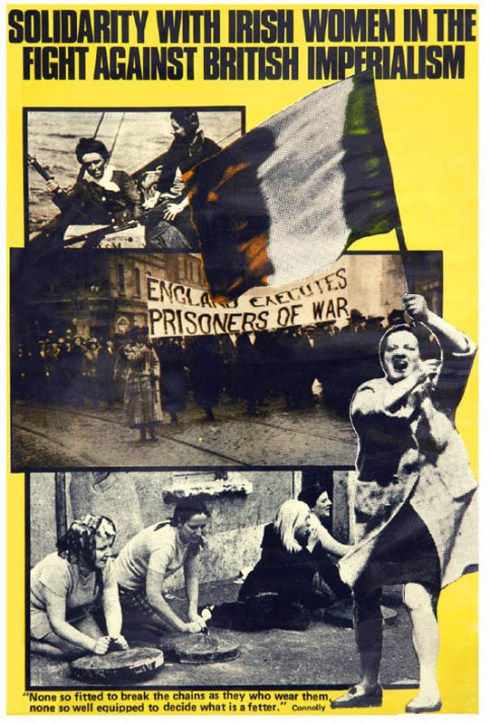
The inspiring Just Seeds Collective which peddles art to fund prison rights activism pointed me via its blog toward the Poster Film-Collective of London.
The Poster Film-Collective is a unique archive of graphics for African, Cultural, International, Irish, British and Women’s causes. With direct politics and robust graphics, poster arts are a nostalgic favourite for many art historians.

‘The Troubles’ of Northern Ireland are a very difficult topic for me to discuss; but not because I am close or emotionally compromised and not because I know or knew anyone involved. I grew up just the other side of the Irish Sea, but Belfast may as well have been the other side of the world to me. I was raised Catholic and my Mum’s family are from the Republic of Ireland. Yet, as a child my family rarely discussed the situation in Northern Ireland. Even in 1996, when the IRA bombed the Arndale shopping centre in Manchester (just down the M61 from my home town) the conflict was still too abstract and ancient for my teenage mind to comprehend.
I think any political labels or alliances that would fall upon my family were deflected by a distant dismay at the violence of the time. ‘The Troubles’ of Northern Ireland are not something I feel comfortable idealising; rather limply I retreat to the cliche that one man’s terrorist is another’s freedom fighter. All sides (there were more than two) were guilty of arrogance, obstinacy and extreme violence. The ideological brutality played out on the streets was matched by that meted out in the prisons, most notably Long Kesh, later renamed The Maze.

It is a lingering guilt for me that ‘The Troubles’ have always been historical … historicised. It is this guilt that accounts for the fact I’ve not before discussed Donovan Wylie’s The Maze on Prison Photography. Wylie is saturated in Irish history – it is his life’s vocation. On the other hand, I would be a fraud if I attempted to summarise the complex events of a physically-close-culturally-distant conflict.
It is with similar guilt I refer readers – in the first instance – not to news reports or academic reflection but to a 2008 film. But, I do so because Steve McQueen’s Hunger is a breath-taking portrayal of a life-taking episode in the history of Maze prison. It is a wonderful observation of British prisons, Irish Republican solidarity and inmate management in the face of political protest.
McQueen, in his directorial debut, specialises in long uninterrupted shots which grip time (and all its anguish) and forces the politicised narratives through the mangle. He flattens and simplifies the visuals drawing out the incredible fragility of human skin, snow-flake, fly, lamb, ribcage … McQueen is surely a great photographer too.

Through Donovan Wylie’s work I learnt of Dr. Louise Purbrick’s excellent continuing research “concerned above all with the meanings of things and how those meanings are contained or revealed, experienced and theorised.” Purbrick wrote the essay for Donvan Wylie’s book, Maze. That was in 2004. In 2007, Purbrick extended the survey, jointly editing the book Contested Spaces. It analysed the “divided cities of Berlin, Nicosia and Jerusalem, the borderlands between the United States and Mexico, battlefields in Scotland and South Africa, a Nazi labour camp in Northern France, memorial sites in Australia and Rwanda, and Abu Ghraib.”
Purbrick worked with another academic Cahal McLaughlin on the oral history & documentary film project Inside Stories featuring Irish Republican Gerry Kelly, Loyalist Billy Hutchinson and ex-warder Desi Waterworth. And it is here I start (and I encourage you to start), with personal testimony when trying to understand ‘The Troubles’.
Donovan Wylie has continued his visual archaelogy of Irish history with Scrapbook.
 Born in Belfast in 1971, DONOVAN WYLIE discovered photography at an early age. He left school at sixteen, and embarked on a three-month journey around Ireland that resulted in the production of his first book, 32 Counties (Secker and Warburg 1989), published while he was still a teenager. In 1992 Wylie was invited to become a nominee of Magnum Photos and in 1998 he became a full member. Much of his work, often described as ‘Archaeo-logies’, has stemmed primarily to date from the political and social landscape of Northern Ireland.
LOUISE PURBRICK is Senior Lecturer in the History of Art and Design at the University of Brighton, UK. She is author of The Architecture of Containment in D. Wylie, The Maze (Granta, 2004) and, with John Schofield and Axel Klausmeier, editor of Re-Mapping the Field: New Approaches to Conflict Archaeology (Westkreuz-Verlag, 2006). She also works on the material culture of everyday life and has written The Wedding Present: Domestic Life beyond Consumption (Ashgate, 2007) (Source)
CAHAL McLAUGHLIN is Senior Lecturer in the School of Film, Media and Journalism at the University of Ulster. He is also a documentary filmmaker and is currently working on a Heritage Lottery Funded project, ‘Prison Memory Archive’.

 Prison Photography