
You are currently browsing the category archive for the ‘Uncategorized’ category.
As if on cue…
Blatant racism. If we needed any more convincing that racism is thriving in parts of the US
Interracial couple denied wedding licence in Louisiana “because of the children”.
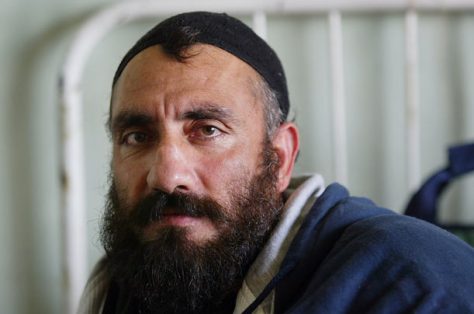
One of the first to be released in 2002, Mohammad, a farmer, says that he was forcibly conscripted into the Taliban, but tried to get away by surrendering himself to the enemy, the notorious warlord Abdul Rashid Dostum, who promptly served him up to the Americans. After less than a year, the Americans deemed him no threat and returned him to Afghanistan. He says that during his time in captivity, he was well treated by the U.S. military. © Paula Bronstein/Getty
In my recent feature of Edmund Clark’s work on Guantanamo (that focuses on not only the fabric of the prison but also the environmental details of their homes post-release) I was reminded of Paula Bronstein‘s Guantanamo detainee portraits.
Whereas Clark focuses on detainees released into Western – I presume UK – society, Bronstein tracks former detainees down in their homeland, Afghanistan. She has photographed returning prisoners many times since 2002. All her work is collated at here at Getty Images. Time magazine ran Portraits of Gitmo Detainees earlier this year.
There are many stories to consider, and they are of course more vital than the photographs. The early releases, including Jan Mohammad (above), from 2002 came with favourable testimony in which detainees said they were treated fairly and allowed to practice their religion.
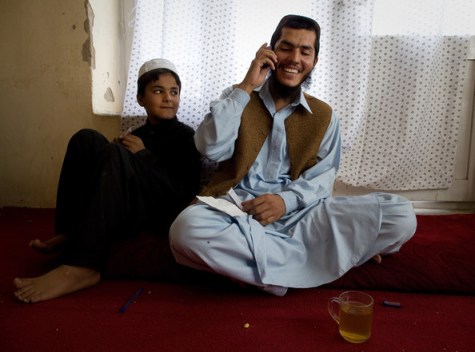
Mohammed Jawad talks on the phone to a friend as a relative looks on in his family home on September 25, 2009 in Kabul, Afghanistan. He was the youngest Guantanamo Bay prisoner only 17 when he was arrested six years ago, but his lawyer says he was 14 and family members say he was 12. Jawad's conviction was for throwing a hand grenade at two U.S. soldiers. The judge said his confession was obtained under torture. © Paula Bronstein/Getty
Mohammed Jawal, who could have been as young as 12 when he was detained was, according to a judge, tortured.
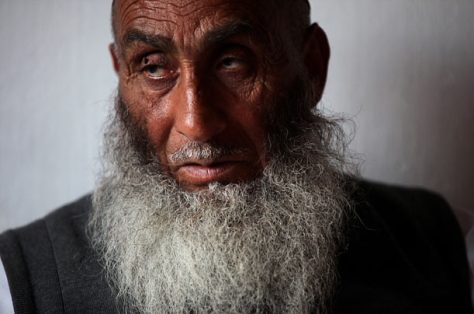
Haji Nasrat, 77 Released in 2006, the farmer was Guantanamo's oldest prisoner. Partially paralyzed for more than 15 years and illiterate, Nasrat says he does not know why the Americans detained him. Government documents relating to his case allege that he was a member of Hezb-e-Islami Gulbuddin, a former mujahadeen group said to be tied to Al Qaeda. © Paula Bronstein/Getty
Haji Nasrat, Guantanamo’s oldest detainee, has spoken words which bear the experience of failed American policy in Afghanistan, “When (the Americans) came to Afghanistan everybody was waiting for America to help us build our country. We were looking for you guys and we were very happy that you would come to our country. The people who hated you were very few, but you just grabbed guys like me. Look at me. Our very happiness, you changed it to (bitterness).”
After eight years of war and too many attacks that have killed civilians, President Obama’s military and non-military personnel have a large task to improve security and win back the trust of the Afghanistan people. Is it even possible? If not, the biggest losers resulting from the lie that was the war on Iraq – and all the distractions it carried – may be the people of Afghanistan.
Found via Travel Photographer

Puppies Behind Bars, Photo: Joyce Dopkeen/The New York Times
NPR’s Fresh Air featured the Puppies Behind Bars project yesterday. They train young dogs for two primary purposes – seeing-eye/guide dogs and bomb-sniffing canines.
Here’s a New York Times article and photo essay from June 2008.
I am away from the computer for the next week. Joseph Rodriguez will occupy much of my thoughts during that time. As I have said before, I’ll be returning to his work and method.
In the meantime, read his interview and watch his multimedia piece over at RESOLVE blog.

Lee Grant contacted me a few months ago to tell me of her project Belco Pride – an institutional portrait of the now empty Belconnen Remand Centre. ‘Belco’ was a small facility designed for 17 people, but according to Lee housing approximately 70 toward the end. Officially, the capacity is/was “under revision”.
The remand prisoners have since been relocated to the Alexander Maconochie Centre, which is talked up as Australia’s first prison built in accordance with the Geneva Convention (more on that in a later post).
After inmate rehousing, but before total closure, Grant took another opportunity to tour the facility, “thanks to an open day … billed, believe it or not, as a family event. And the families were out in force …”
Therefore, I was happy to see Lee post a few of her images from the ongoing series. I particularly liked these two pairings which are a wry juxtaposition.


Shortly thereafter my enjoyment turned to bafflement.
In Lee’s description of the open day she mentioned that the phrase “Arbeit macht frei” was clearly visible to all arriving visitors. This flat out shocked me. On Lee’s blog, I commented,
There is no correlation between Nazi concentration camps and modern Australian prisons. The inclusion of the phrase is confusing and offensive.
I had originally mistaken the facility, thinking the quote was on view at an opening for the new prison and not, as the case was, a closing of the old. Still, wonder remains at this crude and ill-advised allusion.
Lee responded;
[I will be sure to post any developments – be they images or elaborations on this peculiar alignment of geography, phrase and history.]
Like Lee, I do not want to judge individuals working in Corrective Services. Instead, I’ll simply say that systems in which workers operate along lines of strict procedure are likely to harbour casual and offensive attitudes. Workers are as disciplined as inmates in all prisons. So when individuals are subject to a system – relieved of actual decision making – there is no incentive to challenge objectionable attitudes.
For the best of the rest, check out Lee Grant’s Op Shop series, which proves that you can change the country and you can change the moniker (charity shop, UK; thrift store, USA) but the look, personnel, wares and atmosphere remain the same.


Guantanamo © Chris Maluszynski/Agence VU

Guantanamo Map http://www.cubafutour.de/Karte%20Guantanamo%20Provinz.jpg

Guantanamo Bay Tents. Courtesy of The Department of Defense Visual Information Center
I am very happy with the way Prison Photography is progressing. I have done interviews with some outstanding photographers and artists. I have offered opinion where I think there’s something to be said. The most satisfying work on the blog is that contributed by guest bloggers, comment-makers and interviewees. Photographers have contacted me and I have been eager to comment upon their work.
But, there is one audience I never anticipated – The Google Image Search Audience. I get many hits for searches on Guantanamo, Guantanamo video, Iraq prison, Abu Ghraib, Abu Ghraib Images of Prisoners, etc, etc – which is strange because these are topics that many people have grappled over with more proficiency and depth than I am likely to.
It is obvious that there is a need for fast access to images of America’s sites of torture and incarceration, namely Abu Ghraib and Guantanamo. I certainly don’t wish to fuse the two institutional histories so I shall deal only with Guantanamo Bay.
Louie Palu
Walrus Magazine. 8 of Palu’s photographs and accompanying article.
The Atlantic. 6 of Palu’s photographs.
Private galleries. Palu’s Photoshelter profile offers three separate galleries, but they’re password protected. Contact the photographer directly.
NPR Interview. Palu offered insight into his experience and impressions of Guantanamo.
Christopher Sims
Mother Jones. 15 images of daily life outside of the prison complex.
Civilian Arts Project. 25 images of a bizarrely serene Guantanamo Naval Base.
BBC, The Other Side of Guantanamo. Article about Sims’ series.
Daylight Magazine. 4 minute audio of Sims’ experiences on project.
Chris Maluszynski
Agence VU/Moment. Twenty-six images exhibited. Likely more on file at the agency.
Cesar Vera
Guantanamo Prison. 18 Black & White images. 3 Colour.
Joint Task Force (JTF)
Many of the photographs shown in the press over the last few years were taken by members of the Navy’s own Joint Task Force. When press photographers visited the JTF vetted all images before release.
Boston Globe. 30 Hi-Res images.
Repeat of above selection. 20 Hi-Res images selected.
JTF Photo Galleries. 22 months (July 2007 – May 2009). Hundreds of images. Official photography.
Miami Herald
Description of the 8 different camps at Guantanamo
Explanation of the Legal contexts: Key defendants, the judges, the defense and prosecution counsel.
Cursory look at Art influenced by Guantanamo
Magnum
Bruce Gilden. Guantanamo Bay. Enemy Combatant Camps, 2003
Paolo Pellegrin. Guantanamo Detainees, 2006
Stuart Franklin’s work Cuba, 2003, included images from Guantanamo and you’ll need to search the Magnum website for images.
McClatchy
An eight-month McClatchy investigation of the detention system created after the Sept. 11 terrorist attacks has found that the U.S. imprisoned innocent men, subjected them to abuse, stripped them of their legal rights and allowed Islamic militants to turn the prison camp at Guantanamo Bay, Cuba into a school for jihad.
Intro. Text and 11 minute video.
Photos. Detainees held at Guantanamo Bay
Photos. Faces of Guantanamo Detainees. Part one.
Photos. Faces of Guantanamo Detainees. Part two.
Photos. Detainees held in Afghanistan.
Eyeballing
Comprehensive overview of base using Google Maps, official photographs. Details structures, uses and topography of naval base.
Camp America, Camp Delta, Camp V and Administrative & Court building.
Camp X-ray and construction of later detention camps.
Associated Press
Images of facilities and interiors of various detention blocks and camps.
Stars & Stripes “The Independent News Source for the U.S. Military Community”
Work at Guantanamo
Education at Guantanamo
Recreation at Guantanamo
Artistic Turns
David Hicks. Virtual Guantanamo Cell
Penny Byrne. Porcelain Guantanamo Detainee Figurines
Gregor Schneider. 21 Cells, Bondi Beach, Australia
Legofesto. Guantanamo reconfigured with Lego men and Lego pieces and Wired Interview
Flickr – Protest Images
Amnesty International. Guantanamo Protests
Various Photographers. 100 Days to Close Guantanamo and End Torture.
James M. Thorne. Protest images.
Miscellaneous Media
Prisoners of War. 2004 article by the San Francisco Gray Panthers with images of US airforce transporting detainees and early 2003 images of Camp X-Ray.
BBC. Life in a Guantanamo Cell

Rendition. Photographer Unknown
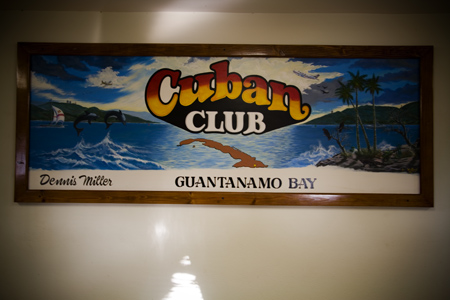
© Cesar Vera

Guantanamo Bay Navel Base with a New Commander-in-Chief. Photographer Unknown. http://www.obamalouverture.com/f39/guantanamo-bay-switch-bush-photo-obama.html
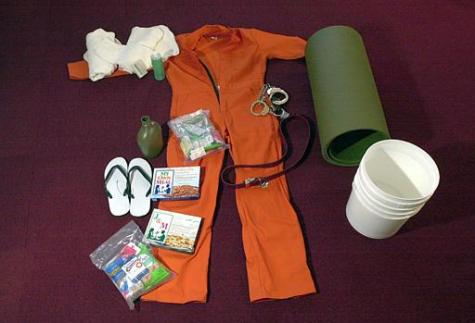
The standard issue of clothing, sleeping mat, food, sandles, canteen, soap, and buckets for detainees of Camp X-Ray is pictured in Camp X-Ray at the U.S. Navy Base at Guantanamo Bay, Cuba, on Wednesday, Feb. 20, 2002. © Tomas van Houtryve/AP Photo
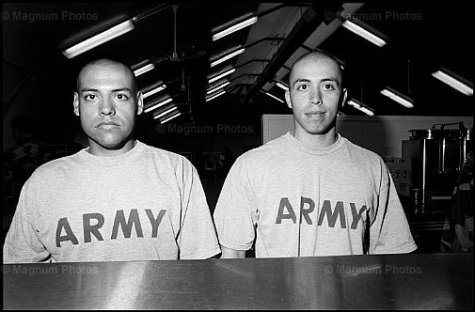
CUBA. Guantanamo Bay. 2003. Soldiers wait for their meals before a prayer breakfast at Camp America. Photo: Bruce Gilden/Magnum
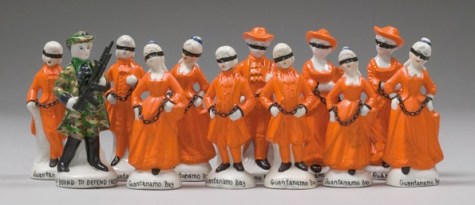
Penny Byrne Guantanamo Bay Souvenirs 2007, vintage figurines, metal chains, epoxy resin, plastic, re-touching medium, powder pigments, 14 x 32 x 10 cm.
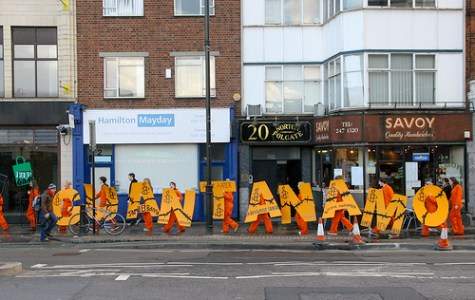
Photo: Jon McClean. http://www.flickr.com/photos/jonmclean/410055117/
IF YOU HAVE ANY RESOURCES TO SUGGEST,
PLEASE CONTACT ME AND I’LL ADD THEM TO THIS LIST.
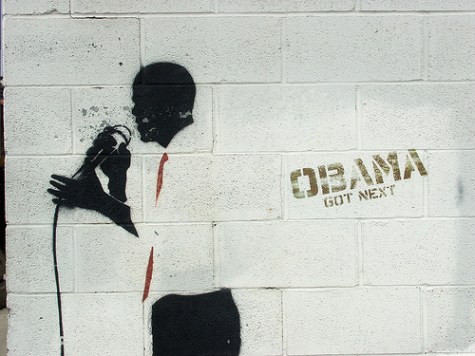
Obama Stencil. By Christopher V. Smith. Source http://www.flickr.com/photos/christophervsmith/3382123801/in/pool-obamastreetart
Obama’s decision to quash the release of Iraqi prison torture photographs has welled across the journo networks today. It began as a rumour and then confirmed by the Huffington Post, New York Times and other major news outlets.
Last month, I blogged about ACLUs legal victory and announcement of images release on May 28th. I told you to keep the date in mind as the images were sure to be a thwack on the retina – of course, not half as bad as some of the thwacks of twisted acts meted out by American rank and file under America military order.
I even went as far to say that Obama – with seeming little control – would possibly suffer at the fate of an early leak. Well, Obama’s done his u-turn and it looks like he might stop their release. He gets some support from Tomasky at the Guardian, but I can’t buy this argument. Obviously, Obama’s worried about the safety of his troops but the rest of us are worried about Cheney et al. getting off scott-free. The official line is that the Abu Ghraib abuses have been investigated fully, but in truth 25 low ranking officers were hung out to dry. There was no accountability further up the chain.
We should bear in mind that these are new images to the public and media, but not to politicians and internal investigators, and this is not the first time images have been suppressed and challenged.
The military’s mood was one of relative calm last month, with army investigators going on record that “these images are not as near as bad as Abu Ghraib”, but some are recalling long forgotten testimonies from 2004, namely by Seymour Hersh, here, here and here.
Hersh alleged that the children of female prisoners were sodomized in front of their mothers. These assertions were made on two occasions in 2004 – during a speech at the University of Chicago and at an ACLU conference.
There were audio files of these speeches online, but they do not seem to be operating. ACLU will have this on file nonetheless. And, in any case, Information Clearing House has a transcript of Hersh’s statements, from which I quote below:
Some of the worst things that happened that you don’t know about. OK? Videos. There are women there. Some of you may have read that they were passing letters out, communications out to their men. This is at [Abu Ghraib], which is about 30 miles from Baghdad — 30 kilometers, maybe, just 20 miles, I’m not sure whether it’s — anyway. The women were passing messages out saying please come and kill me because of what’s happened. And basically what happened is that those women who were arrested with young boys, children, in cases that have been recorded, the boys were sodomized, with the cameras rolling, and the worst above all of them is the soundtrack of the boys shrieking. That your government has, and they’re in total terror it’s going to come out. It’s impossible to say to yourself, how did we get there, who are we, who are these people that sent us there.
When I did My Lai, I was very troubled, like anybody in his right mind would be about what happened, and I ended up in something I wrote saying, in the end, I said, the people that did the killing were as much victims as the people they killed, because of the scars they had.
I can tell you some of the personal stories of some of the people who were in these units who witnessed this. I can also tell you written complaints were made to the highest officers. And so we’re dealing with an enormous, massive amount of criminal wrong-doing that was covered up at the highest command out there and higher. And we have to get to it, and we will. And we will, I mean, you know, there’s enough out there, they can’t.
And finally, if you thought you’d experienced the depravity of Abu Ghraib via the pictures – and if you thought you understood the extent to the crimes – you’d be wrong. This Guardian article, quoting Washington Post relays the testimony of a detainee witness to juvenile rape.
Detainee, Kasim Hilas, describes the rape of an Iraqi boy by a man in uniform, whose name has been blacked out of the statement, but who appears to be a translator working for the army.
“I saw [name blacked out] fucking a kid, his age would be about 15-18 years. The kid was hurting very bad and they covered all the doors with sheets. Then when I heard the screaming I climbed the door because on top it wasn’t covered and I saw [blacked out], who was wearing the military uniform putting his dick in the little kid’s ass,” Mr Hilas told military investigators. “I couldn’t see the face of the kid because his face wasn’t in front of the door. And the female soldier was taking pictures.”
It is not clear from the testimony whether the rapist described by Mr Hilas was working for a private contractor or was a US soldier. A private contractor was arrested after the Taguba investigation was completed, but was freed when it was discovered the army had no jurisdiction over him under military or Iraqi law.
IF THE IMAGES PEGGED FOR RELEASE ON THE 28TH ARE TO STIR UP FRESH INQUIRY INTO SEXUAL ABUSE OF JUVENILES THEN OBAMA HAS A SERIOUS PROBLEM.
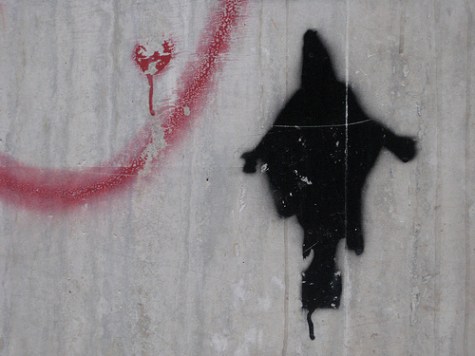
Detainee on Box Stencil. By Steve Reed. Source: http://www.flickr.com/photos/sreed99342/2077223377/
Author’s Note: I am taking my lead from Michael Tomasky for this blog post tying Obama’s call for a block on the release of images to the worst case scenario (sexual torture). Bear in mind that the buzz has been over 44 images – why, I don’t know – but over 2,000 were/are set to be released on May 28th. Also bear in mind that the images are said to be predominantly from facilities other than Abu Ghraib. There are a lot of unknowns in this matter. Nevertheless, I am sure of two things: 1) there is more visual evidence of abuse in existence and 2) Obama is obstructing the release of the latest evidence. Time will tell how these two variables cross or diverge.
First image by photographer Christopher V. Smith whose work can be found on his Flickr profile.
Second image by Steve Reed, whose work is on his Flickr profile and blog Shadows & Light.

 Prison Photography
