
You are currently browsing the category archive for the ‘Visual Feeds’ category.
I knew something was going on when my blog stats spiked over the weekend. Prison Photography interviews with those who photographed Fabienne Cherisma’s body in Haiti were drawing readers … and they came from Sweden.
PAUL HANSEN’S SPoY WIN
At the Swedish Picture of the Year Awards, photojournalist Paul Hansen was recognised as International News Photographer and won the International News Image for his image of Fabienne (below).
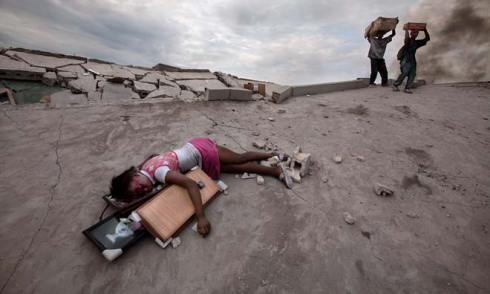
Fifteen year-old Fabienne Cherisma was shot dead by police at approximately 4pm, January 19th, 2010. Photo: Paul Hansen
In March 2010, Hansen answered some of my questions about the circumstances of Fabienne’s death, “For me, Fabienne’s death and her story is a poignant reminder of the need for a society to have basic security – with or without a disaster.”
Paul Hansen was one of eight journalists I quizzed about that fateful day in an inquiry that revealed that 14 photographers were present immediately after Fabienne’s death.
At the time, I noted how the Swedish media and public discussed the ethics of the image and that, by comparison, similar debates were absent elsewhere.
The debate has continued following Hansen’s award, focusing on Nathan Weber’s image (below) that was first published along with my interview with Weber.
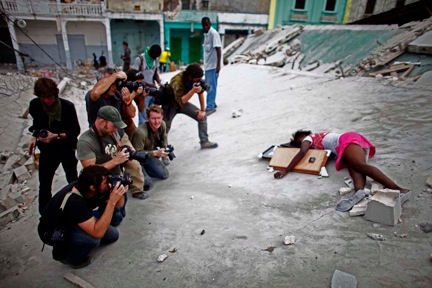
Photo: Nathan Weber
Weber’s image has unsettled many it seems. Judging by garbled Google translations here, here, and here it seems there are a few issues:
– General surprise that Weber’s image – and the revelations it brings – was not widely known before the SPoY award.
– Rhetorical questions about whether – given the scores of photographs made – Hansen’s image was “the best.”
– The expected accusations of exploitation and vulture behaviour by photographers.
– Fruitless thoughts on “truth” within this particular image.
Before they awarded Hansen, I wonder if SPoY were aware that so many photographers were present? Would it have altered the final decision? The image of Fabienne limp on the collapsed roof (whoever made a version) is the summary of innocent death, a society’s desperation and the man-made tragedies that compound natural disasters. It’s is a striking vision.
The circulation of Weber’s image has fueled skepticism toward photojournalism.
The problem with these types of brouhaha is that never are they able to measure if or what effect images – in this case Hansen’s – have. Did Hansen’s image secure a dollar amount of donations for the Haitian relief effort? Did it mobilise professionals and resources that would have otherwise not have moved?
If we are to talk about the “power of photography” then shouldn’t we expect and/or propose criteria for measuring and defining that “power”?
MICHAEL WINIARSKI, REPORTER AND HANSEN’S PARTNER
It should also be noted that Michael Winairski won the the award for News Storyteller from Dagens Nyheter, the national news outlet he and Hansen work for. When I contacted Winiarski last year about coverage of Fabienne’s death, I was particularly impressed with his transparency and commitment to the story. He and Hansen followed up two months after the killing and met with Fabienne’s family.
On receipt of the award, Winiarksi said, “”I’m glad we did not let go of Haiti. I and the photographer Paul Hansen have been back twice. And Paul is down there now with another reporter, Ole Roth Borg.”
ACCOLADES AFTER RECORDING DEATH
Paul Hansen is not the first photographer to be awarded for coverage of Fabienne’s death.
James Oatway won an Award of Excellence at POYi in the Impact 2010 – Multimedia category for Everything is Broken. Fabienne’s corpse open the piece and appears again in images 25 to 33. Olivier Laban-Mattei won the Grand Prix Paris Match 2010 for his coverage of Haiti, including the aftermath of Fabienne’s death. Fredric Sautereau was nominated for Visa d’Or News at Perpignan for his coverage of Haiti, which include seven images about Fabienne’s death.
There may be others.
RIGO 23 recently accompanied Robert H. King (formerly one of the Angola 3, now released), Emory Douglas (printer and legend of revolutionary graphic art) and Billy X Jennings (you HAVE to click that link!), three veterans of the Black Panther Party, on their recent trip to Porto and Lisbon in Portugal.
RIGO emailed:
“Here’s a little clip from the mural I painted at a housing complex south of the River Tejo in Lisbon to commemorate the visit to their community by Robert, Emory and Billy. Robert is a survivor of 29 1/2 years of solitary confinement; Emory Douglas was the Minister of Culture for the Black Panther Party.”
I have mentioned RIGO’s art in support of US political prisoners before. His TRUTH mural in San Francisco marked Robert H. King’s 2001 quashed conviction. RIGO continues to advocate for Herman Wallace and Albert Woodfox, the remaining Angola 2.
He supports Mumia’s ongoing legal battles and RIGO also recently joined Michelle Vignes – a true matriarch of radical documentary photography – for an exhibition in solidarity with Leonard Peltier. (Details and review of the show at the Warehouse Gallery in Syracuse, NY. Closed Feb. 6th)
RIGO conceived of the space as an imaginary museum – The Tate Wikikuwa Museum: North America 2024. Tate Wikikuwa is Leonard Peltier’s Lakota name and 2024 is the year of his next parole hearing. It showcases arts & crafts by the Oglala Sioux and Peltier’s paintings, as well as documents, books, writings and educational material. Making use of Peltier’s colour choices, RIGO created a spiritually and politically charged space.

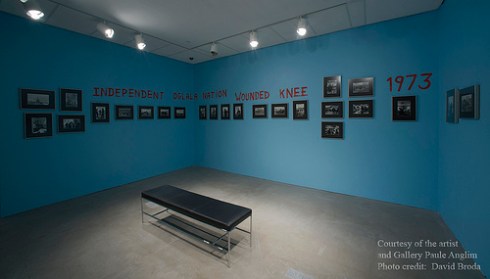
I would have loved to have seen Vignes’ prints of Peltier and the AIM Movement exhibited within the mood set by RIGO’s installation.
For such an important photographer of America’s West Coast counter cultures and radical movements, Vignes does not have a large web presence; there is a paucity of reviews and there are few images too. Next time I’m in the Bay Area, I will have to pay a visit to UC Berkeley’s Bancroft Library which acquired her archives in 2003.
Look out for more about Michelle Vignes on Prison Photography in the future.
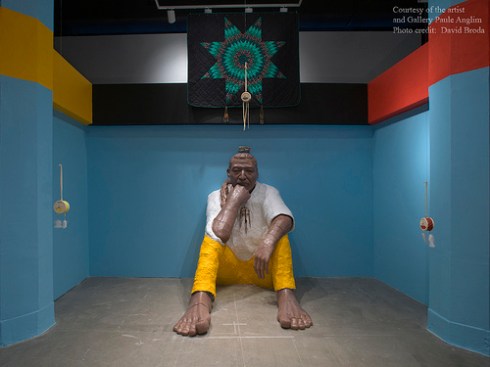
Photo Credits: All images David Broda
(Found via Just Seeds and Bob Gumpert)
PAUL RUCKER
In May of 2009, Paul Rucker partook of a two week residency at the Blue Mountain Center. The theme: Prison Issues.
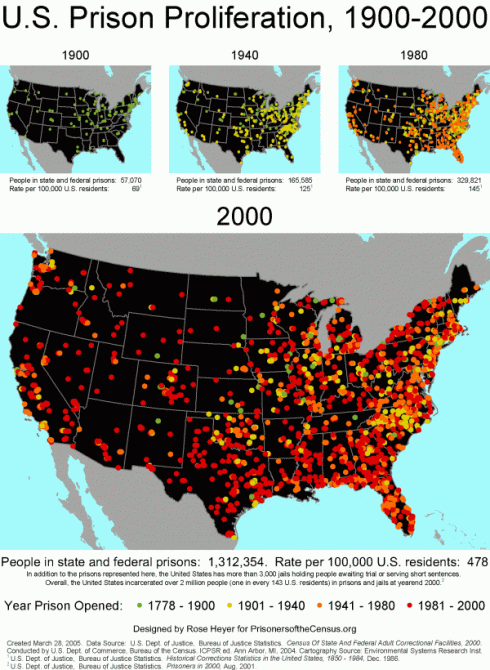
During his research he happened upon some pioneer GIS maps by Rose Heyer which modeled the growth of the US prison system. With the information he composed an original score. A note to accompany each carceral outpost to blink into existence in the “Land of the Free.”
232 years in 10 minutes and 45 seconds.
ROSE HEYER
Incidentally, Rose Heyer is a wonderful thinker. She developed the GIS methodology for the Prisoners of the Census project, enabling quick calculations of how Census Bureau’s prison miscount distorts representative democracy.
Heyer produced the map U.S. Prison Proliferation, 1900-2000 and she co-authored Too big to ignore: How counting people in prisons distorted Census 2000, Importing Constituents: Prisoners and Political Clout in Massachusetts Importing Constituents: Prisoners and Political Clout in Texas, Importing Constituents: Prisoners and Political Clout in Ohio, and Thirty-Two Years After Attica: Many More Blacks in Prison but not as Guards. Rose is now GIS and CAD consultant in California.
(Source)
Following up on my post about Julie Green’s The Last Supper, I think it is necessary to make an overview of the photography and painting projects that consider America’s death penalty by meals of depicting last meals and last meal requests.
Celia A. Shapiro
Shapiro’s recreations of last meals in lurid colour are possibly the best known within this subject matter. She made the series Last Supper in 2001. Of Shapiro’s work, critic Fred Ritchin said it proves the US only executes poor people. Ritchin’s position might be true, but as Julie Green reminded me most inmates, particularly in Southern states are limited to food from the prison kitchen and usually to a budget of $20. States that rarely employ the death penalty offer a generous $50 or no limit at all.
In all their garishness, Shapiro’s works are reminiscent of Martin Parr’s work. Parr too photographed the food of the poor; fish and chips, cupcakes, bangers and mash and trays of tea. Whatever Parr claims about objectivity there is a snide judgement in his work. Indeed it is his strength that his pictures show us the true absurdity of many of our dietary mores.
Shapiro’s work disgusts me. It disgust me in a good way. It angers me. Each of Shapiro’s images represent a life extinguished … gassed, cooked, fried. It’s hard to stomach. Good art evokes strong response.

John William Rook, age 27, executed by North Carolina, 9/19/86. © Celia A. Shapiro
James Reynolds
James Reynolds‘ Last Suppers was well received in 2009 but the interest in his birds-eye view still-lives seemed short-lived. I suspect they were appreciated more for their unorthodox view of a infrequently seen subject and for their role as conversation starter, than they were as lasting pieces of art.
The visual discipline of the institutional orange trays of containing in most cases a bizarre allocations of food, fairly reflects the irrationality of a state killing a citizen.
There is something maddening and suffocating about Reynolds’ ordered still-lifes. The demarcated space of the foodstuffs reminds me of aeroplane meals. For the executed it all comes down to a tightly presented meal, and this is meal is absurd.

© James Reynolds
Jonathon Kambouris
Jonathon Kambouris‘ efforts with The Last Meals Project is roughly contemporary with Reynolds (completed over 2009/2010). Judging by the shadows to the chicken legs, cups of coffee, Kambouris places food items ontop of a blown-up mugshot of a (infamous) inmate mugshot and makes the photograph from directly above, looking down.
Kambouris is tying his desire for a debate about the death penalty to the most renowned and media-coveted men and women. I am not convinced this is a good tactic as (whipped up) emotions about serial killers is not the place to begin a rational discussion on the symbolic foolishness of the death penalty. I think a better place to start a progressive debate – at least within the framework of art – would be Taryn Simon’s The Innocents or the painter Dan Bolick’s Resurrected. The existence of innocence on America’s death rows is a powerful argument working in favour of death penalty abolition.
One footnote to add is my astonishment at Kambouris’ statement at Feature Shoot: “In 2010 this photo essay traveled to Singapore to be shown in the Singapore Fringe Festival: Art and the Law. Ironically, Singapore has an extremely strict death penalty stance and I was informed that it is part of school curriculum to watch an execution take place.” Kids spectating murder? Can that be true?
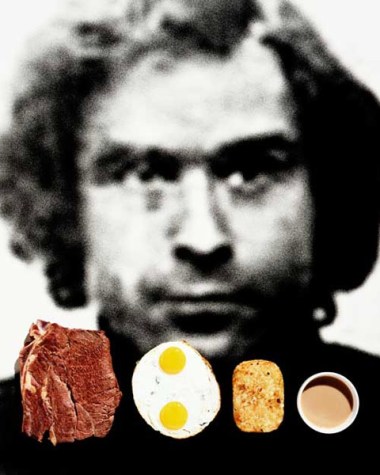
Name: Ted Bundy; Last meal: Steak, eggs, hash browns, coffee; Sentence: Death by electric chair; Executed: January 24, 1989, 7:16am; State: Florida. © Jonathon Kambouris
Mat Collishaw
Mat Collishaw goes all Flemish Master on his last meals. Except it isn’t the girl with the pearl earring chomping down on that lettuce it was Karla Faye Tucker a few hours before she was lethally injected by the State of Texas in 1988. Flemish still lives were part allegories of life, death and cycles of nature but frequently used items of trade as story telling devices. Knowledgable viewers would identify flowers or precious metals from across the globe brought by the Dutch merchants that dominated sea-trade in the 16th and 17th centuries.
In the age of supermarkets and year round strawberries, the global food trade and who runs is of little significance. The inference in Collisaw’s work is that America trades in sublime murder.
Found via Art Most Fierce.

Karla Faye Tucker (2010). C-Print, 73 x 60 com (29 x 24 inches) © Mat Collishaw
Jacquelyn C. Black
Black’s … last meal … (Courage Press, 2003) is a curious little publication. It is clearly an act of conscience. The studio photography is very literal without the interpretation we see in other artists’ works. I cannot be sure Black’s prints have ever gone on exhibition. Black pairs images of last meals with text of last statements.
When one is looking at photography in order to draw critical conclusion, it is often the absence if photography (or more precisely, the presence of something unexpected) that can provide the Eureka! moment. I am somewhat desensitised to the issue of state violence; I suspect the emotive response Black and her peers expect of the viewer, I do not deliver. It was therefore, an absent image and text in its place that caught my attention and really drove home the spiteful retribution of execution:
ASKED THAT HIS FINAL MEAL BE GIVEN TO A HOMELESS PERSON
(REQUEST DENIED)
… last meal … includes valuable auxiliary material – on the history of capital punishments; on statements made in landmark legislation; and on US death penalty statistics. Black also lists political resources for anti-death penalty activism.

Name: Anthony Ray Westley
Executed:May 13, 1997
Education: 8 years
Occupation: Laborer
© Jacquelyn C. Black
Barbara Caveng & Ralf Grömminger
Glowing like fast food menu boards but with the deliberateness of illustrations in a noodle bar, Grömminger’s photographs mounted in lightboxes for Caveng’s Final Meals installation are a bit pop. Any illusion of vitality is deflated by the procedural details of the eater’s execution.

Detail from ‘Final Meals’, installation by Barbara Caveng, 2000. Backlit boxes: Steelcases (40 x 40 x 18cm) with a pane on one side to pull, showing the execution protocol. Two audiostations with final statements. Meals photographed by Ralf Grömminger
Kate MacDonald
“The leftover table scraps relate the humanity of the condemned to our own ordinary experience,” says Kate MacDonald of her painted Last Meals series. That’s a bit poetic for me. More powerful is the fact these plates are empty. The remnants of sauce and chicken bone are primordial and bloody. Just as these items were devoured, so too will be the body that consumed them. Despite the polystyrene cup and plastic cutlery there is something very animalistic about MacDonald’s oil paintings.
Last Meals featured in the Texas Moratorium Network’s exhibit Justice For All? Artists Reflect on the Death Penalty, in which MacDonald and peers considered the injustices embedded within the death penalty; “Mental health and lack of advocacy, racial discrimination, poverty, and at the issue’s most basic argument, the possible innocence of the executed.”
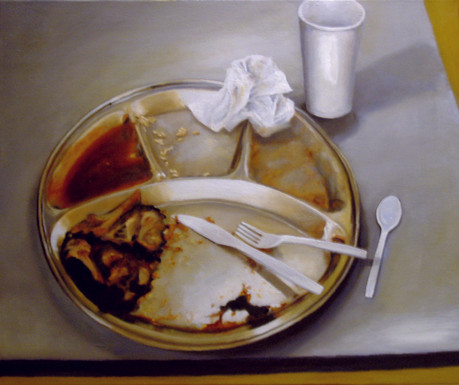
The last meal of Ruben Cantu, believed to be wrongfully convicted and executed in Texas. (24 x 20 inches), oil on canvas. © Kate MacDonald
As of May 2009, there had been 1165 U.S. state-sanctioned executions since 1976.
– – – – – – – – – – – – – – –
UPDATE: August 19th 2012
Two more projects.
Helen Grace Ventura Thompson
Ventura Thompson’s website. Her work in The Guardian. My thoughts.

© Helen Grace Ventura Thompson
and
Julia Ziegler-Haynes
Ziegler-Haynes’ website. Her work.

© Julia Ziegler-Haynes
– – – – – – – – – – – – – – –
UPDATE: December 14th, 2012
Henry Hargreaves
Hargreaves‘ No Seconds is a series of 10 stark photographs that re-create last meals alongside the name, age and conviction of the murdered individual. See more of his work on Raw File, Wired.com

© Henry Hargreaves
– – – – – – – – – – – – – – –
UPDATE: January 29th, 2013
Patrick Guns
For My Last Meals, 2007-2009, Guns asked 54 chefs to interpret 54 last meals.
“From this list of last meals, I asked renowned chefs to choose a meal according to their affinity for cooking and to recreate these last wills without any fear of asserting their own Humanism. As a tribute to a deceased man, their creations are more concerned about Man than about the Cook,” writes Guns.
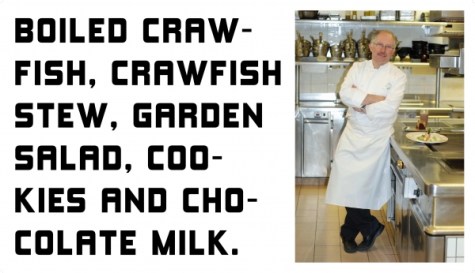
© Patrick Guns
– – – – – – – – – – – – – – –
If you have any other projects that need adding to the list, please get in touch.
– – – – – – – – – – – – – – –
For all sorts of reasons, my life is a whirlwind right now.
With regard Prison Photography and what it all means, might mean, things are tabled for renegotiation. Rejigging.
The renegotiation is in thinking of more creative ways to share new content, but also leverage old content to make it available to interested parties.
A complete redesign of Prison Photography is on the cards; old interviews and criticism would resurface again. But overhaul is not scheduled within the next year. In the meantime, there exist novel means to share the archive of information on Prison Photography.
This week, I made the trip to Coventry University to guest lecture for the Picturing the Body (#PICBOD) course. Course leader Jonathan Worth is a lesson in enthusiasm. With the backing by Jonathan Shaw and the assistance of Matt Johnston along with a host of others within and beyond the photo deptartment’s walls, Jonathan Worth is creating something wholesome, giving and pioneering.
Worth and his collaborators are building a model for free, online photography curricular in criticism and practice for both BA and MA students; students in Coventry and across the globe.
My presentation ‘Tattoos, scars and tears, Robert Gumpert’s work in San Francisco jails’ (which you can listen to here) focused on Robert Gumpert‘s ever developing project ‘Take A Picture, Tell A Story‘. As an introduction and to provide context to Robert’s work, I summarised the work of photography within sites of incarceration throughout the history of the medium.
Following the lecture, Jonathan Worth suggested the introduction alone could constitute a lecture. I would venture farther and say it could warrant a full course in itself.
I’m writing a few syllabi presently and – in the spirit of #PICBOD – I realised I should be sharing my notes.
So, here they are … on a cachable page for perpetuity.
A BRIEF HISTORY OF PRISON PHOTOGRAPHY (IN LOOSE CATEGORIES)
Before the golden age of photojournalism, the photographing of prisoners was used for purposes of identification, order and discipline. The two part mugshot (front view and profile view) was standardised by Alphonse Bertillion. Police departments adopting the system had in-house technicians and photographers but they are anonymous in history.
Remarkable archives by anonymous police photographers exist the world over, but two noteworthy collections are in New Orleans and Sydney.
American prisons fell on to the radar of professional and committed photojournalists in the sixties and seventies, more and more. Three Magnum photographers (Eve Arnold, Bruno Barbey, Danny Lyon) went to Texas. Arnold returned to the subject again and again. The Lone Star state had a punitive prison culture with reform commonly taking the form of hard labor on the chain gang; images echoed those of slavery in the South.
The “exotic” prison (Late 70s, 80s, USA):
Morrie Camhi’s photographs of California prisoners remain some of the most authentic portraits made within US prisons. Douglas Hall Kent, spent years and published at least two books on prison tattoos. Garry Winogrand stopped by Huntsville for the prison rodeo. The much lesser known Ethan Hoffman produced a book titled Concrete Mama about Walla Walla Penitentiary in Washington State. The brutality and tenderness of interactions between prisoners as depicted by Hoffman are surprisingly frank.
Pioneers in prison documentary photography/photojournalism (1980s and 90s in USA):
Cornell Capa (Attica, NY, USA); Taro Yamasaki (Michigan), Ken Light (Texas), James Nachtwey (Texas and other Southern states), Bruce Jackson (Arkansas), Alan Pogue (Texas).
Contemporary to the Americans (above) was the anomalous Jean Gaumy. In 1976, Gaumy was the first photographer allowed access to a French Prison.
Contemporary prison photography (1990s, 2000s):
Lori Waselchuk (Angola, Louisiana), Ara Oshagan (California juveniles), Victor Blue (California), Andrew Lichtenstein (multiple states).
Collaborative/rehabilitative projects (2000s):
Casey Orr (Leeds, England), Mohamed Bourouissa (Paris, France); Deborah Luster (Louisiana, USA), Klavdij Sluban (France and Eastern Europe), Mikhael Subotzky (South Africa), Steve Davis (Washington State, USA); Robert Gumpert (San Francisco, USA); Leah Tepper Byrne (USA)
Eastern European and Former USSR (Late 90s, 2000s):
Much of the photography from the former Soviet bloc is characterised by the grey abandonment of it all. Into the new millenium, younger photographers took less documentary approach with more nuanced fine art engagement with the inmates of Russia and its satellites. Examine the work of Christian Als (Latvia), Carl de Keyzer (Siberia), Yana Payusova (Russia), Sasha Maslov (Ukraine); Delmi Alvarez (Latvia) and Jane Evelyn Atwood.
Western Europe:
Generally, a more tactical use of technique and viewing from photographers such as Nico Bick (Netherlands), Juergen Chill (Germany), Matthieu Pernot (France and Spain), David Moore (London, UK) Danilo Murru (Sicily and Sardinia); Lizzie Sadin (Multiple countries); and Melania Comoretto (Italy).
Guantanamo (2002 – ):
Many photographers have addressed Guantanamo including Paolo Pellegrin, Brennan Linsley, Tim Dirven, Chris Maluszynski, Bruce Gilden, Louie Palu and Christopher Sims. Above all others, Edmund Clark has made the best contribution with emotive images from former detainees’ homes, letters of the detainees and an extremely engaging essay from Dr. Julian Stallabrass.
Political memory (20th and 21st centuries):
Donovan Wylie (Northern Ireland), Paula Luttringer (Argentina), Dana Mueller (US POW camps), Phillip Lohoefener (East Berlin Stasi prisons) and Anna Schteynschleyger (Former USSR).
Archives of Atrocities:
Willhelm Brasse, known as the Photographer of Auschwitz during WWII; the photographers of Tuol Sleng in Cambodia during the Kymer Rouge regime (1975-1979); Victor Basterra, Naval Mechanics School (ESMA), Buenos Aires, Argentina during the Dirty War (1976-1983)
Conceptual:
Chris Jordan‘s large digital composites that stack 2.3million prison uniforms upon six floor-to-ceiling cnavases approach the depressing scale of US incarceration. Featured in ‘Invisivle’ a summary of his first ten years or so probing military and state secrets, Trevor Paglen “stalked” previously clandestine extrajudicial prisons used in the global war on terror. Broomberg and Chanarin, on a tour of Afghanistan rolled-out sheets of photographic paper on days of historical importance, in one case a jail-break.
Africa (21st Century):
Without exception the photographs of African prisons focus n the deplorable conditions, the mistreatment of children and usually both. Julie Remy (Guinea), Fernando Moleres (Sierra Leone), Lynsey Addario (Uganda & Sierra Leone), Nathalie Mohadjer (Burundi), Joao Silva (Malawi).
INQUIRY NOT GENRE
Given the breadth of photogs’ motives and the different uses of these images it is foolhardy to think of prison photography as a genre. I have taken to calling it a ‘non-existent’ genre.
The website Prison Photography is an inquiry, primarily into the uses and abuses, creation, consumption and distriubtion of images within highly politicised institutions. The photograph is only the beginning.

Nieman Labs reports:
“Starting in February, The Atlantic will have a new section on its website: In Focus, a photography blog featuring “photo essays on the major news and trends of the day.” Editing the site will be Alan Taylor, who’s moving to the magazine from the Boston Globe, where, for the past two-and-a-half years, he edited Boston.com’s celebrated photo-essay feature, The Big Picture.”
The incredible thing about this story is the figures it detailed. The Big Picture had 8 million page views per month. That is an incredible number of eyes on an incredible number of images. Rather naively, I’d never imagined that scale of internet image distribution … and I don’t really know what it means.

Cast of One Flew Over the Cuckoo’s Nest posing for their photograph on location at the Oregon State Hospital, Salem, Oregon, 1974. © MaryEllen Mark.
MARY ELLEN MARK
Mary Ellen Mark first went to Oregon State Hospital (OSH), Salem, OR in 1974 to photograph the cast and set of Milos Forman‘s 1975 adaptation of Ken Kesey’s novel One Flew Over the Cuckoo’s Nest. (Mark often shot on film sets).
During the filming, Mark met the women of Ward 81. She promised to return and after over a year of negotiations with the hospital authorities and families of residents she was allowed to live on Ward 81 with writer Karen Folger for 36 days. American Suburb X has republished Folger’s essay for Mark’s book giving a familiar and surprising account of the routines and dreams of the women on Ward 81.
Mark’s book was a breakthrough. Granted, photographs of Oregon State Hospital existed previously, but Mark’s work was a pioneer intimate portrait of an American group outside of the dream, outside of the reality. LIFE magazine had covered an OSH camping trip before. Oregon Historic Photograph Collections have 14 images of OSH.

Horsing around. © Marl Ellen Mark, 1974
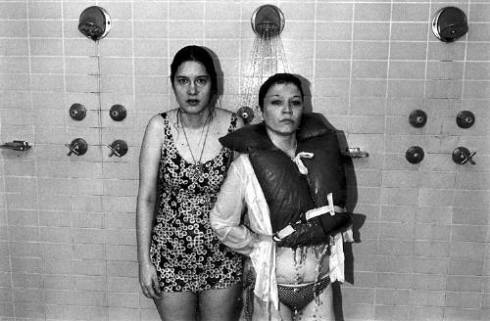
© Marl Ellen Mark, 1974

Mary Frances Peeking from Tub, 1976. © Mary Ellen Mark.
Mark’s Ward 81 was a personal call to action; she cared deeply about the residents and wanted to use photography to describe their lives. Mark contends in all interviews I have read that the treatment of patients was good and fair.
Prison Photography has touched upon institutions developing an “art” persona overtime through the work of several art photographer, specifically Stateville Prison, Joliet, Illinois. The architectural form of Stateville can be pinned as the common fascination that drew art photographers Gursky, Dubois, Goldberg and Leventi.
Alternatively, the preoccupations at Oregon State Hospital are varied. In some cases, the emergence of a new story to be told and in others an homage to past photographic action at the institution.
DAVID MAISEL
David Maisel‘s Library of Dust is a meditation on the cremains of former OSH patients. Until 2004, the urns were locked in a basement and not public knowledge. The patients died at the hospital between 1883 (the year the facility opened, when it was called the Oregon State Insane Asylum) and the 1970’s; their bodies have remained unclaimed by their families.
Over a period of twenty years the basement in which the urns were locked flooded repeatedly. Studio360 describes well the chemical reactions ongoing between the copper, elements within the ashes and substances afixed by flood water. Maisel’s studies are a “yearbook of the socially dispossessed.”
The Oregonian newspaper won the 2006 Pulitzer for Editorial Writing in its coverage of the forgotten remains and the sad scandal of silence. The story caught the attention of the nation and Maisel’s work toured the country to wide acclaim. Maisel talks about his work here and BLDGBLOG has the best text as entry point to the multiple layers in Library of Dust.
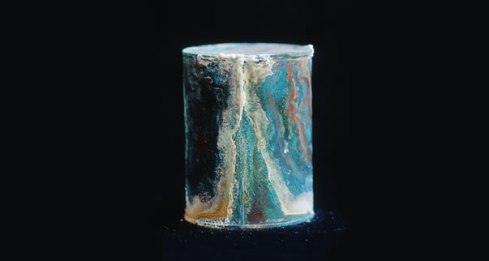
© David Maisel

© David Maisel
The Mental Health Association of Oregon summarises Maisel’s work well:
The tale behind the canisters is indeed deeply disturbing. They hold the remains of 5,121 people who languished in the psychiatric hospital in — many of them for their entire adult lives — for reasons that nowadays might require nothing more than a Zoloft prescription and some couch time. The patients’ conditions listed in hospital records include “worries about sex” and “worries about money” — “things everyone walks around with today,” Maisel says. When these patients died, their relatives either had no money for a burial or no interest in claiming the bodies.
Maisel positions the work within the taboos of “craziness”, “death” but also links Library of Dust to his earlier mineralogical studies. Interestingly, Maisel’s title was first uttered by a custodian of another state institution. Maisel explains:
On my first visit to the hospital, I am escorted to a decaying outbuilding, where a dusty room lined with simple pine shelves is lined three-deep with thousands of copper canisters.
Prisoners from the local penitentiary are brought in to clean the adjacent hallway, crematorium, and autopsy room. A young male prisoner in a blue uniform, with his feet planted firmly outside the doorway, leans his upper body into the room, scans the cremated remains, and whispers in a low tone, “The library of dust.” The title and thematic structure of the project result from this encounter.
While on site, Maisel also made some interior studies of the decaying fabric of the building. The series is Asylum. OSH was shuttered in 2005 and demolition began in 2008. A new facility is slated for completion in 2012.
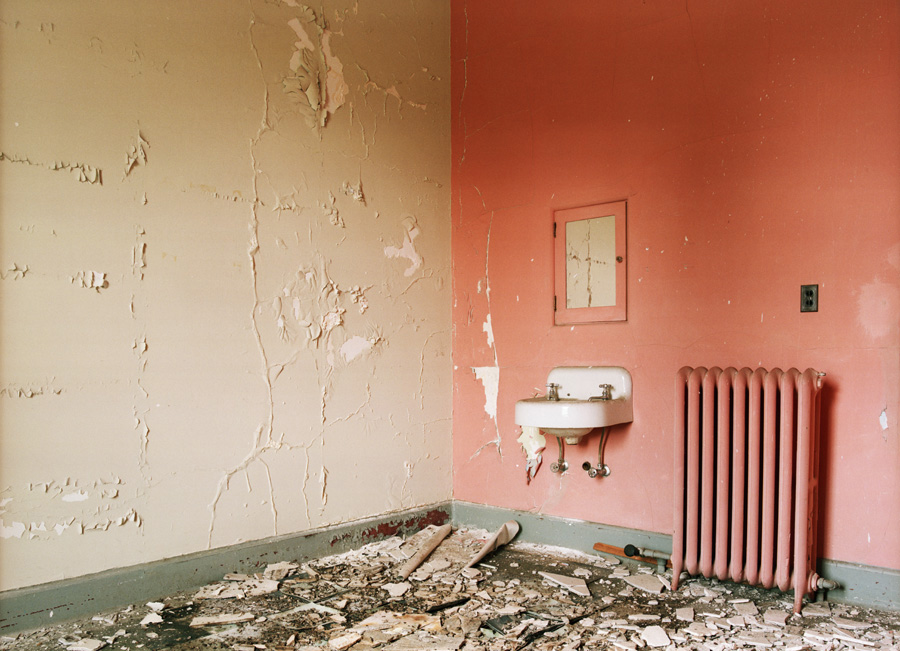
Asylum 2. Doctor’s Office, Ward 66, Abandoned portion of J Building. © David Maisel.

Asylum 3. © David Maisel

Asylum 7. Tubs, Ward 7, Abandoned portion of J Building. © David Maisel
Maisel’s studies of the interior are less complex or politicised as the poetics of Library of Dust. Nevertheless, bare these images in mind as you read on.
CHRISTOPHER PAYNE
Between 2002 and 2008, Chrsitopher Payne took on the largest photographic survey to date of America’s decaying psychiatric hospitals. For Asylum, Payne visited scores of old facilities and OSH was among them.
Interestingly Payne, photographed the storage room of cremains but didn’t extrapolate the stories into a memorial of politics as Maisel expertly did. And once, again the steep sided tiled bath tubs make a reappearance.
Oliver Sacks wrote the essay for Payne’s book. It is a ranging historical narrative of palatial institutions that could provide the best and the worst of care, but in most cases rarely prepared the patient for release back into society, “most residents were long-term.” The essay is accompanied by some wonderful historic postcards and generally Sacks tries to push us away from a narrative of “snake pits” and “hells of chaos” when thinking of psychiatric hospitals.
On Payne’s work, Sacks’ description is exactly how it appears, “[Payne’s photographs] pay tribute to a sort of public architecture that no longer exists. They focus both on the monumental and the mundane, the grand facades and the peeling paint.”
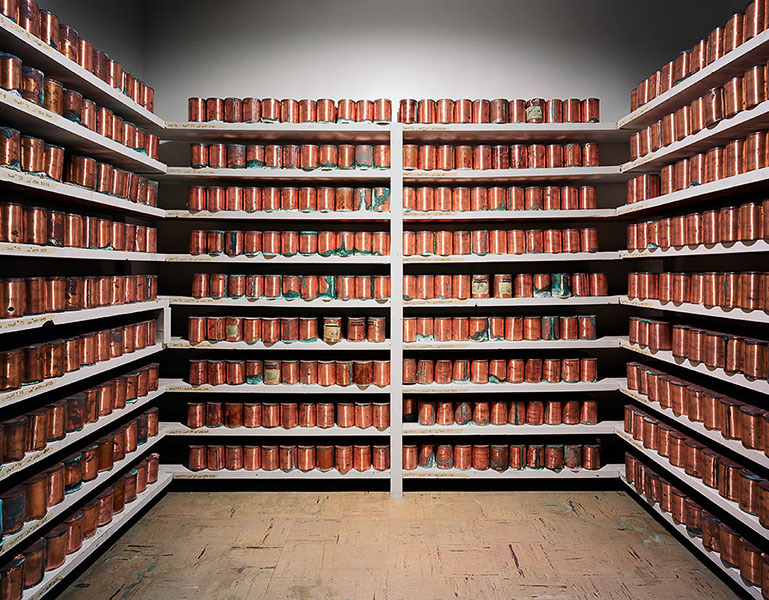
© Christopher Payne

© Christopher Payne
Peeling paint and broken down fixtures is a preoccupation of many a photographer. Architectural enthusiasts, disaster journalists and fine art photogs have all conspired to bring us the genre of “ruin porn” which continues to baffle and frustrate as much as it engages (but that discussion is for another time).
BILL DIODATO
This inquiry began when Bill Diodato contacted me with news of his book release. c/o Ward 81 is a conscious revisit to OSH; a closing of the circle of photographic practice put into motion by Mary Ellen Mark 30 years previous. Indeed, Mark provides the foreword:
‘It’s painful for me to look at these pictures. They evoke feelings of life and death. I can hear the sounds of women running through hallways and someone shouting, “Meds, meds, come and get your meds.” I can hear the crying of a woman being locked down in restraints. I can hear the music of the jukebox at the once-a-week dance with the women of Ward 81 and the men of Wards 82 and 83. Bill’s book brings me back to the haunted cell in which I slept in a deserted ward right next to Ward 81. I swear I heard people walking above me all night. This was so puzzling because the floor was not occupied. Bill’s images confirm the feeling that I always had—that Ward 81 was and still is inhabited by many ghosts. ‘ (Source)
Diodato states that this book is about the “demise of institutional services’ and it’s effect on women.” When Diodato visited both he and Warden Marvin Fickle knew he would be the last person to document the infamous closed-off Ward 81.
c/o Ward 81 is more focused than Payne’s one stop of many on his tour US psychiatric hospitals and it is more intentional than Maisel’s context-giving shots that rightly or wrongly have formed the backdrop to Library of Dust. Diodato is paying homage to the cultural impact of golden-age documentary photography as much as the site itself.
“The physical crumbling and decaying cells, represent the end of old, corrupt, poorly-run asylums and bring about a sense of closure for the women of Ward 81,” explained Diodato by email. But I can’t help think that’s a superimposition of idea upon the images. Mark’s refuted allegations poor treatment of patients in some interviews, yet talks of “hauntings” in the book intro quoted above. OSH did become known for substandard mental health care provision, but was it a constant of the institution, over all its years?
In addition to being a requiem to the occupants, residents and survivors of OSH, Diodato’s images are a requiem to public awareness.
The silenced and invisible lives of the population within OSH and similar facilities is a shameful past. Diodato’s images represent for me a breakdown in social responsibility for one another. How else can we explain OSH’s unclaimed remains for over 5,000 individuals? Families wrote their relatives out of family history just as the old asylums of the 19th and 20th century allowed the public to erase patients from the social fabric.

© Bill Diodato
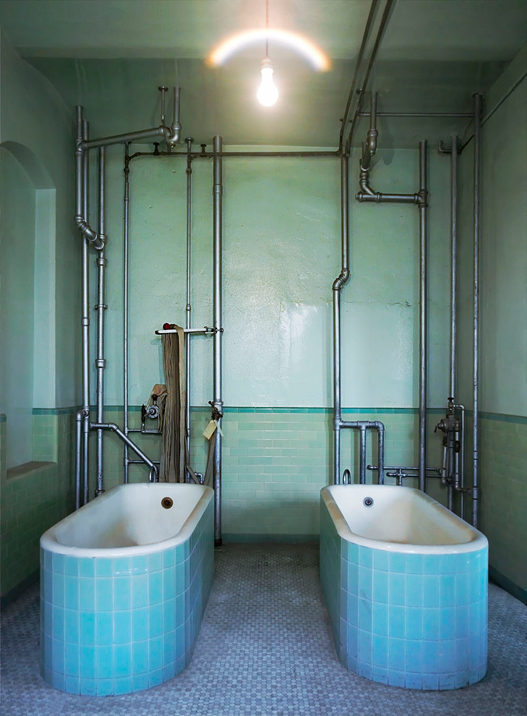
© Bill Diodato

© Bill Diodato
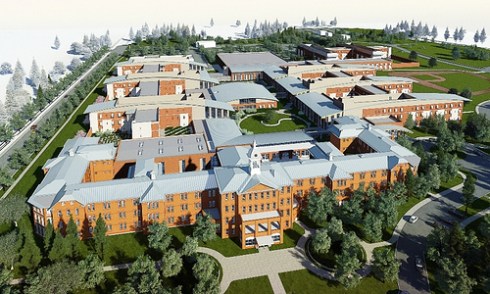
Oregon State Hospital was demolished in 2008. A new era and a new regime of treatment and control is to be established upon completion of the new proposed complex (below). What – if any – will be the photographer’s interaction with the new $458 million complex and its residents?
FURTHER READING
“Mary Ellen Mark – 25 Years” (1990) Pt. I and “Mary Ellen Mark – 25 Years” (1990) Pt. II
Interview: Mary Ellen Mark on Photography (Oregonian)
Interview: The Unfiltered Lens of Mary Ellen Mark


 Prison Photography