
You are currently browsing the category archive for the ‘Visual Feeds’ category.

In a massive 3×9-metre grid, Daniel Schwartz‘s Corrections (above) tiles a satellite view of every facility in the United States’ federal prison system. It’s a literal but effective means to describe the frightening scale of mass incarceration. If we bear in mind that the federal system houses approximately 210,000 prisoners, which is less than one tenth of the total prison population in the US only, then Corrections assumes an even more terrifying edge.
Schwartz created the images, I presume, by means of a customised script based upon the publicly available Google Map API. GPS coordinates inserted into the customised script allow for an automatically captured a satellite view and .jpg of sites (prisons in this case) when the script is run. I make this assumption because this was Josh Begley’s method in creating Prison Map, a similar project.
Corrections presents 1,218 facilities, about one fifth of the 6,000+ locked facilities in the US–including state, county, private and immigration prisons. To present all of the types of all of the United States’ prisons facilities would require a lot of wall space and a lot of double-sided sticky tape. I know this because as part of the Prison Obscura exhibition, I printed 392 images from Josh Begley’s Prison Map. and put them on walls. (See the heavily illustrated point below)
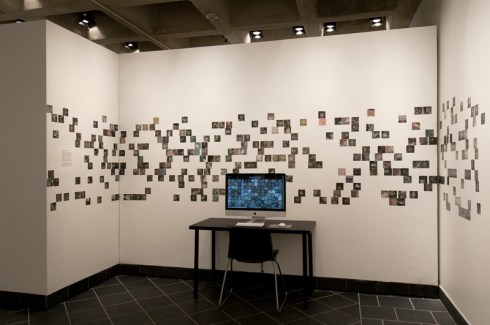
Prison Map, part of the exhibition ‘Prison Obscura’ at Haverford College, PA
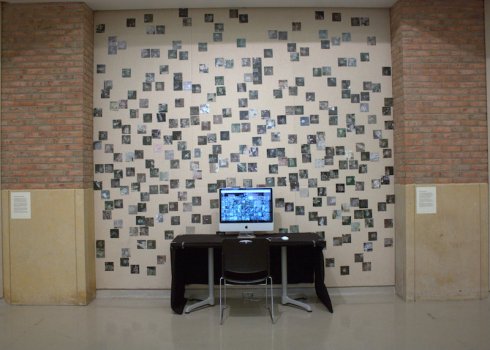
Prison Map, part of the exhibition ‘Prison Obscura’ at the University of Michigan, MI

Prison Map, part of the exhibition ‘Prison Obscura’ at Parsons New School, NY

Prison Map, part of the exhibition ‘Prison Obscura’ at Scripps College, CA

Prison Map, part of the exhibition ‘Prison Obscura’ at Newspace, Portland, Oregon
It was my intention to provide a visual backdrop to the computer/screen/console in the gallery at which people navigated Prison Map. Begley had, up to that point, never printed out the images from Prison Map (he did later make and sell large fine art prints), but physical objects were never the primary purpose of the project. Rather, Prison Map was an experiment how Google Earth could be manipulated to produce an image-set based upon a dataset; an experiment in how a corporation’s empire of images could be bent toward a social justice conversation. I’m speculating on this because I wonder if, after the point of automated capture, Schwartz intended to print out Corrections and stick it on a wall? There are arguments for doing so as valid as those for maintaining it as a virtual user experience. I should give Schwartz a phone-call.
I mention this, also, because there are other parellels between the work of Schwartz and Begley. In tackling the issue and enormity of the US/Mexico border, Begley made the film Best of Luck with the Wall and Schwartz made two accordion books. Both stitched together staellite images that tracked the entire border. One virtual, one physical.
On the topic of gun use, Begley made Officer Involved, which automatically captured Google Street View (GSV) scenes of the sites in which law enforcement officers killed a citizen, and Schwartz made Death By Gun, which maps firearm homicides in Los Angeles County carried out by citizens.
Both Schwartz and Begley are interested in tempting users to reimagine their smartphones’ purpose. Both are interested in having content “enter” the phone in real time. Once installed the Death By Gun app automatically saves the auto-generated images to the camera-roll. Begley’s MetaData+ app sends push notifications to your phone each time a confirmed US drone strike occurs.
Unsurprisingly, these two artists who are connecting the dots between non-human camera operation, emerging datasets and power as it relates to cyber-infrastructure, are both peering at surveillance too. Begley’s Profiling.Is usurps the photographs made by the NYPD during covert surveillance of Muslim owned businesses in New York City. While in Geo-fragments Schwartz uses GSV to automatically compose collages of sites a person (I presume himself) travels to over a 24 hour period based upon the GPS data *broadcast* by his smartphone.
What Now Then?
I’ve discussed the work of Begley and Schwartz at length because I feel they’re heading toward some very fruitful areas in which state and corporate power is challenged, if not subverted. We would do well to follow. Sure, putting the real estate portfolio of the Federal Bureau of Prison on a single wall makes for a stark visual argument–how can you not be effected by prisons filling your entire field of vision? Especially when each tile is only 4×6 inches and still the entirety towers over you.
Bringing the virtual into the real world can be a very canny strategy as Bernie Sanders showed recently in his commandeering of a Trump tweet and printing it out for the house floor. But visual effects work only in one place at one time. By contrast, superpowers’ surveillance and data gathering is non-stop. Consider that a citizen has the capacity to manipulate Google’s benign platforms but the US military has the power to plug in any data set of coordinates and launch a thousand drone strikes.
Beyond the information war in which art is essentially engaged against state and corporate malfeasance, art clearly has limited power. It is here that hacktivism and cyber-insurgence emerge as both tactic and necessity. Begley and Schwartz’s artworks reveal the gross concentrations of power inherent to astronautic surveillance but they do not fight it. They alter public perception of the oppression, but not the apparatus of oppression. Cyber-sabotage that downs, damages or compromises the apparatus is the front line of the fight. What does that mean for artists? Is hacktivism now the most crucial form of resistance? Is hacktivism art? Just spit-balling here.
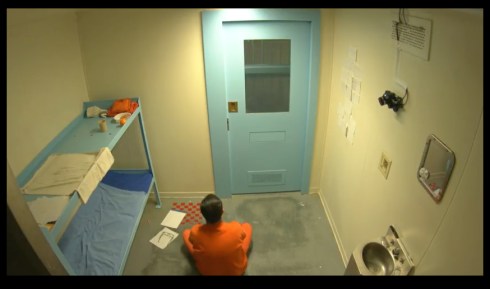
Screengrab from the VICE webpage livestreaming James Burns’ 30 days in La Paz County Jail, Parker, AZ. Captured 02.01.2017
VICE reporter James Burns is spending 30 days in solitary confinement in La Paz County Jail in Parker, Arizona. You can watch any time. He’s into his third week. Why? Good question. Burns has many a good answer. He explains:
Unlike most of the rest of the planet, America embraces this practice at almost every level of the system—local jails, state and federal prisons, mental health facilities, you name it. By most estimates, solitary ensnares 65,000 to 100,000 people at any given time in the United States. Just this past month, a study from Yale Law School carried out in coordination with the heads of state prisons across America suggested nearly 6,000 of them have been in solitary for three years or longer. And like most layers of the American criminal justice system, solitary disproportionately impacts people of color.
It’d be one thing if this practice of confining people in cramped, isolated cells worked—if all the loneliness and human misery had a point. But report after report (and study after study) suggests solitary brutalizes the incarcerated and in some cases may even make them more likely to hurt others when they get out.
I’ve just watched 15-minutes. My immediate response was one of anxiety. Usually when I view a screen it’s with interest in a narrative (documentary film), or for clear information (news broadcast), or for the development of script and fictional character (TV), or the footage is reflexive of itself as a medium (video art), or it’s a quick, cheap laugh (cat GIFs). In other words, there’s always something happening, or about to happen. Or there’s mystery, tension or story arc; something’s coming up and something will change. The livestream puts me on edge because there’s no obvious movement in it, for it. We see everything in Burns’ world and at his disposal and it’s almost nothing. The footage not only holds no change, it inhabits the near-complete absence of any potential for change.
If the cell was to erupt in action, it’d likely be in a moment of Burns’ crisis or breakdown. Watching, I find myself simultaneously tormented by the lack of action but also fearful of anything extreme (because it’ll be very negative) actually happening. If Burns can last the 30 days and the “program” runs its full course I hope Burns can quietly survive.
I wasn’t convinced about the 30-day livestream as a form when VICE launched it on the 14th December, but having spent an hour with it I am greatly intrigued. (As I type have the feed playing in another browser tab, and the audio of Burns pacing his cell passing an orange from one hand to the other)
This isn’t active reporting but it is a full 30-day long report. It isn’t time-based art, but it is without doubt performative and requires investment by, and presence from, the audience. The slow-pace and anti-narrative are very effecting.
We cannot ignore the full cooperation of the jail administration though. Lieutenant Curt Bagby explains La Paz Sheriff departments motives:
“Having cameras in our facility showing any part of the process is an easy thing for us to agree to because we take great care to follow the rules set forth for us by the Arizona guidelines on dealing with our incarcerated population. We are happy to show the general public the way we operate as we have nothing to hide. We understand VICE wanted to highlight the practice of solitary confinement, and we are willing to show how it is done here.”
I and many other activists could list countless prisons and jails in which a month-long live web-feed of a cell would not be considered or carried out. Merely the noise from a disturbance on the tier would be enough to put of most administrations. I don’t know the configuration of other cells and corridors in the pod or the block Burns is in, but I have heard noises from beyond his cell suggesting that a large disturbance would be clearly audible. I take Bagby at his word and I speculate he derives confidence from a belief or measurement that La Paz County Jail is less volatile than other facilities.
After years of conjecture about prison and jail administrators’ attitudes toward cameras, I’m interested to read Bagby’s statement on cameras relationship to transparency and management. It also is a clear indicator that no external factor will dictate the outcome of this experiment. Only mental stress upon Burns will end the confinement prematurely. We wait either for nothing or for total disaster. By occupying this box (at considerable risk to himself) Burns embodies the fact that confining others to solitary results either in absolutely nothing or in the complete destruction of the spirit.

–
It’s not even December, but I’m getting my pick for photobook of the year pick out the way early. My choice for 2016 is the ‘Apple Cabin 2016 Calendar‘ by Sean Tejaratchi.
Advertising is super-weird, but our eyes and minds quickly become accustomed to its garish agenda. We are exposed to 5,000 ads daily. We ambulate through three dimensions constructed from image-planes urging us to buy buy buy.
Some ads are ingenious, most are not, and most follow formulas. Tejaratchi tweaks the grocery-store insert formula with nasty little words and plucky phrases. He shows advertising to be the creepy thing it is. In the Apple Cabin calendar he takes a pop at foodstuffs that are luminous, canned, mysterious. As food-desertification checkers its way across the United States, we’re reminded that many Americans eat stuff closer to Soylent Green than fresh farm greens.
Tejaratchi undermines the footings to advertising generally. The ‘Apple Cabin 2016 Calendar’ is the anti-ad; the anti-Times Square; it’s the opposite of political pantomime; it’s a gross mirror to the fact an orange man-baby tantrumed his way to the White House by means of simplistic and fear-based messaging.
In a rather humorless year, thank god for Tejaratchi.



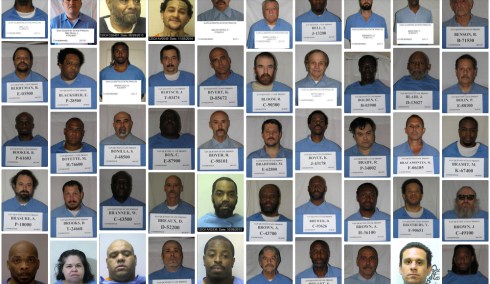
Screengrab from the Los Angeles Times’ interactive feature Should California execute these 749 death row inmates?
–
Pursuant to recent posts about California’s potential bellwether ballot vote to repeal the death penalty and about the grouping portraits of men executed by the state of Texas, here’s an important interactive feature from the Los Angeles Times on the 749 prisoners on California’s death row: Should California execute these 749 death row inmates?
Thirteen prisoners have been executed in California since 1978. A tiny figure in contrast to the 728 men and 21 women currently on its death row. With 749 prisoners, California has by far the largest number of capital convictions of any state.
The Los Angeles Times provides a close look at each condemned prisoner and the crimes that put them on death row. Crucially, for me, they’re using photographs (mugshots) of each as the entry point into the cases. This is a deliberate attempt to put a face to the statistics. I wouldn’t say it is humanizing, but it does hammer home the individuality of each prisoner. Even with each prisoner represented by only a small thumbnail, it is a long, long scroll through the portraits. The effect is chilling. There are a lot of lives at stake and they are, effectively, in our hands. The title Should California execute these 749 death row inmates? is a direct challenge to each of us.
As I outlined earlier this week, California has two competing initiatives on its ballot, Prop 66 would expedite executions whereas Prop 62 would repeal the death penalty replacing it with Life Without Parole (LWOP). For me, Prop 62 is not an ideal solution as LWOP is just another form of state-delivered death, yet Prop 62 could be a step in the right direction if future campaigning against LWOP succeeds. And it does get California out of the business of killing its residents.
In light of this vitriolic, shambolic and bilious Presidential campaign, I guess I’m also relieved to see images that are related to criminal justice being used responsibly and without spin. Of course, that’s what we should expect from journalism. The tone of this news treatment of mugshots runs counter corporate circulation of mugshots for personal, financial gain, and the abuse of people in mugshots by public officials. (Thankfully, Maricopa County in Arizona has ceased its ‘Mugshot Of The Day’ public humiliation exercise).
What do you think about the LA Times’ use of these photographs to inform public debate? Do they help California voters decide?

For its seventh and final stop, Prison Obscura will be on show at Newspace Center for Photography in Portland, Oregon from April 1 to May 28.
(Check out official Prison Obscura website and the PP “Prison Obscura” tag for the background and journeying of the exhibition.)
I’ll be at Newspace for the opening next Friday night, April 1, 6–8pm. I’ll be installing Wednesday and Thursday so stop by and say hello.
Also, on the Saturday afternoon I’m moderating a panel titled Can Images Counter Mass Incarceration? with some of my favourite artists and thinkers. Here’s the Facebook event page and see bolded events’ details below.
THE BLURB (AGAIN)
No country incarcerates a higher percentage of its population than the United States. More than 2.2 million people are currently locked up in the U.S.—a number that has more than quadrupled since 1980. But sadly, the lives lived behind bars are all too often invisible to those on the outside. Prison Obscura sheds light on such experiences and the prison-industrial complex as a whole by showcasing rarely seen surveillance, evidentiary, and prisoner-made photographs. The exhibition encourages visitors to ask why tax-paying, prison-funding citizens rarely get the chance to see such images, and what roles such pictures play for those within the system.
Alyse Emdur’s prison visiting room portraits from across the nation and Robert Gumpert’s recorded audio stories from within the San Francisco jail system provide an opportunity to see, read, and listen to subjects in the contexts of their incarceration. Juvenile and adult prisoners in different workshops led by Steve Davis, Mark Strandquist, and Kristen S. Wilkins perform for the camera, reflect on their past, describe their memories, and self-represent through photographs. The exhibition moves between these intimate portrayals of life within the prison system to more expansive views of legal and spatial surveillance in Josh Begley’s manipulation of Google Maps’ API code and Paul Rucker’s animated video. Prison Obscura builds the case that Americans must come face-to-face with these images to grasp the proliferation of the U.S. prison system and to connect with those it confines.
Prison Obscura is made possible with the support of the John B. Hurford ‘60 Center for the Arts and Humanities and Cantor Fitzgerald Gallery at Haverford College, Haverford, PA.
PUBLIC PROGRAMS
In conjunction with the exhibition, Newspace is hosting a series of events related to the prison industrial complex and the role images play in exposing the structures of the U.S. criminal justice system.
OFFSITE Panel discussion: Can Images Counter Mass Incarceration? Saturday April 2, 2-4pm: Panelists Lorenzo Triburgo, Sarah-Jasmine Calvetti and Barry Sanders. Moderated by me. OFFSITE Location: Native American Student and Community Center, Portland State University (710 SW Jackson St). Sponsored by Portland State University Camera Arts Society.
Discussion: Re-Envisioning Justice: What Is Between Reform and Abolition of the Criminal Justice System?: Sunday, April 24, 4-6pm. At Newspace (1632 SE 10th Ave.)
Community Discussion: The Ethics of Photography: Thursday, May 12, 6:30-8pm, organized in collaboration with the Oregon Jewish Museum. At Newspace (1632 SE 10th Ave.)
All public programs are free, open to the public. Please note event location.
CLASSES
Expanding Photography: Discovering the Stories Behind Your Work: May 9 – May 23, 6:30 -9:30 pm | Instructor: Gregory Parra.
Education Lecture Series: The Screen Politics of Public Projections: May 17, 7:00 – 8:30pm | Instructor: Dr. Abigail Susik.
Build Your Own Pinhole Camera: June 5, 12:00-4:00pm | Instructor: Pete Gomena.
INFO + HOURS
Newspace Center for Photography, 1632 SE 10th Ave, Portland, OR 97214
Mon–Thurs 10am-9:30pm; Fri–Sun 10am-6pm
Facebook | Instagram | Tumblr | Twitter | Vine
For press inquiries, contact Newspace Curator Yaelle S. Amir at curator@newspacephoto.org or 503.963.1935.

–
This is mind-boggling. But perhaps not surprising. It’s another very large leap in AI/robotics/super-computing.
At Google, Tobias Weyand and his team have trained a deep-learning machine to work out the location of almost any photo using only the photo; only the pixels it contains.
They fed the neural network–which they’ve named PlaNet–126 million images along with their accompanying Exif location data. Based upon that info, when fed a new image, PlaNet analyses visual clues (buildings, topography, vegetation, weather, etc) to determine the most probable location.
“PlaNet is able to localize 3.6% of the images at street-level accuracy and 10.1% at city-level accuracy,” say Weyand and co. What’s more, the machine determines the country of origin in a further 28.4% of the photos and the continent in 48% of them.
So that’s 3 in every 100 PlaNet puts right at the front door. 1 in 10, it knows the city, and in over a quarter the neural network correctly identifies the country. Impressive.
–
What’s the future looking like? For the first time, I’m really fretting over the strength of the global human community to make the right–and ever-recurring–decisions on the ethics and control of AI. After a computer beat the world’s best Go player this month, the making of AlphaGo (another Google project) warned against hasty application of AI technologies. Stephen Hawking has been erring caution for decades. AI is still is a long way from applying learning from one system to another so we needn’t worry about self-driving cars learning to control markets or journalism robots changing careers and taking the reigns of power.
But who’s to say that in a few decades, you won’t be able to connect the automated detection of news events in, say, social media, to trigger the dispatch of drones pre-programmed to make photos (behind police tape/above breaking stories/inside toxic environs)? Then the images are sent images to the systems of robot journalists which in turn publish a story in a template. Possible? Maybe. Fine-tune the identifying capacity of PlaNet and you’ve accurate captioning info enough to furnish a news agency … and dispose of the photojournalist!?!
Such a scenario would take care of breaking news, but I’ll still wager on humans, not robots, to fashion the long-form documentary projects. Hell, by then, documentary photography stories might be one of the few things left connecting us!
–
Thanks Robert Gumpert for the tip off
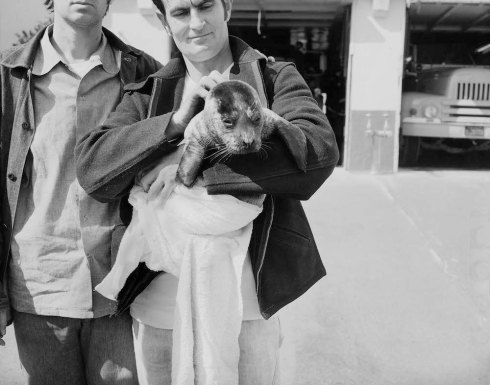
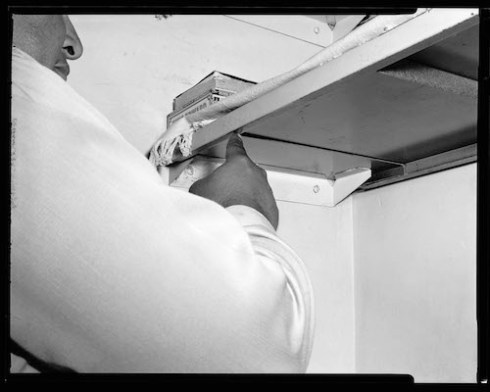
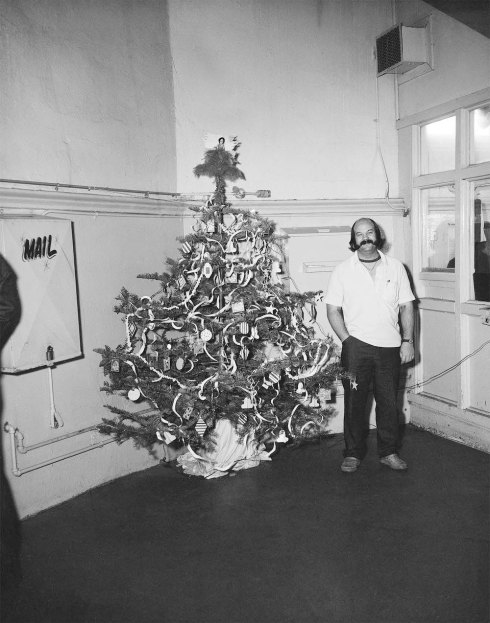
It is every artist, collector or photographer’s dream; the discovery of an archive of thousands of negatives. For artist and professor Nigel Poor, it became a reality. In late 2012, she was making a routine visit to Lt. Sam Robinson’s office in San Quentin State Prison. She’d just finished teaching her class in photo-history and collaborating on image interpretation project with her incarcerated students. Knowing her life in the medium, Robinson pulled out a bankers box.
“He lifted the lid,” recalls Poor. “Inside were hundreds of yellow envelopes that I recognized instantly as those which hold 4×5 photo negatives.”
Poor’s heart “exploded.” More than three years on, Poor has only just finished going through all the negs: she estimates there’s more than 10,000.

In the weeks, after the discovery, Poor took some negatives and scanned them. She showed the prints to Robinson to prove what she could do and he gave her permission to take the entire box. So far, she’s scanned about 600 of the 4×5 negs. There’s four or five other boxes still to scan and categorize.
I anticipate that there’s hundreds of similar archives gathering dust inside cupboards and administration buildings in prisons across the United States. Kudos to the San Quentin authority for empowering Poor to share the finds with a wider public. The archive ultimately belongs, in my opinion in a California State-run Museum.
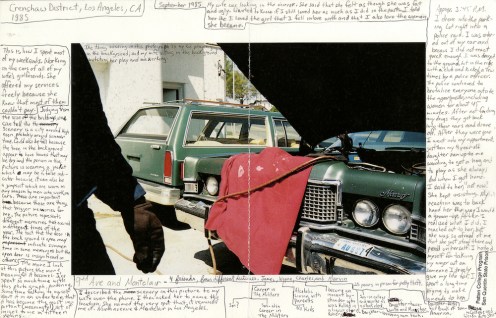


The other wonderful thing that has come out of this is that Poor is using the images as teaching aids. Just as she had done with iconic images from art history (see the William Eggleston, Lee Friedlander and David Hilliard images above), Poor asked her students to deconstruct, examine and interpret the newly-found images from the San Quentin archive. After she had scanned and printed them on card-stock with large white borders, Poor gave them to the men to interpret.
She has given the prisoners first go at interpreting San Quentin’s history. They are writing the latest stories of a very-storied institution.
Read my article about the archive discovery Rarely Seen Images of the Real San Quentin on the Marshall Project. The article was also cross-posted to The Atlantic — Unearthing San Quentin: Resurrected photos capture moments of daily life at the California prison.




 Prison Photography