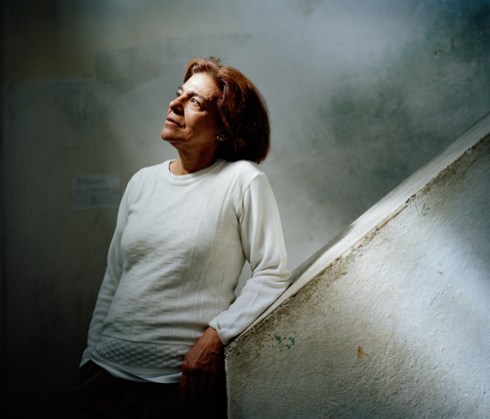
© Maja Daniels

You may have noticed that I like to talk not only about prisons but also about other total institutions.

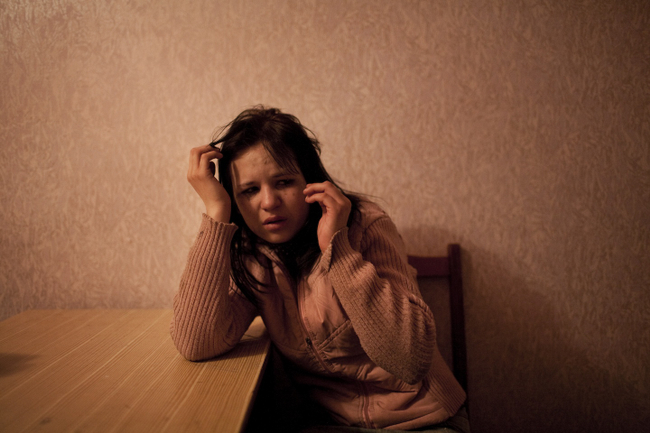
Maja DanielsInto Oblivion photographed on a Protected Unit of a French geriatric care institution “attempts to create a discussion about our institutionalized, modern way of living as well as the use of confinement as an aspect of care.”

Many of the images in Daniels’ series feature patients at the door to the secured wing:

“Ruled according to the “principle of precaution”, residents in the unit can circulate freely within the secured area but due to a lack of activities and a limited presence of carers in the ward, the locked door becomes the centre of attention for the elders who question the obstruction and attempt to force it open. The daily struggle with the door, damaged due to repeated attempts to pick the lock, can last for hours.”

Prostitute & Drug Dealer. © Donald Weber

Last year, Colin Pantall and Prison Photography ping-ponged some responses with Donald Weber about his series Interrogations.

Now, Tony Fouhse at drool has had Weber’s ear.

In an enclosed room of interrogation, subjugation and bullying, audiences are likely – again and again – to pose questions about the photographer’s responsibility … or his sanity … or his stomach. Tony Fouhse does so but in a way to give Weber a platform to explain his approach to photography as it relates to Interrogations:

“I think the only way to get anything of sincerity or honesty is to dedicate yourself to something. I guess it’s an old fashioned concept, this idea of sincerity in an age of strict irony. I am a believer in a very slow working method.”

“I believe there is no judgment in these pictures, and that is what is strong and makes an iota of sincerity. Don McCullin called it the “Composition of Empathy,” a direct counter to the Bresson way of photographing, where often it is about the “Composition of Composition.” I take that to heart, and truly I am just interested in who is in front of me.”

“I am not a stylist or even a very sophisticated photographer, compositions are left to the detritus of the roadside… Time allows you to journey past a superficial creation, to “make” a photograph really isn’t that difficult, but to move beyond, and try to offer at least a glimmer of your subject, who they, what they feel, what they think, is the mark of a great photograph.”

Read the full interview.

____________________________________________________________

Donald is represented by the photo agency Vll Network. Donald Weber’s book INTERROGATIONS will be available this fall. Donald’s website is here.

Dvafoto’s Interview: Donald Weber, inside the Imperium from 2008 fleshes out Donald’s influences, philosophy and trajectory up until that point.

Normally, I would be quite skeptical of poetry set to photography, but in this case the blend is stark, current and relevant. Both art forms win in this mix.

In 2009, Susan B. A. Somers-Willett collaborated with photographer Brenda Ann Kenneally and radio producer Lu Olkowski to create “Women of Troy,” which documents the effects of the economic crisis on women living below the poverty line in Troy, New York.

The multi-media Women of Troy combines poetry, photography and audio footage to create “documentary poems” for radio, the web, print and iPhone.

Women of Troy is not a new project so I apologise for those who are familiar with it already. However, if you are not familiar with Kenneally’s work it is you who should be apologising.

Kenneally’s work is possibly the most relevant American photography of the past decade.It is about depressed economies and daily hardships; themes Kenneally has grappled with since long before America’s middle class and global banking began to wither in the global recession. It’s the type of economic disenfranchisement we should be aware of all the time, because depressingly it’s the type of poverty that abides despite the bubbles and bursts of marco-economics.

Untempted by “larger” stories in other lands, she has focused on the difficult lives in her own communities; seven years in Brooklyn, on the border of Bushwick and Bedford-Stuyvesant and since then repeated visits to her home town of Troy in upstate New York.

From 1996 onward, pursuing her Masters in Photography at NYU, Kenneally says, “The education that I got came not from the lecture hall but from the streets in my new neighborhood.”

I was first ware of Kenneally’s photography when I came across her 5-part documentary series on mother and child, Tata and Andy. As a viewer, voyeur, empathetic soul or human in search of solutions, Tata’s monologue for part 3 “The Prison Interview” is very difficult viewing. This and all of Kenneally’s production group can be seen at The Raw File.

Kenneally has made successful use of collaboration and exhibition beyond the usual photo-distribution routes. Her work in Troy began with Upstate Girls, a project that follows seven women for five years as their escape routes out of generational poverty have lead to further entrapment. “I am looking to compile a generational history of the emotional spiral of those resigned to the lower class in The United States,” explains Kenneally.

Kenneally, “The proud aspirations of America’s beginning are seen in stark contrast to Troy’s present social conditions. In 2007 16.3% of all children in Troy were living in households headed by a single female, of these 16% reported income below the U.S. poverty line. Minimum wage jobs with little or no benefits are what most families in Troy survive from. The median income for a family of three is 16,796$.” (Source)

Between The Raw File and Upstate Girls, Kenneally and her colleagues have created a wealth of information. Spend some time.

Lastly, you should check out BagNewsNotes’ recent slideshow with audio commentary from Kenneally. Of which, Kenneally says, “I’ve been trying to figure out why people often feel separated from themselves and their earliest desires and loves and aspirations.”

Further reading

Kenneally on New York Times Lens Blog.

WOMEN OF TROY ELSEWHERE

Kenneally’s photographs and Somers-Willetts poems appeared in the Virginia Quarterly Review. (Fall 2009). Somers-Willett’s Women of Troy poems have aired on the Public Radio International/WNYC program Studio 360 with Kurt Andersen and BBC Radio.

Women of Troy won the Gracie Award from the Alliance for Women in Media in 2010.

BIOGRAPHIES

Susan B. A. Somers-Willett

Somers-Willett holds an A.B. from Duke University, and an M.A. in Creative Writing and a Ph.D. in American Literature from The University of Texas at Austin. She has taught poetry and creative writing at Carnegie Mellon University, The University of Texas at Austin, and the University of Illinois at Urbana-Champaign, where she was an Andrew W. Mellon Postdoctoral Fellow in the Humanities. Somers-Willett has received fellowships from the Millay Colony for the Arts and the Center for Arts in Society, and her honors include the Ann Stanford Poetry Prize, the Robert Frost Foundation Poetry Award, VQR’s Emily Clark Balch Poetry Prize, a Gracie Award, and a Pushcart nomination. She currently teaches creative writing and poetics as an Assistant Professor of English at Montclair State University in New Jersey.

Brenda Ann Kenneally

Brenda Ann Kenneally is a mother and an independent journalist whose long-term projects are intimate portraits of social issues that intersect where the personal is political. She is working to push the boundaries of the social document, using the web as a tool to expand and contextualize her immersion style of reporting. Her many awards include the W. Eugene Smith Award for Humanistic Photography, a Soros Criminal Justice Fellowship, the Mother Jones Documentary Photography Award, the International Prize for Photojournalism, a Nikon Sabbatical Grant, the National Press Photographers Association’s Best of Photojournalism award, and the Cannon Female Photojournalism Grant.

Cast of One Flew Over the Cuckoo’s Nest posing for their photograph on location at the Oregon State Hospital, Salem, Oregon, 1974. © MaryEllen Mark.

MARY ELLEN MARK

Mary Ellen Mark first went to Oregon State Hospital (OSH), Salem, OR in 1974 to photograph the cast and set of Milos Forman‘s 1975 adaptation of Ken Kesey’s novel One Flew Over the Cuckoo’s Nest. (Mark often shot on film sets).

During the filming, Mark met the women of Ward 81. She promised to return and after over a year of negotiations with the hospital authorities and families of residents she was allowed to live on Ward 81 with writer Karen Folger for 36 days. American Suburb X has republished Folger’s essay for Mark’s book giving a familiar and surprising account of the routines and dreams of the women on Ward 81.

Mark’s book was a breakthrough. Granted, photographs of Oregon State Hospital existed previously, but Mark’s work was a pioneer intimate portrait of an American group outside of the dream, outside of the reality. LIFE magazine had covered an OSH camping trip before. Oregon Historic Photograph Collections have 14 images of OSH.

Horsing around. © Marl Ellen Mark, 1974
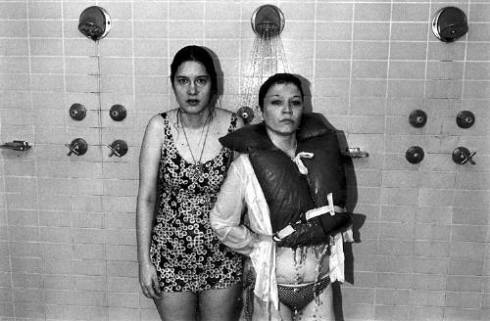
© Marl Ellen Mark, 1974

Mary Frances Peeking from Tub, 1976. © Mary Ellen Mark.

Mark’s Ward 81 was a personal call to action; she cared deeply about the residents and wanted to use photography to describe their lives. Mark contends in all interviews I have read that the treatment of patients was good and fair.

Prison Photography has touched upon institutions developing an “art” persona overtime through the work of several art photographer, specifically Stateville Prison, Joliet, Illinois. The architectural form of Stateville can be pinned as the common fascination that drew art photographers Gursky, Dubois, Goldberg and Leventi.

Alternatively, the preoccupations at Oregon State Hospital are varied. In some cases, the emergence of a new story to be told and in others an homage to past photographic action at the institution.

DAVID MAISEL

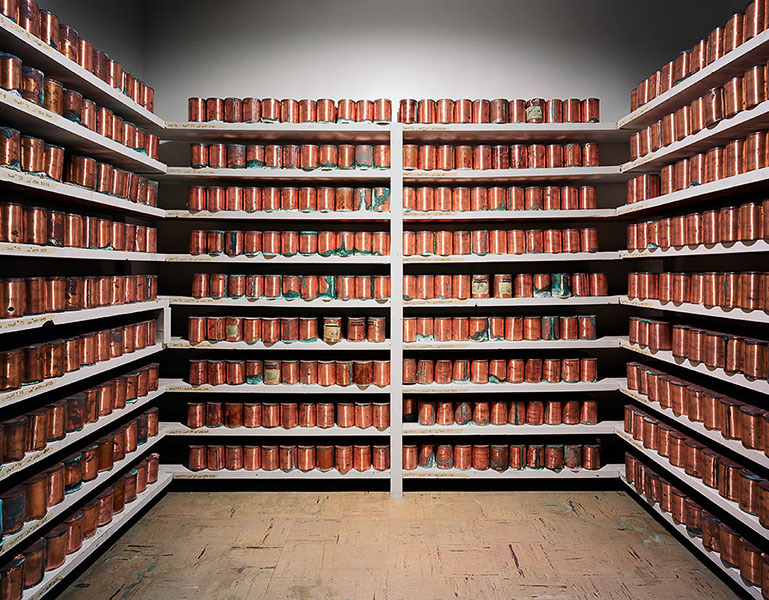
David Maisel‘s Library of Dust is a meditation on the cremains of former OSH patients. Until 2004, the urns were locked in a basement and not public knowledge. The patients died at the hospital between 1883 (the year the facility opened, when it was called the Oregon State Insane Asylum) and the 1970’s; their bodies have remained unclaimed by their families.

Over a period of twenty years the basement in which the urns were locked flooded repeatedly. Studio360 describes well the chemical reactions ongoing between the copper, elements within the ashes and substances afixed by flood water. Maisel’s studies are a “yearbook of the socially dispossessed.”

The Oregonian newspaper won the 2006 Pulitzer for Editorial Writing in its coverage of the forgotten remains and the sad scandal of silence. The story caught the attention of the nation and Maisel’s work toured the country to wide acclaim. Maisel talks about his work here and BLDGBLOG has the best text as entry point to the multiple layers in Library of Dust.
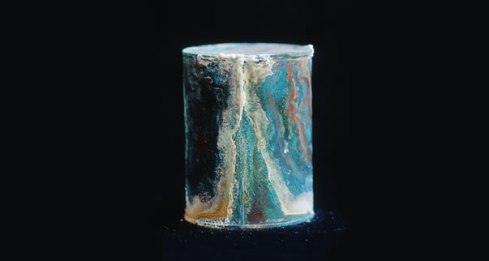
© David Maisel

© David Maisel

The Mental Health Association of Oregon summarises Maisel’s work well:

The tale behind the canisters is indeed deeply disturbing. They hold the remains of 5,121 people who languished in the psychiatric hospital in — many of them for their entire adult lives — for reasons that nowadays might require nothing more than a Zoloft prescription and some couch time. The patients’ conditions listed in hospital records include “worries about sex” and “worries about money” — “things everyone walks around with today,” Maisel says. When these patients died, their relatives either had no money for a burial or no interest in claiming the bodies.

Maisel positions the work within the taboos of “craziness”, “death” but also links Library of Dust to his earlier mineralogical studies. Interestingly, Maisel’s title was first uttered by a custodian of another state institution. Maisel explains:

On my first visit to the hospital, I am escorted to a decaying outbuilding, where a dusty room lined with simple pine shelves is lined three-deep with thousands of copper canisters.

Prisoners from the local penitentiary are brought in to clean the adjacent hallway, crematorium, and autopsy room. A young male prisoner in a blue uniform, with his feet planted firmly outside the doorway, leans his upper body into the room, scans the cremated remains, and whispers in a low tone, “The library of dust.” The title and thematic structure of the project result from this encounter.

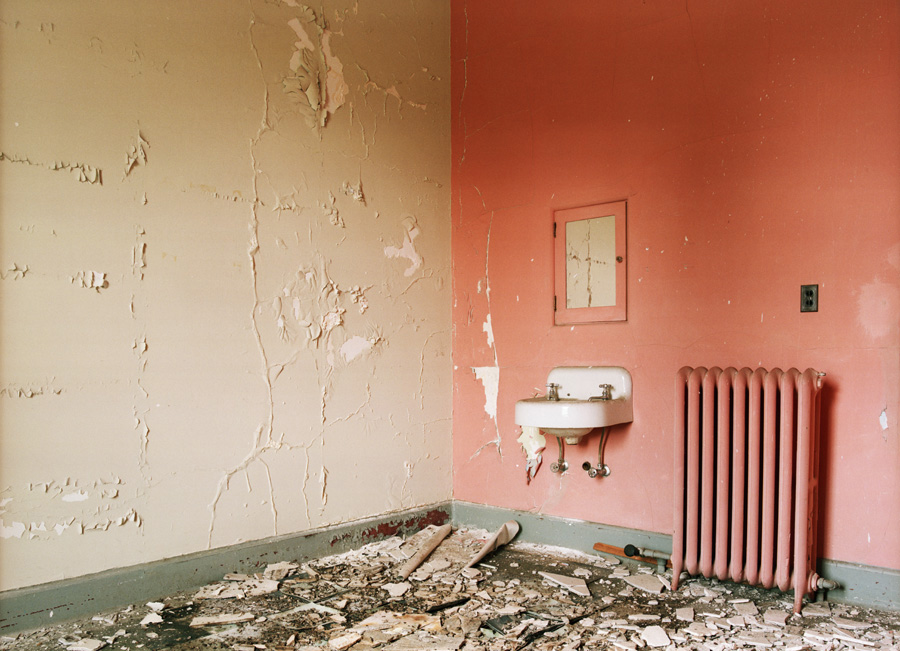
While on site, Maisel also made some interior studies of the decaying fabric of the building. The series is Asylum. OSH was shuttered in 2005 and demolition began in 2008. A new facility is slated for completion in 2012.
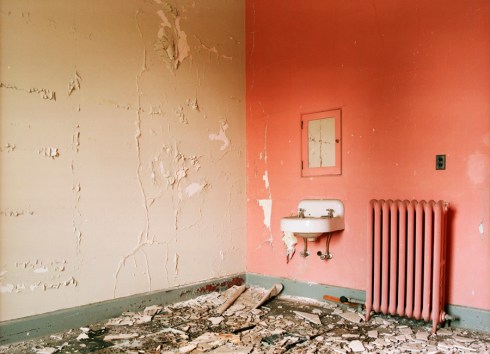
doctor's office, ward 66, abandoned portion of J building

Asylum 2. Doctor’s Office, Ward 66, Abandoned portion of J Building. © David Maisel.
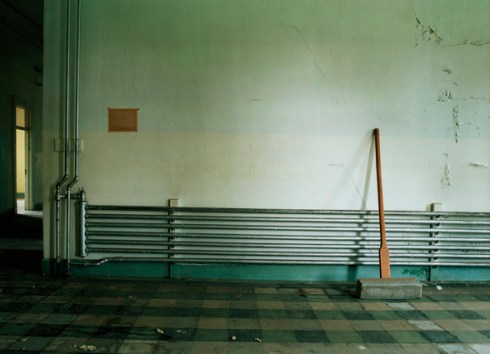
Asylum 3

Asylum 3. © David Maisel

Asylum 7

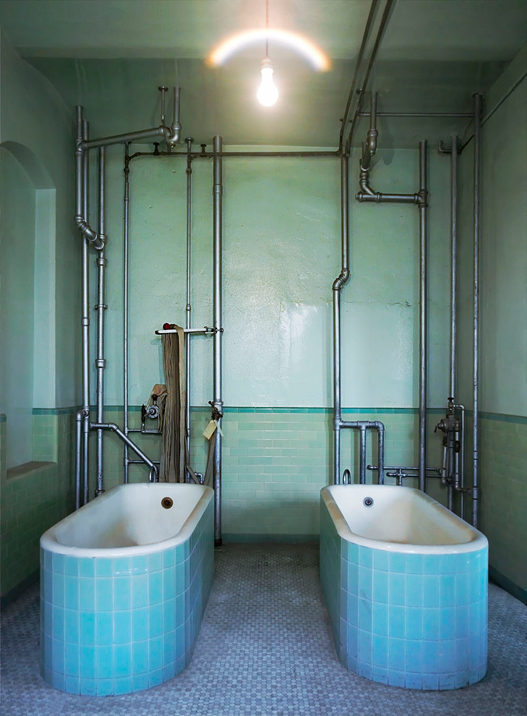
Asylum 7. Tubs, Ward 7, Abandoned portion of J Building. © David Maisel

Maisel’s studies of the interior are less complex or politicised as the poetics of Library of Dust. Nevertheless, bare these images in mind as you read on.

CHRISTOPHER PAYNE

Between 2002 and 2008, Chrsitopher Payne took on the largest photographic survey to date of America’s decaying psychiatric hospitals. For Asylum, Payne visited scores of old facilities and OSH was among them.

Interestingly Payne, photographed the storage room of cremains but didn’t extrapolate the stories into a memorial of politics as Maisel expertly did. And once, again the steep sided tiled bath tubs make a reappearance.

Oliver Sacks wrote the essay for Payne’s book. It is a ranging historical narrative of palatial institutions that could provide the best and the worst of care, but in most cases rarely prepared the patient for release back into society, “most residents were long-term.” The essay is accompanied by some wonderful historic postcards and generally Sacks tries to push us away from a narrative of “snake pits” and “hells of chaos” when thinking of psychiatric hospitals.

On Payne’s work, Sacks’ description is exactly how it appears, “[Payne’s photographs] pay tribute to a sort of public architecture that no longer exists. They focus both on the monumental and the mundane, the grand facades and the peeling paint.”

© Christopher Payne

© Christopher Payne

Peeling paint and broken down fixtures is a preoccupation of many a photographer. Architectural enthusiasts, disaster journalists and fine art photogs have all conspired to bring us the genre of “ruin porn” which continues to baffle and frustrate as much as it engages (but that discussion is for another time).

BILL DIODATO

This inquiry began when Bill Diodato contacted me with news of his book release. c/o Ward 81 is a conscious revisit to OSH; a closing of the circle of photographic practice put into motion by Mary Ellen Mark 30 years previous. Indeed, Mark provides the foreword:

‘It’s painful for me to look at these pictures. They evoke feelings of life and death. I can hear the sounds of women running through hallways and someone shouting, “Meds, meds, come and get your meds.” I can hear the crying of a woman being locked down in restraints. I can hear the music of the jukebox at the once-a-week dance with the women of Ward 81 and the men of Wards 82 and 83. Bill’s book brings me back to the haunted cell in which I slept in a deserted ward right next to Ward 81. I swear I heard people walking above me all night. This was so puzzling because the floor was not occupied. Bill’s images confirm the feeling that I always had—that Ward 81 was and still is inhabited by many ghosts. ‘ (Source)

Diodato states that this book is about the “demise of institutional services’ and it’s effect on women.” When Diodato visited both he and Warden Marvin Fickle knew he would be the last person to document the infamous closed-off Ward 81.

c/o Ward 81 is more focused than Payne’s one stop of many on his tour US psychiatric hospitals and it is more intentional than Maisel’s context-giving shots that rightly or wrongly have formed the backdrop to Library of Dust. Diodato is paying homage to the cultural impact of golden-age documentary photography as much as the site itself.

“The physical crumbling and decaying cells, represent the end of old, corrupt, poorly-run asylums and bring about a sense of closure for the women of Ward 81,” explained Diodato by email. But I can’t help think that’s a superimposition of idea upon the images. Mark’s refuted allegations poor treatment of patients in some interviews, yet talks of “hauntings” in the book intro quoted above. OSH did become known for substandard mental health care provision, but was it a constant of the institution, over all its years?

In addition to being a requiem to the occupants, residents and survivors of OSH, Diodato’s images are a requiem to public awareness.

The silenced and invisible lives of the population within OSH and similar facilities is a shameful past. Diodato’s images represent for me a breakdown in social responsibility for one another. How else can we explain OSH’s unclaimed remains for over 5,000 individuals? Families wrote their relatives out of family history just as the old asylums of the 19th and 20th century allowed the public to erase patients from the social fabric.

© Bill Diodato

© Bill Diodato

© Bill Diodato

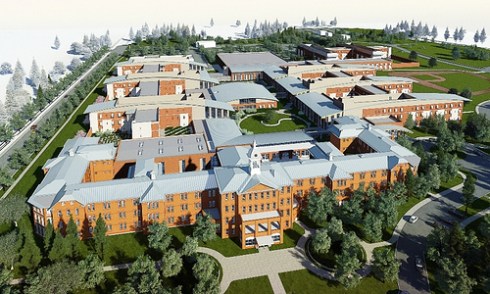
Oregon State Hospital was demolished in 2008. A new era and a new regime of treatment and control is to be established upon completion of the new proposed complex (below). What – if any – will be the photographer’s interaction with the new $458 million complex and its residents?
FURTHER READING

“Mary Ellen Mark – 25 Years” (1990) Pt. I and “Mary Ellen Mark – 25 Years” (1990) Pt. II

Interview: Mary Ellen Mark on Photography (Oregonian)

Interview: The Unfiltered Lens of Mary Ellen Mark

Mona Dancing with a Man, 1976. © Mary Ellen Mark.

“[Gaga] swore and postured during the CES press conference in a way that would have angered [Polaroid cofounder]  Edwin Land immensely.”

“Out of three products revealed by Polaroid from the Lady Gaga Grey Label collection, only one was in its working state. Bobby Sager, the new head of Polaroid, stood beside her dressed in a curious outfit with sneakers on his feet and a cardigan tied around his shoulders. It’s a curious outfit because in reality Sager is a Boston bruiser with a hard-nosed business sense. He ain’t no Lady Gaga loving dilettante whatever image he wanted to pedal in Vegas.”

“The New Polaroid is like New Coke – a terrible idea. It now pumps out crappy television, awful digital photo frames and instant cameras that look like they were designed by some state-owned skunk work in a former Soviet State. Lady Gaga could not care less about Polaroid or its heritage.”

– from, Look away while Lady Gaga molests the corpse of Polaroid

PREVIOUSLY ON PRISON PHOTOGRAPHY

Check out Lady Gaga is Not an Offender, She’s Just Offensive

Jackie Dewe Mathews‘ series Trafficantes, is time spent with women imprisoned for drug smuggling in Brazils’ Sao Paolo Capital Penitentiary for Women. Pretty much without exception, each woman made bad choices, but those were bad choices born of tough lives, low self-esteem and sometimes addiction.

The women come from all over the globe. Dewe Mathews opens the essay with this caption: “Sao Paulo Capital Penitentiary for Women, where women from over 30 countries are held. The largest numbers come from South Africa, then South America, followed by former Portuguese colonies in Africa such as Angola, Cape Verde and Mozambique, as well as Europe, especially, Spain and Portugal and Asia, particularly Thailand and the Philippines.”

Throughout, Dewe Mathews makes efficient use of text-captioning to tell these womens circumstances. Some of the portraits are first class; by first class I mean laden with emotion and character. Other photos can be flat, but the series as a whole is a illuminating look at a hidden world.

Mathews appeared on Verve today, providing the following bio:

Jackie Dewe Mathews (b.1978, England) worked in the film industry as a freelance camera assistant on feature films and commercials. Her continued interest in cinematography has informed her photography practice which she was able to develop during an MA in Photojournalism and Documentary Photography at the London College of Communication in 2007. In 2008 she was awarded the Joan Wakelin bursary for a social documentary project from the Guardian newspaper and the Royal Photographic Society. In 2009 she was selected by the Magenta Foundation for emerging photographers. In 2010 she was a runner up in the Ojodepez and Julia Margret Cameron awards.

More in the Global Post

_____________________________________________________

Thanks to Bob Gumpert for the tip.

Dewe Mathews’ work should be compared with Chan Chao‘s intimate portraiture.

It was with great sadness I heard about Pete Postlethwaite‘s death. He’s a Lancashire lad like myself. He and my dad attended the same teacher training college in London during the sixties. Postlethwaite’s performance in In the Name of the Father knocked me off my seat, making a huge impression on my teenage mind; on what justice was and what injustice could be masked to be.

And, until today, I did not know he was ever an advocate for prison reform.

R.I.P. Pete.

Above clip found at the Prison Reform Trust’s Youtube channel.

The Prison Reform Trust (UK) has also just launched a new website – http://www.prisonreformtrust.org.uk/. As a side note, the new website includes the work of Edmund Clark.

_________________________________________________

EMAIL

prisonphotography [at] gmail [dot] com

Prison Photography Archives

Post Categories