I have just watched Ghosts of Abu Ghraib, an HBO documentary made in 2007 by director Rory Kennedy.

It interviewed all the military police involved and prosecuted for the abuses, with the exception of Specialist Graner who remains in prison. It also features John Yoo, law and military scholars and Mark Danner.

It provides a voice to the military police who were portrayed as “bad apples” on the Abu Ghraib night-shift. It does not allow the military leadership off the hook.

The close of the film concentrates on the fact that no investigation followed the chain of command to the Pentagon, from where Rumsfeld’s Department of Defense had signed off on the most brutal interrogation techniques in US history.

In the first round of Pentagon memos, Rumsfeld questioned why the standing stress position would be limited to ONLY four hours!

IMG_7200

Rumsfeld is a worm and you can quote me on that.

Hunger

During 1981, there were two hunger strikes – the culmination of a five-year protest during The Troubles by Irish republican prisoners in Northern Ireland.

Ten men died.

28 years ago today, 3rd October, the strikes were called to an official end.

“I thought it was about the right policies and the right principle. It is really about the money.”

Jeanne Woodford, Former Warden of San Quentin and Former Secretary of the CDC, on the California prison system.

On one occasion in the past, I drew both criticism and praise for an unapologetically emotive tone. In that instance it was on the colliding social issues of Hospitals, Schools & Prisons.

Yesterday, with Beds in Gymnasiums: Prison Guards and Prison Overcrowding in California, I feel I may have ventured into similar territory as per my thoughts on the California Correctional Peace Officers Association (CCPOA). Consider this post a back up and not a back down of my previous sentiments. Consolidation is good for the soul.

So, allow me to describe two important podcasts I listened to yesterday and today and hopefully the dots will join themselves.

folsomcashplaying

A BRIEF HISTORY OF FOLSOM & CALIFORNIA PRISONS

Folsom Embodies California’s Prison Blues (NPR) traces the decay of the California Department of Corrections from heights I wasn’t even aware of. Apparently, in the late 70s Folsom Prison was the shining light of progressive American prison cultures. All prisoners lived in their own cells, virtually every inmate was enlisted in a program or had a job, and upon release very few of them returned. It was record envied across the US.

Today, over 4,400 men live in the facility designed for 1,800. Folsom is entirely segregated by race. Education, rehabilitation and work programs are down to a few classes with a waiting list of over 1,000. Folsom and California has the worst recidivism rate of any state – over 70% will return to prison within three years.

The real juice of this podcast is the look at the history of this situation: the lobbying millions of the CCPOA, the disguised money, the pandering and the electioneering. Jeanne Woodford, an inspiring and honest inside voice, talks about how the CDC was hamstrung by the CCPOA’s power. Her sentiments are echoed by the Secretary who succeeded her.

LEVEL OF INEQUALITY vs. LEVEL OF AFFLUENCE

For the past twelve months British comic/rabblerouser, Mark Thomas, has made sense of the global recession by interviewing ‘good’ bankers, economists and policy gurus. All of these are available via podcast.

Professor Richard Wilkinson talks about Western nations and their success/failure in providing a good quality of life for their citizens.

The theory backed up by reputable statistics (WHO and others) is that social problems are more acute in countries with the most inequality. Affluence has nothing to do with social harmony. Wide differences in affluence can destroy social harmonies.

CTS022_graph#1#

Wilkinson notes in countries such as Japan, Sweden and Finland the richest 20% are 4 times richer than the 20% poorest. In Britain, US and Portugal the richest 20% are 9 times richer than the poorest 20%. In the more inequitable countries depression and mental health problems are more widespread; there is more friction in family life as reflected in the harshness of the unjust society. Wilkinson questions the psychological landscape of western nations and asks, “What sort of society I am growing up in? Will I be fairly treated?”

Inequality is about dominance – not reciprocity – which explains why the harshest sentencing (subjugation) exists in America – the most unequal of societies. Wilkinson goes on to discuss prison systems and how their harshness is in direct correlation with social inequality. IT’S A MUST LISTEN.

On the increase of the prison population in the US, Wilkinson quotes estimates that only 10-20% of the increase is due to increased crime.* The remainder is due to more punitive sentencing.

In possession of this information, we must think about how crime, sentencing and prisons relate to society – YES, PRISONS ARE WITHIN NOT OUTSIDE OF SOCIETY. And that said, I’ll be making a return on this blog to discussion of our exposure to, and consumption of, images of prisons and prisoners.

*Both the UK and the US have been incarcerating more and more people, while crime has been falling.

Klavdij Sluban and Jim Casper of LensCulture talked about Klavdij’s photography workshops in juvenile prisons across the world.

Klavdij Sluban

Early in the interview, Klavdij discloses his personal sadness that prisons exist. This emotion may be raw but it is not naive; Klavdij is balanced and realistic about what he can achieve with a camera in these specific distopias. He also says in seven words what I established this blog to say “Jails are a world to be discovered.”

He went to the prisons not as photographer, but as a concerned citizen. He realised if he were to go inside it would need to be with some reciprocity … so he took cameras and used them.

In terms of engagement and commitment to a population – the youth prison population of the world – Klavdij Sluban could and should be considered a ‘Concerned Photographer’. He deserves that loaded epithet.

The San Jose Mercury News which, for as long as I can remember, has been the standard bearer for Bay Area reporting on prison issues produced a short multimedia piece on Monday.

Chino

The presentation is mainly a prison official’s description of the conditions, needs and startling figures at California Institute for Men, Chino. This facility was the scene of riots in August. It is also the CDCr Reception Center for Southern California, which means all new men processed into the system will first go here, before given security classification and shipped elsewhere. Of course, the mix of over-population, diverse and historically antagonistic groups, and non-permanence leads to a tense institution.

My main problem with the piece however is that I – unlike the California Correctional Peace Officers Association (CCPOA) – cannot ignore recent history, lobbying, political action committee millions and the resultant harsh sentencing.

Since the 1980s, the CCPOA – the prison guards union – bolstered its membership from 2,600 to over 45,000, drew in union fees to swell its coffers and began hurling them at victims rights groups, tough on crime politicians and public fear campaigns.

The CCPOA grew year-on-year as well as any corporation. It’s shareholders however were not a disparate public, but a 30,000 strong (comparatively) homogeneous group within a burgeoning prison industry and a Napoleon-complex.

Prior to the mid 80s the CCPOA had virtually no political capital. They were a small union in a small state sector … and they were largely ignored. By 1992 the CCPOA operated the state’s second largest PAC. By the year 2000 the CCPOA was the pariah of the union community in California. The CCPOA bankrolled and won ballot initiatives that meant increased prison funding and construction. Other unions, particularly the teachers, were not blind to this boom in incarceration … all the while public education funds dwindled.

All of this is very difficult for me to forget.

When Arnold Schwarzenegger tried to legislate to put a cap on union spending during his first year in office, he was in fact only interested in controlling the rampant CCPOA. It wasn’t a classic anti-labour Republican maneuver but rather the absolute necessary move if California was to reign in prison spending. In some respects it was the politics of a progressive! Schwarzenegger failed doubly. The initiative was heavily defeated and he forced the CCPOA and other unions closer together by virtue of a shared enemy.

The CCPOA took advantage of the situation and stepped back into line with the agendas of other unions. For years it had unilaterally forced its agenda through. But the CCPOA could see the ‘good times’ were coming to an end. No new prisons have been built in California since 1998. That figure explains the overcrowding, but also reflects recent political and public rejection of yet more warehousing without rehabilitation (as has been the norm).

So while we can all share in a dismay, even disgust in the failure of government to provide adequate housing or programs for those it takes into custody, we should all be sharing in the knowledge of how this situation came about. Don’t let anyone tell you otherwise; the CCPOA are guilty as hell – the rank and file change, the leadership less so, but the organisation remains the same.

This is what I think of when I see correctional officers under stress and duress … I think that their union sold them out a long time ago.

The CCPOA made it’s bed.

UC Berkeley’s Dept. of Governmental Studies provides this brief but comprehensive history of the CCPOA.

The San Jose Mercury News has its own Photoblog.

Marvin Heiferman pointed me in the direction Tim Padgett’s Time article about news outlets’ adoption of Mug-shot galleries. Padgett remarks, “Mugshot galleries are increasingly popular features on newspaper websites, which are on a crusade for more page views and the advertising revenue that accompanies additional eyeballs.”

Tampa

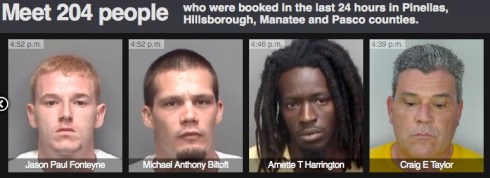
The example offered is that of Mugshots at TampaBay.com of the St. Petersburg Times. The site even breaks down the prior sixty days of bookings into the age, height, weight and eye colour statistics of those arrested.

This exercise is as artless as one would think. The laziness of the filtering of information via an automated platform is matched by the disclaimer regarding mugshots’ accompanying text.

The news group has recognised this and produced these ridiculous FAQ‘s in advance of those booked being disappointed … or worse, misrepresented.

I was arrested but cannot find my mug shot. What gives? Our goal is to provide a complete profile for individuals booked into jail in Pinellas, Hillsborough, Manatee and Pasco counties. A complete profile on Mug Shots constitutes: name, photograph, booking ID, height, weight, age, gender, eye color, birth date, booking date and booking charge.

The majority of arrest records from the county sheriff’s sites have no problems, and we store them and make them available. However, on rare occasions, the photo we receive from the sheriff’s office is flawed, or sometimes the site does not make a photo available. We skip the records that do not have photos attached. You can always search for an individual on the sheriff’s site, but just because you were booked doesn’t mean you’ll necessarily show up on Mug Shots.

I was released and my record was cleared. Will you take down my mug shot? A sheriff’s office Web site maintains publicly accessible arrest records regardless of the disposition of any particular case.One principle behind Mug Shots is to mirror the sheriff’s office Web site policies closely. We provide links from every individual’s profile page to the detail page at the corresponding sheriff’s office site, which contains instructions about how to follow up on any particular case. Much like a county sheriff’s office, there are very few instances in which we would remove a mug shot from the Web site.

Will you fix incorrect biographical information? What if the sheriff does? One guiding principle is to mirror the collective sheriff’s office sites closely. However, sometimes the sheriff’s office site contains a typo or another form of incorrect data. We don’t alter the information that we gather. We do provide links from individual’s profile page directly to their detail page at the corresponding sheriff’s office site.

Continually-updated mugshot galleries continue a long tradition of crime-obsessed media and publics. They are the latest step toward the eradication-of-reason when interfacing with social transgression.

Internet “news” mugshot galleries now dominate a new, middle-ground of visual consumption; that wasteland lies somewhere between the dark pathology (and allure) of Weegee‘s world and the instant digital delivery of crime related stats (think Comp-Stat and the Sex Offenders Registry). They are bland.

These galleries are continuous, and unnecessary, visual feeds of societies’ constructed “bogey-man”.

Street Photography is a recognised genre.

Prison Photography is yet ill-defined. For the most part, it is a series of interventions by camera and operator into the procedures and relations within institutions of containment.

With these criteria in mind – the familiarity of the subject; the public visibility of the practitioner(s); the obstacles to access; and the assumption of existing/distinctive authority – it seems like the two approaches to subject are in opposition.

My presumption my be illustrated as thus:

PrisonStreet

The x axis is Time on the job.

The y axis is The original number of leads (to securing access to your subject) still open. Shown as a percentage.

Danny Lyon spoke out last week about Google books’ disregard for rights, artistic craft and common respect. In Google vs. The Bikeriders he lays out a short and no nonsense argument.

Lyon doesn’t oppose digital distribution of his work – he just doesn’t want it scanned en masse. He wants publishers, software programmers and artists to do the work.

On the existence of books, Lyon warned, “I’d be real careful about messing with this stuff.  I’m not sure I would want to live without them.”

FULL STATEMENT

The Bikeriders 1968, The Destruction of Lower Manhattan 1969, and Conversations with the Dead 1971, were all out of print within two years of their publications. They had all been remaindered by their publishers and would remain out of print for at least twenty years each.

“Conversations” is still out of print. Under Google’s new rules, Conversations with the Dead could be scanned and put on line by Google without even contacting me. Many photo book makers are torn between standing up for their rights, and “being left out” by the Ruler of the Internet.

So what is wrong with having Goggle (sic) bring my out of print work to the world wide web?

1) It is theft. Ownership of out of print work reverts to the author (me). Copyright has worked well in America for centuries and is part of the foundation of our Democracy and the Ist Amendment. I own my writing and my work. They really do have to ask.

2) Picture books are different. You cannot scan them and put them on the internet. Scanning a printed image destroys the beauty of the work which is embedded in the work itself. That is why authors make picture books. They are making a thing of beauty. That is why printers, ink, paper, and publishers and production managers are all so important. They all work  to create a thing of beauty, a book. In this case, as picture book.

There is nothing wrong with putting a picture book on the internet. But that can only be done the way a book is printed, which is to scan the individual images.  It is the difference between “the real thing” and a bad xerox of it.

If they want “Conversations with the Dead” on the internet they have to work with publishers, who employ the people to make the prints and make the scans and recreate the book for internet use, just the way a person makes a good website.

That’s a lot of work that will create a lot of jobs, and it should.

Publishers are the people to do this, as they are in the book business. Google seems intent on destroying the book business and its just possible, that they will.

Books, the printed smelly kind you hold in your hand, have been part of and have helped advance civilization for five hundred years. The Greeks and Ancient Jews used papyrus rolls, which they also held to write on, and to read, 2,500 years ago.  I’d be real careful about messing with this stuff.  I’m not sure I would want to live without them.

I am amazed that Lyon even needs to fight a corner on this. He surely is more valuable to us than scanned copies of his books.

How to tell Google to lay off Lyon’s publications?

__________________________________________________

Danny Lyon’s website is Bleak Beauty.

Here for everything else:

http://www.americansuburbx.com/2009/08/theory-end-of-age-of-photography-by.html
http://5b4.blogspot.com/2007/10/like-thiefs-dream-by-danny-lyon.html
http://www.luminous-lint.com/app/photographer/Danny__Lyon/C/
http://www.scottnicholsgallery.com/artists/danny-lyon/23.html
http://www.geh.org/ne/mismi2/lyon_sld00001.html
http://www.americansuburbx.com/2008/01/theory-doing-life-interview-with-danny.html
http://www.nytimes.com/2009/04/26/arts/design/26kenn.html
http://www.mocp.org/collections/permanent/lyon_danny.php

EMAIL

prisonphotography [at] gmail [dot] com

Prison Photography Archives

Post Categories