
You are currently browsing petebrook’s articles.

Manchester Evening News published a right-objectionable story that’s probably going to get some blood boiling. Thanks to Steve Silberman for alerting me to this via his virtuoso twitter feed (fine editorial nous).
In America there are gangsta’s, crack heads and wild kids. In Britain there are thugs, scallies and pill-poppers – these are broad categories and don’t describe much, but my effort is to say that the two countries have different types of criminal. It is my feeling that the extreme inequalities of American cities breed a certain type of hardened criminal, whereas Britain’s subtler inequalities breed a certain type of hardened idiot.
Few violent offenders have a sociological grasp on why they’ve made the choices they have and often their bare-faced contempt is hard for most folk to stomach. Kane Barratt is a case in point.

This week, after recent sentencing for 5 and a half years, Barratt used a mobile phone to update his Facebook profile from his cell. He changed his staus, chatted with friends and posted two photos. After the Manchester Evening News told the Ministry of Justice about Barratt’s activity the page disappeared from Facebook. The phone was later confiscated.
I don’t want to glorify Barratt’s actions; he is a violent offender who wielded a machete and held it to his victim’s throats. Barratt shows no remorse only bravado in his Facebook antics. Paul Dillon, Barratt’s last victim pondered, probably quite accurately, “He’ll probably come away from this with all his mates thinking he’s some kind of hero.”
That said, Prison Photography‘s charge is to discuss all modes of photographic production within sites of incarceration: “If a camera is within prison walls we should always be asking; How did it get there? What are/were the motives? What are the responses? (Prison Photography ‘About’ page)
Well, Barratt’s camera phone got there because it was not confiscated . One presumes he wasn’t searched at a key moment. I’d suggest the motive was to stay in touch with his friends outside, take the piss (to a degree) and generally showboat when oversight was lax. Predictably, victims and authorities were left aggrieved, offended and embarrassed.
In Britain, as in America, mobile (cell) phone use is banned behind bars. Wired with the aid of Andrew Hetherington recently ran an article on the smuggling and underground economy of cell phones in California. As did Newsweek. I theorised that prisoners strategic adoption of cellphones is the most serious threat AND damaging maneouver to decades of prison management policy. Mobile communications render obsolete much of the advantages brought to controlling prison populations by segregation.
I teach at a Washington State prison and I am generally disheartened by the lack of access prisoners have to books. By law, state departments of corrections must provide access to libraries, but opening hours and actual physical access (within the institutional regimen) are not consistent. Even when prisoners can get to the library, nearly all learning is self directed. Prisons offer GED programs but only one prison in Washington State (Monroe) offers college courses. I believe only one prison in California (San Quentin) offers college courses.
Nowadays, access to a computer is as essential as access to a library for learning. So, while I understand the need to confiscate phones, I don’t want to see all internet connectivity denied. Ideally, internet would be available to prisoners without compromising security. Social networking would certainly be ruled out.

But even if correctional departments could tailor their own prison firewalls, the structure of Web2.0 – and its embedded networking functions – would still allow manipulation by the minority of seditious prisoners. The likelihood of widespread internet access in US prisons is very small.
This situation alone is cause for some chagrin. If one accepts that computers and networks are essential components of contemporary life then their absence within sites of incarceration forges yet another chasm between the life inside and the life of anticipated release.
But then again, in a week when I had glue sticks confiscated on entering the prison, speculation on the provision of internet in prisons is far from the realities of prison life and, regretably, far from relevant …
Lee Grant contacted me a few months ago to tell me of her project Belco Pride – an institutional portrait of the now empty Belconnen Remand Centre. ‘Belco’ was a small facility designed for 17 people, but according to Lee housing approximately 70 toward the end. Officially, the capacity is/was “under revision”.
The remand prisoners have since been relocated to the Alexander Maconochie Centre, which is talked up as Australia’s first prison built in accordance with the Geneva Convention (more on that in a later post).
After inmate rehousing, but before total closure, Grant took another opportunity to tour the facility, “thanks to an open day … billed, believe it or not, as a family event. And the families were out in force …”
Therefore, I was happy to see Lee post a few of her images from the ongoing series. I particularly liked these two pairings which are a wry juxtaposition.


Shortly thereafter my enjoyment turned to bafflement.
In Lee’s description of the open day she mentioned that the phrase “Arbeit macht frei” was clearly visible to all arriving visitors. This flat out shocked me. On Lee’s blog, I commented,
There is no correlation between Nazi concentration camps and modern Australian prisons. The inclusion of the phrase is confusing and offensive.
I had originally mistaken the facility, thinking the quote was on view at an opening for the new prison and not, as the case was, a closing of the old. Still, wonder remains at this crude and ill-advised allusion.
Lee responded;
[I will be sure to post any developments – be they images or elaborations on this peculiar alignment of geography, phrase and history.]
Like Lee, I do not want to judge individuals working in Corrective Services. Instead, I’ll simply say that systems in which workers operate along lines of strict procedure are likely to harbour casual and offensive attitudes. Workers are as disciplined as inmates in all prisons. So when individuals are subject to a system – relieved of actual decision making – there is no incentive to challenge objectionable attitudes.
For the best of the rest, check out Lee Grant’s Op Shop series, which proves that you can change the country and you can change the moniker (charity shop, UK; thrift store, USA) but the look, personnel, wares and atmosphere remain the same.


Granada (Amache) Relocation Camp, Foundations, Prowers, Colorado © Masumi Hayashi. Panoramic photo collage with Fuji Crystal Archive prints, 1997. Size: 23" x 31"
Masumi Hayashi visited every permanent site of Japanese American internment; such was her dedication to its historical truth and visual legacy. I’d like to pay tribute to Hayashi’s artistic rigour, the project and above all her life.

Masumi Hayashi 1945 - 2006
This post is not only a celebration of meaningful photography but also of a life cut short in tragic circumstances.
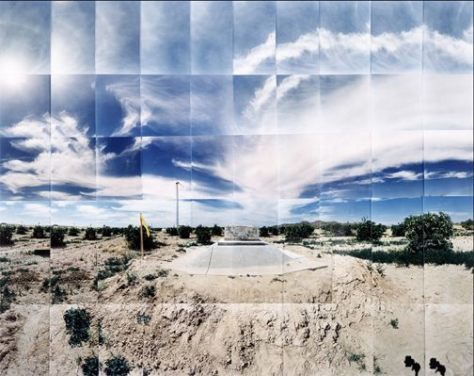
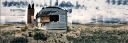
Gila River Relocation Camp, Dog Grave, Gila River, Arizona © Masumi Hayashi. Panoramic photo collage with Fuji Crystal Archive prints, 1995. Size: 38" x 31"
Prison Photography has needed to limit itself in discussion, so rich and extensive was Hayashi’s oeuvre. I recommend that you spend a long time meditating her Prison series, Salt Mine series and a spectacular EPA Superfund Sites series.
Let us focus, for now, on the issue at hand – Japanese American Internment.
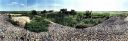
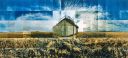
Professor Hayashi photographed all 10 internment camps on American soil. She also documented the 4 Canadian internment sites. It was a subject close to her heart — she was born at the Gila River Relocation camp in Arizona in 1945.
In most cases, Hayashi photographed a full 360 degrees. The gradient of exposure in her photo montages and her extruded viewpoint lent visual richness, height and vertigo to otherwise mundane landscapes. Hayashi’s indelible presence in the works is a reminder of the former human presence in inhumane environments.

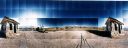
Gila River Relocation Camp, Monument, Gila River, Arizona © Masumi Hayashi. Panoramic photo collage with Fuji Crystal Archive prints, 1995. Size: 31" x 75"

Gila River Relocation Camp, Foundations, Gila River, Arizona © Masumi Hayashi. Panoramic photo collage with Fuji Crystal Archive prints, 1990. Size: 22" x 56"

Topaz Relocation Camp, Foundations, Delta, Utah © Masumi Hayashi. Panoramic photo collage with Fuji Crystal Archive prints, 1995. Size: 31" x 72"
Hayashi’s composite tactic solves the problematic banality of many of the sites. She describes here and here that many of the sites as barren and sun bleached (Manzanar, CA has been well-preserved as a memorial and state park, but it is the exception). The most common denominator among the sites was the concrete sewage system. The large peripheral tanks always remained long after the sheds and tended plots had decayed. A brick structure was a treat, and wooden barns, anomalies.
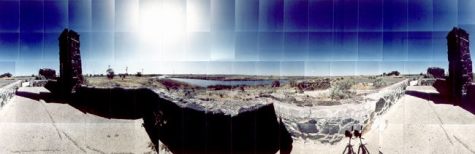
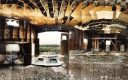
Minidoka Relocation Camp, Visitors Waiting Room, Minidoka, Idaho © Masumi Hayashi. Panoramic photo collage with Fuji Crystal Archive prints, 1992. Size: 27" x 70"
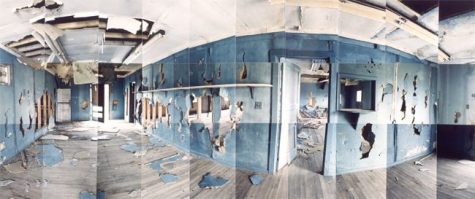
Heart Mountain Relocation Camp, Blue Room, Park, Wyoming © Masumi Hayashi. Panoramic photo collage with Fuji Crystal Archive prints, 1995. Size: 23" x 45"
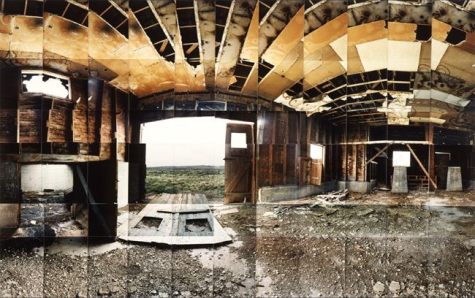
Heart Mountain Relocation Camp, Interior, Park, Wyoming © Masumi Hayashi. Panoramic photo collage with Fuji Crystal Archive prints, 1995. Size: 31" x 42"
Hayashi’s endeavours cannot be underestimated. As Candida Hofer noted;
and
For those of you sitting there thinking, “Oh, yeah, I could take a bunch of little pictures of something too.” No, you couldn’t. Not like this. Her style is built on solid conventional photographic methods (each picture must itself be a very good picture).
Extraordinary.

Heart Mountain Relocation Camp, Hospital, Park, Wyoming © Masumi Hayashi. Panoramic photo collage with Fuji Crystal Archive prints, 1995. Size: 32" x 70"
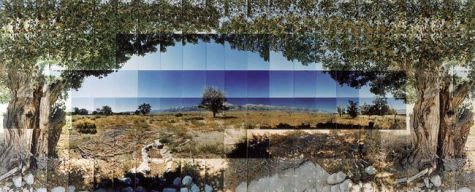
Manzanar Relocation Camp, Tree View, Inyo, California © Masumi Hayashi. Panoramic photo collage withFuji Crystal Archive prints, 1995. Size: 27" x 63"

Manzanar Relocation Camp, Monument (Version 1), Inyo, California © Masumi Hayashi. Panoramic photo collage with Fuji Crystal Archive prints, 1995. Size: 20" x 30"
In addition to her photographic work, Hayashi conducted audio interviews of former internees to develop a complete sense of experience across the American internment archipelago.

Manzanar Relocation Camp, Guard Gates, Inyo, California © Masumi Hayashi. Panoramic photo collage with Fuji Crystal Archive prints, 1992. Size: 27" x 65"

Granada (Amache) Relocation Camp, Water Tank, Prowers, Colorado © Masumi Hayashi. Panoramic photo collage with Fuji Crystal Archive prints, 1997. Size: 23" x 31"
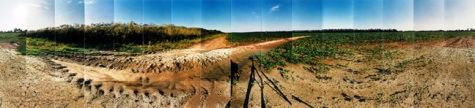
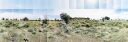
Jerome Relocation Camp, Farm, Drew & Chicot, Arkansas © Masumi Hayashi. Panoramic photo collage with Fuji Crystal Archive prints, 1995. Size: 22" x 59"
In August 2006, Hayashi along with her neighbour John Jackson, knocked at the door of the apartment of another neighbour Jacob Cifelli to complain oncemore about his high volume music. It was the last of many noise complaints. Cifelli shot them both to death in the stairwell.
The story has added tragedy as Hayashi had recently reunited with her biological daughter, Lisa Takata, after 39 years of estrangement. Hayashi gave Takata up for adoption within a few days after her birth in the midst of the Watts Riots in 1965.
Photographer, artist and fellow Cleveland resident, Norm Roulet summed up the loss of Hayashi;
Rest in peace, indeed.
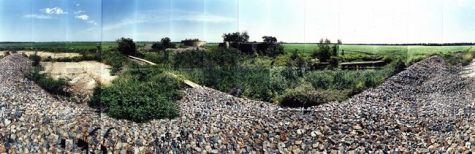
Jerome Relocation Camp, Sewer, Drew & Chicot, Arkansas © Masumi Hayashi. Panoramic photo collage with Fuji Crystal Archive prints, 1995. Size: 23" x 55"
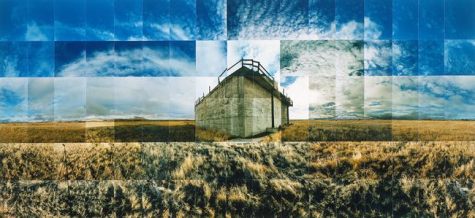
Tule Lake Relocation Camp, Sewer, Tulelake, California © Masumi Hayashi. Panoramic photo collage with Fuji Crystal Archive prints, 1996. Size: 32" x 59"

Poston lll Relocation Camp, Sewer, Yuma, Arizona © Masumi Hayashi. Panoramic photo collage with Fuji Crystal Archive prints, 1997. Size: 26" x 63"
Masumi Hayashi’s work has been exhibited in internationally respected museums and galleries, including the International Center for Photography in New York, the L.A. County Art Museum, the Japanese American National Museum (L.A.), the Tokyo Museum of Photography, the Ludwig Museum of Art in Germany, and the Victoria and Albert Museum of Photography in London, England. In 2003, she had a retrospective one-person exhibit at the Japanese American National Museum in Los Angeles. Professor Hayashi taught photography for 24 years at Cleveland State University, Ohio.
Gallery with pop-out full size images






-

- Masumi Hayashi 1945 – 2006
Thanks to Matt Kelley at Criminal Justice Change.org for alerting me to Hayashi’s work.
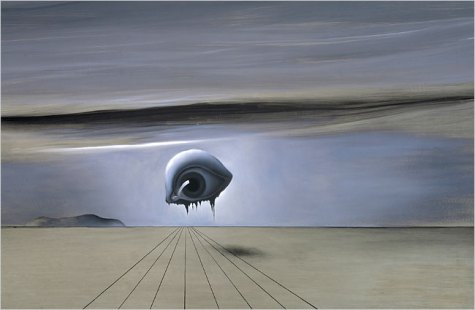
A study Salvador Dalí drew for a dream sequence in Alfred Hitchcock’s “Spellbound” (1944). Salvador Dalí, Fundació Gala-Salvador Dalí/Artists Rights Society, New York

A detainee kicks a soccer ball around the central recreation yard at Camp 4, Joint Task Force (JTF) Guantánamo Bay, Cuba, June 10, 2008, during his daily outdoor recreation time. Detainees in Camp 4 get up to 12 hours of daily of outdoor recreation, including two hours in a central recreation yard. Photo Credit: U.S. Army 1st Lt. Sarah Cleveland

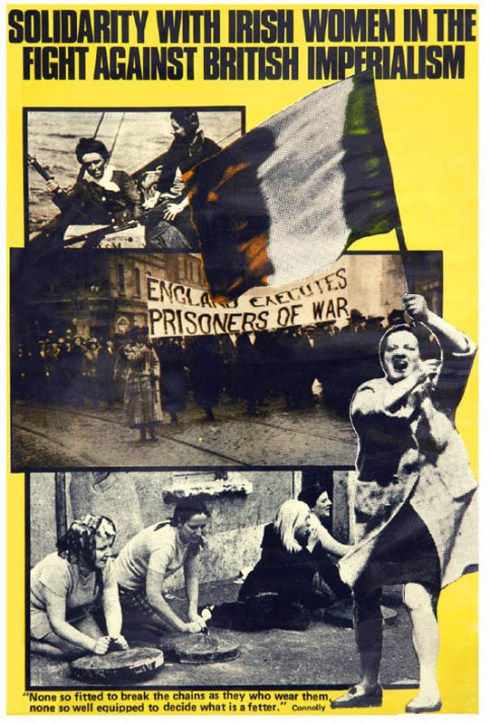
The inspiring Just Seeds Collective which peddles art to fund prison rights activism pointed me via its blog toward the Poster Film-Collective of London.
The Poster Film-Collective is a unique archive of graphics for African, Cultural, International, Irish, British and Women’s causes. With direct politics and robust graphics, poster arts are a nostalgic favourite for many art historians.

‘The Troubles’ of Northern Ireland are a very difficult topic for me to discuss; but not because I am close or emotionally compromised and not because I know or knew anyone involved. I grew up just the other side of the Irish Sea, but Belfast may as well have been the other side of the world to me. I was raised Catholic and my Mum’s family are from the Republic of Ireland. Yet, as a child my family rarely discussed the situation in Northern Ireland. Even in 1996, when the IRA bombed the Arndale shopping centre in Manchester (just down the M61 from my home town) the conflict was still too abstract and ancient for my teenage mind to comprehend.
I think any political labels or alliances that would fall upon my family were deflected by a distant dismay at the violence of the time. ‘The Troubles’ of Northern Ireland are not something I feel comfortable idealising; rather limply I retreat to the cliche that one man’s terrorist is another’s freedom fighter. All sides (there were more than two) were guilty of arrogance, obstinacy and extreme violence. The ideological brutality played out on the streets was matched by that meted out in the prisons, most notably Long Kesh, later renamed The Maze.

It is a lingering guilt for me that ‘The Troubles’ have always been historical … historicised. It is this guilt that accounts for the fact I’ve not before discussed Donovan Wylie’s The Maze on Prison Photography. Wylie is saturated in Irish history – it is his life’s vocation. On the other hand, I would be a fraud if I attempted to summarise the complex events of a physically-close-culturally-distant conflict.
It is with similar guilt I refer readers – in the first instance – not to news reports or academic reflection but to a 2008 film. But, I do so because Steve McQueen’s Hunger is a breath-taking portrayal of a life-taking episode in the history of Maze prison. It is a wonderful observation of British prisons, Irish Republican solidarity and inmate management in the face of political protest.
McQueen, in his directorial debut, specialises in long uninterrupted shots which grip time (and all its anguish) and forces the politicised narratives through the mangle. He flattens and simplifies the visuals drawing out the incredible fragility of human skin, snow-flake, fly, lamb, ribcage … McQueen is surely a great photographer too.

Through Donovan Wylie’s work I learnt of Dr. Louise Purbrick’s excellent continuing research “concerned above all with the meanings of things and how those meanings are contained or revealed, experienced and theorised.” Purbrick wrote the essay for Donvan Wylie’s book, Maze. That was in 2004. In 2007, Purbrick extended the survey, jointly editing the book Contested Spaces. It analysed the “divided cities of Berlin, Nicosia and Jerusalem, the borderlands between the United States and Mexico, battlefields in Scotland and South Africa, a Nazi labour camp in Northern France, memorial sites in Australia and Rwanda, and Abu Ghraib.”
Purbrick worked with another academic Cahal McLaughlin on the oral history & documentary film project Inside Stories featuring Irish Republican Gerry Kelly, Loyalist Billy Hutchinson and ex-warder Desi Waterworth. And it is here I start (and I encourage you to start), with personal testimony when trying to understand ‘The Troubles’.
Donovan Wylie has continued his visual archaelogy of Irish history with Scrapbook.
 Born in Belfast in 1971, DONOVAN WYLIE discovered photography at an early age. He left school at sixteen, and embarked on a three-month journey around Ireland that resulted in the production of his first book, 32 Counties (Secker and Warburg 1989), published while he was still a teenager. In 1992 Wylie was invited to become a nominee of Magnum Photos and in 1998 he became a full member. Much of his work, often described as ‘Archaeo-logies’, has stemmed primarily to date from the political and social landscape of Northern Ireland.
LOUISE PURBRICK is Senior Lecturer in the History of Art and Design at the University of Brighton, UK. She is author of The Architecture of Containment in D. Wylie, The Maze (Granta, 2004) and, with John Schofield and Axel Klausmeier, editor of Re-Mapping the Field: New Approaches to Conflict Archaeology (Westkreuz-Verlag, 2006). She also works on the material culture of everyday life and has written The Wedding Present: Domestic Life beyond Consumption (Ashgate, 2007) (Source)
CAHAL McLAUGHLIN is Senior Lecturer in the School of Film, Media and Journalism at the University of Ulster. He is also a documentary filmmaker and is currently working on a Heritage Lottery Funded project, ‘Prison Memory Archive’.
Admittedly, Wordsworth was a Romantic English poet of the Victorian Age with some highfalutin ideals and a penchant for a Christian God. But he also had some pretty radical ideas about the health of the human soul being dependent on its environment.
“Heaven lies about us in our infancy! Shades of the prison-house begin to close upon the growing Boy.”
Along with the dirt and the consolidation of British class frameworks, the industrial revolution also ushered in the politics of institutions and discipline. Wordsworth lamented a society in which the economies of labour stacked the odds against the young and unschooled.
The prison was a notion of culture; as visible in the cities as it was felt in the soul. Piers Lewis summarised it as such:
Got any conventions or received ideas you’d like to take the opportunity to shed?

Reading the Goethe-Institut Fashion Scene article about Haeftling designers in Berlin, I thought it was an Onion style send up. “Prisoner chic” sounds like something straight out of satire, but I guess I was snoozing when this hit the news wires in 2003.
Haeftling (translated as ‘Prisoner’) employs inmates across Europe to manufacture clothing and housewares inspired (they say) by prison life, “The garments are highly functional and have a classic and timeless cut. Only high-grade, rugged fabrics are used in manufacturing.”
Well, whatever you say. I actually don’t mind how they market it, I am just pleased they support prison reform, the abolition of the death penalty, political prisoners rights and a philosophy of rehabilitative justice.
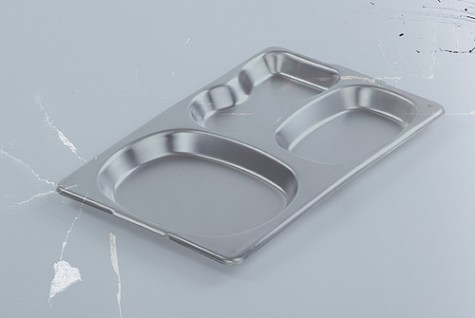
Haeftling Tray
But let’s not kid ourselves. This project was borne of commercial interests. “It began in the JVA (Justizvollzugsanstalt/prison) Tegel and developed into an international undertaking. More and more prisons have joined and today production is even taking place elsewhere in Europe. One Bavarian prison supplies honey from its own two colonies of bees; a prison in Switzerland even has its own vineyard and exports its own red (Pinot Noir) and white wine (Müller Turgau).” (source)
Karola Schoewe, Haeftling’s PR & communications manager says, “On the whole, the prisons are all very helpful,” says “There are some prisons that have very good production capacities for making homeware.”
Schoewe then marries the business speak to social responsibility speak, “Through its production, Haeftling is creating measures that help to support rehabilitation processes.”

Haeftling Espresso
Without seeing Haeftling’s account-books or sitting in on a board meeting, I have no way to tell if resources and profits are divvied up in a way that benefits prisoners more then in the state run prison industries. This was the situation in July 2003
(Author’s Note: €12.50 is substantial pay compared to American prisons.)
Prison industries are a divisive issue. For some they are the perfect use of prisoners’ time and energies developing job skills, work community & self-esteem. To others prison industries are a modern slave labor exploiting societies’ self-created incarcerated class.
Both viewpoints have legitimacy, but the first makes a prior assumption that could be misleading – that work programs are the only means to provide skills, community or self-worth. Education does this too.
But educating someone instead of putting them to work is going to cost a prison authority rather than generate it wealth.

Generally, I am unnerved by the disconnect between the reality of incarceration and its representation to consumers,
Then again, Klaus-Dieter Blank, of Berlin’s Tegel Prison states the success of the label’s online store has meant that people are beginning to understand “what goes on behind the walls”. Haeftling features on the Tegel Prison website.
Is there too much space here for consumers to create their own version of prison life? What is included and/or played down in the minds of consumers? Are they being coerced and sold a disingenuous view along with that ‘rugged’ product?

"Justiz 82" Scratchy Blanket. Haeftling Product
We can assess this a number of ways – rehabilitative worth, public awareness worth, benefits to state finances, tax-payer savings, external benefits of development in social entrepreneurship.
But essentially, we must ask, “Does this enterprise help reduce prison populations by reducing recidivism? It MUST be compared to other rehabilitative programs. The purpose of prisons the world over should be to create societies where prisons are no longer necessary.
How do you judge this type of enterprise?
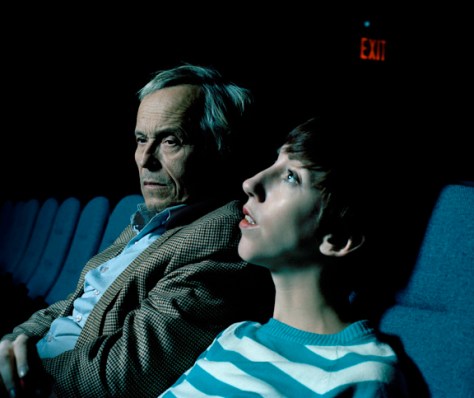
Tina Schula, from the 'Ratline' series
Harlan Erskine contacted me this weekend.
At the moment there are some MFA exhibitions at the blockbuster schools. Before you read this look over Daniel Shea’s neat run down of SVA, Columbia & Yale photography grads.
As concerns Harlan’s graduating class at the SVA, here’s five picks:
Carlos Alvarez Montero for his street portraits, but more so for his meld of youth, friends & skating.
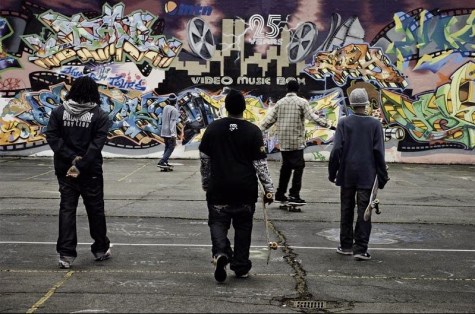
Carlos Alvarez Montero, from the 'Harlem Shuffle' series
Maureen R. Drennan for her sophisticated restraint down at a marijuana farm.

Maureen R. Drennan
Jessica Bruah because I think she takes a lot of shots and edits well. You don’t just “come across” the subjects Bruah photographs.

Jessica Bruah
Scott Houston for a harsh, harsh and close view of meth and people … together. And for proof in the argument that captions are essential; providing caring and careful context for image.

Scott Houston
Tina Schula gets a double shout out for two weird series. Ratlines (very top) is creepy & suspenseful. Oskar’s Sister (below) is playful, offensive & menacing.
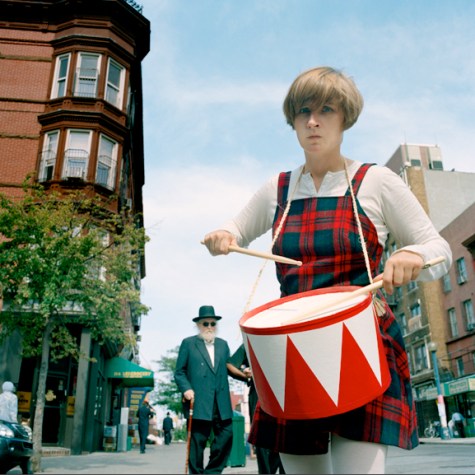
Tina Schula, from the 'Oskar's Sister' series


