
You are currently browsing petebrook’s articles.
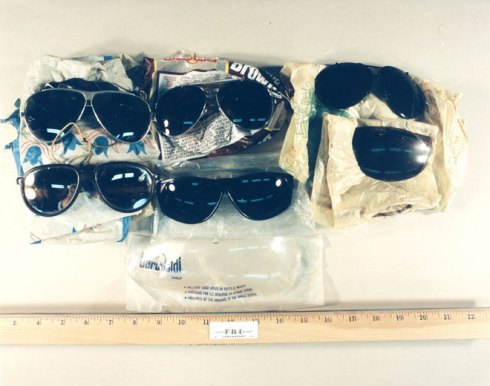
Ted Kaczynski’s Sunglasses. © U.S. Marshals
It may well have been one of the weirdest auctions in American history. Last month, courts order federal authorities to auction off Ted Kaczynski’s belongings in order to raise money for his victims. The auction closed Thursday 2nd June.
Kaczynski, dubbed the Unabomber, pleaded guilty in 1998 to a 20-year spree of bombings that killed three people and wounded 23.
U.S. Marshals used Flickr to post 51 images of the items included in the macabre auction — the first time the site has been used by U.S. Marshals for a sale — to presumably both reach out to and assist potential buyers.
In the press release, U.S. Marshals explained,”We will use the technology that Kaczynski railed against in his various manifestos to sell artifacts of his life. The proceeds will go to his victims.”
David Kravets writes for Threat Level blog, “Kaczynski’s so-called “manifesto” in which he railed against technology, sold for $20,053. In all, the auction raised more than $232,000. ”
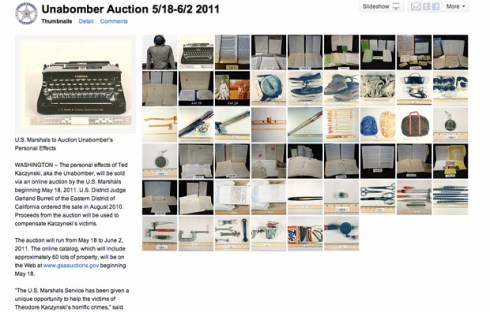
Found via the liberator magazine.
P.S. The U.S. Marshals also have auctions of camera equipment.
If a dozen police officers are firing their guns into a stationary car and killing a citizen in the street then you’d presume they have good reason … and nothing to hide.
Why then did a Miami cop pull a gun on a couple after they’d recorded such an incident and why did Narces Benoit – the man who made the recording – have to hide his memory card under his tongue while police “threw the couple to the ground and smashed the cell phone that took the video“?
The NPPA reports:
Benoit, who was with his girlfriend, Ericka Davis, said police pulled him out of the car, put him face down on the pavement, guns pointed at the couples’ heads, handcuffed him, and smashed his cell phone. Then they put the smashed phone in his back pocket as he lay on the ground.
But Benoit had saved the video to his phone’s SIM card and hid the card in his mouth before the phone was smashed.
He was taken to a mobile command center, photographed, and questioned. Then police took him to headquarters and questioned him again, demanding the video. Benoit says he told police, “The phone’s broken.” He was later released.
“They wanted the video, that’s all they were concerned with,” Davis told CNN.
CNN has purchased the video, and have shown it on air along with Benoit’s interview.
The couple, who have hired a lawyer because, they say, they “want the right thing to be done,” said they saw police taking other people’s cell phones at the scene and smashing them as well, destroying evidence and intimidating witnesses.
Think on.
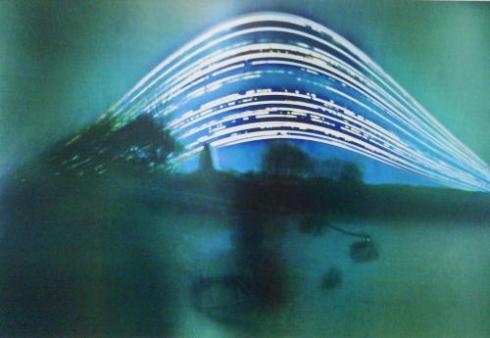
Photographer Mark Woods-Nunn and FLACK, a charitable social enterprise which works with homeless people in Cambridge, UK have put together an intriguing project.
Varsity Mag says, “the attachment of beer-cans to assorted lamp-posts is not another example of misguided modern art. A thin sheet of photographic paper was placed in each can, exposed to the world by only a tiny pin-hole, silently and vulnerably capturing an image.”
Good stuff.
Found via British Photographic History Blog.

There’s a long and verbatim interview with my friend Bob Gumpert at Sojournposse. Salina Christmas and Zarina Holmes ask the questions.
Bob describes the arc of his work from labor to detectives to street cops to the courts to the jails. It’s a trajectory he has described to me before and it’s a lot to get hold of; I’m happy I wasn’t transcribing!
However, I’d never heard Bob tell this particular tale:
The rule was: “Ladies, I take a photo [of you], you tell me your story. Next week, I give you four photos.” Literally, I give them four photos. “And I put the CD in your property.” So that’s the way it works.
The women took the photos and sent them to their boyfriends in [other] jails. The prison didn’t like this. Why? I don’t know. It’s not a problem when the men down [the jail] do it. But when the women did it, it was a problem. Do I understand why? Do I make an issue out of it? No! But what happens? I get banned from the jail. Because the women did it.
So then I went back and I said: can we try again? The jail said yes. So long as they understand the rules…
So I said fine. I went back. And I explained all this: “I give you photos. You can send them home. But you cannot send them to the jail.” All the women said, “No problem, we understand.” They sent them home with instructions to send them to the jail. From home. Why? Because they weren’t sending them to the jail.
So, what happened? I got banned again. So I get back in and I said to the women, “You cannot send anything, any of these photos, in any form, from any place to the other jail.” And a woman raises her hand and said, “Can I have Xeroxes made of photos, instead?” And I said, no, you cannot. And I stopped going in. Because it was – at some point – if I kept going in, a problem.
UPDATED: Bob soon after returned to the jail to work with female prisoners.
I have often described photographs in prisons as emotional currency. The tenacity and single mindedness of these female prisoners is, to me, quite amusing. They’re resolute in how they want to use photographs, and the variant ways they circumnavigate an unenforcable rule trumps any analysis they make of the rule itself.
They’re just trying to connect … but it caused problems for Bob!
Another thing to negotiate when making photographs in sites of incarceration.
Bob Gumpert’s website Take A Picture, Tell A Story

From the inbox:
“Prison Photography will be honored with a 2011 Photo Blog Award from LIFE.com.
This is the first annual Photo Blog Awards from LIFE.com and this year the editors have selected 20 blogs. To determine the 2011 honorees, LIFE.com editors considered nearly 300 blogs that count photography as central to their mission. Winners range from major news organizations to individual enthusiasts who are transforming the ways that photographs are made, shared, and discussed.”
So that’s unexpected and quite a lovely way to start the week. Chuffed to be on a list with so many other great blogs I read and respect – 500 Photographers, A Photo Editor, aCurator, American Suburb X, Bagnews Notes, Burn, Conscientious, Feature Shoot, New York Times’ Lens, NPR’s The Picture Show, PDN, The Sartortialist, TIME.com’s Lightbox, What’s the Jackanory?
To celebrate, my housemate made a rhubarb-sprinkle-surprise-sponge-cake, which is just about the best cake there is.


Scar © Sye Williams
Sye Wiliams photographed in Valley State Prison for Women, Chowchilla, California. His portfolio was included in the June 2002 COLORS Magazine.
Williams’ entire Women’s Prison portfolio can be seen on his website.
It is a bit of a time machine without a specific destination. The images are prior to 2002, we know that much. But it is anyone’s guess which particular year. (I have asked Sye and will update with the answer.)
Williams’ choice of film-stock, the era-less prison issue coats and baseball t-shirts, all amount to a almost “date-less” space and time. Even the hairstyles span any number of decades. Yet, this is what prison is for many inmates; prison is a time of stasis, if not reversal. When time is not your own, how should it matter? And when one’s time is detached (in an experiential way) from that of dominant society, then it stands to reason that very different rules of judging the days, measuring value, gauging worth, choosing behaviour, and – dare I say it – opting for styles, would shift significantly.

Officer © Sye Williams
It is not often prison photographers take portraits of correctional officers (mostly down to legal reasons).
Williams’ Officer (above) is a slippery image. The officer maintains the same steeled look as some of the inmates. The fact that she wears a helmet with visor, and that this particular portrait exists within a portfolio of weapon-still-lifes and an photograph depicting model-hairdresser-heads all unnerves me a little.
It is not that women’s prisons are uncontrollably violent. To the contrary, they’re more likely sites of boredom. However, as a viewer to Williams’ work, I find myself adopting the same caution as the staff and administration. Prisons are places where daily activities are shaped by the need to always prepare for the worst case scenario.
Williams manages to subtly suggest the latent violence of prison, and given recent reports (California Women Prisons: Inmates Face Sexual Abuse, Lack Of Medical Care And Unsanitary Conditions) he is probably close to the truth. Apparently, Valley State Prison for Women in Chowchilla is less dangerous than it once was, but it remains a notorious prison for women.
In the deviant milieu of prison, even when time ceases to exist, vigilance necessarily remains a constant.
View Sye Williams’ entire Women’s Prison portfolio.
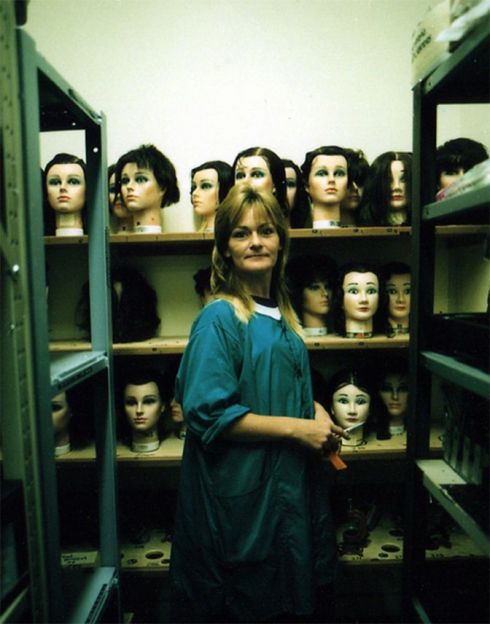
Beauty School © Sye Williams
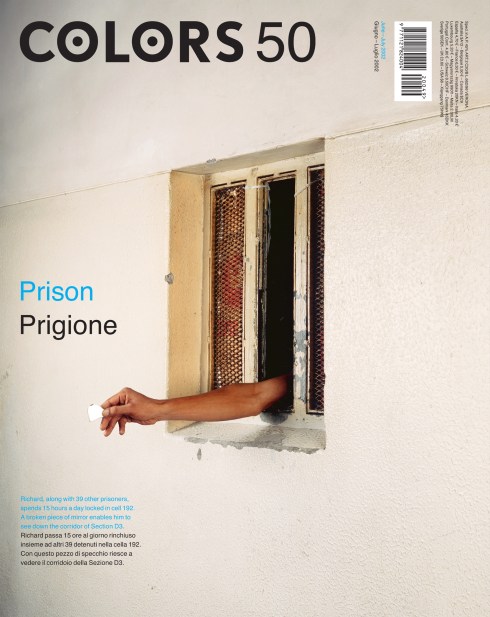
Front cover
COLORS magazine first fell onto my radar last year when reviewing Broomberg & Chanarin’s work. It cropped up again in March when I delved into Stefan Ruiz’s early career. All three were creative directors in COLORS continually rotating roster of aesthetic leadership.
Based in the north Italian town of Treviso, COLORS is part of the publishing activity of Fabrica, Benetton’s communication research centre. Benetton’s searing brand-making hit my young retinas with its controversial United Colours of Benetton (billboard) ad campaign of the early nineties.
Besides Saatchi and Saatchi, Benetton was the only time in my childhood I was aware of the names behind billboard products. That is an assumed level of cultural penetration, but I’m working from precious memory too much to determine its significance.
[As an aside, Enrico Bossan Head of Photography at Fabrica and Director of COLORS Magazine was co-curator for the 2011 New York Photo Festival. He also founded e-photoreview.com in 2010, which delivers without no-nonsense video interviews with photographers.]
The 50th edition of COLORS (June 2002) focused specifically on prisons. From the introduction:
With over eight million people held in penal institutions the prison population is one of the fastest growing communities in the world. In the United States, a country which holds 25% of the world’s prison population but only 5% of the world population, prisons are now the fastest growing category of housing in the country.
For COLORS 50 we have visited 14 prisons in 14 countries and asked a difficult question: Is it possible to rehabilitate a person back into society by excluding them from it? We spoke to murders, rapists, pedophiles, armed robbers, thieves, frauds, drug dealers, pick pockets, high-jackers and prison wardens. In most cases the stories we heard confirm one thing. That prison does not work. In COLORS 50 we ask the inmates themselves to suggest alternatives.
The magazine is 90 pages of portraits and interior landscapes. I came to this collection of work late (in my research here at Prison Photography) and in many ways it challenges many of my former presumptions. This edition is a precursor to the “VICE-aesthetic” celebrating the battered and broken, and I’d be happy to dismiss it if it weren’t for the long-form statements made by the prisoners, which are printed with care and without censorship.
The issue includes bodies of work by photographers I was previously unaware of including Juliana Stein, Vesselina Nikolaeva, James Mollison, Charlotte Oestervang, Suhaib Salem, Federica Palmarin, Mattia Zoppellaro, Ingvar Kenne, Kat Palasi, Dave Southwood, Gunnar Knechtel, Pieter van der Howen and Sye Williams. I will be featuring selections of these photographers over the next few weeks.
I bought the paper edition, but you don’t have to as the entire Prison/Prigione Issue 50 can be viewed online.
Above all, while browsing the images and stories of the magazine, I am really pressed into thinking about the ease with which a commentator can politicise and argue against the prison system in America, but be flummoxed when asked to appreciate prison systems elsewhere. Benetton uses the common theme of incarceration to raise questions, but I am at a loss to think of common answers to tackle the pain, blood and damage done to individuals in their lives before, during and after imprisonment.
At a surface level this is car-crash photography; a look inside worlds we’ll never know, but at its heart it is a call to think about the nature of humanity and to think about the capacity for humans to kill, to survive, to get addicted and to repair and to forgive.
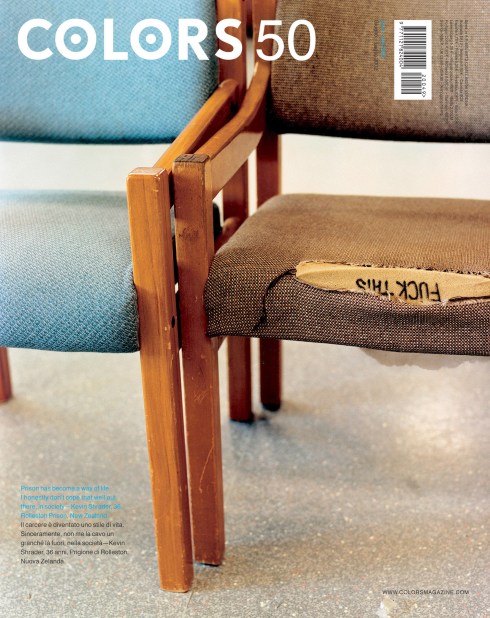
Back cover


 Prison Photography