
You are currently browsing the category archive for the ‘Activist Art’ category.

A few months ago, you may recall, I mounted a show in a brewery in Seattle. It was a prison art fundraiser organised by University Beyond Bars and an appended exhibition of prison photography from Washington State – including the work of Bettina Hansen, Tim Matsui, Steve Davis, Cheryl Hanna-Truscott and Erika Schultz.
During the opening, there was a couple of filmmakers snagging folk for interviews and trying to make sense of what college education can do for a prisoners’ community and why an art auction and photography show can bring those ideas to the public.
Well, the resulting video has just been published. It’s not the slickest media production you’ll find but it is earnest and the film recognises the work of the many individuals and volunteers who quietly work to make prisons more humane and hopeful.

Brandon Tauszik moved to Oakland from San Diego three years ago. He’s got a day job. Some of his images are a little raw — check his Instagram feed @BE_DIZZLE. Tauszik was for a while assistant to the legendary Jim Goldberg. He’s also a big fan of TBW Books the small publisher just down the road run by Paul Schiek. I haven’t asked Tauszik but I reckon he’s probably a fan of the Hamburger Eyes folks too.
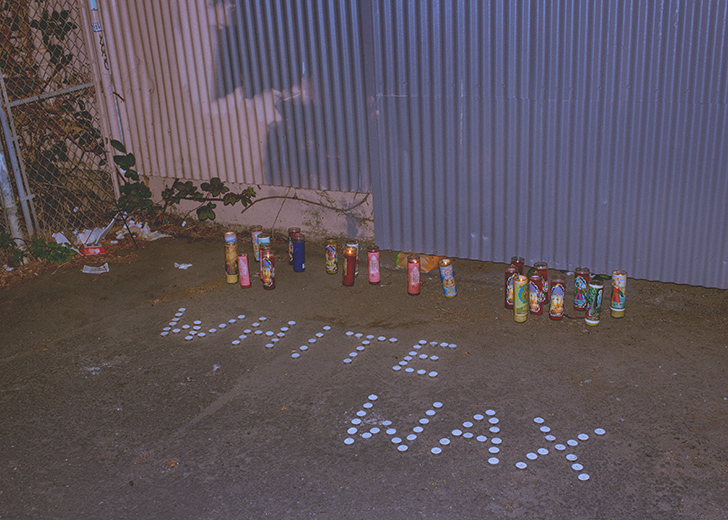
Tauszik is making the Bay Area his home and the aesthetic of his work makes obvious sense amid the prevalent scratched-up, banged-up, gritty, kids-street-realism typical of California. Less obvious though are the motives, goals and choices within Tauszik’s latest body of work White Wax.
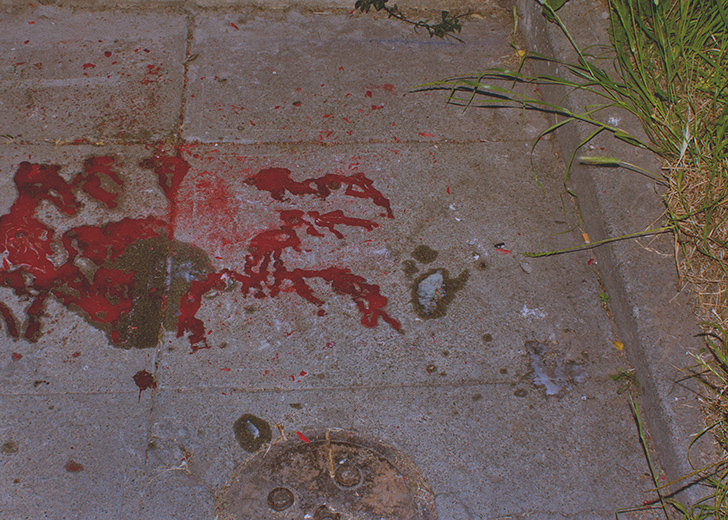
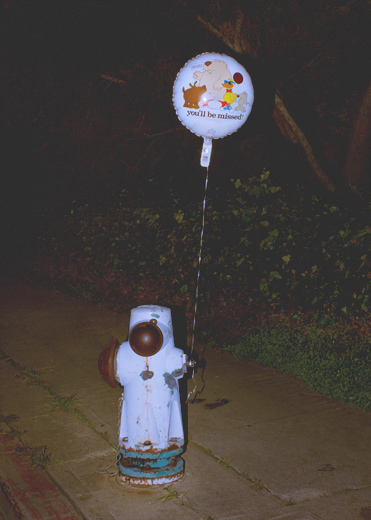
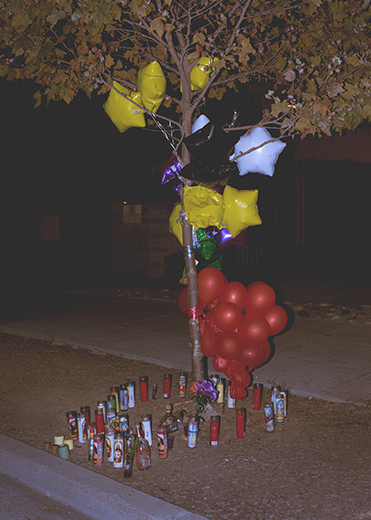
White Wax is a year-long visual document of memorials to homicide victims on the streets of Oakland. Tauszik says in his artist statement that his photos are to serve as a medium for self-examination. He thinks America is in the middle of a collective re-examination of its criminal justice policy, gun culture and post-racial credo.
White Wax is also,I suspect, a means by which Tauszik can remain connected to the place he lives. Unfortunately, for most people, murders are pretty easy to ignore; they just have to stay off the wrong streets. Some Oaklanders don’t have that luxury though.
“Why has the ecology of the American inner city long enabled it’s own self-destruction?” asks Tauszik. “Is it possible to shift our tired narrative of another young black man memorialized with white wax?”
SCROLL DOWN FOR OUR Q&A


Q&A
Prison Photography (PP): Why take on this project?
Brandon Tauszik (BT): Oakland is a violent city, but America is a violent country. Its inner cities particularly so. There is already a great deal of photography approaching this subject with a kind of coarse imagery. We’ve all seen it over and over. I asked myself, ‘How can I photograph gun violence without showing any guns? How can I create an emotional project without showing victims or mourners? How can I approach a politically charged subject, yet leave cops and politicians out of it?’ I hope that with these images I am able to communicate something beyond just melted wax on the sidewalk.
PP: I used to live in San Francisco and there was a bizarre media obsession about the annual homicide rate, as if people were waiting for it to meet or surpass the previous year’s figure. Oakland was always the depressing counterpoint to SF figures as it suffered 2 to 3 times the number of murders. Briefly, can you describe your experience of information, conversation, attitudes about murder? Surely, beyond figures there’s talk of interventions and solutions? Basically, what should Oaklanders do?
BT: That’s a loaded question! There is a lot of social inequality in the Bay Area and particularly here in Oakland. Having been largely de-industrialized over the past few decades, Oakland is currently in the midst of a strong wave of gentrification. Despite this new influx of higher income residents, the crime rate has barely shifted in the past decade. It’s currently the most dangerous city on the west coast and has the highest robbery rate in the whole country. People blame this on the understaffed police department, the economy, the gangs, the guns, whatever.
It’s uncomfortable to address, but ultimately this isn’t about “What should Oakland do?” but instead “What should America do?” In New York City, Memphis, Chicago, Baltimore, Los Angeles (the list goes on and on) young men of color kill and are killed more than any other demographic. We’ve ignored violence in our country because the victims don’t look like us. As one African American mother told me at a memorial, “We have been living a daily Sandy Hook and it’s time for the nation to know.”
There are some very strong local organizations (SAVE, Khadafy Foundation, RJOY) that do amazingly important work, but ultimately this is about a flawed national mindset in regards to prisons, guns and race relations.
SCROLL DOWN TO CONTINUE Q&A



PP: Is White Wax a memorial? A study of vernacular action? Other? Both?
BT: It’s more a study in the unique and visually distinct way that my neighbors mourn the loss of their loved ones. Or in your words, a study of vernacular action.
PP: Was it important to commit to this for one year?
BT: Every big city has their yearly homicide count which is obsessed over and analyzed as strictly data. I wanted to see what that data would look like in context of the shrines, which are a direct result of that count.
PP: White Wax images are taken at night. Was this a deliberate choice? If so, why?
BT: I wanted to capture these scenes as naturalistically as possible. The majority of these murders take place under the cover of darkness, so while this makes my work more difficult and dangerous, nighttime is one of the threads I use to tie the images together.
PP: I know you use Shine In Peace, Google Alerts and word of mouth to discover homicides. Do you fear White Wax has omitted some homicides just as the local news often misses/overlooks these murders? If you have missed some what does that mean?
BT: I’ve definitely missed some, due to a few reasons:
1. These memorials are, by nature, ephemeral and are displayed for anywhere from one day to many weeks. Sometimes I find a site I’ve missed where there are still traces of wax, but the shrine has been removed.
2. The given victim’s family and friends sometimes don’t erect a shrine. If the murder took place in a particular neighborhood where the victim was not welcome, that will usually apply to the victim’s family and acquaintances as well.
3. Many of these murders get little to no media exposure. For example, here is an example of a web-only murder story from last year. I rely on Oakland’s news outlets to report on (or at least tweet on) each murder. However there is low motivation to do so due to the very limited readership on these stories.
There are usually a few murders a week here, so unfortunately it can be hard for me to keep up.
SCROLL DOWN TO CONTINUE Q&A
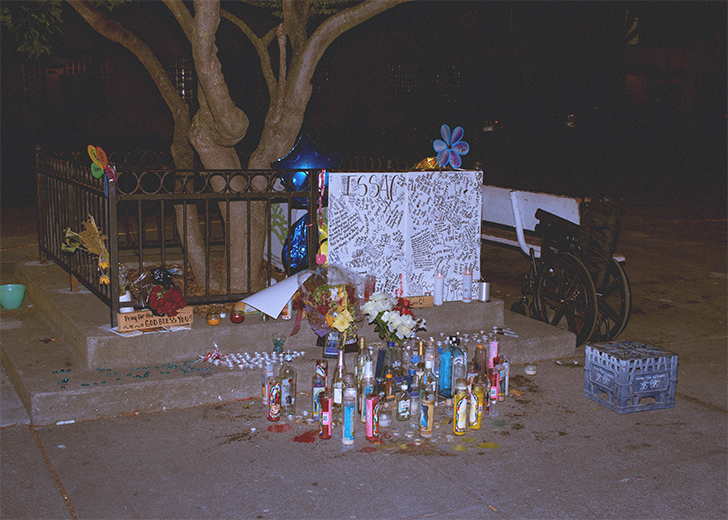


PP: What about captions? Is there a need (from you or audience) to include information about the homicide?
BT: I have the name/age/race/sex/location information for most of these murders. However, captions have a didactic manner of reducing a photograph down to data and information, which is what I am trying to avoid. A recent study showed that Americans assume black people feel less pain than white people. This is deeply frightening. I want the viewer to ponder these images and wonder, ‘Was this person someone who looked like me?’
PP: What’s been the reaction from folks in Oakland to White Wax?
BT: I have been sitting on this project until very recently. I wanted to give it time to fill in and for the thesis to take shape. The local people I’ve showed it to so far seem to think it’s strong and thoughtful. I would love to arrange an exhibition towards the end of the year in Oakland.
PP: Which photographers are working in ways that you admire and value?
BT: When I first moved to the Bay Area, I assisted Jim Goldberg for a while. That was a pivotal time for me which pulled me away from strict photojournalism toward longer, in-depth projects. Lately though I’ve been into Harry Griffin, Yoshi Kametani, and Viviane Sassen.
PP: What’s the purpose of photography? What should we be trying to do?
BT: We have ears to hear, but also eyes to see. The spoken word can only accomplish so much. You can sometimes say so much without using your mouth … a gesture, a glance.
For me, photography acts as a medium to illuminate ideas and questions on all aspects life.
END


Biography
Brandon Tauszik is a photographer and filmmaker based in Oakland, California. He creates visual media at Sprinkle Lab while pursuing personal photography projects.

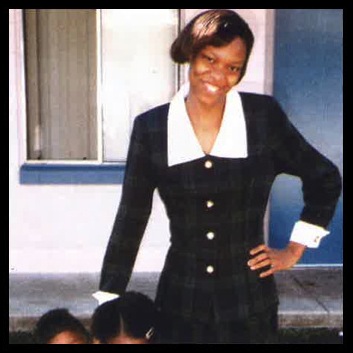
Elainaise Mervil. Source: The Tallahassee Project via VICE
I was recently speaking with an advocate who visited women’s prisons in California to learn about their circumstances and build cases for release. She said to me, “There needs to be more media in prisons. The women with whom I have conversations totally complicate peoples’ ideas about who a criminal is.”
Unquestionably, photographic media plays a role in telling stories. Some photographs better than others. If storytelling is about connection and about empathy, then what better photographs than the family snap or the amateur portrait?
This week, the unavoidable ordinariness of prisoners’ portraits was in evidence on VICE.
Jamie Lee Curtis Taete did us the service of republishing images from the book The Tallahassee Project: One Hundred Prisoners Of The War On Drugs, by John Beresford, M.D.
“The majority of the women shown in the book were charged with ‘conspiracy’ based on the statements of informants who spoke to authorities in exchange for reduced sentences,” says Curtis Taete.
From a woman whose old phone, still in her name, was used by a drug dealer to a women who drove drugs across state lines. Yes, there may have been a poor decision or lack of inquiry involved but there was also coercion (usually by a male friend or family member) and the result is a long, long mandatory-minimum sentence. Such is the War On Drugs which has been largely responsible for an eightfold increase in the female prison population in the U.S.
It’s likely many women implicated in drugs investigations are mere runners and may not even possess the information needed to bargain with the authorities. The result is destroyed families and ruined lives. 16 years, 24 years and even life for a failure to cooperate with authorities. How do these numbers even make sense? They don’t. They are shameful.
Below, I include a particularly insightful contribution to The Tallahassee Project book [my underlining] by Elainaise Mervil (pictured above).
Inmate ID Number: 20982-018
Sentenced to 20 years for conspiracy to possess with intent to distribute cocaine base and cocaine hydrochloride .
Estimated release date: 08-07-2014
I am a Haitian lady who has left 4 minor children behind to do this mandatory sentence. I have no criminal history. I am a first-time non-violent offender. It seems the government is tearing families apart and the children are the ones that are really made to suffer for this “War on Drugs.” P.O.W.
I fell into the wrong crowd in Orlando, Florida. I have never had any problems with the law and only am now learning to read and write the English language. I am a native of the beautiful country of Haiti. I love America, but I believe that the judicial system needs some change and review.
Conspiracy is such an all-encompassing category that if no other charge may be brought forth, one is charged with conspiracy and subjected to the 10-year mandatory minimums which increase rapidly in direct proportion to hearsay evidence whether true or not true. It appears that a person who is found in possession of narcotics will receive less time than a person who was not found in possession of anything, since conspiracy seems like the only viable charge.
Conspiracy was originally designed to target “king pins” who are usually sheltered by runners, etc. But what has happened instead is that the king pins are the ones who receive the most favorable deals since they have the most to provide to the government for substantial assistance motions as they possess many many contacts. The “little man” who does not know as much suffers since his assistance is not as valuable; hence, falling victim to the harsh treatment under the law by being required to serve a decade-plus in prison.
I applaud this use of photography. Let’s see more activists and journalists in prisons gathering such image and word to amplify the voices of those callously thrown away by our society.

A single wall representing the meals of men and women executed in Texas, part of Julie Green’s The Last Supper: 500 Plates exhibited at Marylhurst University, Oregon (April 16 – May 17, 2013). Photo: Pete Brook.
In The Make — a new(ish) website that celebrates artists in their crafty environments with dedicated studio visits and conversations — has a smashing feature on my friend and fellow Oregonian Julie Green. It sure beats the 2011 write-up of my visit to Julie’s studio!
I’ve been thinking a lot about productivity and it’s obstacles recently and I think Julie maintains an incredible output. Part of that is the security of teaching for her but mostly it is passion and commitment to connections and getting the work seen. What use is studio time if the products are not then widely shared?
Julie’s The Last Supper which is now 552 plates deep, is broad and grasps solidly the size of the issue it takes on. Bravo to Julie for leveraging the agency she has as an artist.
Pop over to In The Make and read what makes Julie tick. Here’s a snippet:
Shipping and installation of fragile ceramics is quite an undertaking. I am looking for a library or a university or a museum- in Texas would be great—to donate the project on a ten-year loan. The Last Supper is not for sale.
I plan to continue adding fifty plates a year until capital punishment is abolished. A poet asked if I ever get tired of painting lumpy blue food. No, I don’t.
Oklahoma has higher per capita executions than Texas. I taught there, and that is how I came to read final meal requests in the morning paper. Requests provide clues on region, race, and economic background.
Why is this important? It is because the death penalty is applied unequally depending on the race of the defendant and the victim, not to mention access to adequate counsel, jury bias, prosecutorial misconduct and a whole plethora of factors that make wrongful convictions too frequent to dismiss. End the death penalty and we’ll end the murder of innocent people. As Bryan Stevenson brilliantly puts it, the question isn’t so much does a person deserve to die, it is do we deserve to kill?
ELSEWHERES
I’ve previously talked about Julie’s work here, here and here.
Coincidentally, I edited a story for Wired about the work of Klea McKenna who is editor of In The Make. Check out Crumpled and Abused Photo Paper Makes for New Landscape Photography

Student of Univeristy Beyond Bars, Monroe Correctional Complex, 2011 © Erika Schultz
IF YOU ARE IN SEATTLE …
Opening on Saturday, 20th July is Prison Art an art auction fundraiser for University Beyond Bars (UBB), the prison education I worked with from 2009-2011.
Accompanying Prison Art is a photography component I was invited to curate. Titled Portraits and Pixels: Photography in Washington State Prisons the exhibition features five photographers working in Washington State and making images of Washington State lockdowns.
AND IT’S IN A BREWERY!
ART BEYOND BARS
At Washington State Reformatory, students in a Studio Art class, sponsored by the nonprofit organization University Beyond Bars and led by long-term prisoner-artist Gary Thomas, have created oil, acrylic, and gouache paintings as well as pencil and ink drawings in styles that range from the political to the retro, from the kitsch to the abstract.
You can see a local KING 5 newschannel spot on Gary and the class, here. (Turn the sound down to avoid the over-zealous sound-editing use of cliche clanging doors and locks!)
80 pieces feature in the Prison Art show ranging from nearly pocket-sized to large triptych paintings. All are for sale and proceeds go toward paying for the college education of UBB students. The silent auction lasts two weeks.
‘Portraits and Pixels: Photography in Washington State Prisons’
Young mothers, critical thinkers and children making powerful art may not be the first types of people we’d expect to find behind bars, but Portraits and Pixels challenges our notions of who is behind bars in the Evergreen State.
Portraits and Pixels: Photography in Washington State Prisons brings together images by five established local photographers to provide an overview of arts, rehabilitation and security in Washington State’s lockdowns.
Bettina Hansen, a Seattle Times photojournalist since 2012, photographed the theater productions at Monroe Correctional Complex. In 2011, Erika Schultz, also of the Seattle Times, volunteered her skills and made portraits of students in the UBB art program at Monroe. Tim Matsui, a Seattle-based multimedia journalist, casts a light on the Youth Art Program at the Denney Juvenile Detention Center in Everett. In the early 2000s, Steve Davis led workshops in four Washington State juvenile detention centers producing pinhole camera photographs and narrative-rich images with the children. Davis also made formal portraits of the boys and girls. Nurse-midwife, Cheryl Hanna-Truscott has made dignified and quiet double-portraits of incarcerated mothers with their newborns at the Residential Parenting Program at the Washington Corrections Center for Women in Gig Harbor. The pioneering program is nationally recognized for its commitment to maintain ties between mother and baby by means of rigorous administration, family and volunteer efforts.
The exhibition will be open to the public from July 21 until August 10 during the brewery hours: Fri-Sun 3-7 pm.
OPENING NIGHT, July 20th, 7:30 – 10 pm
Prison Art is hosted by Machine House Brewery, at 5840 Airport Way S in Georgetown, just south of Seattle.
Tickets are available here. Tickets are $15 each, or two for $25.
There will be live music by singer-songwriter Lori Dreier, cellist Ed Tellman, and keyboard artist and former prisoner Dan Pens.
Facebook event page here.
IMAGES

© Steve Davis
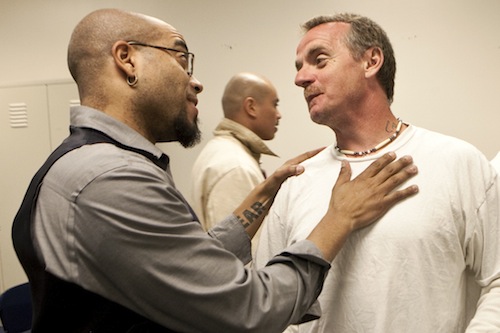
Daemond Arrindell, teaching artist for Freehold Theatre’s Engaged Theatre program, gives words of encouragement to inmate Ted Cherry after a rehearsal at Monroe Correctional Complex April 17, 2013. “They are the most appreciative population we’ve ever worked with,” said Arrindell, who is a local poet and community organizer known for running various writing and performance workshops and the Seattle Poetry Slam. “They recognize what limited opportunities they have.” © Bettina Hansen/Seattle Times
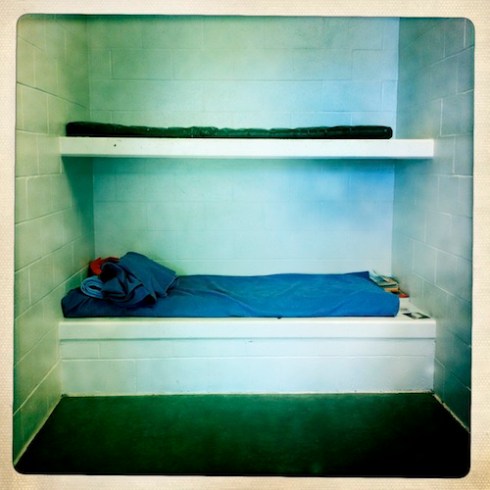
Cell Denney Juvenile Detention Center in Everett. © Tim Matsui

Mother and child in the Residential Parenting Program at the Washington Corrections Center for Women. © Cheryl Hanna-Truscott

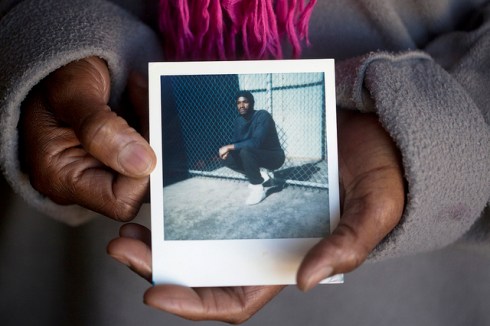
Marie Levin holds a photo of her brother, Ronnie Dewberry, taken at San Quentin State Prison in 1988. Until recently, it was the last photograph he’d had taken. Photo credit: Adithya Sambamurthy/The Center for Investigative Reporting
STARVED OF THEIR OWN IMAGE
We are now into the second week of the California Prisoners Hunger Strike. It is difficult to get firm figures on the number of participating prisoners. The Los Angeles Times reports 30,000; CNN reports 12,000 and Yahoo reports 7,000+.
I’m inclined to trust the figures sourced by Solitary Watch:
The hunger strike began on July 8th with participation of approximately 30,000 people in two-thirds of California’s prisons, as well as several out-of-state facilities holding California prisoners. In the first days of the hunger strike, approximately 3,200 others also refused to attend work or education classes as a form of protest in support of the hunger strike. As of Sunday, there are an estimated 4,487 still on hunger strike.
Still, formidable numbers.
INVISIBLE AND UNPHOTOGRAPHED PEOPLE
Last week, in conjunction with the initiation of the mass peaceful protect, Michael Montgomery for the Center for Investigative Reporting published an excellent article California Prisons’ Photo Ban Leaves Legacy of Blurred Identities about the ban on portrait photographs of prisoners held in solitary confinement.
Accompanying the article is the interactive Solitary Lives feature and a Flickr gallery.
The ban resulted from a tension between what a photograph meant or could mean.
For families, a photograph is a tangible connection to their loved one behind bars, but for staff of the four maximum security prisons that upheld the ban, photographs were potential calling cards — circulated by prison gang leaders — both to advise other members that they’re still in charge and to pass on orders.
The ban was lifted in 2011, following the last California prison hunger strike. Montgomery quotes Sean Kernan, the former Under-Secretary of the CDCR
“I think we were wrong, and I think (that) to this day,” he said. “How right is it to have an offender who is behaving … (and) to not be able to take a photo to send to his loved ones for 20 years?” Kernan directed prison staff to ease the restrictions for inmates who were free of any disciplinary violations.
The ban in the four Californian prisons was extraordinary.
“I have never heard of any other prison system or individual prison in America imposing a long-term ban of this kind,” said David Fathi, director of the American Civil Liberties Union’s National Prison Project.
As I have stated frequently on Prison Photography, prison (visiting-room) portraiture is one of the most prevalent types of American vernacular photography.
Until artists such as Alyse Emdur and David Adler began to draw focus to this disparate, decentralised, emotion-laden, and high-stake vernacular sub-genre, prison portraits were kept in wallets, on mantles and in side tables. There’s tens of millions of them out there.
And yet, for over 20 years, thousands of men in California were not allowed images of themselves. The additional ban of mirrors in solitary units meant that many men often did not see images of themselves for years on end. Again, to quote Montgomery’s article:
“I have asked my husband, ‘Do you even know what you look like?’ And he says, ‘Kind of, sort of,’ ” said Irene Huerta, whose husband, Gabriel, 54, has been detained at Pelican Bay for 23 years.
THE PHOTOGRAPH AS AN OBJECT OF DEPLOYMENT
In the free world, photographs are ubiquitous, easily created, shared and possessed. The fact that these seemingly innocuous objects were caught in the tussle of control between prison authorities and prisoners is astonishing, and speaks to the power struggle (real and imagined) between the kept and the keepers.
Michael Rushford, president of the Criminal Justice Legal Foundation, said easing the restrictions on prisoner photographs raised no major security concerns, so long as inmates had to earn them. “It’s not as if there’s been an epidemic of inmate photos on the street,” he said.
I am not sure how Rushford would measure this, or even it would significantly alter the lives of prisoners, specifically now during the hunger strike, and especially now when proven or alleged gang affiliations have been put aside by prisoners in solidarity for improved conditions for all.
In light of recent art market fetishism, it would seem the primary reason anyone would want to gather prison portraits would be to repeat Harper’s Books’ $45,000 hustle and cash in on the images?
As for the families (following the ban lift) the value of newly acquired images is not in any doubt:
Seeing an image of their incarcerated relative for the first time in years has sparked renewed hope and revived dormant family connections. For others, the photographs are a shocking reminder of the length of time some inmates have been held in isolation.
CENTER FOR INVESTIGATIVE REPORTING LINKS
Michael Montgomery’s California Prisons’ Photo Ban Leaves Legacy of Blurred Identities
Interactive Solitary Lives feature.
A BRIEF NOTE ABOUT THE SOLITARY WATCH WEBSITE
I cannot emphasize enough how important the website Solitary Watch is as a resource. Jean Casella, James Ridgeway, and their team of reporters produce high quality journalism — not only for their website but for other news outlets including The Guardian, Mother Jones, Al Jazeera, Columbia Journalism Review and The Nation.
Solitary Watch is an independent media and advocacy project, funded by grants and donations. It is a project of the Community Futures Collective, a 501(c)(3) non-profit. You can support the project here.
I don’t hesitate to say that Solitary Watch has driven much of the critical and visible public discourse about solitary confinement in U.S. prisons and jails.
As Solitary Watch describes, “Solitary confinement is one of the nation’s most pressing domestic human rights issues — and also one of the most invisible,” which is why I have a vested interest in their work; we’re each interested in making solitary and other egregious aspects of the U.S. prison system more visible.
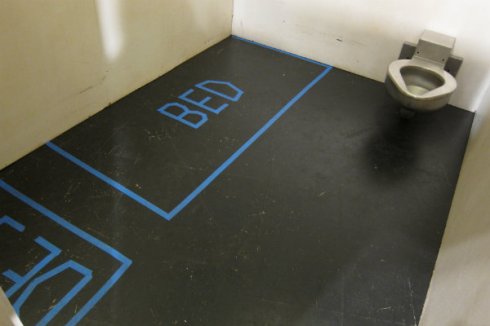
The NYCLU created a mock prison cell to show what life is like in solitary confinement. Kathleen Horan/WNYC
Today resumed a hunger strike by the prisoners of California’s Pelican Bay State Prison SHU (Secure Housing Unit). In solidarity, prisoners across the nation have also joined.
The main issue at hand is solitary confinement. Namely, its longterm use. UN Special Rapporteur on Torture, Juan Mendez, stated that any time over 15 days in solitary confinement constitutes torture. Yet California prisoners have been caged in solitary for 10 to 20 years or more. In addition, the prisoners kept under solitary confinement ask for nutritious food and the same educational programming accessible to prisoners in the general populations of state prisons.
Solitary confinement is an invisible cancer to those outside the system and a terror to those within it.
The prisoners — who refer to themselves at The Short Corridor Collective — are returning to protest that began two years ago. Neither Phase One (July/August 2011) and Phase Two (Sept/Oct 2011) secured the policy changes desired, despite promises from the California Department of Corrections to address the specific issues and reasonable demands made. In 2011, over 6,000 California prisoners went on hunger and work strike making it one of the largest peaceful protests in U.S. prison history.
The Pelican Bay State Prison SHU Short Corridor Collective state:
Our decision does not come lightly. For the past 2 years we’ve patiently kept an open dialogue with state officials, attempting to hold them to their promise to implement meaningful reforms, responsive to our demands. For the past seven months we have repeatedly pointed out CDCR’s failure to honor their word—and we have explained in detail the ways in which they’ve acted in bad faith and what they need to do to avoid the resumption of our protest action.
Five core demands
1. Eliminate group punishments. Instead, practice individual accountability. When an individual prisoner breaks a rule, the prison often punishes a whole group of prisoners of the same race. This policy has been applied to keep prisoners in the SHU indefinitely and to make conditions increasingly harsh.
2. Abolish the debriefing policy and modify active/inactive gang status criteria. Prisoners are accused of being active or inactive participants of prison gangs using false or highly dubious evidence, and are then sent to longterm isolation (SHU). They can escape these tortuous conditions only if they “debrief,” that is, provide information on gang activity. Debriefing produces false information (wrongly landing other prisoners in SHU, in an endless cycle) and can endanger the lives of debriefing prisoners and their families.
3. Comply with the recommendations of the US Commission on Safety and Abuse in Prisons (2006) regarding an end to longterm solitary confinement. This bipartisan commission specifically recommended to “make segregation a last resort” and “end conditions of isolation.” Yet as of May 18, 2011, California kept 3,259 prisoners in SHUs and hundreds more in Administrative Segregation waiting for a SHU cell to open up. Some prisoners have been kept in isolation for more than thirty years.
4. Provide adequate food. Prisoners report unsanitary conditions and small quantities of food that do not conform to prison regulations. There is no accountability or independent quality control of meals.
5. Expand and provide constructive programs and privileges for indefinite SHU inmates. The hunger strikers are pressing for opportunities “to engage in self-help treatment, education, religious and other productive activities…” Currently these opportunities are routinely denied, even if the prisoners want to pay for correspondence courses themselves. Examples of privileges the prisoners want are: one phone call per week, and permission to have sweatsuits and watch caps. (Often warm clothing is denied, though the cells and exercise cage can be bitterly cold.) All of the privileges mentioned in the demands are already allowed at other SuperMax prisons (in the federal prison system and other states).
You can download full text document of the demands here.
WHAT YOU CAN DO
Sign the petition.
Involvement in the July 13th Mass Mobilization!
Plan a solidarity action!
Follow! On Twitter and on Facebook
Use your imagination and your skills; talk to your family and friends about it, and maybe provide them with a handful of shocking facts about the psychological torture that is solitary ? (See below)
Don’t get despondent, get angry.
WHAT IS SOLITARY CONFINEMENT?
In California, nearly 12,000 imprisoned people spend 23 hours-a-day living in a concrete cell smaller than a large bathroom. Across the United states it is conservatively estimated that 20,000 people are in solitary every day. It could be as high as 70,000; it depends on definitions related to time and contact.
In California solitary cells have no windows, no access to fresh air or sunlight. People in solitary confinement exercise an hour a day in a cage the size of a dog run. They are not allowed to make any phone calls to their loved ones. They cannot touch family members who often travel days for a 90 minute visit. They are not allowed to talk to other imprisoned people. They are denied all educational programs, and their reading materials are censored.
UNFATHOMABLE SCALE AND WIDESPREAD USE
“The [psychological and cognitive effects of long term isolation] is not something that’s easy to study, and not something that prison systems are eager to have people look at,” says Craig Haney, psychology professor at the University of California at Santa Cruz, who notes that the widespread use of solitary is a very modern phenomena.
We have an overwhelmingly crowded prison system in which the mandate to rehabilitate and provide activities for prisoners was suspended at the same time as the prison system became overcrowded. Not surprisingly, prison systems faced with this influx of prisoners, and lacking the rewards they once had to manage and control prisoner behavior, turned to the use of punishment. And one big punishment is the threat of long-term solitary confinement. They’ve used it without a lot of forethought to its consequences. That policy needs to be rethought.
Writing for the New Yorker (Hellhole) in 2009, physician Atul Gawande quoted extensively from Haney’s research and added:
After months or years of complete isolation, many prisoners “begin to lose the ability to initiate behavior of any kind—to organize their own lives around activity and purpose. Chronic apathy, lethargy, depression, and despair often result. . . . In extreme cases, prisoners may literally stop behaving” (Haney). [They] become essentially catatonic.
Keep yourself informed; keep progressing; keep honest; follow news on the Prisoner Hunger Strike Solidarity website.
In solidarity, Pete.

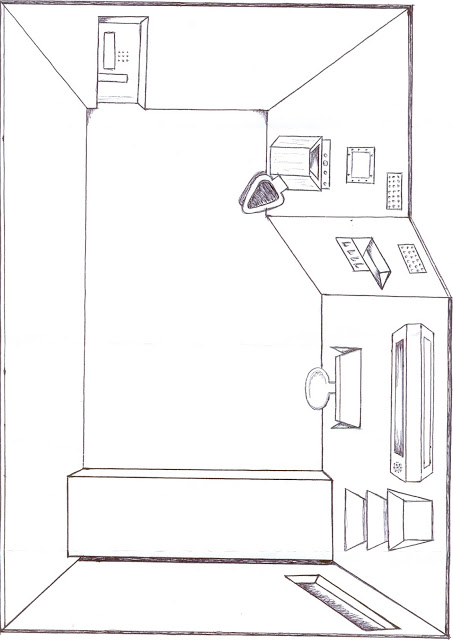
The image above was drawn by Katherine Fontaine, a San Francisco based architect, prison-questioner, friend to all, and book-art-space-collective co-runner.
“There are very few pictures of SHUs. The last drawing that was found at the Freedom Archives in San Francisco was from when Reagan was the Governor of California,” says Fontaine.
With solitary confinement, such a hot news topic, Fontaine was compelled to sketch when she realised there were very few images of solitary cells in circulation.
“I was given the few photos that exist from other similar prisons and a diagram that was used in a previous court case drawn by a prisoner while in an SHU at Pelican Bay. The drawing is what I came up with from the materials I was given,” explains Fontaine who hopes her drawing of a Pelican Bay State Prison Secure Housing Unit (SHU) will be used — in media materials and campaigns — by any organizations protesting solitary confinement.
Fontaine’s commitment to make reliable sketches of prison spaces and apparatus was spurred by a chance encounter with some fellow professionals in an unlikely place. She was among a crowd outside the Central California Women’s Facility protesting overcrowding inside the prison.
Fontaine noticed a person within the crowd with a sign that read ‘Architects Against Overcrowding In Prisons.’ On the back of the sign was www.ADPSR.org. The acronym stands for Architects, Designers and Planners for Social Responsibility. Despite her day job as an architect, ADPSR was not a group with whom she was familiar. Upon reading the statement for the Prison Alternatives Initiative, one of ADPSR’s projects, Fontaine was all-in.
ADPSR state:
“Our prison system is both a devastating moral blight on our society and an overwhelming economic burden on our tax dollars, taking away much needed resources from schools, health care and affordable housing. The prison system is corrupting our society and making us more threatened, rather than protecting us as its proponents claim. It is a system built on fear, racism, and the exploitation of poverty. Our current prison system has no place in a society that aspires to liberty, justice, and equality for all. As architects, we are responsible for one of the most expensive parts of the prison system, the construction of new prison buildings. Almost all of us would rather be using our professional skills to design positive social institutions such as universities or playgrounds, but these institutions lack funding because of spending on prisons. If we would rather design schools and community centers, we must stop building prisons.”
Fontaine’s sketches will regularly appear in Actually People Quarterly, partly to inform as partly as a means to focus her thoughts.
“People need to see them,” she says. “Also it was such a powerful thing for me to draw that SHU cell. I wonder if anyone else can have a similar feeling just by looking at it or if I just feel so changed by it because I drew it. Maybe it is because I’ve spent years of my life drawing, studying, measuring and designing spaces that in actually creating that image I imagined that actual space so much more clearly than I had before? To imagine being an architect and *designing* that space is incomprehensible to me.”
Incidentally, ADPSR was recently featured on the excellent podcast 99% Invisible in an episode called An Architect’s Code, following mainly the activities of Raphael Sperry, ADPSR’s founder.
Below is Fontaine’s sketch of cage used routinely within the California prison system. The cages are sometimes to hold prisoners during transfer between units but, increasingly, used for group *therapy* — an oxymoron if there ever was one.

I’d also like to take this opportunity to share the work of some other determined prison sketchers, some of whom are prisoners.
From the website, Solitary Watch:
One of the most prolific and talented artists in solitary is 60-year-old Thomas Silverstein, who has been in extreme isolation in the federal prison system under a “no human contact” order for going on 30 years. (He describes the experience here.) His artwork appears on this site. It includes meticulously detailed drawings of some of the cells he has occupied, including one pictured below, which is designed (with built-in shower and remote-controlled door to an exercise yard) so that he never has to leave it or encounter anyone at all.

Next is this cell in Ohio, drawn by prisoner Greg Curry.
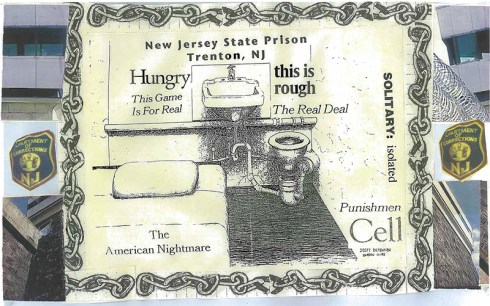
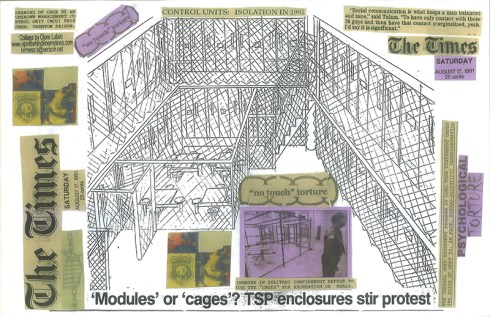
And finally, Ojore Lutalo has made some of the most politically charged prison art I’ve ever seen. Below, an isolation cell, and very below, Control Units, 1992.
When depicting prisons and their abuses there is no hierarchy of medium; sketches, photos, videos and oral testimony conspire to deliver a fuller picture. I will say though that these narrative rich drawings are more powerful than many photographs I come across.

 Prison Photography