
You are currently browsing the category archive for the ‘Activist Art’ category.

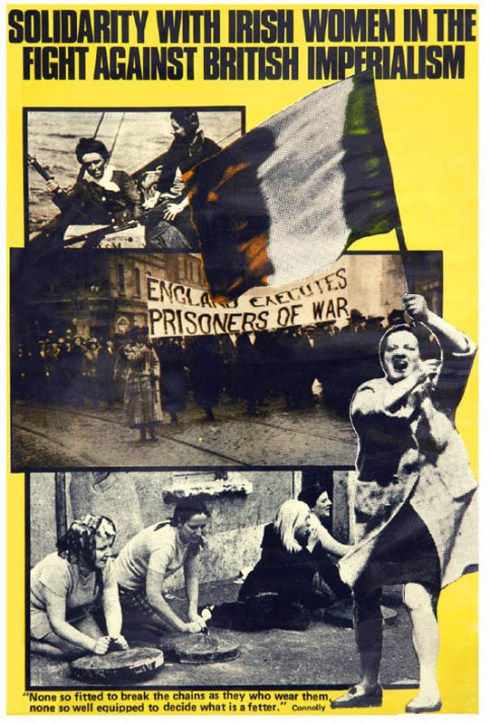
The inspiring Just Seeds Collective which peddles art to fund prison rights activism pointed me via its blog toward the Poster Film-Collective of London.
The Poster Film-Collective is a unique archive of graphics for African, Cultural, International, Irish, British and Women’s causes. With direct politics and robust graphics, poster arts are a nostalgic favourite for many art historians.

‘The Troubles’ of Northern Ireland are a very difficult topic for me to discuss; but not because I am close or emotionally compromised and not because I know or knew anyone involved. I grew up just the other side of the Irish Sea, but Belfast may as well have been the other side of the world to me. I was raised Catholic and my Mum’s family are from the Republic of Ireland. Yet, as a child my family rarely discussed the situation in Northern Ireland. Even in 1996, when the IRA bombed the Arndale shopping centre in Manchester (just down the M61 from my home town) the conflict was still too abstract and ancient for my teenage mind to comprehend.
I think any political labels or alliances that would fall upon my family were deflected by a distant dismay at the violence of the time. ‘The Troubles’ of Northern Ireland are not something I feel comfortable idealising; rather limply I retreat to the cliche that one man’s terrorist is another’s freedom fighter. All sides (there were more than two) were guilty of arrogance, obstinacy and extreme violence. The ideological brutality played out on the streets was matched by that meted out in the prisons, most notably Long Kesh, later renamed The Maze.

It is a lingering guilt for me that ‘The Troubles’ have always been historical … historicised. It is this guilt that accounts for the fact I’ve not before discussed Donovan Wylie’s The Maze on Prison Photography. Wylie is saturated in Irish history – it is his life’s vocation. On the other hand, I would be a fraud if I attempted to summarise the complex events of a physically-close-culturally-distant conflict.
It is with similar guilt I refer readers – in the first instance – not to news reports or academic reflection but to a 2008 film. But, I do so because Steve McQueen’s Hunger is a breath-taking portrayal of a life-taking episode in the history of Maze prison. It is a wonderful observation of British prisons, Irish Republican solidarity and inmate management in the face of political protest.
McQueen, in his directorial debut, specialises in long uninterrupted shots which grip time (and all its anguish) and forces the politicised narratives through the mangle. He flattens and simplifies the visuals drawing out the incredible fragility of human skin, snow-flake, fly, lamb, ribcage … McQueen is surely a great photographer too.

Through Donovan Wylie’s work I learnt of Dr. Louise Purbrick’s excellent continuing research “concerned above all with the meanings of things and how those meanings are contained or revealed, experienced and theorised.” Purbrick wrote the essay for Donvan Wylie’s book, Maze. That was in 2004. In 2007, Purbrick extended the survey, jointly editing the book Contested Spaces. It analysed the “divided cities of Berlin, Nicosia and Jerusalem, the borderlands between the United States and Mexico, battlefields in Scotland and South Africa, a Nazi labour camp in Northern France, memorial sites in Australia and Rwanda, and Abu Ghraib.”
Purbrick worked with another academic Cahal McLaughlin on the oral history & documentary film project Inside Stories featuring Irish Republican Gerry Kelly, Loyalist Billy Hutchinson and ex-warder Desi Waterworth. And it is here I start (and I encourage you to start), with personal testimony when trying to understand ‘The Troubles’.
Donovan Wylie has continued his visual archaelogy of Irish history with Scrapbook.
 Born in Belfast in 1971, DONOVAN WYLIE discovered photography at an early age. He left school at sixteen, and embarked on a three-month journey around Ireland that resulted in the production of his first book, 32 Counties (Secker and Warburg 1989), published while he was still a teenager. In 1992 Wylie was invited to become a nominee of Magnum Photos and in 1998 he became a full member. Much of his work, often described as ‘Archaeo-logies’, has stemmed primarily to date from the political and social landscape of Northern Ireland.
LOUISE PURBRICK is Senior Lecturer in the History of Art and Design at the University of Brighton, UK. She is author of The Architecture of Containment in D. Wylie, The Maze (Granta, 2004) and, with John Schofield and Axel Klausmeier, editor of Re-Mapping the Field: New Approaches to Conflict Archaeology (Westkreuz-Verlag, 2006). She also works on the material culture of everyday life and has written The Wedding Present: Domestic Life beyond Consumption (Ashgate, 2007) (Source)
CAHAL McLAUGHLIN is Senior Lecturer in the School of Film, Media and Journalism at the University of Ulster. He is also a documentary filmmaker and is currently working on a Heritage Lottery Funded project, ‘Prison Memory Archive’.

Reading the Goethe-Institut Fashion Scene article about Haeftling designers in Berlin, I thought it was an Onion style send up. “Prisoner chic” sounds like something straight out of satire, but I guess I was snoozing when this hit the news wires in 2003.
Haeftling (translated as ‘Prisoner’) employs inmates across Europe to manufacture clothing and housewares inspired (they say) by prison life, “The garments are highly functional and have a classic and timeless cut. Only high-grade, rugged fabrics are used in manufacturing.”
Well, whatever you say. I actually don’t mind how they market it, I am just pleased they support prison reform, the abolition of the death penalty, political prisoners rights and a philosophy of rehabilitative justice.

Haeftling Tray
But let’s not kid ourselves. This project was borne of commercial interests. “It began in the JVA (Justizvollzugsanstalt/prison) Tegel and developed into an international undertaking. More and more prisons have joined and today production is even taking place elsewhere in Europe. One Bavarian prison supplies honey from its own two colonies of bees; a prison in Switzerland even has its own vineyard and exports its own red (Pinot Noir) and white wine (Müller Turgau).” (source)
Karola Schoewe, Haeftling’s PR & communications manager says, “On the whole, the prisons are all very helpful,” says “There are some prisons that have very good production capacities for making homeware.”
Schoewe then marries the business speak to social responsibility speak, “Through its production, Haeftling is creating measures that help to support rehabilitation processes.”

Haeftling Espresso
Without seeing Haeftling’s account-books or sitting in on a board meeting, I have no way to tell if resources and profits are divvied up in a way that benefits prisoners more then in the state run prison industries. This was the situation in July 2003
(Author’s Note: €12.50 is substantial pay compared to American prisons.)
Prison industries are a divisive issue. For some they are the perfect use of prisoners’ time and energies developing job skills, work community & self-esteem. To others prison industries are a modern slave labor exploiting societies’ self-created incarcerated class.
Both viewpoints have legitimacy, but the first makes a prior assumption that could be misleading – that work programs are the only means to provide skills, community or self-worth. Education does this too.
But educating someone instead of putting them to work is going to cost a prison authority rather than generate it wealth.

Generally, I am unnerved by the disconnect between the reality of incarceration and its representation to consumers,
Then again, Klaus-Dieter Blank, of Berlin’s Tegel Prison states the success of the label’s online store has meant that people are beginning to understand “what goes on behind the walls”. Haeftling features on the Tegel Prison website.
Is there too much space here for consumers to create their own version of prison life? What is included and/or played down in the minds of consumers? Are they being coerced and sold a disingenuous view along with that ‘rugged’ product?

"Justiz 82" Scratchy Blanket. Haeftling Product
We can assess this a number of ways – rehabilitative worth, public awareness worth, benefits to state finances, tax-payer savings, external benefits of development in social entrepreneurship.
But essentially, we must ask, “Does this enterprise help reduce prison populations by reducing recidivism? It MUST be compared to other rehabilitative programs. The purpose of prisons the world over should be to create societies where prisons are no longer necessary.
How do you judge this type of enterprise?
In the interests of full disclosure, DuckRabbit and Prison Photography have become virtually-close these past couple of months, beginning with an acknowledged shared politic, via encouraging support, to a mention in DuckRabbit’s announcement of a daring competition that I feel I had only a small part to do with.

I am not advertising DuckRabbit’s $1,000 competition for brevity’s sake. I am promoting it because:
a) Stan Banos had an excellent point in the first instance
b) DuckRabbit has not been shy to challenge inequalities before (including MSF – opening dialogue, discussing visual ethics and celebrating consequent positive representations on MSF’s photoblog)
c) PDN, with an all-white 25 juror panel has a valid charge of passive racism to answer.
d) I think it is a ballsy move, and I want to see what comes of it.
Up for the debate?
FOR $1,000 YOU MUST;
“Come to PDN’s defense and answer the question, ‘What possible, plausible excuse could exist for an all white jury from a publication of such influence?’”
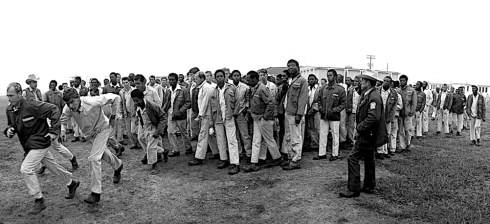
Credit: Bruce Jackson
NY Times LENS Blog
Here, there and everywhere people are celebrating the New York Times’ LENS Blog as a messianic gift for the photophile. I was therefore happy to see that less than two weeks in LENS is featuring Bruce Jackson’s wide angle documentary work from Arkansas Prison in the early 1970s
Bruce Jackson should be a familiar name as it was he that rescued, scanned and shared the enigmatic Arkansas Prison Mugshot series, Mirrors.
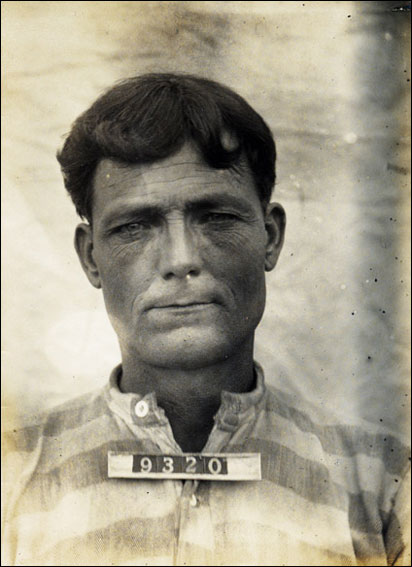
Found and presented by Bruce Jackson. Arkansas State Prisoner Portrait
June 100 Eyes Issue
Over at 100 Eyes, Andy Levin from insists that “Whatever ones perspective, be it victim, civil rights activist or cop, there is one shared idea – something needs to change.”
The June edition of 100 Eyes, titled, America Behind Bars features the work of Dominic Bracco, Jerome Brunet, Darcy Padilla, Jenn Ackerman and Tim Gruber – all very talented and committed photographers.
As editor, Andy Levin, concludes, the genre of prison photography (or to be less aggrandizing) simply the practice of photography within sites of incarceration is often a difficult and thankless task;
The photographers who have contributed to “America Behind Bars” have worked against overwhelming odds to bring back powerful images of American prisons. One can’t simply walk into a prison with a camera. This kind of photography requires long negotiations and often a warden who has the vision and concern to allow a photographer into his jail.
Wonderful exposure for the most pressing of social issues in America today.
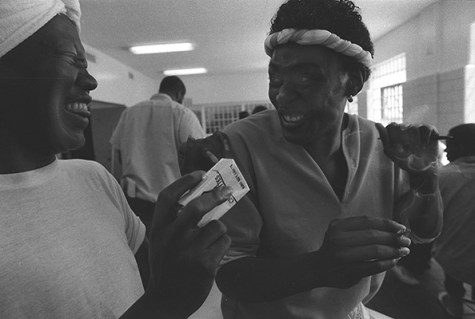
Darcy Padilla. From AIDS in Prison Series.
Prison Photography began its project in September 2008 with a celebration of Darcy Padilla’s portrait of former San Quentin Public Communications Officer, Vernell Crittendon.
In February, I was gob-smacked by Jerome Brunet’s Riding Shotgun with Texas Sheriffs.
The “Prison Movie” belongs to an undefined genre. Everybody has seen a movie that would fall within its flexible parameters of definition, and yet the concept is a little unnerving.
The genre, I believe, is misunderstood and suffers from an overall apathy or misinterpretation of prison realities. ‘Captivity’ – a necessary requisite of prison – has other discomforting associations such as bondage, unequal power relations, psychological violence, abuse & coercion, constant tension, artificial alliances, survival instincts, homosexuality, rape and exploitation to name a few.
Prison movies, because of their (perceived) content are rarely dinner table conversation. To acknowledge a genre is to acknowledge the common problems that arise when one set of humans puts another set of humans in cages.
A prior guest blogger recommended the work of Paul Mason to help me through this quandary. In his excellent introduction to defining the genre, Men, Machines And The Mincer: The Prison Movie, Mason discusses major themes and audience motivations for viewing. Mason sets the tone for discussion with two truisms;
Two dilemmas exist concerning prison movies: first, hardly any research has been undertaken in the area and secondly, there has been little attempt to define the prison movie. Paradoxically, whilst the genre may not be instantly recognisable, there are many prison movies that stick in the memory.
Mason references a multitude of titles including: Brute Force (1947), Riot In Cell Block Eleven (1954), Birdman of Alcatraz (1962), Cool Hand Luke (1962), Papillon (1973), The Mean Machine (1974), Lock Up (1989), Chained Heat (1992), In The Name Of The Father (1994), Murder In The First (1994), A Man For All Seasons, The Count Of Monte Cristo, There Was A Crooked Man, Silent Scream (1990) We’re No Angels (1955), Breakout (1975), Sleepers (1996), The Hoose Gow (1929), Jailhouse Rock (1957), Porridge (1978), Prison Break (1938), Crashout (1955), Breakout (1975), Midnight Express (1978), McVicar (1980), Scum (1983) Lock Up (1989), The Shawshank Redemption (1995), The Loneliness Of The Long Distance Runner (1962), Numbered Men (1930), The Criminal Code (1931), San Quentin (1937), Men Without Souls (1940), Dead Man Walking (1995), The Shawshank Redemption (1995), I Am A Fugitive From a Chain Gang (1932), San Quentin (1937), Wedlock (1990), Two Way Stretch (1960), The Ladies They Talk About (1933), Road Gang (1936), Hell’s Highway (1932), Blackwell’s Island (1939), The Pot Carriers (1962), The Big Doll’s House (1971), The Big Bird Cage (1972), Women In Cages (1972).
Mason elaborates:
The term ‘prison movie’ is both a nebulous and problematic one. It is not a term used in everyday discourse like ‘gangster film’, ‘musical’ or ‘western’ is used and yet most of us would describe Midnight Express, Birdman of Alcatraz and Papillon as ‘prison movies’. Only Querry (1973), Nellis & Hale (1981) and Crowther (1989) have written about the prison movie and none of them attempts to define the genre. It is perhaps the difficulty in definition which explains why so little has been written about the prison film despite over three hundred having been made since 1910.
Mason’s paper was written just over 10 years ago now and if I were to bring the debate up to speed, I’d talk about the many independent documentaries and activist films that have sprouted particularly in response the political landscape of American incarceration since the late nineties – Mr. Big, Up the Ridge, Making the River, Prison Town, Gray Days, In Prison My Whole Life and A Hard Straight are just a few examples.
I’d be eager to hear reader’s favourite, memorable or simply known prison movies.
Bringing us full circle to our medium of choice, this discussion leads me to the difficult task of defining the genre of prison photography which I intend to do in the near future …

Guantanamo © Chris Maluszynski/Agence VU

Guantanamo Map http://www.cubafutour.de/Karte%20Guantanamo%20Provinz.jpg

Guantanamo Bay Tents. Courtesy of The Department of Defense Visual Information Center
I am very happy with the way Prison Photography is progressing. I have done interviews with some outstanding photographers and artists. I have offered opinion where I think there’s something to be said. The most satisfying work on the blog is that contributed by guest bloggers, comment-makers and interviewees. Photographers have contacted me and I have been eager to comment upon their work.
But, there is one audience I never anticipated – The Google Image Search Audience. I get many hits for searches on Guantanamo, Guantanamo video, Iraq prison, Abu Ghraib, Abu Ghraib Images of Prisoners, etc, etc – which is strange because these are topics that many people have grappled over with more proficiency and depth than I am likely to.
It is obvious that there is a need for fast access to images of America’s sites of torture and incarceration, namely Abu Ghraib and Guantanamo. I certainly don’t wish to fuse the two institutional histories so I shall deal only with Guantanamo Bay.
Louie Palu
Walrus Magazine. 8 of Palu’s photographs and accompanying article.
The Atlantic. 6 of Palu’s photographs.
Private galleries. Palu’s Photoshelter profile offers three separate galleries, but they’re password protected. Contact the photographer directly.
NPR Interview. Palu offered insight into his experience and impressions of Guantanamo.
Christopher Sims
Mother Jones. 15 images of daily life outside of the prison complex.
Civilian Arts Project. 25 images of a bizarrely serene Guantanamo Naval Base.
BBC, The Other Side of Guantanamo. Article about Sims’ series.
Daylight Magazine. 4 minute audio of Sims’ experiences on project.
Chris Maluszynski
Agence VU/Moment. Twenty-six images exhibited. Likely more on file at the agency.
Cesar Vera
Guantanamo Prison. 18 Black & White images. 3 Colour.
Joint Task Force (JTF)
Many of the photographs shown in the press over the last few years were taken by members of the Navy’s own Joint Task Force. When press photographers visited the JTF vetted all images before release.
Boston Globe. 30 Hi-Res images.
Repeat of above selection. 20 Hi-Res images selected.
JTF Photo Galleries. 22 months (July 2007 – May 2009). Hundreds of images. Official photography.
Miami Herald
Description of the 8 different camps at Guantanamo
Explanation of the Legal contexts: Key defendants, the judges, the defense and prosecution counsel.
Cursory look at Art influenced by Guantanamo
Magnum
Bruce Gilden. Guantanamo Bay. Enemy Combatant Camps, 2003
Paolo Pellegrin. Guantanamo Detainees, 2006
Stuart Franklin’s work Cuba, 2003, included images from Guantanamo and you’ll need to search the Magnum website for images.
McClatchy
An eight-month McClatchy investigation of the detention system created after the Sept. 11 terrorist attacks has found that the U.S. imprisoned innocent men, subjected them to abuse, stripped them of their legal rights and allowed Islamic militants to turn the prison camp at Guantanamo Bay, Cuba into a school for jihad.
Intro. Text and 11 minute video.
Photos. Detainees held at Guantanamo Bay
Photos. Faces of Guantanamo Detainees. Part one.
Photos. Faces of Guantanamo Detainees. Part two.
Photos. Detainees held in Afghanistan.
Eyeballing
Comprehensive overview of base using Google Maps, official photographs. Details structures, uses and topography of naval base.
Camp America, Camp Delta, Camp V and Administrative & Court building.
Camp X-ray and construction of later detention camps.
Associated Press
Images of facilities and interiors of various detention blocks and camps.
Stars & Stripes “The Independent News Source for the U.S. Military Community”
Work at Guantanamo
Education at Guantanamo
Recreation at Guantanamo
Artistic Turns
David Hicks. Virtual Guantanamo Cell
Penny Byrne. Porcelain Guantanamo Detainee Figurines
Gregor Schneider. 21 Cells, Bondi Beach, Australia
Legofesto. Guantanamo reconfigured with Lego men and Lego pieces and Wired Interview
Flickr – Protest Images
Amnesty International. Guantanamo Protests
Various Photographers. 100 Days to Close Guantanamo and End Torture.
James M. Thorne. Protest images.
Miscellaneous Media
Prisoners of War. 2004 article by the San Francisco Gray Panthers with images of US airforce transporting detainees and early 2003 images of Camp X-Ray.
BBC. Life in a Guantanamo Cell

Rendition. Photographer Unknown
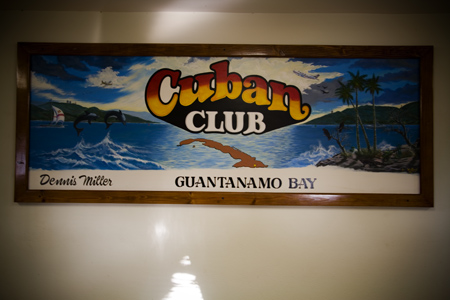
© Cesar Vera

Guantanamo Bay Navel Base with a New Commander-in-Chief. Photographer Unknown. http://www.obamalouverture.com/f39/guantanamo-bay-switch-bush-photo-obama.html
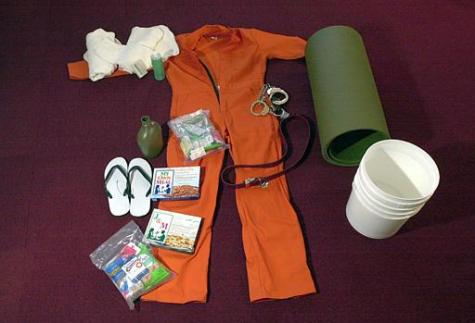
The standard issue of clothing, sleeping mat, food, sandles, canteen, soap, and buckets for detainees of Camp X-Ray is pictured in Camp X-Ray at the U.S. Navy Base at Guantanamo Bay, Cuba, on Wednesday, Feb. 20, 2002. © Tomas van Houtryve/AP Photo
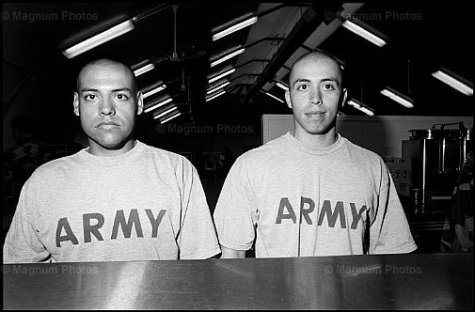
CUBA. Guantanamo Bay. 2003. Soldiers wait for their meals before a prayer breakfast at Camp America. Photo: Bruce Gilden/Magnum
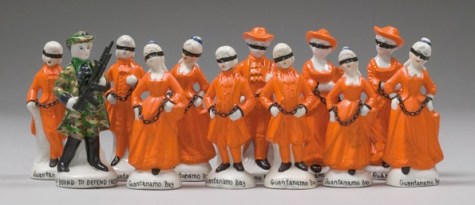
Penny Byrne Guantanamo Bay Souvenirs 2007, vintage figurines, metal chains, epoxy resin, plastic, re-touching medium, powder pigments, 14 x 32 x 10 cm.
Photo: Jon McClean. http://www.flickr.com/photos/jonmclean/410055117/
IF YOU HAVE ANY RESOURCES TO SUGGEST,
PLEASE CONTACT ME AND I’LL ADD THEM TO THIS LIST.

A TB patient at Tomsk Regional Clinical Tuberculosis Hospital, Building #3. Photograph and caption © James Nachtwey/VII.
“Tuberculosis is a disease of poverty and stress“.
Merrill Goozner, The Center for Science in the Public Interest.
“Sixty percent of all new cases of tuberculosis have resulted from the rapid growth of the post-Communist prison archipelago”.
Proceedings of the National Academy of Sciences. Aug. 26th, 2008
Tuberculosis (TB) was under relative control in the former USSR. Soviets had lifestyles, nourishment and conditions of living that kept disease at bay. When communism fell, so did a civil order in many areas. The phalanx of activity that filled the vacuum involved new systems, new relationships, new businesses and new criminal opportunities.
The prisons filled in a society that needed to organize itself before it could organize it’s transgressors. The prison population swelled to 1.1 million (it is now down to little over 700,000). Post-communist prisons held malnourished, crowded populations with weak immune systems; they have been described as ‘Tuberculosis incubators‘.

Correctional Treatment Unit #1, a TB prison colony in Tomsk, Siberia. TB patient/prisoner gets a chest x-ray. Treatment is supervised by Partners in Health in partnership with the government TB program. James Nachtwey/VII
TB is best treated with various labour intensive methods known under the umbrella-term Directly Observed Therapys (DOTs). Due to TB’s many different strains – each with different drug resistancies – case by case treatments differ according to patient reactions to drugs. At the least, a patient must be observed and his/her drug regime modified over a 6 month period. For Multi-Drug-Resistant Tuberculosis (MDR-TB) the treatment can take as long as two years. And, MDR-TB & XDR-TB are increasingly common among prison and civilian populations of Tomsk and other Siberian urban centers. Unfortunately, closely monitored drug regimes are improbable in over-stretched and poorly funded state systems.
It wasn’t always so dire. The former Soviet provided a regular supply of drugs to abate disease amongst its prison population, but those supplies were interrupted in the fall of Communism – sporadic and incomplete treatments gave rise to multiple resistant strains of tuberculosis. To compound this the side effects of drugs were enough to discourage patients, and rarely, if ever, did courses of treatment go with a prisoner into his community following release.

TB patients smoke cigarettes in the smoking room of Tomsk Regional Clinical Tuberculosis Hospital, Building #1. James Nachtwey/VII
James Nachtwey‘s mega-promoted TED prize crusade addresses the spread of Extremely Drug Resistant Tuberculosis (XDR-TB), its mutant forms and human tolls. This excellent Guardian article notes Nachtwey has photographed the epidemic worldwide, from Siberian prisons to Cambodian clinics.
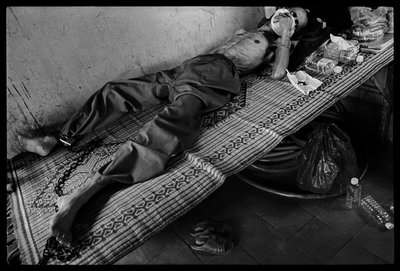
A prisoner who was convicted of murder was moved from prison to the TB ward of Battambang Provincial Hospital, Battambang, Cambodia when he was diagnosed with TB. He is coinfected with AIDS. James Nachtwey
Nachtwey stands with Sebastião Salgado in the “super-photographer” stakes. They both make the ugly beautiful.
Both Nachtwey and Salgado have inspired others to action and both believe firmly in the power of photography to change existences … even in a time when such sentiment is derided as old-fashioned, false idealism.
But, despite the odds, Nachtwey has succeeded in forcing his work into the conscience of millions. For some his work is an inspiration for social justice; but for others his work is a sub-conscious default to guilt, despondency and powerlessness to help others less fortunate.
James Nachtwey puts human faces to global suffering. And we are outraged. Or we feel we should be outraged.
I think Nachtwey wants us to believe in ourselves as agents of change. Nachtwey deliberately chose Tuberculosis – because while the situation is critical, it is not terminal and TB is theoretically entirely curable. Beating TB on a global scale is dependent on the behaviours of individuals and their communities.

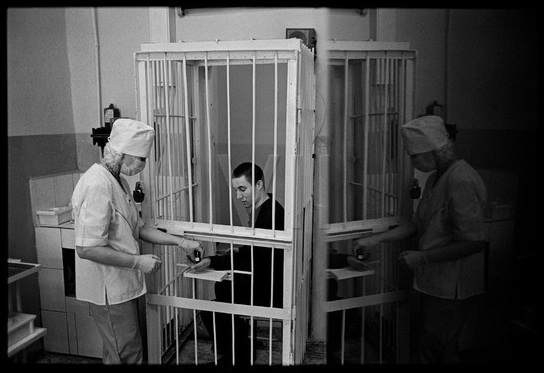
Correctional Treatment Unit #1, a TB prison colony in Tomsk, Siberia. A prisoner proves to a nurse that he has swallowed his daily oral TB medication. The prisoners receive treatment through metal bars in order to give security to the nurses. Treatment is supervised by Partners in Health in partnership with the government TB program. © James Nachtwey/VII.
Nachtwey’s work extended beyond the prison walls in Tomsk and went into the public clinics (some images included here show those facilities); TB is no respecter of human walls or demarcations. Regional, economic poverty will spike rates of TB.
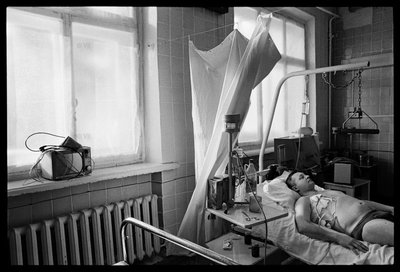
A TB patient has excess fluid drained from his chest a Tomsk Regional Clinical Tuberculosis Hospital, Building #1. James Nachtwey/VII
The worst thing we could do here would be to think that TB is a disease of other nations and other peoples. In Pathologies of Power (2004), Paul Farmer wrote about the New York prison system’s huge Tuberculosis epidemic of the mid-nineties, “By some estimate, it cost $1 billion to bring under control”. The strains that arose in the NYDoC have been directly related to the resistant strains of the former Soviet Union. Tuberculosis is latent within one third of the world’s population. Tuberculosis needs only the conditions for its growth.
Paul Farmer, of Mountains Beyond Mountains fame has taken the lead on combating TB, as well as other infectious diseases, amongst the world’s poorest populations. He worked with Partners in Health partly funded by a Soros Grant to “develop demonstration tuberculosis control projects which could become a model for replication throughout Russia.”
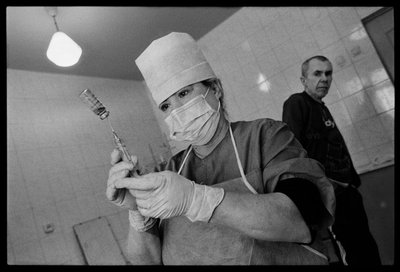
A nurse prepares a daily injection for TB patients at Tomsk Regional Clinical Tuberculosis Hospital, Building #3. James Nachtwey/VII
Prison Photography blog has focused twice previously on photographers’ responses to the USSR and its aftermath – the Gulag and the new prisons that arose. While Anna Shteynshleyger and Yana Payusova are working with very different issues, regions and populations they – along with Nachtwey’s work – remind us of the severe problems facing parts of modern Russian society. Unfortunately, and certainly in the case of Tuberculosis, these problems exist in other nations also. Nachtwey focused on TB because it was not – despite being a global problem – on the radar of most people. That sounds like something I’d say about prisons and prisoners’ rights.

Correctional Treatment Unit #1, a TB prison colony in Tomsk, Siberia. A patient/prisoner receives a daily medical injection. The prisoners receive treatment through metal bars in order to give security to the nurses. Treatment is supervised by Partners in Health in partnership with the government TB program. James Nachtwey/VII
For more information on XDR-TB read the Action – Advocacy to Stop TB Internationally website, and the Center for Disease Control & Prevention website. For the most accessible and recent article, read Merrill Goozner’s 2008 Scientific American article about Russian Tuberculosis strains which also includes a audio segment with a clear explanation of the situation.
A TB patient/prisoner receives his daily oral medication at Correctional Treatment Unit #1, a TB prison colony in Tomsk, Siberia. © James Nachtwey/VII.
James Nachtwey built his reputation as a combat photographer.
He was always reluctant to be the focus of media attention but after 5 Capa Gold Medals for War Photography he couldn’t escape the curiosity of Christian Frei who made the extraordinary film War Photographer. Nachtwey comes across as an articulate, self-isolated journalist-force devoted to his craft and courteously distant to others; here is a clip.
Nachtwey has done interviews here, here and here. Read an interview about his 9/11 pictures, and associated videos on Digital Journalist. The images were published in TIME.
He worked in Rwanda for his book Inferno.
View his TED Prize acceptance speech and the consequent October 2008 launch of his XDR-TB project and Flickr pool.

 Prison Photography

Jacob Holdt’s America: Hitch-hiking, Poverty, Racism, Prisons, Death and Love
May 19, 2009 in Activist Art, Documentary, Historical | Tags: America, Anti-Racism, Comment, Death, Drugs Addiction, Inequality, Jacob Holdt, Love, Murder, Philosophy, Poverty, Prison, Prisons, Problems, Social, Violence | by petebrook | Leave a comment
Jacob Holdt presenting at the New York Photo Festival, 2009. Screen shot from WTJ? Video.
In 2008 it was Ballen. In 2009 it was Jacob Holdt; The highlight of the New York Photo Festival.
I have been a fan of Holdt’s work for a couple of years now. Longer than some and not a fraction as long as others. Holdt has lived across the globe as an activist against racism and a harbinger of love for nearly four decades.
In 2008, Jacob Holdt was nominated for the Deutsche Borse Prize eventually losing out to Esko Männikkö. It was a shrewd shortlisting by a notoriously urbane committee at Deutsche. Holdt’s life and productive trajectory is his own, and much like Ballen does not conform to any norms of expected photographic career paths.
Any nomination – any praise – is purely a recognition of Holdt’s philosophy, his “vagabond days”, his trust in fellow humans and his rejection of stereotypes, fear and pride. Holdt does not revere photography as others may, “Photography never interested me. Photography was for me only a tool for social change.”
© Jacob Holdt
I watched Holdt’s presentation without expectation. I was, in truth, very surprised by the number of times he referred to his subjects – his friends – spending time in prison. It seemed only death trumped incarceration in terms of frequency amongst his circle of friends.
Prison Meal on Toilet © Jacob Holdt. Through a “mysterious mistake” I got locked up in this California prison with my camera and had plenty of time to follow the daily life of my co-inmates. Food was served in their cells where the only table was their toilet.
Slide after slide: “I can’t remember the number of times I have helped him get out of prison” and, “He’s in prison, now” or “He’s doing well now. He was in prison, but now he is out, has a family, and is doing well.”
Holdt described his method of finding community. Upon arrival in a new place, he would visit the police station and ask where the highest homicide rate was. He’d go to the answer.
Violence was tied up with poverty, was tied up with drugs, was tied up with deprivation, was tied up with hurt, was tied up with punishment and was tied up with prison – usually long sentencing.
Holdt’s series straddles the massive prison expansion experiment of America that began in the 1980s. Also enveloped are the crack epidemics, the racial fragmentation of urban populations and the relocation of middle classes to the suburbs. Holdt’s photographs are the mirror to racial economic inequalities.
Dad in Prison © Jacob Holdt. Alphonso has often entertained my college students about how he and the other criminals in Baltimore planned to mug me when they first saw me in their ghetto. However, we became good friends, but some time later he got a 6 year prison term. Here are the daughters Alfrida and Joann seen when they told me about it at my return. Today Alphonso has found God with the help of these two daughters who are now both ministers.
Holdt doesn’t play the blame game. Just as institutions and corporations walked all over many African Americans in Philadelphia, Baltimore, New York, and states across the South, so too did people step on each other, “This is a photo of a man the night after he shot his own brother in the head.” The next night, he was out stealing again and soon after was convicted for another crime and served 16 years in prison.
Holdt only makes excuses for the failings of his friends insomuch as their mistakes are more likely – almost inevitable – set in the context of their life experience. He doesn’t jump in, drive-by, photo some ghetto-shots nor cadge some poverty-porn. Holdt involves himself directly and tries to open other avenues.
He and his team has lectured across the globe running anti-racism workshops. Holdt had ex-cons sell his anti-racism book on the streets when they were released from prisons without opportunity. He offered pushers the chance to sell his books instead of dope. Sometimes he saw the money and sometimes not, “But, it was never about the money” Holdt adds.
Prisoner cleaning up on Palm Beach. © Jacob Holdt
One of the most sobering facts of the talk was a double mention of Lowell Correctional Institution in Florida. It was the only facility referred to by name and twice Holdt named friends who’d spent time inside. Lowell is a women’s facility. The female prison population of America has quadrupled in the past 25 years. It is still expanding at a far faster rate than the male prison population. Women’s super-prisons are singularly an American phenomenon. Holdt dropped as an aside, “I have three friends with grandmothers in prisons.”
If he could help, he would. Holdt described a struggling young lady who he desperately wanted to get on staff of American Pictures, but in 1986 she was too strung out on crack. In 1994 he visited her in prison. In 2004 she was released. In 2007 she was still out and Holdt photographed her with her son.
He photographed mothers, lovers, father and sons behind bars. In one case, when the father was convicted the son turned to crime to keep enough money coming in to support the family. He soon joined his dad in prison.
Prison Kiss © Jacob Holdt. I was visiting the friend of this inmate when his wife suddenly came on a visit.
But when it would be expected that Holdt may be too deep inside the experience of the poor Black experience, he took the chance to live amid the poor White experience.
Poor whites at a Klan gathering in Alabama. © Jacob Holdt
In 2002, Holdt had the opportunity to live with the Ku Klux Klan. He became pals with the Grand Dragon and his family.
“I have spent my life photographing hurt people.” The KKK members were no different. The leader had been abused as a child, subject to incest and beatings. Holdt presumed this but it was confirmed around the time the leader was sent to prison for 130 years for murder.
Holdt moved in with Pamela, the leaders wife, to support her in her husbands absence. Also in his absence he brought the unlikeliest of people together.
Pamela with white friend (Jacob Holdt). © Jacob Holdt
Pamela with black friend. © Jacob Holdt
During this time and only through informal discussion did Holdt learn that the man was innocent – he had voluntarily gone to prison to spare his son, the real culprit, from conviction for a hate crime.
Holdt petitioned and won his release. The former Grand Dragon was unemployed upon release and went on to sell Holdt’s anti-racism book on the streets … just as the dope-dealers of Philly had 15 years earlier.
Holdt’s presentation confirmed to me that the prison is inextricably linked with the social history of America. But this should not be surprising in a society so violent. Holdt paints a portrait of America from the 70s through to today in which the poorest people (both Black and White) held the monopoly on violence, disease, depression, addiction and struggle.
When Holdt was in Africa he showed people there his images of African-Americans suffering. Africans thought the Black communities of America would fare better in Africa, “Why don’t they come back here?”
Two unemployed Vietnam veterans at wall on 3rd St. © Jacob Holdt
Given the situations he walked into, some may think Holdt is fortunate to still be alive but having armed himself with love he made his own luck … and friends.
Check out more on Jacob Holdt here and here. Here is an article in support of his hitch-hiking activity.
Holdt’s incredible 20,000 image archive American Pictures.
WTJ? 70 minute video of his NYPF presentation.