
You are currently browsing the category archive for the ‘Fine Art’ category.

The National Arboretum, Westonbirt, Gloucestershire, 2013 150 x 122cm, Lambda print on Fuji Crystal Archive Paper. Image courtesy of Flowers Gallery.
There’s something about Simon Roberts’ photographic surveys of England that leave me feeling a little uneasy. This is not a bad thing; better to feel something than nothing at all when encountering art.
I published a piece Very English Tourism Spots are Just Intensely Managed Distractions on Medium dealing with my hesitations.
I think my unease stems from the fact that while Roberts is critiquing the quirks of the English and riffing on nostalgia (certainly) and cliche (probably) there remains space in his work for massive misunderstanding — massive under-estimation to be precise.
Roberts’ work could be read as uncritically nationalistic by those who are already that way inclined. Although the ironic title of his latest series National Property: The Imperfect Picturesque directs people away from simplistic and politicised readings of the photographs, the scenes he captures are nonetheless relatively bucolic. They smack of the quaint English countryside and of honest folks at leisure (which they are) but they leave so much of England and experiences of people in England out too.
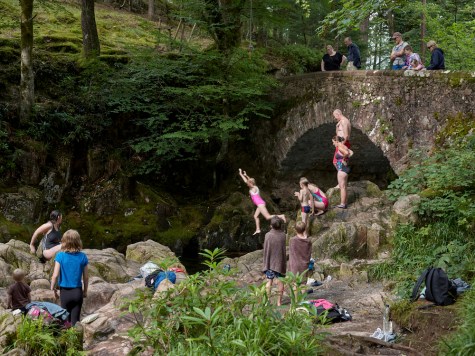
Trough House Bridge, Eskdale, Cumbria, 2014, 150 x 122cm, Lambda print on Fuji Crystal Archive Paper. Image courtesy of Flowers Gallery.
I’m hesitant to frame this even as an argument. It’s hardly fair to critique something on that which it is stated not to be. And Roberts, nor any other photographer, can be held accountable for the jingositic readings of work by pockets of distant audience.
Many English photographers (Parr, Dench, Stuart) hold a mirror up to their nation with biting snark. Roberts’ mirror is little more removed, less in your face and returns images that are not immediately or obviously critical.
All of these are still forming thoughts. It is one of the luxuries of being a blogger, that with enough caveats, you can share early thoughts and canvas response. So, what do you think?
Read Very English Tourism Spots are Just Intensely Managed Distractions.

Willy Lott’s House at Flatford, East Bergholt, Suffolk, 2014. 150 x 122cm, Lambda print on Fuji Crystal Archive Paper. Image courtesy of Flowers Gallery.

Penshaw Monument, Penshaw, Tyne and Wear, 2013. 150 x 122cm, Lambda print on Fuji Crystal Archive Paper. Image courtesy of Flowers Gallery.
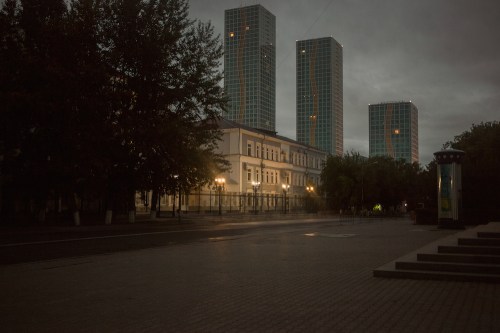
Verint Israel and NICE System Monitoring Center, Astana, Kazakhstan 2014.
Much of my weekend was spent putting a final editing-touches on the latest Vantage article Panopticon For Sale. The piece, details trade between authoritarian regimes (such as Uzbekistan, Kazakhstan, Azerbaijan, Bahrain and others) and corporations that manufacture and maintain cyber-surveillance.
The author, Mari Bastashevski, spent 12 months researching this shady industry — trailing paper work, filing FOIA requests, interviewing and protecting sources, and corroborating statements. Many previously unreported (but commonly suspected) business relations uncovered by Bastashevski have been confirmed by information included in the July 5th hack of Hacking Team (a company that manufactures surveillance technologies) when the identities of its clients were posted online.
As Bastashevski writes in her closing statements:
Companies like NICE, Gamma Group, Verint, and Hacking Team, who sell this power to governments for which “watched a YouTube protests video” constitutes criminal behaviour become co-arbiters of what is and isn’t a “wrong act”. Yet for the companies, much like for their clients, their own secrecy remains absolute and proprietary: not something for press consumption, researchers, or advocates.
Private corporations are facilitating the unfettered surveillance of citizens by paranoid rulers.

NICE Systems HQ, Ra’anana, Israel 2014.
The comparatively unregulated republics in the post-Soviet region are proving grounds for the shit that the power hungry can get away with.
I’ll stop yelling now, encourage you to read Bastashevski’s #longread, and leave you with an my editor’s foreword to further convince you to take in Bastashevki’s text and images.
This is a narrative built upon information that’s incredibly difficult to verify. Outside of the community of privacy advocates and cyber-surveillance researchers, no-one really saw this story, or necessarily knew what it was or why it mattered. That’s because everything that Bastashevski was looking at — or looking for — is invisible, confidential or both.
When Hacking Team was itself hacked, Bastashevski felt vindicated. Not only did the hack confirm the presence of Hacking Team in countries she investigated, it also confirmed the presence of other companies she knew were providing surveillance to those countries. The lies and questionable dealings of a catastrophic industry were laid bare.
“To photograph or to look at what exists on the verge of catastrophe,” critic Ariella Azoulay once wrote, “the photographer must first assume she has a reason to be in the place of the nonevent or event that never was, which no one has designated as the arena of an event in any meaningful way. She, or those who dispatch her, must suspend the concerns of the owners of the mass media regarding the ratings of the finished product and with her camera begin to sketch a new outline capable of framing the nonevent. Photographing what exists the verge of catastrophe thus is an act that suspends the logic of newsworthiness.”
By virtue of hackers’ actions, and not the logic of the news industry, I find myself in a position to publish Bastashevski’s remarkable findings. A condensed version of this work was exhibited at Musee de Elysee and published in the Prix Elysee catalogue (Musee de Elysee, December 2014). It has since been expanded to include a review of targets and surveillance in Azerbaijan, and cross references of the recent evidence obtained through Hacking Team leak.
This is not a photo essay but rather an essay with photos. Bastashevki makes photographs, in many ways, to show her stories cannot be photographed. These images are way-markers along roads of discovery.
–
Read the full piece Panopticon For Sale and see more large images.
–

Ministry of Communication Tashkent, Uzbekistan, 2014.
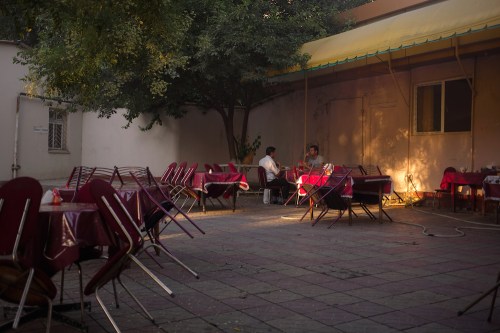
SNB lunch spot, secure Gazalkent district, Tashkent Uzbekistan. 2014.

Monitoring centre (roof) -Tashkent, Uzbekistan. 2014. Location where data obtained with Hacking Team, Nice Systems, and Verint Technologies is analysed and processed.
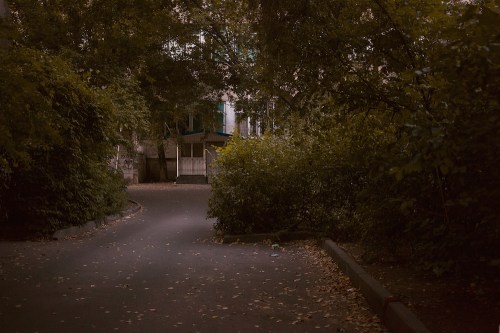
PU-data collection point Kazakhtelecom-Almaty, Kazakhstan, 2014.

Presidential Palace and MNS HQ, Baku, Azerbaijan 2013.
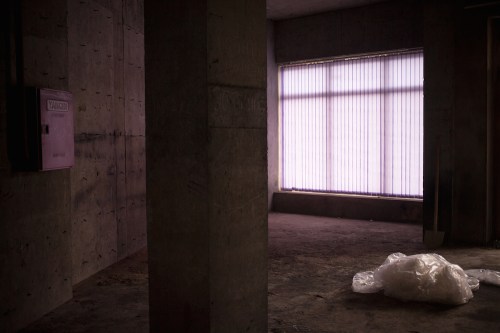

Inside Verint Israel HQ, Herzliya Pituach, Israel 2014.

Transaction — Dedeman Silk Road Radisson Blu, Tashkent ,Uzbekistan. 2014.
–
All images: Mari Bastashevski
“If a book can have a trailer, I guess this is sort of that,” wrote Steve Davis in his email this morning.
Me Steve have a long history* but that in no way discredits what I am about to say. Whether I am biased or not (I am) this video absolute nails it. Why? The process of image-making is often messy. It get messier the more people are involved. Making photographs inside a prison — for Steve and his students — involves local authorities, management and staff. Everyone thinks they have a say or a role. If everyone is a photographer, then everyone is a photo-critic, or worse, everyone is the Photo Police.


Steve saw nice things and he saw absolutely devastating things. He met kids raised to be racists and they were very personable. He encountered kids stuck in the system and devolving to the oppressed and hardened personalities required for survival. He met staff who were moving heaven and hell to give these troubled kids the best shot at the rest of their lives, and he met adults who had already written them off and goaded the kids.
As Steve says, layers of contradictions and complex challenges exist in juvenile detention facilities. These images will not give you any easy answers; they will probably throw up more questions.
This is the best, quickest and truest introduction to Steve’s series Captured Youth that currently exists. If you like what he says an dyou like the images then pre-order the book of this work Unfinished at Minor Matters Books.
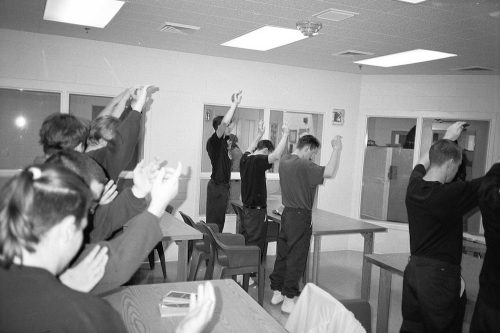

*Steve Davis was my first ever interview on Prison Photography. That happened because he was geographically the closest when I started the site. He didn’t have to say yes to the interview but he did. I must have done something right because a year later he invited me to his class to give a lecture. Steve Davis’ student were the first college students I ever presented material to. Years ago, when I was going through a really hard break-up and needed to get out of town, I headed down I5 and crashed on Steve’s couch for a couple of nights. Photographs made by incarcerated boys and girls who were students in his workshops feature in Prison Obscura. Next year, Prison Obscura will be shown at Evergreen State College in Olympia, Washington. Steve is the coordinator of the photography program at Evergreen and introduced the show to the gallery’s curator. Steve is a friend.
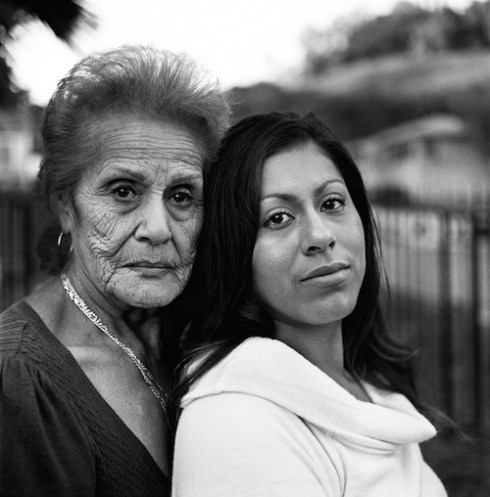
Darlene Escalante with her grandmother, Veronica, she is on a home visit that she earned at Walden House. Darlene talks about how both parents were in prison and affiliated with gangs. As young girl, she remembers going to Chino State Prison to visit her father. When her mother went to prison too, Darlene’s grandmother took her to make visits. “Both my grandmother and my mother were drug addicts. In 1989, my dad died after he changed his life, he was a nurse. He was gunned down and shot nine times. I want so much to change my life now, that’s why I came to Walden House. I don’t want to continue this horrible legacy that has existed in my family.” Los Angeles, 2008. From the series Re-entry.
–
IN CONVERSATION WITH JOSEPH RODRIGUEZ
A long time ago Joseph Rodriguez and I chatted. An edited version of the conversation just made the webs.
If you know Joe, you know he’s not short of words. We covered a lot, but given Mark Ellen Mark‘s recent passing, I wanted to highlight this anecdote with which Joe closed the interview.
I was shy. I gotta tell you. I did it at ICP. Going to school there was amazing. I remember Salgado looking at my pictures, and all I could do was photograph my life as a taxi driver. I was really very shy, and I just I wound up shooting through the windows a lot—stuff on the street. It was pretty cinematic, but he saw the pictures, and he didn’t say anything. I fucking blew it. That killed me!
Then I took a workshop with Mary Ellen Mark, and she was the one who really kicked my ass. She said, “You don’t believe in who you are.” I got defensive and said “What do you mean?”
“Well, you don’t believe in yourself as a photographer,” she said. So, she gave me this exercise. “When you get up in the morning in your underwear stand in front of the mirror and tell yourself you’re a photographer for 15 minutes.”
Doesn’t that sound a little hokey to you? Believe it or not, your boy did it, and I began to slowly believe more in myself as a photographer.
Now, I tell my students the same. If you don’t go out with reverence when you say you want to photograph somebody, they’re not going to take you seriously. You’re going to get a snapshot, nothing more.
I found photography in a very amateur way; it gave me happiness, gladness, and made me want to produce something that I was interested and excited about. To this day, though, I’m still nervous when I’ve got to go out and photograph.
Read the full conversation at the ICP website.

Homicide Detectives Dobine and Cedric Pacific Division. From the series LAPD.

The Quiles family at home. Ramiro and Danny from Marianna Maravilla, with their mother Aida, and sister Maria. East Los Angeles, CA, 1993. From the series East Side Stories.
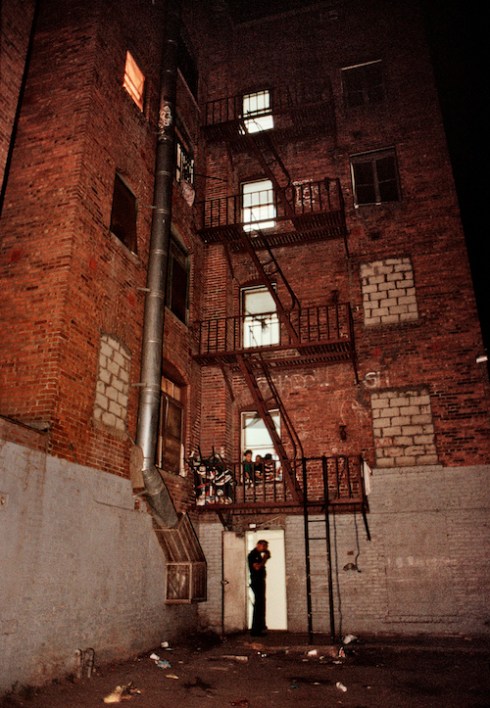
Rampart Officers search the house of a family of a man who was shot by a gang member in his living room. They check the building for the suspect. From the series LAPD.

Boyle Heights, Los Angeles, CA, 1993. From the series East Side Stories.

A Clarence Gang member is hit with five bullets from an automatic weapon on the night of a gang truce in East Los Angeles. His fellow gang members rush him to the hospital. From the series East Side Stories.

From the series Juvenile.

Rampart Division Officers detaining an arrested woman. From the series LAPD.
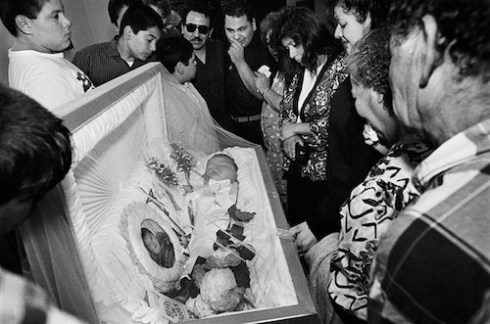
A family gathers the round of the coffin of Thomas Regalado III, who was killed by a stray bullet during a drive-by shooting. East Los Angeles, CA 1992. From the series East Side Stories.
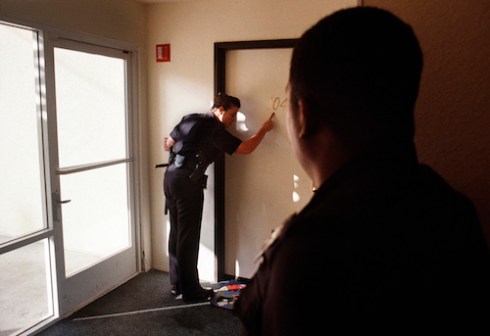
Officers responding to a domestic violence call. From the series LAPD.
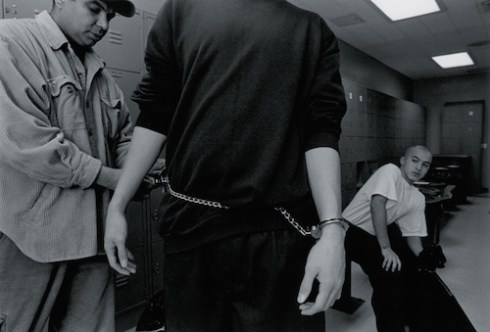
The minors are leaving the facility and are chained down for transporting. San Jose Juvenile hall. San Jose, California 1999. From the series Juvenile.

From the series Juvenile.
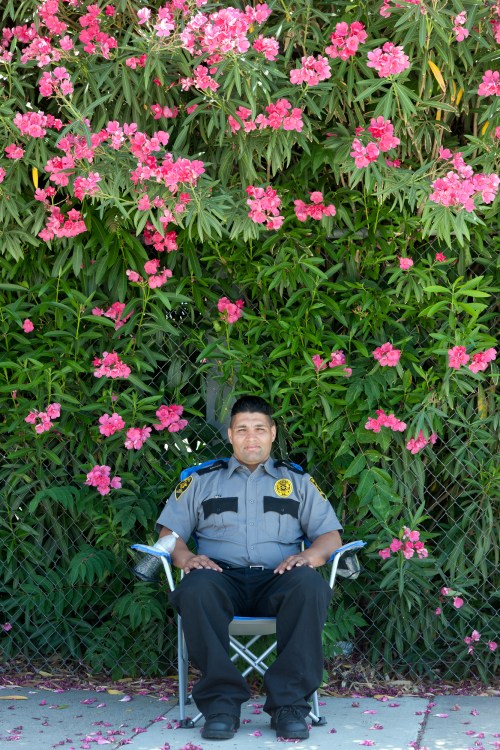
My latest for Vantage:
When Stockton filed for bankruptcy in 2012, it was the largest city in US history to do so. Kirk Crippens has spent the past three years photographing its residents.
It seems unlikely Kirk Crippens’ portraits are really going to affect the lives of the residents of Stockton, California. It is their portraits that make up his series Bank Rupture. Rather, it will be food banks, loan relief, and Stockton’s fiscal restructuring that will deliver much more direct — negative and positive — effects.
Grand statements and big claims aren’t Crippens’ style. Modest and curious, Crippens uses image-making to investigate and connect with the world. He photographs to establish relationships beyond his immediate working and daily experience. It might sound trite, but Crippens employs photography to show he cares. Having interviewed Crippens numerous times I’m confident in the claim.
“I served as witness. I immersed myself for a time and took some photographs along the way,” says Crippens.
Read the full piece and see a larger selection of images larger.
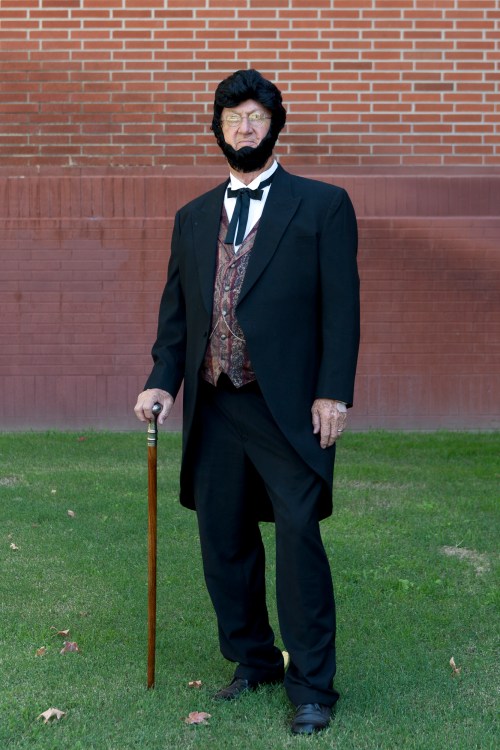

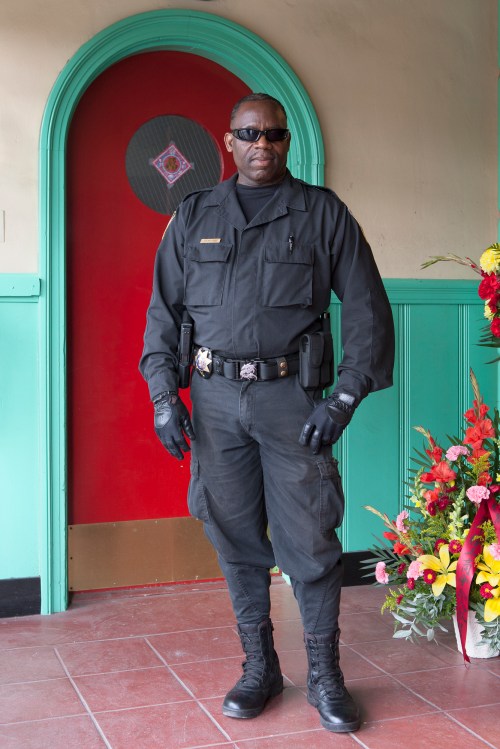

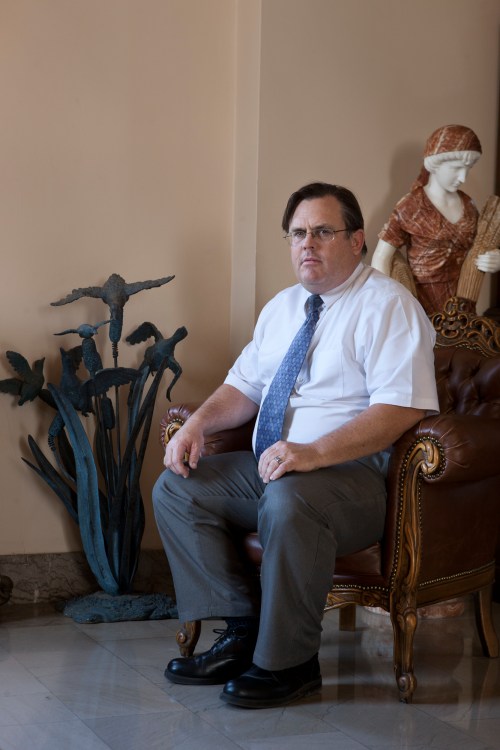


I spoke with Jan Banning yesterday. What a lovely fellow. He reads more than he photographs. He does non-fiction more than he does fiction. He does academic papers more than anything else right now. He’s been reading up on the philosophy of punishment, the biological roots of murder, and social control of “transgressive” women. What a lovely fellow.
Anyhoo, it’s going to take me a while to transcribe our hour long conversation which doesn’t help Jan in the immediate as he raises funds for his new book Law & Order.
Law and Order is a photo project that compares the criminal justice systems in Colombia, France, Uganda and the United States of America. Jan opted for this quadruplet after consultation with the Max Planck Institute for Foreign and International Criminal Law (MPI) in Germany … and after reading hundreds of pages of journal articles.
“Law and Order gives a human face to the authorities responsible for the investigation (police), trial of offenses (judges and lawyers) and the execution of sentences (prisons). Jan was able to gain access to these institutions – often with great difficulty – and he was also able to photograph suspects and convicts. Law & Order raises questions such as: How do we deal with criminals? What is the relationship between punishment and crime? Is confinement, besides being an instrument of punishment, also effective as a means of correction?”
It’s not just prisons. Jan photographed in police stations, courts and remand centers too.
The book will be designed by Peter Jonker, will be 144 pages, with 75 photos and measure 240 x 320 mm. Ipso Facto (Utrecht, Holland) is the publisher. Prison specialist, Michiel Scholtes provides an introduction and experts from the Max Planck Institute are contributing essays. Infographics and stats will abound too. Sounds like a dream.
Here’s the problem though. The pre-sales through the crowd funding have gone gangbusters in Holland and Jan hightailed it past his original target a long time ago. However, at the time of writing, Jan has only three pre-sales from people in the United States.
Jan didn’t use Kickstarter and so the fundraising campaign just didn’t run those media channels in America that Kickstarter has got locked down. That’s just the way it is. Ultimately though, it matters to Jan and it matters to his publisher and, quite frankly, it matters to me that interest exists among an American audience. At $55 (postcards too!) the book isn’t even an out of reach price-point.
Personally, I am looking forward to the new directions conversation will take once Jan and his Plancker friends crank the comparative cogs between these four geographically disparate spots. (Spoiler alert: the U.S. possessed the worst prison system Jan encountered).
So while you’re waiting for me to publish our conversation, you’ve time to go pre-buy Law & Order HERE or HERE (direct pre-buy at janbanning.com).

WORK DETAIL
At the back-end of 2011, I paid a visit to Nigel Poor and Doug Dertinger at the Design and Photography Department at Sacramento State University where they both teach. We talked about a history of photography course that Nigel and Doug co-taught at San Quentin Prison as part of the Prison University Project. At the time, there was no other college-level photo-history course other class like this in the United States. I have no reason to believe that that has changed (although I’d happily be proved wrong — get in touch!) We cover curriculum, student engagement, logistics, and the rewards of teaching in a prison environment.
Toward the end of the conversation we move on to discuss an essay by incarcerated student Michael Nelson. It was a comparative analysis between a Misrach photo and a Sugimoto photo. The highly respected TBW Books recently released Assignment No.2 which is a reissue of Michael’s essay. Packaged in a standard folder and printed on lined yellow office paper, Assignment #2 caught the photobook world a little off guard. Reviewers that dared to take it on admitted to being flummoxed a little. And then won over.
Back in 2011, TBW’s interest hadn’t yet been registered and Poor was still in production of the audio of Michael reading the work for public presentation. TBW Books publisher Paul Schiek has talked about the production of Assignment No.2, but Nigel Poor less so. This is the back-story to one of the most unique photo books of recent years — a book that combines fine art and fine design with an earnest recognition of a social justice need.
–
Scroll down for the Q&A.
–
Q & A
PP: How did you come to teach at San Quentin?
Nigel Poor (NP): I was always interested in teaching in a prison, and I just really never had the time to do it. While I was on a sabbatical [in 2011] I got an email from the Prison University Project saying they were looking for someone to teach art appreciation. I thought it would be a perfect time to teach there and form a class around the history of photography. I really wanted to do something with Doug so we got together to write this class.
PP: What do you look at?
NP: The history of contemporary photography — focusing on the 1970’s to the present. The course is 15 weeks like a regular semester. We met once a week for three hours. We started with early photographers — August Sander, Walker Evans and Robert Frank just to put some context and talk about how these photographers are often quoted and we move forward and show people like Sally Mann, Nan Goldin, Nick Nixon, Wendy Ewald.
Doug Dertinger (DD): Nigel tended to teach about the photographs that dealt with people, portraits, and social issues. My photographs tended to be the ones that dealt with land use and then also media. We struck a nice balance.
DD: The first two classes were strictly on aesthetic language, form, how to experience images, how to talk about them. The first assignment asked them to describe a photograph that doesn’t exist, that they wished they had that would describe a significant moment in their life. In that way they would create a little story for us and we would get to know something about them but they’d also have to use all the language about how you talk about a photograph. It was a really wonderful way to get them to think about making themselves part of the story of the photograph. Even if a photograph isn’t about you, you can bring your experience to it. It’s not solipsism; it is a way of entering photography. The exercise allowed them to take emotional chances with photographs.


In later classes, in 2012, Poor printed out famous photographs on card stock and asked her students to annotate directly upon the images. Click the William Eggleston analysed by Marvin B (top) to see a larger version of it. Kevin Tindall analysed Lee Friedlanders’ Canton, Ohio 1980 (middle), and Ruben Ramirez looked at David Hilliard’s tripychs (bottom).
–
PP: Were there any issues with your syllabus? Did you have to adapt it? Omit anything? Compared say to here at Sacramento State?
NP: I always tell my students, wherever we are, that it is an NC-17 rating. I naively thought I could just show the same images in San Quentin [as at Sac State] but when we started going through the process we were told that we couldn’t show any images that had to do with drugs, violence, sex, nudity, and children. Which is about 95% of photography!
At that point, I wasn’t quite sure how that was going to work but Jody Lewen [Director of the Prison University Project] is an incredible advocate and she didn’t want to presume censorship — Jody wanted the burden of explaation as to why we couldn’t show a particular image to be on the officials of the California Department of Corrections. She set up a meeting with the with Scott Kernan, the [then] Under-Secretary of the California Department of Corrections, and the [then] warden of San Quentin Prison, Michael Martell.
Kernan and Martell wanted me to show all the images that I was using for the class. I basically give them a mini-course in photography from 1970 to the present. We talked for close to two hours. I ended up getting permission to show everything except for four images.
PP: Not the worst case of censorship then?
NP: No. It was kind of a triumph. And, it must be said, without their help — especially Scott Kernan — I don’t think we would have gotten the class in.
PP: Can you describe the philosophy for the course?
NP: The central idea is to expose students to photography but really ask them to think about it quickly in an accessible and emotional way. Nor Doug or I teach from a theoretical or academic point of view. We argue that the images exist and they come to life because of the conversations we have around them. Students learn basic things about framing, form, content, but I really want them to explore all the areas of the photograph.
At the beginning, I describe the photograph as something akin to a crime scene; we are detectives trying to piece all the visual clues together to uncover subtext — perhaps, even secrets of the images that maybe the photographer isn’t even aware of.


In 2012, Poor was shown an archive of 4×5 negatives of photographs made by the prison administration in the 70s and 80s. The amount of information attached to the images is minimal. Poor broke the archive into 12 loose categories. One from the ‘Violence & Investigations’ category (top) and one from the ‘Ineffable’ category (bottom).
–
PP: Let’s come back to that. Because I want to bring Doug in here. Doug, what did you think when Nigel asked you to co-teach this program inside San Quentin Prison?
DD: I thought great. My parents are doctors and spent the last five years of their careers teaching at Federal Prison System. I taught in prison back in 1993 — one summer just general education stuff. So, when Nigel said that she was going to do this, well, I knew I wanted to partner with Nigel and thought it would be fun, in a way, to see what the what’s going on inside San Quentin.
PP: How do these students fair compared to your students in *free* society?
NP: They really understand the power of education and the importance of being present. I never had a student fall asleep at San Quentin or look at me with that blank expression! They were so hungry, open to conversation. It makes you worry about finding that same intensity outside of the prison setting.
DD: The men they already knew what they were about in a sense and so they came to the class with questions about photography and they understood that photography could reveal the world to them in ways that they were hungry for. A lot of students that I’ve had outside are still trying to figure out what they’re about and they haven’t yet come to their own necessity.
And, some of the men [in San Quentin] somehow understood that learning to talk about images, learning to see the world in a more complex way, could actually change them. I wish there was a way that didn’t sound trite to explain it but I could see transformations in them from the conversations that we had. Every Sunday when I left teaching there I would drive home in silence just contemplating the conversations that we had and how I felt I was becoming a better person for spending time with them. I would like to humbly think that they were too. It was a real back and forth.
Was it Wordsworth that said the imagination is the untraveled traveler? It seemed like when we went to class we all went on these journeys that were very significant for all of us. They were ready to travel.


In Nigel’s final class, she asked her students to annotate on print outs of photos from the newly discovered prison archive, in a manner similar to that they had with famous photographs from the art historical canon. Above are two examples.
–
PP: Earlier you mentioned Sally Mann. I presume a photographer that the authorities think is controversial, a photographer that wider society considers controversial and divides opinion. How did the discussion about Sally Mann’s work pan out?
NP: Some of them definitely had questions about the intent: Why would the mother want to photograph her three children romping around naked on their beautiful farm? But what I wanted to talk about how those images are highly staged and stylized. They’re not documentary images of how her children grew up. They are images about maybe desire about childhood, maybe the photographer inserting herself very clearly into these images. What is Sally Mann saying about the complexities of childhood or how children do have sexual feelings and act out in various ways? The images are about creating a tableau in a sense. It isn’t just about this mother who may have made images that made her children uncomfortable; it’s about creating stages to talk about emotional states of being.
PP: Well, I would think that many of the students are interested in notions of fact, truth, whether you can trust an image. Apart from the body, ones word is pretty much all you have when you’re incarcerated.
NP: We had a discussion very early on about the image always being a fabrication. It’s one person’s opinion putting a frame around the world and we always have to keep that in mind whether it’s documentary work or artist’s work. A lot of them got upset about that because I think they wanted to trust that something was reliable and truthful.
NP: And that may reflect a little bit on what happens to them, as people give evidence, or they want to assert their innocence, or not necessarily their innocence but how something unfolded in their life — this idea that everything is flexible and fluid was a little bit unnerving at times. They couldn’t look at the picture and think that’s exactly what the photographer meant and a few of them got prickly about it. It would come up off-and-on, you know. Can we use the word truth in reality when we’re talking about images and then by extension can you use those words when you’re talking about your own experience?
DD: That was a continuing topic throughout the whole semester. It was interesting too that they I don’t know how to describe it but they knew when they looked at a picture that there were all these elements in there. They explained it to us once: They get one picture from home once every 6 months, they pour over every detail of it and the desire is to create a narrative that they can fully believe and fully immerse themselves in. It was hard for them to understand that at first, at least, that there could be five different opinions about what a photograph was and each one kind of had equal weight.

Detail of Assignment No.2. Courtesy TBW Books.
NP: We don’t have a truth to give [the prisoners]. We’re going to give them our experience and talk about how we see the pictures but we’re going to learn something from them by the way they interpret images. I would see a photograph in a different light, often, after I heard what they had to say about it. I was the teacher in the classroom but it was very much about the power of group conversation. You have to outline what you want to discuss but you never quite know where the conversation’s going to go and I think that gave them a sense of power.
DD: I wonder if it was us not being, in a sense, “guards of meaning” that allowed them to say, ‘Oh, Nigel and Doug can be trusted to be privy to what we think, and they’re going to let us say things, and they’re going to correct themselves in relation to what we’re saying. We can participate, we have equal voice.’
PP: What do your students have to contribute to society?
NP: Before you have an experience in prison as a teacher or someone who’s going in as a civilian volunteer, prisoners are a group of invisible people. Even though I think I’m a thoughtful person, I had assumptions from what I read in the paper, in movies, in news.
PP: What you saw in photographs?
NP: Yeah! That these are going to be scary men, that if you turn your back are going to hurt you, that they’re animals they need to be separated from us and that they’re one-dimensional.
PP: Not so?
NP: When you go in there and you start talking and you see that these are complex, fascinating, thoughtful people; they’re citizens. They are part of our society. Yes, some of them have done terrible things but we have to think about reform and education, and the huge issues of, yes, redemption and forgiveness. How do we deal with those things? I think the only way you can thoughtfully talk about rehabilitation and forgiveness and make change is if you have a personal experience in there — you’re going to change your mind.


Details of Assignment No.2. Courtesy TBW Books.
NP: We need to find ways to use what’s in there to contribute to our society — to tap their experiences and thoughts. I became a better person by going in there and spending time. I learnt what it means to be human.
PP: That is similar to the feedback that I’ve got from other educators who’ve worked in prisons. Do you feel you are a conduit to the outside world. Do you have an added responsibility to share these stories, to share these men and their experiences with the wider public?
NP: I’m a pretty shy person and sometimes it’s difficult for me to talk at parties or whatever. But, now, I call myself the San Quentin bore. All I want to do is talk to people about this amazing experience, what these men are like. I feel very strongly about it, it’s not about me; it’s about this world that’s veiled and it’s about these men that are made invisible.
PP: You are not only a teacher, you are now an advocate. I hear you’re about to give a student the opportunity to “present” his work to the public?
NP: One of the assignments we had for the students was to give them two images from by two different artists and to ask them to analyse them. The only things the student knew about the works were the artists’ names, the dates, and the titles.
One student, Michael Nelson was given an image from Hiroshi Sugimoto’s Theater series and a Richard Misrach image of a drive-in theatre from his Desert Canto series.

Richard Misrach. Drive-In Theatre, Las Vegas (1987), from the series American History Lessons.

Hiroshi Sugimoto. La Paloma, Encinitas (1993), from the series Theaters.
NP: While Michael was doing the assignment he was put in the hole, isolation, segregation for four weeks. He wrote an amazing paper talking about those two images. So beautiful that I wanted to get it to Richard Misrach which I was able to do and Richard was blown away by the piece.
Richard had been invited to be part of an event in San Francisco called Pop-Up Magazine which invites 20 to 30 different artists, once a year, to tell six minute stories. Richard’s idea was to read the paper that Michael wrote which was incredible. BUT! Then we started talking about it more, the organizer of Pop-Up decided he wanted Michael to read the paper. So, I went into San Quentin and recorded him reading his beautiful paper.
PP: Fantastic.
NP: It will be edited together. Richard will introduce it, show the two photographs and then play the recording of the student reading. It’s thrilling that this man who’s been in prison for more than half of his life is going to have the chance to be heard by 2,500 people.
 PP: Nigel, Doug, Thanks so much.
NP/DD: Thank you.
ASSIGNMENT NO.2 (2014)
In an edition run of 1000, Assignment No. 2 will give many more people the opportunity to experience Michael’s words.
By Michael Nelson, Hiroshi Sugimoto, Richard Misrach.
12 x 9.5″ closed / 12 x 30″ open.
20 pages.
2 full color plates.
All proceeds go to the Prison University Project.
Buy here.
–

I was interviewed by ACLU recently: Prisons Are Man-Made … They Can Be Unmade.
The Q&A focuses around the exhibition Prison Obscura and you’ll notice a return to many of my favourite talking points. Still, the work never ends, and I know that ACLU will push out — to an expanded audience — my argument that we should all be more active and conscientious consumers of prison imagery. My thanks to Matthew Harwood for the questions.

 Prison Photography