
You are currently browsing the category archive for the ‘Opinion’ category.
Last month, spurred by Michael David Murphy‘s summary opinion piece I started writing about photographers rights.
I have talked before (and here and here) about the diminished freedoms for photographers in the UK. While the National Union of Journalists (NUJ) led many of the actions, it is the support of the whole photographic community that has driven the issue.
The half-penned piece was rendered redundant by last weekend’s “I’m A Photographer, Not a Terrorist” demonstration in Trafalgar Square, London last weekend. The event looked like a hoot (see here, here, here and here)! Nevertheless, I want to throw down a few thoughts and some links.
ONGOING CONFUSIONS
In November 2009, the UK police issued a memorandum retracting some of the misguidance it had issued; bobbies on the beat were reminded that it wasn’t illegal to take photos. Seemingly, this was more a PR exercise or simply the rank and file didn’t get the memo. Harassment continued.
This situation has totally degraded. The level of trust between the photographic community and police authorities is at an all time low (more here and here). Granted, the Guardian is my sole source here, but it covers the issue so well.
Outside of Britain, incidents have occurred in Los Angeles and elsewhere in the US. Some might say there is a certain amount of baiting employed by some journalists’ tactics (Paul Lewis outside the Gherkin in London springs to mind), but they are merely testing the communication and enforceability of new directives immediately after they’ve been announced by police authorities (in Lewis’ case, directives from New Scotland Yard).
In 2010, I hope to see less harassment of photographers. But, if hassle does continue I hope (and expect) to see its continued reporting to keep the pressure on police chiefs and politicians … particularly in the UK.
And with that I have a site recommendation. Photography is Not a Crime is a good one-stop shop for the unfortunate new genre of photog/authority face-off stories.

The watchdog is compiled by Carlos Miller a Miami multimedia journalist arrested by Miami police after photographing them against their wishes. He goes into his case at length and I still don’t think it is resolved.

Regardless of his motives, Miller’s coverage is comprehensive. As a silo for moments of confrontation and antagonism, the Photography is Not a Crime blog can be a repeated depressing look at abuses of authority.
More than the individual stories – which warrant extended consideration in themselves – it is the cumulative weight and significance of collected incidents that makes Miller’s site a cultural mirror.
Photography is Not a Crime is a must-read for photographers and other media journalists.
The governator wants to outsource California’s prisons to Mexico. Arnie went totally off script and blurted out an idea not even Matthew Cate, Secretary for the California Department of Corrections could, or would, back up.
Schwarzenegger suggested that outsourcing would save California $1billion/year, but couldn’t state from where he got the figure.
The idea is a non-starter for so many reasons. I know Arnie is desperate for solutions but he must at least be expected to stay within the realms of reality, no?
In a loose tangential thread, I have been impressed recently by the works of Livia Corona and Alejandro Cartagena.
Corona and Cartagena both train their lenses on suburbia, not prisons (although the psychologies of the two architectures may converge?)
On the evidence of their photographs the construction industry in Mexico is booming, even if it is ugly.

© Livia Corona. From the series, 'Two Million Homes for Mexico'

© Alejandro Cartagena. From the series, 'Fragmented Cities'
Thanks to Katie DeGraff for the tip off on Arnie’s madness

There are prisons and there are jails. The two differ.
Prisons are where sentenced offenders get sent after trial, and they are run by the state.
Jails are where offenders go before trial, and they are run by the county. All offenders, at least for a short while, will go to jail and get booked. If they can post bail they’re out until court date. If they can’t afford it, they remain until their day in court … which can sometimes be many, many months. (It should be said, some short-term sentences are served in local jails).

Across the street from the county jail in Lubbock, Texas, is a row of one-story offices housing Lubbock's bond companies. There are about a dozen bail bond companies in this city of 250,000. © Katie Hayes for NPR
THE BAIL BOND INDUSTRY
Last week, Laura Sullivan‘s sterling three-part report on the US’ broken bail system ran on NPR. Sullivan writes it LARGE: Money rules; the bond system is simple market capitalism. It favours the rich and punishes the poor.
Research shows that those who post bail serve less time post-trial. This is for many reasons, but mainly because once released, the accused can prove to the court (between arrest and trial) that they can stay straight; hold down a job; and publicly respond to their transgression in a socially-agreeable manner, in other words, attempt whatever is necessary to please the court.
However, there are half-a-million people locked-up in US jails either waiting or unable to pay bail. This is more criminal than any act these half-a-million may have committed. REMEMBER: Bail is not granted to violent or dangerous suspects, and the majority of those jailed are non-violent criminals usually for a small-victimless crimes (minor traffic infraction, petty theft).
Amounts differ to post bail differ, sometimes being as low as $50 (that’s a $10 down-payment to a bondsmen on a $500 bail).
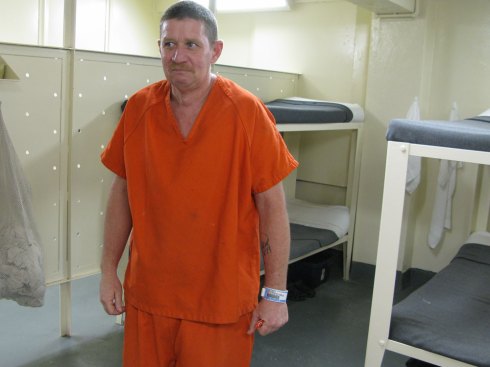
Leslie Chew, in Lubbock County Jail for theft, said his $3,500 bail was "like a million dollars to me." © Laura Sullivan for NPR
The result is that cases such as Leslie Chew’s cost the tax payer over $7,000 for 185 days of incarceration … all because he couldn’t afford the $350 down-payment for bail. His crime? Stealing $120 worth of blankets because he was suffering the cold sleeping in the back of his station wagon.
Chew is typical of many stuck in the system. But the system has alternatives. Offenders could be released on trust (a practice that used to be common) and expected to show up for court OR they could be part of pre-trial release programs using probation officers and tagging technology.
Pre-tirla release programs cost only between $2-$7/day. Compare that to $38-$115/day to house an inmate. Statistics have shown pre-trial release programs effective and offenders show up for court as regularly as those on bail.
In total the broken bail bond system costs US tax-payers $9billion/year!
WHY DOES A BROKEN SYSTEM PERSIST? WHAT ABOUT THE ALTERNATIVES?
NPR describes, ‘Ken Herzog, manager of Trammel’s Lubbock Bail Bond for over 25 years, sees an average of six people a day who need to be bonded out of jail. His bonding company currently has between 2,500 and 3,000 active accounts.’ Because they cannot secure new accounts, the bail bond industry sees pre-trial release programs as direct completion. Bail-bondsmen have organised strong lobbying groups in counties where alternative pre-trial release programs were in use.
As an example, Sullivan points to Broward County, Florida:
Bail bonding became political in Broward [and] sent shock waves through pretrial programs across the country. Here in Broward, bondsmen pushed hard for a new county ordinance that now limits the pretrial program. Now industry experts say powerful bail lobbying groups have begun using Broward as a road map of how to squash similar programs elsewhere, even though public records show the programs have saved taxpayers millions of dollars.
This gutting was all the more catastrophic because the pre-trial release program was so successful. It alleviated jail overcrowding that was deemed by a judge as unconstitutional.
Instead of building a new $70 million jail as they had proposed, county commissioners voted to expand pre-trial release, letting more inmates out on supervised release. Within a year, the jail population plunged, so much so that the sheriff closed an entire wing. It saved taxpayers $20 million a year.
And, according to court records, the defendants were still showing up for court.
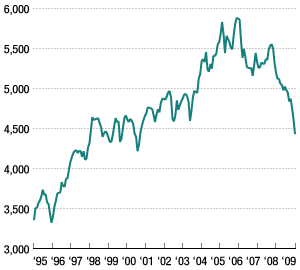
“DON’T PISS ON ME AND TELL ME IT’S RAINING”
The Broward ordinance passed and, in so doing, slashed the number of defendants eligible for the pre-trial release program by hundreds.
Who, they wondered, could possibly be against a demonstrably successful program? Follow the money:
In Broward County, 135 bail bondsmen amassed and hired a lobbyist, Rob Book:
“To be perfectly arrogant about it, I’m considered if not the best, [then] one of the best in the state,” says Book. He has been lobbying for bondsmen in Florida for more than a decade.
According to campaign records, Book and the rest of Broward’s bondsmen spread almost $23,000 across the council in the year before the bill was passed. Fifteen bondsmen cut checks worth more than $5,000 to commissioner and now-county Mayor Ken Keechl just five days before the vote.
EDITORIAL: THE UNITED STATES OF CORRUPTION
Sometimes, I am carefully worded. I work with prisoners, correctional officers, DoC administrative staff and activists weekly – I must be diplomatic.
But I have no care for the bail-bond business nor the corrupt bondsmen and bought politicians of Broward County, Florida.
Their system is self-serving. It does nothing to protect NOR serve. It is overly punitive. The bondsmen are hacks and the politicians they bought are contemptible.
I hope that the backhanded decision-making in Broward is not typical, but I fear it is not isolated. Selfish, zealous systems such as those Laura Sullivan exposed are ruled by revenge, fear-emotion and profit.
The bail-bond system of America is on this evidence devoid of progressive policy. And, when a small light of common sense policy rears its head based on solid figures and a reduced bottom-line, still well-heeled and big-footed buffoons can kick it all to shit.
DISPICABLE.
THE FULL ROSTER
Part One: Bail Burden Keeps U.S. Jails Stuffed With Inmates
Part Two: Inmates Who Can’t Make Bail Face Stark Options
Part Three: Bondsman Lobby Targets Pretrial Release Programs
All brought to you by Laura Sullivan
Thanks to Jim Johnson for alerting me on this.

Children Playing in the Ruins, Seville, 1933. 6 5/8 x 9 5/8" silver print. Circa, 1947 © Henri Cartier-Bresson.

Taliban Prisoners, Afghanistan, 2001. © Alan Chin
I have it on good authority that Alan Chin is one of the hardest working and spontaneous photojournalists in the business. He also caught this gem of a shot which for me sums up the shell-shock of war. These men may have been fighters, then prisoners, but they were/are also naive protectors of a regional social-order based upon the most closed of religious dogmas.
For all America’s imperialist crimes over the past decade, let’s not forget that the Taliban were brutal abusers of human rights, particularly women’s rights.
Is it not the case that the vast majority of men who fight do so because they are followers and not leaders? Heroism is passe; we are all victims of circumstance, not agents of change.
Image Sources; Chin, Cartier Bresson
Andy Kershaw‘s view is a welcome counter to the presumptions of an unknown scenario I and others had considered:
“Most journalists were reporting breathlessly that Port-au-Prince’s main prison had collapsed. Good story. But not for the reasons we were told. The inexperience – and indeed arrogance – of every single reporter who drew our attention to the jail, missed the real significance of its destruction.
It was not that “violent criminals”, “murderers”, “gang bosses” “notorious killers” or “drug dealers” had “simply walked out the front gates”. (And just how did these escapees miraculously avoid being crushed to death in their cells?) Even if true, that was a minor detail to the people of Port-au-Prince, who had more urgent concerns.
The true significance of the prison’s implosion was that it represented for ordinary Haitians, like the wreckage of the presidential palace and the city’s former central army barracks, exquisite revenge upon the prime symbols of decades of state cruelty and oppression.
And many of the prison’s inmates were surely not the dangerous stereotypes of these lurid reports. Haiti’s jails were, notoriously, full of petty thieves and other unfortunates who shouldn’t have been in there anyway. I once had to go into that Penitentiaire Nationale, where I saw hundreds of men kept in cages, without room to lie down, shuffling around literally ankle deep in their own shit, to get out of there the son of a Haitian friend who’d been arrested so that the local police could extort money from his father for the release of his boy.”
via Colin
Currently, truth is also a large casualty in Haiti.
Kershaw’s version is as politically self-serving as most accounts coming out of Haiti, in the confusion following the earthquake citizens, aid-workers and journos are making fast assertions based on their own observations. We should expect that most of these assertions will need modifying in time.
Nevertheless, Kershaw’s is the only commentary that has countered the immediate furor and conjecture surrounding the vacated national prison.
Indeed, Kerhsaw makes it clear that the obfuscations of fact are the direct result of the typical blend of fear and uninformed judgement; judgement applied to prison populations of every nation.

A crowd of people look at two men who were caught stealing and were bound and shot on Delmas Road in Port au Prince, Haiti 17 January 2010. The man in the yellow shirt was still alive after being shot through the head but neither the Haitian national Police nor the general public expressed any concern. EPA / Shawn Thew
Chay soti sout tet, tonbe sou zepol.
The load goes from the head to the shoulder.
(Problems go from bad to worse.)
Haitian Proverb.
DISCLAIMER: THERE ARE MANY LINKS HERE, BUT I HAVE CHOSEN THEM CAREFULLY AND ASSEMBLED SOME ORDER
First things first …
100Eyes
My early enthusiasm for Andy Levin’s proposed wider view of Haiti is now thoroughly tempered. In 100Eyes first statement, Andy made no mention of money. I presumed he was redirecting already committed attendees and resources, but he has extended the venture to new takers and at $1,500, the issue of money-flows (not to mention the obvious dangers and liabilities) makes it seem and sound like a bad idea … for reasons mentioned here and here.
And, I didn’t think Andy’s response was adequate.
GIVE MONEY!
Immediately, let’s us not confuse our value. We know it sits in our wallets and purses. GIVE.
Here is a list of organizations which have been highly rated by the American Institute of Philanthropy through which you can aid those in need in Haiti:
Source
UPDATE:
I also want to add that Paul Farmer’s Partner’s in Health has been doing increible work in Haiti for more than two decades. Money donated to his organization will be very well spent. http://www.standwithhaiti.org/haiti (Thanks Chris)
Possibly the most important and startling initiatives I have found all week …
The Young Haitian Documentary Photographers Group of the St.Marc region of Haiti in March of 2006. “This was the first time these young photographers had used cameras. Their work is ongoing. For more information about this unique group please visit the Haiti page.” (found via Manchester Photography)
Zanmi Lakay is an NGO that offers among its many educational opportunities, photography workshop for Haitian Street Children.
Zanmi Lakay is also Andy Levin/100Eye’s partner in Haiti, which complicates judgement on 100Eyes workshop, no? Maybe, maybe not.

© The Young Haitian Documentary Photographers Group
If you want to contribute while consuming art …
Haiti Benefit Sale was brought to my attention via the The 20×200 Blog.
William Greiner is auctioning an exhibition print & monograph book.
Aline brought to our attention a new Flickr Charity Print Auction. It isn’t exclusively for Haiti, but no doubt, Haiti will dominate current donations.
And, of course there is the Onè Respe Magazine at MagCloud with photos by Chet Gordon, Kari Hartmann, Mary Ellen Mark, Peter Pereira, Lindsay Stark.
@jeffantebi has made limited editions from Haiti available stolen space to benefit Oxfam and MSF.
Singular pieces of photography coming out of Haiti
American Red Cross Flickr Photostream.
Jonathon Torgovnik photos Anderson Cooper picking up a bloodied boy off the street.
Two photo essays from the Prospekt collective.
Flickr: Catherine Laine photographs for the Appropriate Infrastructure Development Group.
David Levene for the Guardian.
Jan Grarup and once again for Noor
Panos by Jeroen Oerlemans and Moises Saman.
Redux showcases Emiliano Larizza.
Not photography, possibly more important than photography, worth reading
“Stop treating these people like savages” by Andy Kershaw of The Independent, “An unbelievable 10,000 charities were already working in Haiti when the earthquake rocked the island, most of them tiny independent organisations. Humanitarian aid is, almost by definition, never where it is needed when natural disasters strike. But, in Haiti, what’s needed has been flown in with impressive speed. Yet the combined concern of all those organisations – many of them regarding fellow charities as professional rivals – has so far been unable to get that assistance a ride from the airport. Too much energy in the last week has been expended on bickering about procedure and the fetish about “security”.”
Interactive map of Haiti to report incidents.
From the BBC –Haiti earthquake: Aid workers’ diaries.
Bizarre turn of events when an American cruise company chose to find a Haitian berth only 100 miles from Port-au-Prince but then to soften the blow offered to donate sun loungers to a Haiti makeshift hospital.
Poynter Online offers welcome perspective on photography in Haiti by focusing on Patrick Farrell’s Pulitzer winning work from last year.
Colin Pantall‘s Junot Diaz, Trujillo and The Dominican Republic looks obliquely at Haiti’s historical relationship with its neighbour.
Philip Gourevitch makes a modest proposal; “Goldman Sachs and JPMorgan Chase should give a billion dollars apiece to Haiti relief and reconstruction efforts—and they should do it swiftly and without hesitation.”
Also, from the New Yorker, Earthquakes and Journalism Steve Coll offers some insight, “I learned something about journalism while covering my first earthquake, in northwest Iran, in June, 1990.”
Saturated in the Image
LENSblog (Maggie Steber, Damon Winter, James Estrin) have been leading the way with classy and sensitive coverage diluting images with interviews .. and even dipping into the Archive: Haiti, Alive.
The Boston Globe started the trend for newspaper’s to post them large. It has had three monster galleries thus far: Earthquake in Haiti, 48 Hours Later and Haiti Six Days Later.
Plethora of disaster from the NJ Star-Ledger.
The Denver Post has two offerings: One Week Later Photos and Earthquake in Haiti Photos.
The Los Angeles Times goes Hi-Res with Carolyn Cole, Rick Loomis and Brian Vander Brug.
The Wall Street Journal has led the charge with mammoth galleries daily, ominously titled WSJ Photographers Document Chaos. Here’s the last three days, they go back further:
WSJ Photographers Document Chaos in Haiti: January 17, 2010.
WSJ Photographers Document Chaos in Haiti: January 18, 2010.
WSJ Photographers Document Chaos in Haiti: January 19, 2010.
The Sacramento Bee has also been offering the large scrolling wide web galleries. They used images by Logan Abassi and The Red Cross to take an aerial view. Here’s the SacBee’s latest, Haiti One Week Later.
Interview with Melissa Lyttle & gallery of Melissa’s images from St. Petersburg Times.
NPR Picture Show has been offering constant Haiti coverage from the ground.
Photographers in Haiti
Here’s the scoop from Lightstalkers: Is anyone on the ground in Haiti?
And finally, PDN ran this: Photographers in Haiti Face Shortages of Fuel, Water, Housing, and Food, which may be true but the headline is hardly tactful.
How many photographers does it take to photograph a humanitarian disaster?
Juan Barreto / AFP / Getty Images
Bruno Stevens / Cosmos
John W. Poole / NPR
David Gilkey / NPR
Ramon Espinosa / AP
Luis Acosta / AFP / Getty Images
Jae C. Hong / AP
Minustah / Logan Abassi / AP
Julie Jacobson / AP
Francois Mori / AP
Chris Hondros / Getty Images
Win McNamee / Getty Images
Ariana Cubillos / AP
Ricardo Arduengo / AP
Olivier Laban Mattei / AFP / Getty Images
Sophia Paris / Getty Images / UN / Minustah
Gerald Herbert / AP
Uriel Sinai / Getty Images
Patrick Farrell / AP / The Miami Herald
Peter Andrew Bosch / Miami Herald / MCT
Carl Juste / AP / The Miami Herald
Melissa Lyttle / St. Petersburg Times
Dominic Nahr / The Wall Street Journal
Julie Platner / The Wall Street Journal
Ron Haviv / New York Times / VII
Heather L Rohan / NJ Star & Ledger
Nicholas Kamm / Getty Images
Gregory Bull / AP
Michael S. Wirtz / Philadelphia Inquirer
Federico Gambarini / EPA
Orlando Barria / EPA
David Fernandez / EPA
Juan Barreto / AFP Getty Images
Shawn Thew / EPA
Thomas Coex / AFP / Getty
Thony Belizaire / AFP / Getty
Julie Remy / AP / MSF
Julien Tack / AFP / Getty
Michael Laughlin, Sun-Sentinel / AP
Francois Mori / AP
Julie Jacobson / AP
Jewel Samad / Getty Images
Paul J. Richards / Getty Images
Joe Raedle / Getty Images
Mario Tama / Getty Images
Martin Oeser / Getty Images
Jody Amiet / AFP / Getty
Logan Abassi / AFP / Getty
Marco Dormino / AP / United Nations
Frederic Dupoux / Getty Images
Eduardo Munoz / Reuters
Cris Bierrenbach / AP
Jorge Cruz / AP
Maggie Steber / The New York Times
Tequila Minsky / The New York Times
Damon Winter / New York Times
Michael Appleton / The New York Times
Erika Santelices / Getty Images
Jonathan Torgovnik
Boots Levinson
Alvaro Ybarra Zavala / Getty
Jan Grarup / Time
Jeroen Oerlemans / Panos
Moises Saman / Panos
Zoriah
Carolyn Cole / LA Times
Rick Loomis / LA Times
Brian Vander Brug / LA Times
Nick Kozak
Jason Henry / Wall Street Journal
David Levene / Guardian
Francesco Giusti / prospekt
Samuele Pellecchia / prospekt
Emiliano Larizza / Contrasto / Redux
Carol Guzy / Washington Post
Lisandro Suero / AFP / Getty
Clarens Renois / AFP / Getty Images
Kena Betancur / Reuters
Ivanoh Demers / AP / Montreal La Presse
Sam Yeh / AFP / Getty
Gus Ruelas / Reuters
Carlos Barria / Reuters
Jess Hurd
Axel Oberg
Jorge Silva / Reuters
Carlos Garcia-Rawlins
Andy Levin
Robert Larson
(List not exhaustive)
AND LAST BUT NOT LEAST
Special mention must go to Daniel Morel (AFP / Getty Images) who has photographed Haiti all his working life and holds the nation and its people close to his heart.
See a slideshow of his work here at The New York Times Lensblog

 Prison Photography