
You are currently browsing the category archive for the ‘Portraiture’ category.

Photographer Nick Vedros made some images in Lansing Correctional Facility (formerly the Kansas State Penitentiary) for Reaching Out From Within, a charity that supports rehabilitation programs for prisoners “who want to make lasting changes in their behavior so they can become a role model for non-violence, while still in a penitentiary, and also be contributing members of society when they return to society.”
The images are patently promotional and that’s okay. All quite benign. I’m sure this is a program that helps prisoners a great deal. Any committed efforts usually do. Some interiors, some portraits, some observed studies. Above is the photo that stood out for me.

‘Chasing the Dragon’ © Robert Saltzman / Juan Archuleta. From the series “La Pinta: Doing Time in Santa Fe”
–
I’ve heard from a couple of folk that when I started Prison Photography, they laughed at its folly. Not only had a bleeding-heart liberal thug-hugger come along to explain a world no-one cared about to no-one in particular, but silly-little-leftie-me would run out of projects and photographs in no time. Not only had I picked a subject nobody cared for, I’d neglected to do the proper amount of research and maths.
Well, more than eight years later, and I’m still stumbling upon scintillating projects that challenge my ever-evolving timeline of prison-based visual arts. Case in point La Pinta: Doing Time in Santa Fe, a collaboration between Robert Saltzman and the prisoners of New Mexico State Penitentiary, in Santa Fe, NM.

© Robert Saltzman / Keith Baker. From the series “La Pinta: Doing Time in Santa Fe”
Saltzman first visited the prison in 1982 to visit a friend and thereafter was fascinated by the lives behind the walls. Despite a massive riot less than two years prior, Saltzman convinced the warden to allow him in with his 35mm SLR, three lenses and camera-mounted flash. Saltzman gave assurances he was there as an artist and not as a reporter.
Over 9 months, Saltzman made 500 images on Kodachrome64 film. He picked the 35 strongest portraits but still wasn’t happy. They failed to tell a fraction of the stories or reflect even a small slice of the range of emotions he encountered. So he printed the 35 out and mounted them on white illustration board. He sent them back in, a few at a time, with a request.
“Please use the white space however you want,” Saltzman told Popular Photography in 1985.
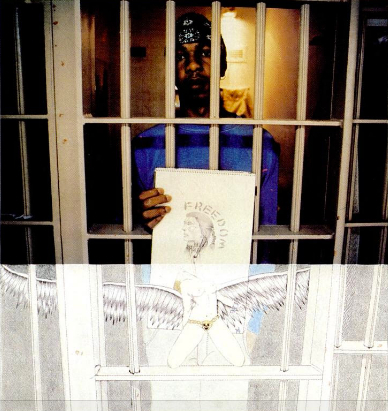
© Robert Saltzman / Jonathan S. Shaw. From the series “La Pinta: Doing Time in Santa Fe”. Screengrab from Google Books scan of an issue of Popular Photography (Vol. 92, No. 3, March 1985, pages 66-69 + 141, ISSN 1542-0337)
Some photographers would be happy to get in and out with some portraits and call it a day. Plaudits to Saltzman that he distanced himself enough to make a hard call about the nature of his pictures. And with it adding more time and uncertainty to the project.
28 total works came back. In the first exhibition of La Pinta: Doing Time in Santa Fe, 11 were shown. Later, 14 were exhibited.
“The drawings and writings, coupled with Saltzman’s portraits, communicate a poignant and often tension-filled commentary on the prison experience,” writes James Hugunin, art historian, expert on prison imagery and curator of a 1996 show Discipline and Photograph which included Saltzman’s work.
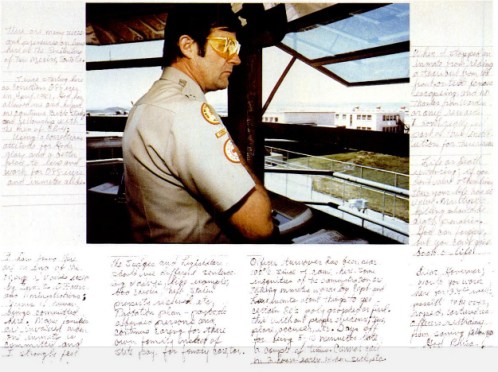
© Robert Saltzman / Ralph K Millam. From the series “La Pinta: Doing Time in Santa Fe”. Screengrab from Google Books scan of an issue of Popular Photography (Vol. 92, No. 3, March 1985, pages 66-69 + 141, ISSN 1542-0337)
This work excites me because it avoids easy categorisation. This type of collaborative work is standard-fare these days with a new generation of practitioners inspired by the social justice priorities of photographers like Wendy Ewald, Anthony Luvera, Eric Gottesman and many more. In the early eighties however, when Saltzman et al. made these, collaboration was considered a bit amateurish. God forbid you allow scrawls upon photographs! Pencil was meant only for contact sheets, editing and for marking crops for the darkroom. Note that among famous photographers Robert Frank made some good scrawls on his stuff in the 70s for himself and for ad campaigns in the 80s and we all know Jim Goldberg’s Rich and Poor (1977-78) was before its time and the high-profile example of a photographer handing over prints for subjects to write upon.
With the exception of Danny Lyon, all the photographers I know that preceded Robert Saltzman in photographing inside US prisons–Steven Malinowski, Gary Walrath, Joshua Freiwald, Sean Kernan, Cornell Capa, Ruth Morgan, Douglas Kent Hall, Taro Yamasaki–were invested in keeping the camera, and thus the message and interpretation, in their own hands. Given the times and the preciousness of access, it makes sense that photographers would internalise society’s general attitude toward them as special messengers. (I should flag here, as I always do, that Ethan Hoffman’s work and book Concrete Mama was exemplary of this time in terms of giving over great space for his imprisoned subjects recount their stories.)
I wouldn’t say that photographing prison guards hadn’t happened by the early eighties, but it was unusual. So for Saltzman to get the written reflections of guard Ralph K. Millam (above) is significant too. Most photography projects within prison focus on the prisoners and very few focus on both the kept and the keepers.
In short, due to both its subject matter and approach, Saltzman’s La Pinta is landmark. Prisons weren’t photographed much in the early eighties and certainly not for as long as a year, the time it took Saltzman to complete the work. Its collaborative methodology allows for heightened emotional impact and positions it ahead of other works that later used similar formulas and embodied likeminded sympathies.
See more here.

Richard Wayne Jones was convicted and sentenced to death for the February 1986 kidnapping and murder of Tammy Livingston in Hurst, Texas. Photographed on Aug. 2, 2000, executed Aug. 22, 2000 (AP Photo/Brett Coomer)
–
Rian Dundon, photo editor at Timeline, has pieced together 20 years of Texas Death-Row Portraits, a photo-gallery depicting some of the men executed by the state of Texas since the early eighties. The images are made by a host of photographers down the years working for the Associated Press (AP).
“As the only non-local news organization with a guaranteed seat at every execution, the AP is granted special access to prisoners, and as a result the agency has accumulated an unusual set of portraits made shortly before inmates’ executions,” writes Dundon.
Never intended to be seen in aggregate, Dundon argues that the portraits assume a weight and significance when brought together. Prisons are a time capsule so regardless of who is shooting, the visiting booths, prison issue uniforms, standard spectacles and prisoners’ pallid skin are constants throughout. The lighting is artificial adding to the sense of unnaturalness in which the subject and photographer operate. Dundon makes comparison to lauded photographers of our time.
“The portraits are uncanny for a wire service. Eerily intimate, carefully composed. There are echoes of Robert Bergman or Bruce Gilden,” he writes.
If art exists here, I’d argue it is not in the individual portraits per se but in Dundon’s grouping. A whole greater than its parts. Looking into the eyes of these condemned men provides a view into the soul of a nation. Here’s a gallery of American vengeance. An album devoted to violence in response to violence.

Hospital lobby. © Kim Rushing
–
Long before I started writing about prison imagery and before I even set foot in the United States, photographer and educator Kim Rushing was making images of the men at the infamous Parchman Farm, known officially as Mississippi State Penitentiary. Rushing made these photographs and others over a four year period (1994-1998). They recently been published by University Press of Mississippi as a book simply titled Parchman.
After a first glance at the photographs I was surprised to hear they were made in the nineties. Many images appear as if they could have been captured in much earlier decades, but such is the nature of prisons which either change at glacial pace or remain in a temporal stasis–uniforms replace identifiable fashion; hardware is from eras past; conditions can appear mid-century; and the vats of the kitchens and gas chamber seem permanently footed to the concrete foundations.

Spaghetti, central kitchen. © Kim Rushing
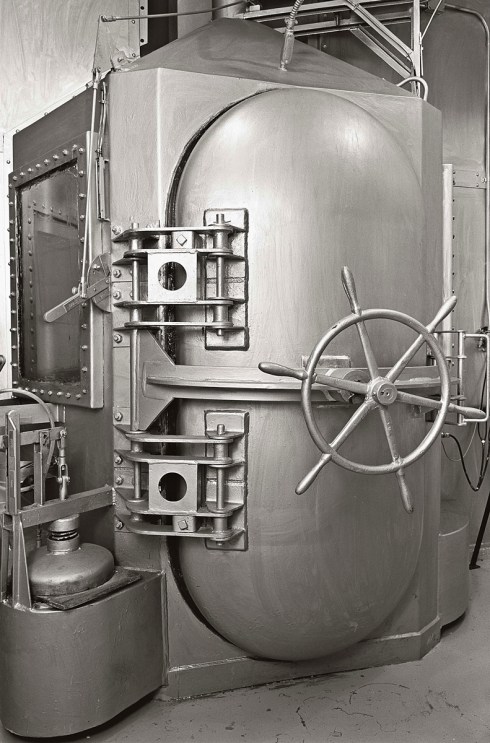
Gas chamber. © Kim Rushing
Rushing’s photographs are a welcome view to a past era and a brief step back in time. My overriding takeaway from the project is that time, as in all prisons, operates by its own rules.
Rushing’s contribution to the emerging visual history of American incarceration is valuable, not least because it contains some hope. Whether the absence of violence is a fair reflection of Parchman would be a worthwhile discussion but for broader research some other time. Take the images at their face value and we can identify other prevalent characteristics of prisons, namely boredom, containment, some programming, and certain longing. (I’d hazard to guess the programming such as gardening have been scaled back.)
To insist that an almost predictable perspective on prisons exists in Rushing’s work is borne out in close comparison of the work of other photographers. Rushing’s portraits are very similar to those of Adam Shemper’s made at Angola Prison, Louisiana in 2000.

Cornelius Carroll © Kim Rushing
There are also quiet echoes of David Simonton’s 4×5 photographs of Polk Youth Facility in North Carolina made in the nineties. Except in Rushing’s images prisoners inhabit the scratched, peeling interiors. Interestingly, both bodies of work remind me of Roger Ballen‘s dark worlds, but that might be a leap too far given the specific psychological manipulations by Ballen in his native South Africa.
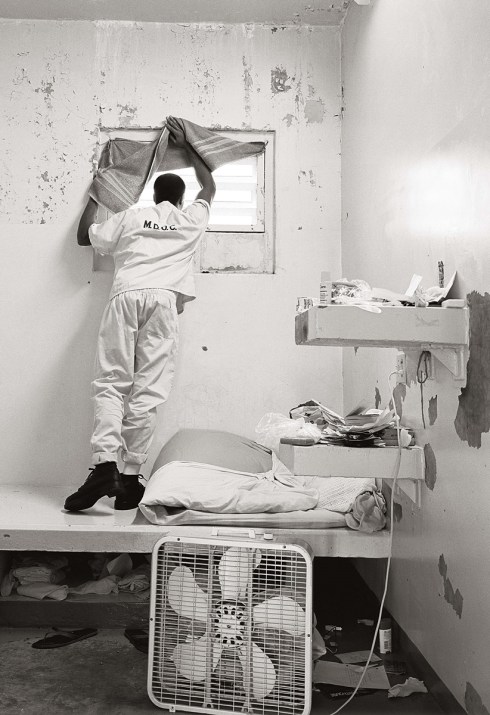
Gregory Applewhite at window © Kim Rushing
In terms of touchstone and stated portraiture projects, I see fair comparisons with the incredible work of Ruth Morgan in San Quentin Prison, California made in the early eighties.
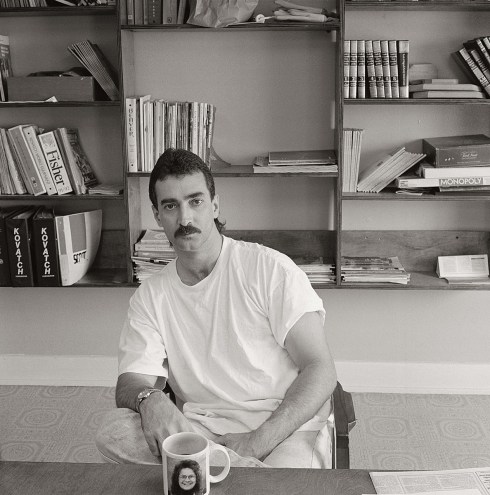
Billy Wallace. © Kim Rushing
And in terms of predictable moments, I cannot help but think of Ken Light’s portrait of Cameron Todd Willingham in Texas from 1994, when I view Rushing’s photo of Kevin Pack (below).

Kevin Pack watching TV. © Kim Rushing
In the book Parchman, alongside Rushing’s images are the handwritten letters of 18 prisoners–ranging in custody level from trustee to death row–who volunteered to be photographed. “What does it feel like when two people from completely different worlds look at each other over the top of a camera?” asks University Press of Mississippi. In this case, I’d argue, the successful insertion of humanity into an institution that has historically crushed the spirits of those inside. Clearly adept in his art, Rushing has made a stark and sometimes touching portrait of an invisible population.

Feeding the spider © Kim Rushing
–
Parchman (cloth-bound; 10 x 10 inches; 208 pages; 125 B&W photographs) is now available for $50.00 from University Press of Mississippi.

Thomas Roma‘s book In The Vale Of Cashmere is probably familiar to you. It has had enjoyed widespread press and positive comments. And rightly so. It’s one of my favourite books of the year. I just did a review of the book and project for Vantage.
Roma’s arresting photos go inside the Vale of Cashmere a renowned casual hook-up spot that has, for decades, hidden in plain sight on the northern side of New York’s prospect Park–an overgrown, knotty pocket of criss-crossing paths that is of Brooklyn’s most active gay cruising spots. The Vale of Cashmere is commonly, but not exclusively, frequented by African American and Caribbean men.

Not only are Roma’s portraits–that take us on long and repeated walks through the foliage and dappled light–wonderful so too is the contributing essay by G. Winston James. Between the two of them we are able to encounter, pass or pause with the men who meet among those trees.
I write:
James reminds us that sex is an activity designated for private spaces, namely the domestic space of the home. But for gay men living in the late nineteenth and early twentieth century, homosexual sex could not be expressed at home so it became a public act in public space. Crucially though, gay cruising and meeting spots only function as such at designated times.
“The most defining characteristic of queer space is its temporality. Queer space is not a permanent fixture of the urban landscape, but a sudden transformation that briefly renders traditional public spaces as something more dynamic,” Shaw once wrote.
James adds, “It is precisely this process of transformation (witnessed by a relative few), this dynamism, this history, that Thomas Roma has photographed.”
–
Read the full review: Loving Portraits Of Gay Black Men Cruising In Prospect Park
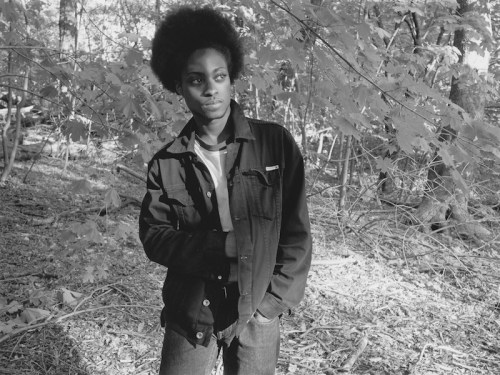
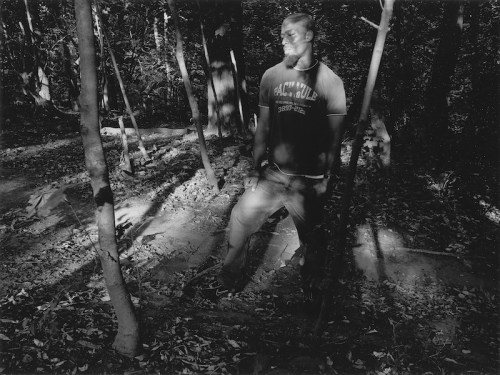
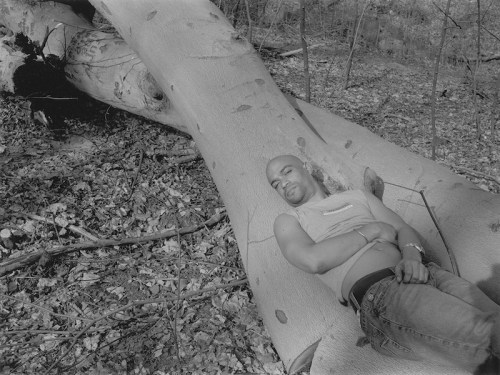


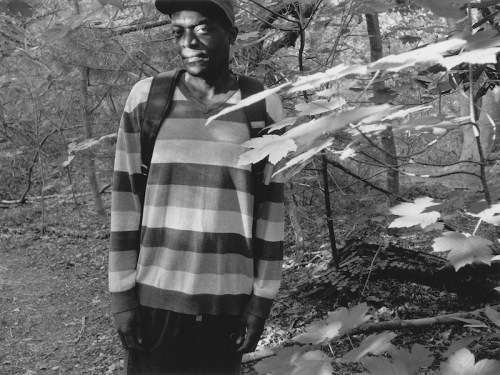

Camilo Cruz, Untitled from the Portraits of Purpose series, 56 x 45 inches. Courtesy of the artist.
–
ARE WE HITTING PEAK-PRISON-ART-SHOW?
Of course, I’m being provocative, but the rise and rise of prison criticism and reflection (and commodification) in the cultural sphere bears consideration.
Here is not an exhaustive list but a few examples — Life After Death and Elsewhere, curated by Robin Paris and Tom Williams at apexart; To Shoot A Kite curated by Yaelle Amir at the CUE Foundation; Voices Of Incarceration at Loyola Marymount University in Los Angeles; Try Youth As Youth curated by Meg Noe at David Weinberg in Chicago; Site Unseen: Incarceration curated by Sheila Pinkel; The Cell and the Sanctuary put on by the William James Association in Santa Cruz, CA; and my own Prison Obscura.
–
This weekend, Inside/Outside: Prison Narratives will end its 10-week run at the Wignall Museum of Contemporary Art at Chaffey College in Southern California. Inside/Outside is a relatively large survey of prisoner art, prison photography and visual activism that brings together the work of Sandow Birk, Camilo Cruz, Amy Elkins, Alyse Emdur, Ashley Hunt, Spencer Lowell, Los Angeles Poverty Department (LAPD), Jason Metcalf, Sheila Pinkel, Richard Ross, Kristen S. Wilkins, Steve Shoffner, the Counter Narrative Society and students at the California Institute for Women.
It’s a great exhibition.
As many of the names in Inside/Outside: Prison Narratives are familiar, I felt a review by me would be redundant; it’d be dominated by applause to the committed artists I see as asking the right questions … because they’re the questions I’ve ask too.
Instead, I wanted to focus on the recent uptick in fine art exhibitions orbiting the issues of prisons.
Rebecca Trawick, Director of the Wignall Museum and co-curator of Inside/Outside and I were in touch a while before I realised that this should be what we should discuss. And how the cultural production of art around, and about, the prison industrial complex propels, inspires, derails (and much else besides) dialogue about mass incarceration in America.
Kindly, Trawick and her co-curator, Misty Burruel, Associate Professor of Art at Chaffey College accepted my invite to answer some questions. The Q&A is peppered with artworks from Inside/Outside: Prison Narratives.
Scroll down for our discussion.
–

Camilo Cruz, Untitled from the Theater of Souls series, 56 x 45 inches. Courtesy of the artist.
Q & A
Prison Photography (PP): Why did you make this exhibition?
Rebecca Trawick (RT): Incarceration was an issue that I kept returning to in my research.
As a curator, I’m specifically interested in shedding light on important but difficult social issues through the lens of contemporary art. I love how artists can take an unwieldly topic and consider it thoughtfully, often personally, and in really compelling ways that allow the viewer a chance at transformation, or expansion of, thought and perspective.
Because we work at an institution of higher education, these exhibitions become a safe space to start difficult discussions about issues such as incarceration, and they become a tool to educate and inform. This kind of exhibition (if done well) can demonstrate the value of art to transform ideas, minds, and communities.
Misty Burruel (MB): Because it was a challenge. On the heels of a number of incarceration exhibitions in southern California that focused on works by incarcerated artists and artists confronting the criminal justice system, it was appropriate to look at it through the lens of education.
We are confronted daily with students that have either been incarcerated or have family who are incarcerated. It was time to have difficult discussions about the role of education in the penal system, our responsibility as citizens to each other, and how parolees reintegrate into yet another system.

Spencer Lowell, La Palma prison, Arizona
PP: Is incarceration a “hot topic” right now? Why?
RT: As Misty and I mention in our remarks in the printed takeaway, we seem to be experiencing a unique convergence of policy discussions in the US as well as popular culture interests, so we feel like the conversation is already happening in certain circles.
We hope our exhibition helps to expand the discussion and dig a little deeper into some of the topics looked at in contemporary documentary (think the recent Vice episode, Fixing the System, in which President Obama – the first sitting US President to do so – visited a federal prison) to the popularity of Orange is the New Black.
MB: Jenji Kohan’s, Orange is the New Black, portrayal of incarcerated women created a splash on Netflix and revealed through mass media the complexities of a system within a system. The women were all too real and relatable. We live in the Inland Empire and have two prisons at our footstep.
PP: California Institute for Men and California Institute for Women.

Jason Metcalf, Cheeseburger, French Fries, Iced Tea (Dwight Adanandus), 2013, archival pigment print, 16 x 24 inches. Courtesy of the artist.
PP: Is Inside/Outside about incarceration or is it about the representation of incarceration?
RT: The exhibition is about the many issues surrounding incarceration that we hope our viewers will consider more deeply after viewing the work on view. Issues include the value of rehabilitation behind bars; juveniles in justice; death penalty, segregation, prison labor, and isolation as systems of control, among others.
PP: How did you select the artists?
RT: The Wignall Museum mainly draws from Southern California for practical reasons–funding limits us to local pickups mainly. In some cases (Kristin S. Wilkins, for example) agreed to ship the work to us so we were able to include her. We’re often limited regionally, which explains the SoCal bias. We would have loved to include works outside our region, if possible. (see next question for a list of some we would have included if possible.) The one thing I remind myself is that we’re not trying to be essentialist in what we portray or explore, but rather offer some really amazing work to assist us in digging a little deeper into the state of incarceration today.
MB: We are in a human warehousing gridlock. The works collectively focus on how the system of control does not discriminate (women, men, and youth detention).
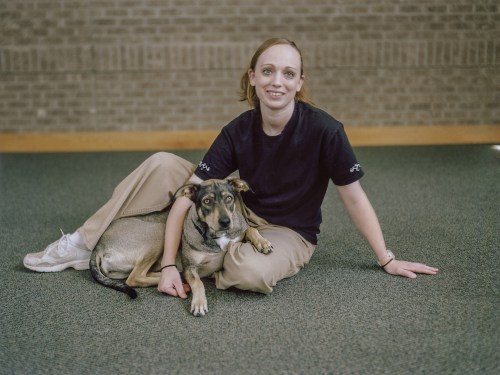
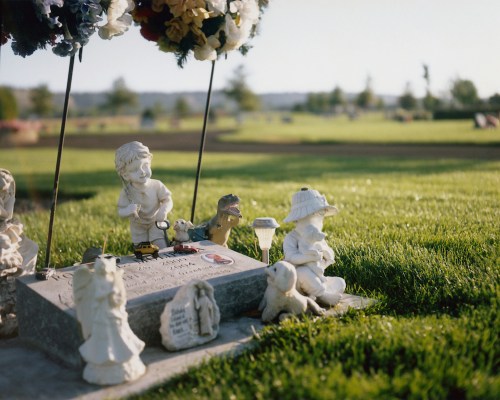
Kristen S. Wilkins, Untitled #10. From the series ‘Supplication’ (2009-2014) “Grand Ave. by Shiloh (Cemetery). Left side of water fountain. Has colorful wreath with flowers. It is where my son is @. He is the best thing that happened to me in my life. He was my world.”
PP: Were there any artists or works out there that you’d wanted in the show but couldn’t for whatever reason?
RT: Yes! Many. The list includes Deborah Luster, Dread Scott, Jackie Sumell’s The House That Herman Built, and Julie Green’s Last Supper installation all immediately come to mind. There were many others, but those three stand out for me.
MB: We wanted to have more guest speakers, but funding always seems to be a hurdle. We can certainly look at the issue, but we really wanted to talk about it.
PP: Really? From the outside that you had a phenomenal amount of programming. I applaud you. How important was programing around the exhibition?
RT: Programming is critical. Because we’re limited in many ways in terms of what we can show – due to spatial and fiscal restrictions – programming allows us to bring in experts in the field to further contextualize and expand the themes of the exhibition. It also allows community engagement and for other voices to join in the conversation, often in a public forum. That ability can’t be underestimated, I think.
MB: When the discussing an exhibition about incarceration we were most focused on programming. Rebecca and I are collaborative by nature and we were able to find others who were very interested in asking difficult questions within their own disciplines (Sociology, Philosophy, Correctional Science, Administration of Justice).

© Sheila Pinkel
PP: I’ve been asked a number of times “Who are you (a white, cis-gender, male, college graduate) to speak to these issues?” Every time by a highschooler — God, I love them. Were you ever challenged over your role and/or position while putting Inside/Outside: Prison Narratives together?
RT: As a curator at an institution situated on the campus of a Community College I feel strongly that it is our responsibility to explore a wide array of topics in our exhibitions and to look from a place of diversity – diversity of media, content, viewpoint, race, ethnicity, etc. – and through the lens of contemporary art, but it is critical that we do so in a way that is thoughtful and multifaceted.
Philosophically we try to schedule our exhibitions and programs in a way that expand outside of our own limited perspectives. We also try to use multiple guest voices – guest curators, guest speakers, etc. to expand the discourse around an exhibition. But the long and the short of it is, I try to always be conscious of my privilege and to present diverse voices. That said, my own experience/perspective was never called into question during the exhibition planning or implementation phase.
MB: The college has wholeheartedly embraced the exhibition and its programming.

Amy Elkins. 26/44 (Not the Man I Once Was), 2011. Portrait of a man twenty-six years into his death row sentence where the ratio of years spent in prison to years alive determined the level of image loss.
You’ve said the response so far has been positive. More than other Wignall shows? More among the student body, or beyond? How do you measure response/success?
RT: This exhibition definitely has seemed to link to something that is personal and relatable for many of our students, faculty and community visitors, evident by the verbal responses and reactions we’ve seen in the galleries. We’ve held a number of panel discussions, engagement activities, a film screening, and dozens of tours. Unequivocally, discussions always seem to lead to the personal and comments suggest that the ability to discuss a somewhat taboo topic has been relevant.
MB: This work is incredibly personal and relevant to the Inland Empire.
PP: Can you see the successes and failures of the show already? Or is it too soon for that type of assessment?
RT: Success can be measured in qualitative and quantitative ways … (as of course, can failure). Due to the high level of programming, and the sheer number of student tours we’ve conducted, we can see an increased level of engagement. Our visitor numbers are up, the number of students speaking up during tours has increased a great deal, and the unsolicited feedback from students/faculty/staff we’re getting has been remarkable.
We also ask all students who visit us as part of a tour to fill out a short survey. Results won’t be tabulated until the close of the exhibition, but I feel the results will mirror the anecdotal evidence we’re seeing. As a curator, however, I’m always thinking about what we can improve upon – from the curatorial practice, to layout and installation, to printed collateral and programming…reflection is key.
MB: I think the museum does an amazing job of allowing artists to ask difficult questions and explore relevant social and political issues.

The Wignall Museum hosted workshops and discussion led by Mabel Negrete and the Counter Narratives Society.
PP: Anything you’d like to add?
RT: We hope that Inside/Outside and the many other excellent exhibitions and artists looking at incarceration with a critical perspective will encourage the questioning of the system as it is, and that it might even encourage engagement in our communities in ways that can make real change in the world.
–
Follow the Wignall Museum at Chaffey College on Facebook and Twitter.

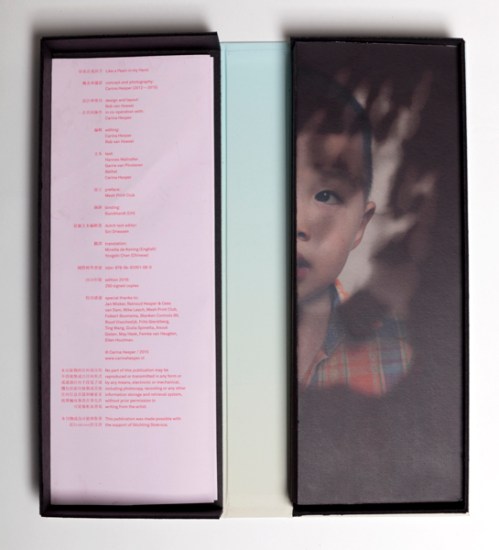
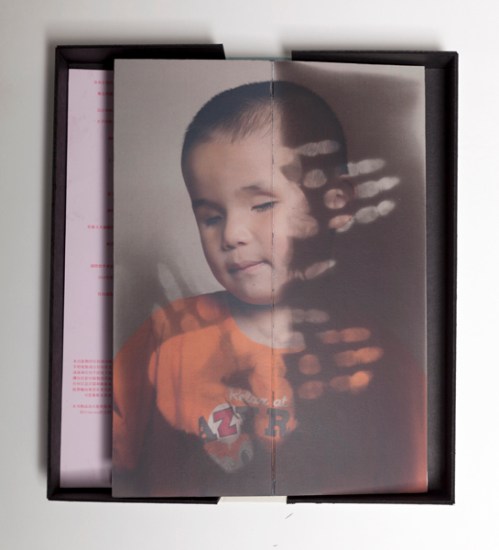
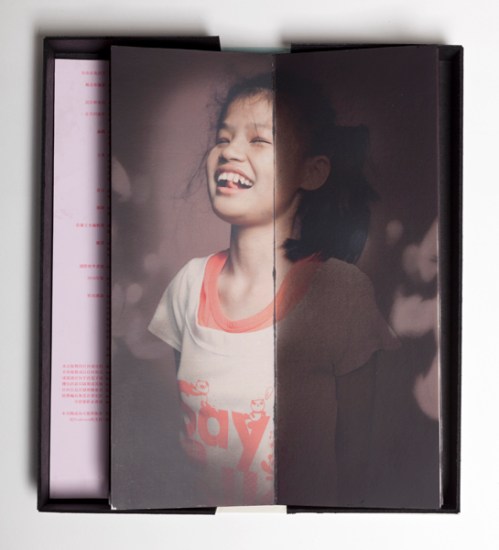
I just wrote, for Vantage a review titled The Portraits In This Book Are Only Visible When You Hold It In Your Hands of Carina Hesper’s yet-to-be-made book, Like a Pearl In My Hand.
The book is printed with thermochromatic ink (yes, the same stuff used to make 90s Generra Hypercolour Tshirts) and so it changes from pitch black in a resting state to emerging portraits of blind Chinese orphans the next.
I’ve never seen anything like it. Of course, the book hasn’t made full production yet, so I’ve not held on in my hands, but the dummy and the vids look impressive.
The degrees to which Like a Pearl In My Hand plays with metaphor and reconfigures our use of sight and touch further distinguishes Hesper’s book.
Disability is a hidden problem. Blindness prevents sight. By literal description or by strategic manipulation, everyone is in the dark. But when sight is denied, other senses compensate. Hesper plays with this truth.
Hesper is currently raising Kickstarter funds to get the project into book form (it’s already shown at numerous festivals as single prints on the wall.)
Read my review in full and see more pictures: The Portraits In This Book Are Only Visible When You Hold It In Your Hands.



Uganda, May 2010, from the series “Law and Order.” Chief Justice Benjamin J. Odoki is his office in Kampala. Like other judges, he has a huge backlog. Judges are appointed by the President on the advice of the Judicial Service Commission, with the approval of Parliament.
PREAMBLE
When our Skype call connected, Jan Banning was rubbing his brow. He was trying desperately to chase down statistics with which to give his three years of photographs, across four continents, context.
 Banning has, since 2012, worked on a project called Law and Order looking at the institutions–prisons included–that result from different philosophies and systems of justice. Banning recently successfully crowdfunded a book which includes photographs from four nations: France, Uganda, Colombia and the United States.
Banning spends a lot of time traveling, but more time in his studio synthesizing all his images and their meaning. While he labors, he listens to everything from Frank Zappa to The Kinks to African beats.
Jan lit a cigarette, apologized for the disregard for his health, but said the stress of hunting stats required some nicotine to take the edge off. I wanted to know how he viewed different prisons from around the world, how they compared, and what it was like to make photographs within closed facilities.
And so we began …

Kirinya Main Prison, Uganda, 2013. Uganda’s second maximum security prison, in Jinja, was built for 336 prisoners. It now holds 922 prisoners. Here, a primary level biology class is taught by a prisoner sentenced to death, known because of his uniform is white in color.
Q & A
What’s up Jan? How’s the work? The book?
I try to make work that contributes to the public debate. The book will include statistics about the long term development, trends and crime rates for the four countries I photographed, but also for other relevant countries. ‘Relevant’ in two senses: for one, Holland should be involved. Secondly, Germany, UK, Canada are relevant because they are industrialized too.
We can make fair comparisons?
To a degree. And make contrasts. Also, possibly Norway because of its extremely liberal prison policies. And possibly Japan because of its really low murder rates.
An American audience will find this book interesting — to really see, in line graphs, how much higher the levels of incarceration are in the U.S. compared to a lot of Western European countries and how that relates to recidivism rates. Finding reliable sources on murder rates, incarceration rates, recidivism rates and remand rates is the big problem. But they’re essential.
Have you tried Prison Policy Initiative? Or the Vera Institute?
I have. I’ve been looking mostly in Bureau of Justice Statistics, the United Nations and the World Health Organization. These websites are incredibly confusing. You can find one year but not another. For example, U.S. murder rates starting in 1900, but the sources are so ridiculously confusing I cannot judge whether they are reliable or not and I do not want to include sources that are not verified.
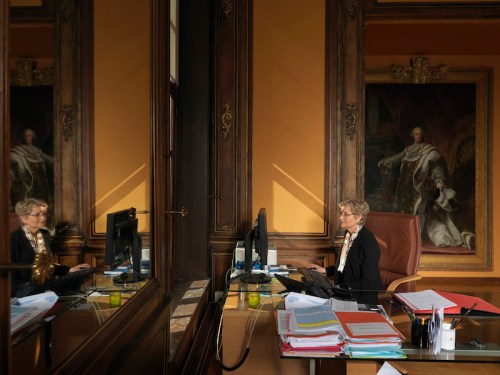
Premier president Mme Dominique Lottin heads the business of the court at the Palais de Justice, Douai, Nord/Pas de Calais.
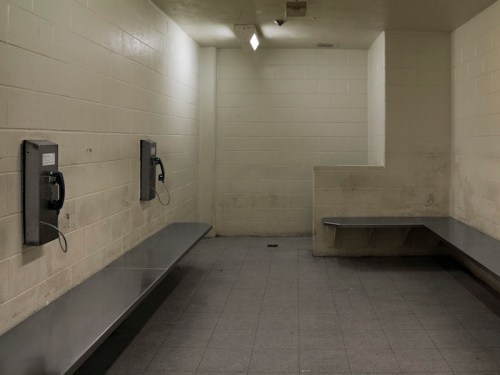
Holding Cell #1, Dekalb County Jail, Atlanta. Built in 1995, with around 3,000 prisoners it is the biggest jail in Georgia.

Two court writers of the court, Cartagena. Colombia, Sept. 2011, from the series “Law and Order”. Gina Marcola Perez and Mahira Julio Amigo finish the paperwork and processes that still go forward under law #600 even though the law has been abolished. Courts in Colombia have a huge backlog.
How did you decide on the four countries–Colombia, France, Uganda and the U.S.?
I started with Uganda as because I had good connections. A friend of mine was working in the Dutch Embassy in Kampala. It was kind of an experiment to see if I could visualize this whole thing—a visual comparative analysis of law and order—in a let’s say, different or interesting way. After Uganda, I concluded that it would be tough but interesting.
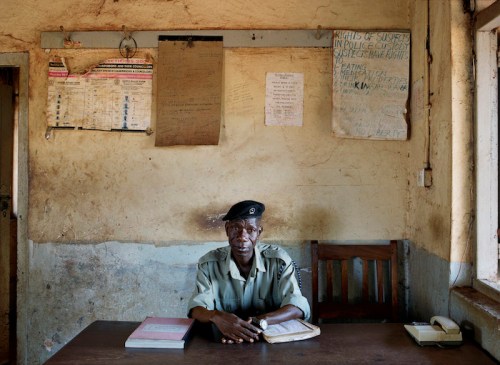
Uganda, May 2010, from the series “Law and Order”. Kakira Police Station, Jinja Town. Police Constable #11431, Ndalira John, 54. He earns 205,000 shillings (54 Euro/US$72) a month.

The chapel at Putnam County Jail in Eatonton, Georgia, doubling as sick bay.
I had some private courses in criminal justice from a professor here in my home town Utrecht. He said I should contact the Max Planck Institute in Freiburg which is the top European institution on criminal justice. The director there advised me. I wanted to a geographical distribution so it’s four different continents. I wanted to include the two major lines of justice so the civil system in which France played a big role. And secondly, the common law system, a more Anglo-Saxon system. Of course I could have gone to the UK where it originated but it made more sense to pick the U.S.
A more extreme application of that type of law?
In a way. Certainly I wanted a State that still employed the death penalty. I ended up in Georgia basically because I had the best contacts there.
Ah, I thought it would be more targeted than that because Georgia leads the way in many of the wrong statistics—disproportionate numbers of minorities, high levels of female incarceration, poor folks locked up too.
Those things played a role, but so did the practical side.
First, I actually tried Texas because it kills the largest number of people but I just couldn’t get access. Then I saw that Georgia holds a larger percentage of people under control of the whole judicial system than anywhere else on earth. Approximately 1 in 13 adults is either in prison or in jail or in parole or on bail in Georgia.
Colombia is in Latin America. It’s a big country and it had high murder rates for a long period. Uganda seemed interesting because of its colonial heritage of common law whereas Colombia is from the Spanish sphere of influence.
Then, there are the religious-based justice systems such as Sharia. But after talking to several specialists, I learnt that real Sharia in the criminal justice system is only practiced in Saudi Arabia and Iran and they are not exactly easy to access.
The communist system is not easily accessible either and I didn’t want to fall into a kind of PR trap by trying China, so unfortunately that had to be left out.

Canning greens at a canning factory at which the workers are prisoners of the State of Georgia. Of the 1500 prisoners at the medium security Rogers State Prison near Reidsville, 350 work. Some unpaid. The products of the Georgia Correctional Industries manufacture plants, food production and processing factories are sold to government agencies. This plant producing one million cans of vegetables per year.
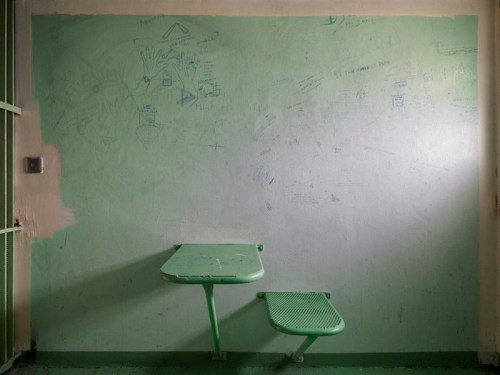
Disciplinary cell in the Grand Quartier of the Maison d’arrêt de Bois-d’Arcy, in France, was opened in 1980. Designed with a capacity of 500 prisoners, it now houses 770.

Luzira Women’s Prison in Kampala, Uganda, 2013. 370 women and 30 children (of convicted mothers) are locked up here.
Can you go name all the different prisons you visited?
Oh my goodness, that’s a long list! In Uganda I went to ten prisons including the big ones of Luzira, Jinja and Luzira Women’s Prison. Four in France after struggling to get access for two years. Five in the U.S. of which three will be included in the book. I’ve still to make a return visit to Colombia to photograph more but it’s as many, if not more, than in other countries.
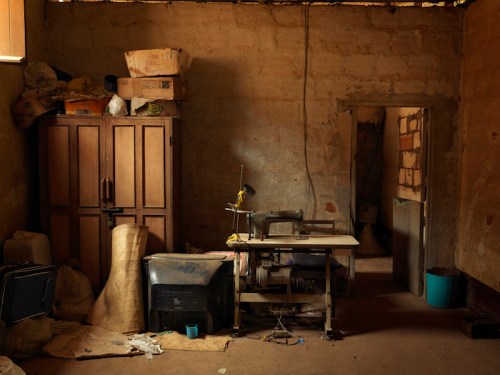
Part of reception area of Luzira Upper Prison, Kampala, Uganda, 2013. Here, uniforms are adjusted for new prisoners. Luzira Upper Prison is Uganda’s biggest maximum security prison. Built to accommodate 600, the prison held in March 2013) 3114 prisoners.
Clearly you have a broad interest in systems and institutions of justice. How did you arrive at prisons, specifically?
My project Bureaucratics looked at one of the three pillars of the state: the executive. Law and Order looks at the judicial, the second pillar of the trias politica.
And the third pillar?
The legislative.
How do different societies handle crime? Police are involved. Courts involved. But I am fascinated by prisons. I studied of history so I’ve always gravitated toward a more structural analysis. As a photographer, I’ve been really interested in the news or in short term of events and developments.

San Diego Women’s Prison (Carcel de Mujeres de San Diego), the city of Cartagena, Colombia, Sept. 2011. From the series “Law and Order”. Rosa Martinez Meza (left, age 20) is serving ten years on aggravated criminal conspiracy charges. She studied Marketing and sales. Eliana Sofia Gonzalez (right, age 23), is still under investigation, accused of attempted extortion. She studied business administration and is self-employed. They share their room with ten other women.

Uganda Chief Magistrate’s Court, Buganda Rd, 2013.
You’re taking the longer view. An overview. So what are prisons supposed to do?
They can function an instruments of revenge for society, to punish. But as instruments of correction and as instruments to bring down crime rates, I don’t think they work.
French prisons are no hotels but they had the most humane atmosphere. U.S. prisons, in Georgia, were horrible. Of course prisons in Uganda are primitive and there’s a lot of bad things that can be said about them—corruption and bad personnel. But prisons in Uganda still gave me a much more humane impression than those in the U.S. Even in the maximum security prisons in Uganda, I was allowed to roam around freely. I had some nice relaxed chats with prisoners, even the most heavily sentenced prisoners would be patting somebody on the shoulders.
The maximum security prison in Jackson, GA had a horrible atmosphere and I think that is noticeable in the photographs. For example, if you look at the photographs from Uganda, it’s earth colors, it just looks nicer, now of course that can be deceitful, but in this case I don’t think it is. In the U.S., it is all steel and concrete, like an ice cold industry. You walk around with a couple of old marines who are heavily armed and wear bullet proof vests. Prisoners had to turn around and face the walls as I passed them in the corridor and that brings me to the conclusion that the U.S. was really extreme.
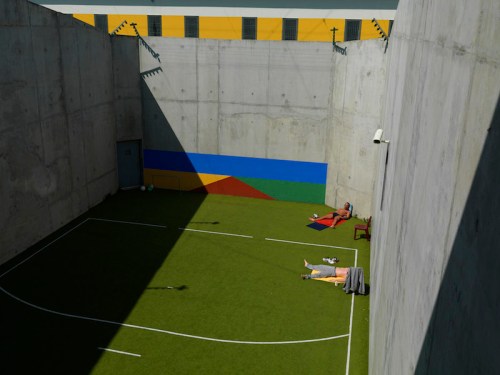
Court, Quartier Maison Central, Centre Penitentiaire de Lille-Annoeullin, France, 2013.

Colombia, Sept. 2011, from the series “Law and Order”. “Establecimiento Carcelario de Reclusion Especial” in Sabana Larga is a special facility with only 100 prisoners, 18 guards and 5 administrators. Over half of the prisoners at the small medium-security prison are officials who have been convicted or are under investigation i.e. governors, mayors, police officers, judges. Leonel Silvera Padilla (20) is under investigation for theft.
Latin American prisons have a reputation for being overcrowded and in squalor.
At first they allowed me into relatively mild prisons in 2011. Recently, however, I went to some disgusting facilities in Colombia. At times it felt like I was making propaganda for the prison authority. It’s a long story I cover here.
Do you think as an Dutch photographer, an outsider, you are able to tell reveal something new about U.S. prisons to the American public?
I made a photograph of a guy who is bathing in a jail. Obviously I would never use that photograph in a news context for which one photograph is being used to illustrate the Georgia prisons or jails. However, as part of a series it finds it’s place.
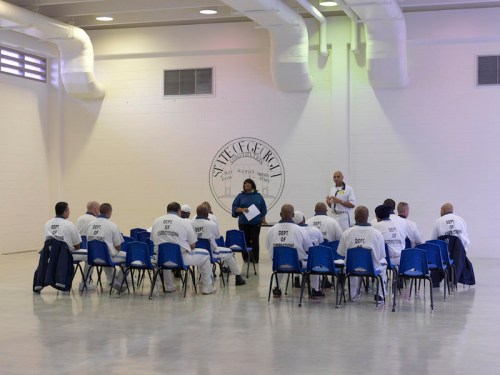
Meeting of committee of the “lifers” — men with a life sentence, at Georgia State Prison which is a medium security prison near Reidsville with 1500 prisoners.
I think my photographs give two different messages at the same time. There’s a photograph of a group of lifers that are being trained to advise other prisoners. Management matters are playing a big role there (the prison is probably trying to keep the lifers occupied there so they are not coming up with ways to make life hard for the guards).
And use them to bring other prisoners around to a more compliant set of behaviors.
True. So, something is being done for people, but it is in the surroundings which look like an old factory. I’m trying to come up with a nuanced picture and to paint a confusing picture and I hope that that will somehow contribute or stimulate people to ask questions Confusion is my main purpose.
In some ways, it’s more important to me that this plays a role in the public in the U.S. than in Europe because we have less tendency to be tough on crime and to lock everybody up than the U.S.

Putnam County Jail in Eatonton, Georgia.
The U.S. needs more introspection, relatively?!
Absolutely. Homeless people are absolutely unable to get housing because of their criminal past. From a European perspective it was astounding to hear that this information on them would be out on the internet so they couldn’t get a house because it was registered, they often couldn’t get a job because the employee would go on the internet. Now this is a weird situation. Let me put myself in the position of an employer and one of these women comes out and has a job interview with me and I am going to go on the internet and I am going to see what I find about them. I have found very few people who are somehow shocked by it. When I tell people in Europe or in Holland or in Germany, people are absolutely flabbergasted.

And this informed your side project of portraits of women at Pulaski Women’s Prison?
Law and Order has a distant approach, but soon I wanted another aspect. This is confusion for me as well as the viewer. Anywhere in the world, people are trying to make clear distinctions between criminals and us—to define them as different and as bad people but I don’t think they are, actually. I could have been in prison myself many years ago. I wasn’t so I am “a decent citizen”!
I wanted to bring these two groups closer together so that’s why I photographed the female prisoners the way I would photograph my family members or the Dutch Prime Minister.
But yet more confusion. I had to get permission to photograph them and yet all their portraits are on the Department of Corrections website!
But this work is not in your forthcoming book?
No, it was a parallel project. It’s formally different. The Law and Order book is not about portraits; it stresses on the consequences and environments of different systems.
I was only allowed to ask very few questions. I was not allowed to ask, why they were in prison or for what they were sentenced. But all that information was on the website of the Georgia Department of Corrections. So all the text that you find in my portfolio was found on the internet.


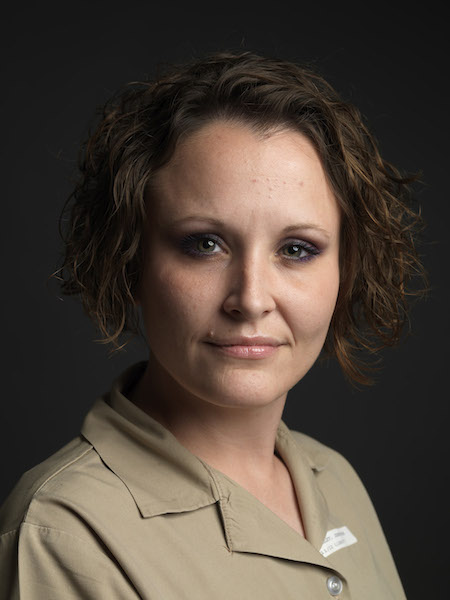
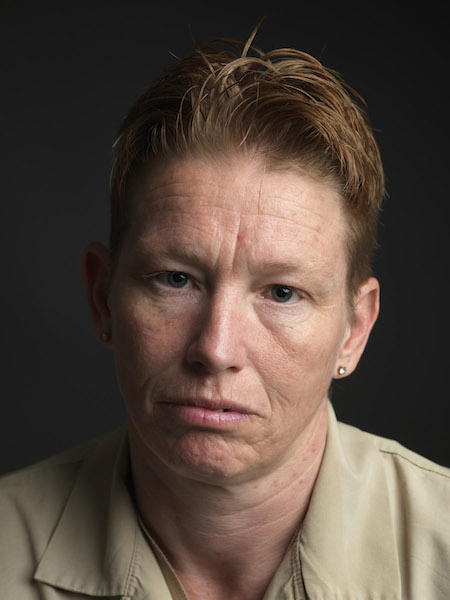
There’s a couple of other artists I know who’ve taken umbrage at the public exchange of mugshots for entertainment, Jane Lindsay and Kristen S. Wilkins. But you’re the first male to adopt such empathy. You’re also non-American.
Apparently for U.S. citizens it’s quite normal to trade in the personal details of felons.

What the people in Holland think of America and Americans?
The U.S. seems to have an image problem. I happen to I often find myself in the strange situation, to some extent, defending the U.S. or bringing up nuances in conversations with friends. For Dutch people who have not spent much or any time in the U.S., it is hard to see these nuances or to have a sympathetic view of Americans.
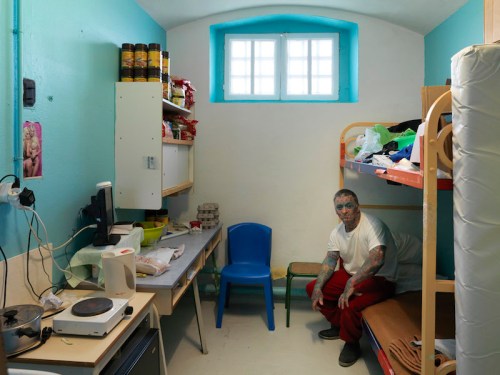
Etablissement Pénitentiaire — Maison d’Arrêt / Douai, Cell 10, Batiment B. Jean Michel, France, 2013.
What’s the situation like in Holland in terms of criminal justice and crime statistics and prisons?
Our prisons are underpopulated. We’ve started renting them out to Belgium and Norway because they are getting empty. A nice development. I think Holland would, in American terms, be called “soft on crime” and I think we’re doing pretty good.
The murder rates have been going down here since the 90s here and in a lot of other countries. As far as I know, crime rates are going down as well. The reasons still allude researchers. But we can definitely say that the bigger the social difference between the richest and poorest, the higher the crime rate. That is an interesting point to put to an American audience, don’t you think?
I do. Thanks, Jan.
Thank you.
This conversation was edited for length and clarity.
—
Jan Banning is a photographer based in Utrecht, Netherlands. Follow him on Twitter and Facebook.

 Prison Photography