
You are currently browsing the category archive for the ‘Rehabilitative’ category.

Angelo on his cell bunk
–
Marc and Brett of Temporary Services shared a tribute to Angelo this week. They collaborated together on Prisoners’ Inventions, and although I never knew (very few people did) Angelo (not his real name, his artist name), I wanted to mark his passing here on the blog.
Prisoners’ Inventions started as a collection of more than one hundred annotated illustrations of inventions that Angelo made, saw, or heard about while incarcerated. From homemade sex dolls, salt & pepper shakers to chess sets, from privacy curtains and radios to condoms and water heaters–all “attempts to fill needs that the restrictive environment of the prison tries to suppress,” writes Temporary Services.
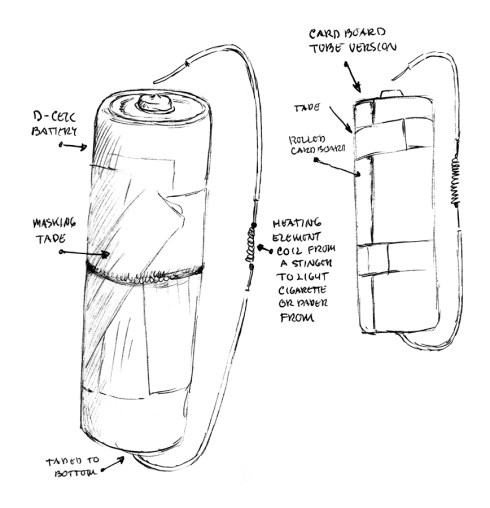
Battery Cigarette Lighter
It seems so long since Prisoners’ Inventions landed on my radar and even then, I was years late to the project. Someone showed me a copy of the book in 2011. But the first edition of the book was published in 2003, and new editions followed. In 2003 and 2004, Prisoners’ Inventions was presented as an exhibition at MassMOCA, complete with a full replica of Angelo’s cell, and later travelled to numerous venues. Around that time, international press blew up around the originality and the cheekiness of it all. This American Life did a bit.
Prisoners’ Inventions set a standard in many ways for artists and incarcerated individuals working in tandem–the way Angelo insisted on anonymity; the way Temporary Services held the space; the way together they let the illustrations do the work; the manner in which they (despite the barriers and censorship) communicated transparently and studiously; the way they fired public imagination with recognitions of human spirit, ingenuity and agency among a prison population so frequently vilified; the way Angelo and Temporary Services resisted any over-politicization of the project; I could go on and on.

Coat Hanger
Too often we think of art as being things not doings, as objects not relationships or as things that can exist on a shelf instead of in our hearts and minds. While Angelo and Temporary Services made objects based upon the drawings, objects were never the goal. Prisoners’ Inventions existed to demonstrate the innate creativity we all hold and also the potential in even simple written (and drawn) correspondence. It was about meaningful relation and understanding of people in very different circumstances. Temporary Services call Angelo their greatest ever collaborator, which is a huge statement from an art collective known for it communal underpinnings.
“Angelo’s writings and drawings about the creativity he observed in prison collapsed the distinctions between art and everyday survival,” said Temporary Services. “He transformed our thinking in ways that have influenced everything we’ve done since.”
In truth, Prisoners’ Inventions has influenced many an artist’s thinking and methodology since.

Steamer Cooker
A common problem with artwork that deals (even tangentially) with the issue of mass incarceration, or with prisoners directly as art makers, is that the art can often fail to break down the inherent power imbalance; that the prisoner is packaged by the outsider for outside public consumption. Furthermore, some art and language can’t help but fall into patronizing stereotypes about how the artist is helping the prisoner … and that the prisoner is helpless. Prisoners’ Inventions never trivialised, infantilized or boxed Angelo’s work. Nor did Temporary Services and Angelo ever try to argue it was something it was not which I think is a reflection of their trust, equity and confidence.
“People seem willing to accept the inventions of prisoners as creative objects that merit our attention and thought without us having to force them into goofy critical constructs like *Outsider Art*,” said Temporary Services in the book Prisoners’ Inventions: Three Dialogues (PDF). “These objects don’t need critical help to become interesting. New terminology does not need to be invented to create a niche market or new genre for a stick of melted-together toothbrushes and bits of metal that can be used to make apple strudel in a prison cell.”
If you can take the time to read Prisoners’ Inventions: Three Dialogues, please do. It lays out the origins, conversations, adaptations and logistics of the multi-year project. It elaborates on subtle concepts. It shows that good art rests on a solid idea and no-bullshit presentation of the idea. The way Prisoners’ Inventions moved through cultural space, both IRL (galleries, vitrines, fabricators’ hands) and virtual (image, video, online featurettes, audience mind and assumption) and through real economic systems is fascinating. The way Temporary Services discuss the negotiation of these things in relation to their promises and shared goals with Angelo is grounding and, I think, instructive.
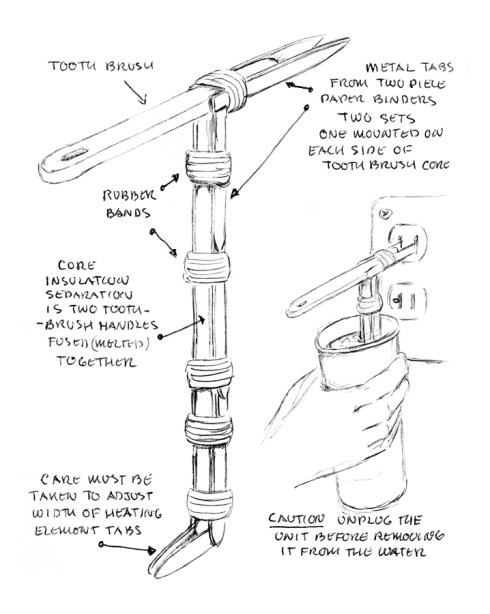
Stinger (Immersion Heater)
Marc and Brett explain that since Angelo’s release in 2014 he lived quietly in Los Angeles, keeping to himself, catching up on TV and films he missed while locked up for 20 years. They also mention that Angelo had to wait until release before he could see and hold a book of his drawings; the prison administration banned any copies entering the prison because (and you can’t help but laugh) the drawings would show Angelo how to jury-rig objects and homebrew solutions!
The threat was imagined and the logic flawed, of course, but this brings me to a final point. Prisoners’ Inventions did not advocate for Angelo. Never did he and Temporary Services get involved in discussions about his case or legal matters. Not once did the work threaten prison security or reveal anything unknown to nearly every prisoner locked up in America. Opportunities for meaningful, collaborative and non-combative artwork within the prison industrial complex are few and far between. I think it is vital that we recognize art and activity that amplifies the existence of some without ignoring that of others; that we seek projects that lift us all. Mass incarceration is a depressing thing, but there are moments of humor, surprise quirk and enlightenment. Be ready for them! Prisoners’ Inventions succeeded in closing the gap between us and them without forcefully or uncomfortably insisting on the defining terms of us and them. Prisoners’ Inventions occupied a rarified space and we do well to learn from it.


I’ll close with a story about when, during a cell search, guards found photos of the full replica of Angelo’s cell.
“Stunned and angered that an inmate had somehow acquired photos of his own cell, the guard demanded information on how he got the pictures. When Angelo pointed out the fabricators’ subtle discrepancies in the cell recreation and explained a little about the exhibition, the guard’s anger quickly turned to wonder and amusement.”
Angelo, you mined your memory, you humbly shared your knowledge, you made drawings that confounded expectations and shifted minds. You never wanted fame or fortune. You made a thing that will last. RIP.


‘Chasing the Dragon’ © Robert Saltzman / Juan Archuleta. From the series “La Pinta: Doing Time in Santa Fe”
–
I’ve heard from a couple of folk that when I started Prison Photography, they laughed at its folly. Not only had a bleeding-heart liberal thug-hugger come along to explain a world no-one cared about to no-one in particular, but silly-little-leftie-me would run out of projects and photographs in no time. Not only had I picked a subject nobody cared for, I’d neglected to do the proper amount of research and maths.
Well, more than eight years later, and I’m still stumbling upon scintillating projects that challenge my ever-evolving timeline of prison-based visual arts. Case in point La Pinta: Doing Time in Santa Fe, a collaboration between Robert Saltzman and the prisoners of New Mexico State Penitentiary, in Santa Fe, NM.

© Robert Saltzman / Keith Baker. From the series “La Pinta: Doing Time in Santa Fe”
Saltzman first visited the prison in 1982 to visit a friend and thereafter was fascinated by the lives behind the walls. Despite a massive riot less than two years prior, Saltzman convinced the warden to allow him in with his 35mm SLR, three lenses and camera-mounted flash. Saltzman gave assurances he was there as an artist and not as a reporter.
Over 9 months, Saltzman made 500 images on Kodachrome64 film. He picked the 35 strongest portraits but still wasn’t happy. They failed to tell a fraction of the stories or reflect even a small slice of the range of emotions he encountered. So he printed the 35 out and mounted them on white illustration board. He sent them back in, a few at a time, with a request.
“Please use the white space however you want,” Saltzman told Popular Photography in 1985.
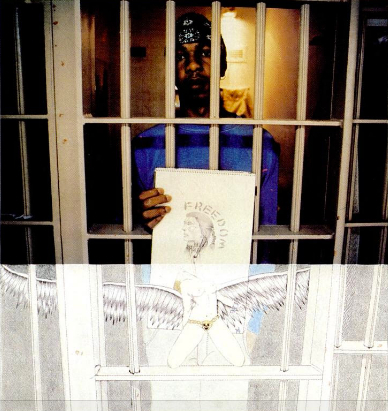
© Robert Saltzman / Jonathan S. Shaw. From the series “La Pinta: Doing Time in Santa Fe”. Screengrab from Google Books scan of an issue of Popular Photography (Vol. 92, No. 3, March 1985, pages 66-69 + 141, ISSN 1542-0337)
Some photographers would be happy to get in and out with some portraits and call it a day. Plaudits to Saltzman that he distanced himself enough to make a hard call about the nature of his pictures. And with it adding more time and uncertainty to the project.
28 total works came back. In the first exhibition of La Pinta: Doing Time in Santa Fe, 11 were shown. Later, 14 were exhibited.
“The drawings and writings, coupled with Saltzman’s portraits, communicate a poignant and often tension-filled commentary on the prison experience,” writes James Hugunin, art historian, expert on prison imagery and curator of a 1996 show Discipline and Photograph which included Saltzman’s work.
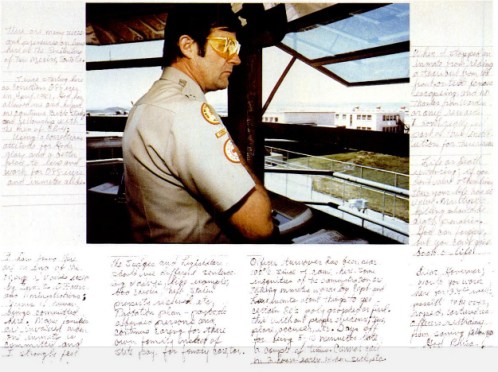
© Robert Saltzman / Ralph K Millam. From the series “La Pinta: Doing Time in Santa Fe”. Screengrab from Google Books scan of an issue of Popular Photography (Vol. 92, No. 3, March 1985, pages 66-69 + 141, ISSN 1542-0337)
This work excites me because it avoids easy categorisation. This type of collaborative work is standard-fare these days with a new generation of practitioners inspired by the social justice priorities of photographers like Wendy Ewald, Anthony Luvera, Eric Gottesman and many more. In the early eighties however, when Saltzman et al. made these, collaboration was considered a bit amateurish. God forbid you allow scrawls upon photographs! Pencil was meant only for contact sheets, editing and for marking crops for the darkroom. Note that among famous photographers Robert Frank made some good scrawls on his stuff in the 70s for himself and for ad campaigns in the 80s and we all know Jim Goldberg’s Rich and Poor (1977-78) was before its time and the high-profile example of a photographer handing over prints for subjects to write upon.
With the exception of Danny Lyon, all the photographers I know that preceded Robert Saltzman in photographing inside US prisons–Steven Malinowski, Gary Walrath, Joshua Freiwald, Sean Kernan, Cornell Capa, Ruth Morgan, Douglas Kent Hall, Taro Yamasaki–were invested in keeping the camera, and thus the message and interpretation, in their own hands. Given the times and the preciousness of access, it makes sense that photographers would internalise society’s general attitude toward them as special messengers. (I should flag here, as I always do, that Ethan Hoffman’s work and book Concrete Mama was exemplary of this time in terms of giving over great space for his imprisoned subjects recount their stories.)
I wouldn’t say that photographing prison guards hadn’t happened by the early eighties, but it was unusual. So for Saltzman to get the written reflections of guard Ralph K. Millam (above) is significant too. Most photography projects within prison focus on the prisoners and very few focus on both the kept and the keepers.
In short, due to both its subject matter and approach, Saltzman’s La Pinta is landmark. Prisons weren’t photographed much in the early eighties and certainly not for as long as a year, the time it took Saltzman to complete the work. Its collaborative methodology allows for heightened emotional impact and positions it ahead of other works that later used similar formulas and embodied likeminded sympathies.
See more here.
–
Three years ago, I spoke with photographer and filmmaker Karen Ruckman about her work as a photography teacher in Lorton Correctional Facility, an infamous prison in Virginia used to house men from Washington D.C. until it was shuttered in 2001. At that time, Ruckman was in the midst of producing a documentary film about the photo program. Well, now the film is complete. It has toured in the past few months, but can travel further and into the future.
From the working title InsideOut, the film is now being distributed as In Lorton’s Darkroom. Early reception has been extremely positive with screenings in Washington DC and Chicago at the Injustice For All Film Festival. Now the hard work is done, Ruckman and her team is keen to get the documentary seen. Are you a supporter? Would you like to do a screening? Get in touch with Ruckman and discuss possibilities.
This photo project was extremely rare and as far as I know the last program of its kind in an adult mens prison in the United States. The film depicts what we have missed in the past couple of decades. Despite this, the film radiates hope and shows us the bright spots on the yard. It fires the imagination.
–
Follow on In Lorton’s Darkroom through its website and its Twitter, Tumblr , Instagram and Facebook channels.

–
Louisiana State Penitentiary, known commonly as Angola, is the largest maximum security prison in the United States. Of its 6,300 prisoners, over 85 percent are serving life. This shocking fact is due to Louisiana’s harsh sentencing laws. Activists and reformers who fight against Life Without Parole (LWOP) sentencing refer to life sentences as “death by incarceration”. If we focus on the fact of death–as opposed to focusing on the crime, transgression, legal proceedings, or behaviour of the men during their incarceration at Angola–then we see with stark clarity the brutality of the system.
The catastrophic results of LWOP are many, but perhaps one that isn’t so obvious is an emotional turmoil surrounding the death of prisoner’s loved ones during incarceration. What do prisoners think about, do about and cope with when they hear of death beyond the prison walls? What are their responses to sudden death in free society when they’re condemned to a slow, slow death inside the prison industrial complex?
These questions were the starting point for Stories from Prison/Honoring Ancestors, a collaborative project led by Benjamin D. Weber in collaboration with Angola prisoners, their friends and family and students at the University of New Orleans (UNO).
“Due of the length of their sentences, most of Angola’s prisoners have experienced the loss of a loved one while they have been locked away,” says Weber. “Prisoners are quick to remind you, many are doing life for non-violent offenses and many others for first offenses that would not carry such a sentence in just about any other state.”
Weber decided to create a collaboration in which a group of allies could commemorate prisoners’ loved ones who had passed. The commemorations would be directed by prisoners.
Weber distributed forms at Angola on which prisoners could tell a story about a loved one who had died, and request for them to be commemorated in specific places that were meaningful to them. The prisoners chose whether they wanted their story to be shared publicly or not.
All of the commemorations, photographs and supporting documents are presented in interactive map form at the Stories from Prison/Honoring Ancestors website.
Groups of UNO graduate and undergraduate students and Weber performed the commemorations. They then mailed letters and photographs to the prisoners.
“Prisoners requested all sorts of different actions to be performed,” says Weber. “We released balloons inscribed with special messages, visited grave sites to recite poems, placed flowers and a bingo chip atop a waterfall, and even improvised a dance with relatives.”
In the process, Weber and the UNO students discovered that the photographs fell secondary to the performances and commemorations. The photographs are important documents, but creating the photographs was not the primary focus during the commemorations. When it came time to commune and be present with one another, making photographs didn’t always seem important, mindful or, frankly, appropriate.
“Many [photos] were snapped on students phones as we sought to document what we were doing without interrupting it too much,” says Weber.
Such adjustments to behaviours and goals were typical of Stories from Prison/Honoring Ancestors and, indeed, are common to similar socially engaged projects.
Weber was kind enough to speak about the motives, the involvement of the community, the students’ learning and the outcomes of the project. Here, we publish a Q+A and photographs fulfilling the requests of Gerald Davis, Derrick Allen, David Wilson and starting (below) with Elmo Duronselet
–
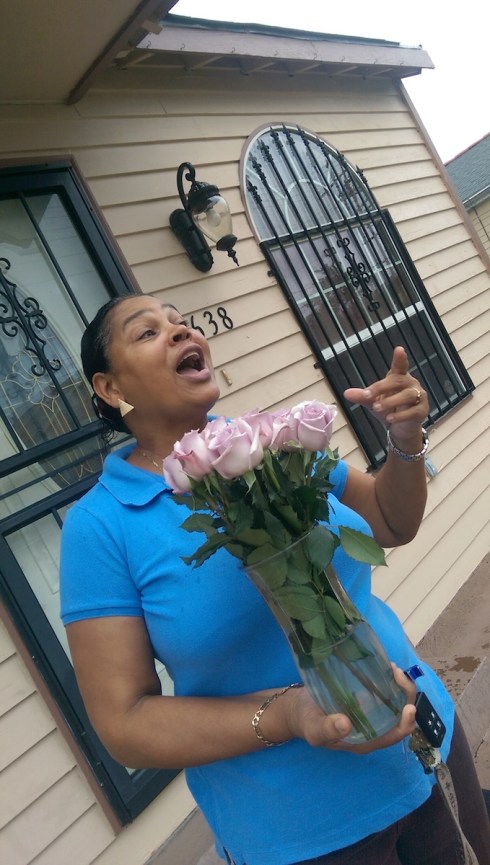
Elmo Duronselet

–
Q + A
Prison Photography (PP): Your PhD covers the eighty years between the Civil War to the end of WWII. You have many intersecting interests in prisons, policing, society. How do you summarize the origins and growth of the prison industrial complex in the United States?
Benjamin Weber (BW): There are a number of reasons why the dissertation covers that particular time period. The first is the massive expansion of racialized incarceration that took place after the Civil War, triggered in part by the “convict clause” of the 13th Amendment which allowed for the perpetuation of slavery and involuntary servitude as “punishment for a crime.”
I see the origins of this expansion of the prison system as being bound up with war-making and imperial expansion, first across the continental U.S. and then, especially after 1898, overseas. That’s why the dissertation focuses on practices of confinement and forced labor in places like the Pacific Northwest, the Panama Canal Zone, and the Philippines. I believe that if we can understand these things as part of a history of racial domination in U.S. empire, we might be able to think more clearly and critically about how to fight against them in the present. Or to put it slightly differently, if we can better understand the origins of the problem, as you point out, we might better understand the range of possible solutions.
PP: Where does your interest in incarceration stem from?
BW: I believe the problem of mass incarceration to be the defining social justice issue of our generation.
My academic interest comes from a place of trying to understand how various forms of injustice have operated and how people have struggled to combat them in the past, and the present. My personal commitment comes from experiences visiting friends and former students in jails back in California and witnessing first hand the way that young people, particularly people of color, are treated by the police and prison systems.
Working alongside others who have friends and family members who are locked up provides example after example of how terribly broken and institutionally racist the system is.
–
David Wilson


–
PP: You’re at Harvard. This project was at the University of New Orleans. Was this first project for which you’ve travelled and worked with students elsewhere? I ask this because I wonder if it could function as a pilot; with elements that are all replicable by you, or others?
BW: This project came together the way it did largely because my partner and I moved to New Orleans so she could do residency in her hometown and I could finish writing the dissertation and start in on the book manuscript down here. The timing worked well because UNO Professor Molly Mitchell was interested to have the Midlo Center participate in the States Of Incarceration national public history project. So, I agreed to come help run the Louisiana piece of that project.
The Midlo Center has a visiting scholars program that could be replicated by other universities. In terms of replicable elements, I think the workshop or toolkit model tends to be more common when it comes to traveling to work with students from other universities. It worked really well, for instance, to have Mark Strandquist come and do a workshop with my students and I’ve talked with him and many others about how to share materials, strategies, and best practices about teaching issues of racism and mass incarceration. There’s already some really great stuff out there as well; The Knotted Line, as one example, has some pretty creative and inspiring examples of educator resources and curriculum guides for teaching about the prison industrial complex.
PP: The methodology of the project was inspired by Mark Strandquist’s Windows From Prison, but there’s a key difference between the methodology of Strandquist’s project and yours: You are convening a group at a specific place for an action and memorial. Place and gathering is important, for example, in Photo Requests From Solitary by Tamms Year Ten, I was always thrilled by Rachel Herman’s photograph of Bald Knob Cross for Willie Sterling because Mr Sterling understood he could use the general offer to make a photograph to bring/force people together in a physical space, beyond the prison walls.
How important was it for you to convene a group? Was that the core of the project? What does that convening do?
BW: The Tamms Is Torture project is an amazing example, and reminds me in some ways of the role of art-activists like Jackie Summell and Brandan “BMike” Odums in the campaign to free the Angola 3 down here in Louisiana. The comparison with Rachel Herman’s photo is really apt, because we definitely saw ways that prisoners improved upon our project design in precisely this same way.
There were cases where they would write in a person’s name in the line that asked where they wanted us to perform the commemoration. They explained that we could best honor their deceased loved ones by talking, singing, and even dancing with their living relatives. These were some of the most moving experiences for everyone involved.
PP: How did your discussions with students differ or remain the same throughout this project as compared with lectures/seminars in the classroom about incarceration?
BW: In his workshop, Mark Strandquist encouraged us to do the commemorations in groups and spoke about the importance of embodied learning. This type of convening allowed for conversations that could never happen inside a classroom. It was also profoundly moving to see how people of different faiths and spiritual traditions talked and went about honoring ancestors, as it were.
–
Derrick Allen


–
PP: What were the responses of family and friends of the prisoners with whom you contacted and held memorials?
BW: There was definitely a range of responses, from the cautiously apprehensive to the overwhelmingly appreciative. Some relatives who weren’t especially religious were suspicious at first that we belonged to a church group, while others who were more religious promised that God reserves a special place in heaven for people who take time to do this kind of work on behalf of their friends and family locked away in the Louisiana State Penitentiary.
Some were somber in their recollections about deceased loved ones, while others laughed and joked as they told stories about the person a given prisoner had asked us to commemorate. When we went to find Elmo’s aunt Tamika and do a dance, as he requested, at first she laughingly begged us not to, but we all felt like we needed to honor his request down to the letter so ended up doing a little dance right there on her front doorstep.
Occasionally, interactions turned into more sustained collaborations. Liz, whose fiancé is at Angola, not only performed the commemoration along with us but has stayed involved with the project and will be coming with us to the States of Incarceration exhibit launch in New York City.
PP: Have you received feedback from Gerald, Derrick, Elmo, David or other prisoners about the photo/results of the project?
BW: We received thank-you letters from several of them, and some have carried on extended letter-writing exchanges with my students and I.
Derrick wrote to us that receiving the letter and pictures from the commemoration “kind of felt like the service itself to me,” and signed off with this quote: “there are things we don’t want to happen, but have to accept, things we don’t want to know but have to learn, and people we can’t live without but have to let go.”
Sean told us that “when my days get gloomy, now I have the memories of what you all have done for my mother and for me.”
Gerald and Hannah have now written upwards of ten letters back and forth. And the forms of communication flow in other ways as well. Liz’ fiancé called her during an event we were having at the Ashé Cultural Arts Center, for example, and we were able to put him on the microphone to speak to the audience.
Gavin spoke to one of his family members on the phone and had her email me for him to clarify some things about the commemoration we were planning for his father who had recently passed away.
–
Gerald Davis

–
PP: Shortly after you made this work with prisoners of Angola, the longstanding warden Burl Cain resigned amid still-as-yet unclear accusations of shady business dealings. What was your experience working with Cain? Did the prisoners have anything to say about his regime? What lies in store for Angola in the wake of Cain’s departure?
BW: I worked primarily with the staff at Angola’s prison museum, but did have to get approval for the pilot project from Warden Cain’s chief of security and the public relations manager there. There is always a period of transition where people are worried about how things were shift around and shake out when an entrenched figure like Burl Cain leaves a prison like Angola.
The prisoners we worked with didn’t say anything specifically about Warden Cain. Some mentioned being optimistic that the new Louisiana Governor, Democrat John Bell Edwards, will have a better stance on pardons and clemency than Bobby Jindal, the outgoing Republican Governor. As one of them put it in a recent letter to me: “The new governor is supposed to open up doors for some offenders a little early…”
I’m honestly not sure what lies in store for Angola in the wake of Cain’s departure, but I do know that we all need to continue doing absolutely everything we can to address the shamefully high rates of racial disparity in incarceration in Louisiana and around the country, and stop putting so many people in cages period.
Because we know that prisons don’t work.
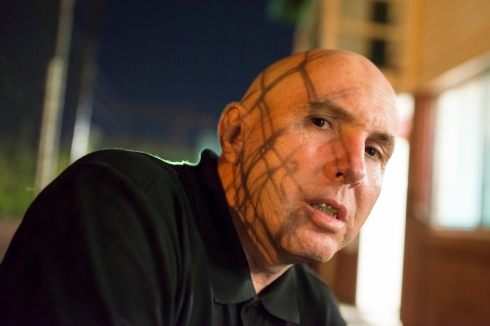
Owen at a community outreach service, near Brisbane, that provides free meals. Owen had been out of prison and in Australia for three months when this portrait was made. © Cory Wright
–
A BOY OF GREAT PROMISE
What happens if you’re released from prison in one country and deported to another? What happens if you’ve no recourse? What happens if your so-called “home” is not at all a home but a place you’ve not seen for 30+ years?
These questions can be answered, partially, by looking at the experience of Owen, who was sentenced to life in prison at the age of 32 in the United Kingdom. In late 2013, after serving 19 years, Owen was released aged 51.
“As an Australian citizen Owen was released as part of a scheme devised to reduce taxpayer expenditure and ease prison overcrowding in the U.K. by deporting foreign national prisoners,” explains photographer Cory Wright who met Owen in January 2014 a few months after his return.
“Owen was taken from a maximum security prison to a detention facility and then to the airport where he was flown back to Australia under guard escort,” continues Wright. “After clearing customs at Brisbane International Airport, he went his way and the guards went theirs.”
For his first few nights in Australia, Owen camped out in a wooded area behind a university campus. Having no family in Brisbane, he headed a local church to get some help.
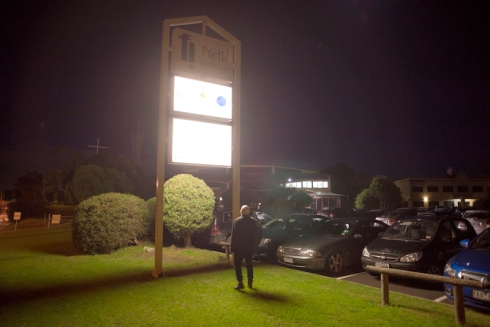
Owen on faith and imprisonment: “In prison, I could actually feel the strength when I walked into the prison chapel and it helped me a great deal. I don’t get that feeling now. When I walk into a church sometimes I feel as though it could be any other room.”
It was at a prison ministry conference in Brisbane that Owen and Wright first met. After striking up a conversation and learning about their recent histories and their need to unpack disorienting experiences. Owen and Wright decided to work together. For one year, through image-making, conversation and archives, they reflected upon Owen’s institutionalization, the social stigma of incarceration, repatriation and reentry.
Soon, Owen moved from Brisbane to Melbourne where his ailing mother lives. He cared for her for a while until she has since moved to a nursing home where he expects her to stay from now on. She was in her 60’s when Owen was sentenced to life in prison and over 80-years-old when he was released.
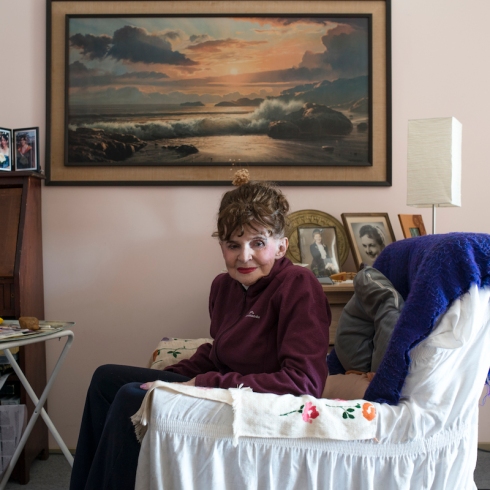
Owen’s mother lived in Bundaberg, a small town in northern Queensland for many years. She was a well-known member of the community, but she moved to Melbourne shortly after “Owen got into trouble” because it was too difficult to stay once members of the community learned of his offense.
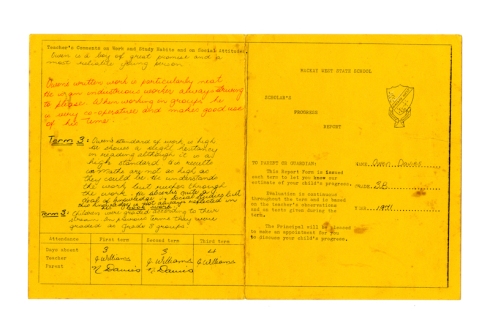
A scan of Owen’s year 3 report card. The series takes it’s title from the first sentence of the teacher’s remarks at the top left. “Owen is a boy of great promise…”.
Wright titled the project A Boy Of Great Promise, a phrase taken from Owen’s year 3 report card, written by his then teacher.
Wright and Owen could not help becoming friends.
“With empathy and attention afforded to the victim, little thought is given to the lives of those who have “paid their debt to society”. The stigma of the crime is often residual as is the label it caries. It is difficult to be known as anything other than an ‘ex-con’. Furthermore, the lasting effects of prisonisation often make reintegration back into society especially difficult,” says Wright.
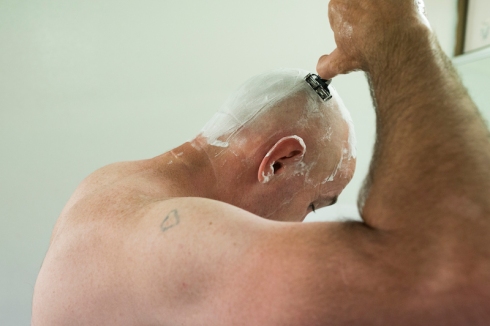
During his time living in Brisbane, Owen often relied on free amenities provided by community shelters.
“While A Boy Of Great Promise offers no firm resolution, it starts discussion among those who, all to readily, apply this stigma and rely on assumptions to judge those who have been convicted of a crime.”
I wanted to know more. I sent Cory Wright a few questions. But he replied saying he wanted to share the repsonsibility with Owen. And so I sent a few more questions and Owen and Wright explain the project jointly.
Q & A
How did you meet?
Owen (O): We met at the Uniting Care Prison Ministries Conference in Brisbane, March 2014.
Cory (C): I was encouraged to contact a local prison ministry in Brisbane, Australia and invited to attend the conference, which led me to meet Owen.
Due to the restraints outlined in the Queensland Corrective Services Act 2006, I was unable to photograph or interview any Australian individuals who were on parole as it is forbidden under the act since they are still classified as ‘prisoners’ by the state.
Owen’s circumstances were unique because he was incarcerated in the UK and therefore not considered a ‘prisoner’ under the Act.
I remain very grateful to Owen and members of his family for allowing me into their lives over a period of time.

Serving his sentence in the United Kingdom, Owen did not have many visits from family. During the 19 years he was in prison his mother did not visit him and his father visited only once.
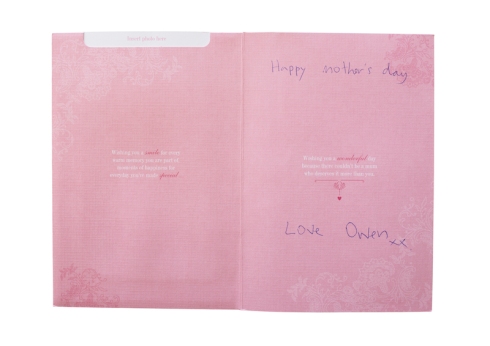
A card Owen bought for his mother whom he hadn’t seen since before he went to prison.
Why did you both agree to document this transition?
O: Cory approached me with the idea, explaining he needed a subject for his university assignment. I’m always willing to help people. And I like the idea of prisoners/ex-offenders getting positive exposure.
C: I wanted to spend period of time documenting post-release transition. I wanted to learn more about life post-incarceration with specific focus on individuals who had been recently released. The term ‘paid their debt to society’ has always interested me and I wanted to know if it was ever ‘paid’ or whether it was something that individuals continue to ‘pay’ following their release.
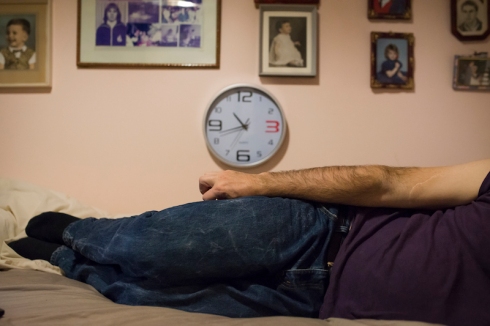
Owen in his rooms surrounded by past family photographs, mainly from his childhood.
What did you hope to get out of the project?
O: I do see myself as a kind of ambassador for ex-offenders. I wanted positive exposure for ex-offenders. I like art. I like turning life into art. There’s a freeing up and a cleansing that comes from it.
C: I hoped to learn more about life after prison. It’s not something that is discussed, certainly not in mainstream media. In Australia specifically, there seems to be a focus on vilifying criminal behaviour in order to support a tough on crime political approach. I’m not condoning crime, but I think there needs to be more thought and discussion on what happens after prison, which may lead to more consideration about what prisons are for.
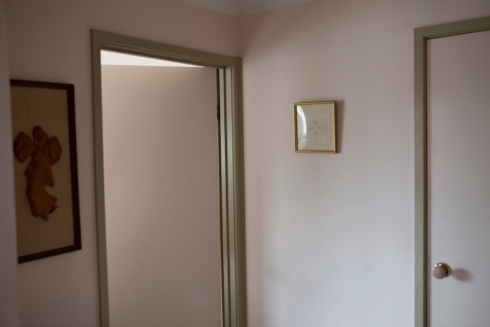
Owen on the long term effects of prison:“It’s like going to war. When you come home you have PTSD just like those soldiers coming home from war in Iraq or Afghanistan.”
Owen, do Cory’s photographs reflect your emotional state during this time?
O: Yes. I was happy and at peace, very happy to be released and enjoying my new found freedom. I think that is captured.
Cory, were you trying to reflect Owen’s emotional state?
C: I was documenting what I saw over a period of time, which was Owen gradually become more comfortable in Australian society. I saw happiness and relief yes, but I also saw Owen’s struggle to regain his place in a society from which he’s long been absent.
Owen repeated told me how relieved he was to be free, but he also said that he was worried he would be sent back to prison. There was a certain level of anxiety that the other shoe would fall and somehow he would be locked up again.

Shortly after Owen moved to Melbourne, he entered a romantic relationship with S. Initially, S was unaware of his past and Owen was reluctant to tell her. Here, Owen and S. during a camping trip in northern Victoria. During the time they were together Owen helped S. learn English (which is not her first language) for her studies in a masters program. They would buy two copies of the same book and take turns reading aloud to one another.

The garage of Owen’s mother’s townhouse where Owen and S. had sex when his mother was home.
Owen, what preparation did the UK government give you for the return trip to Australia?
O: None at all.
Owen, what has worked and what has not worked in your transition back to civilian life?
O: Australia is an easy country to live in, which has made the transition easy. None of my former friends welcomed me back and hardly any of my family, which has been the hardest thing to accept. I found I needed to start again and accept that people wouldn’t generally be accepting of my circumstances. I don’t tell people about my criminal past any more.
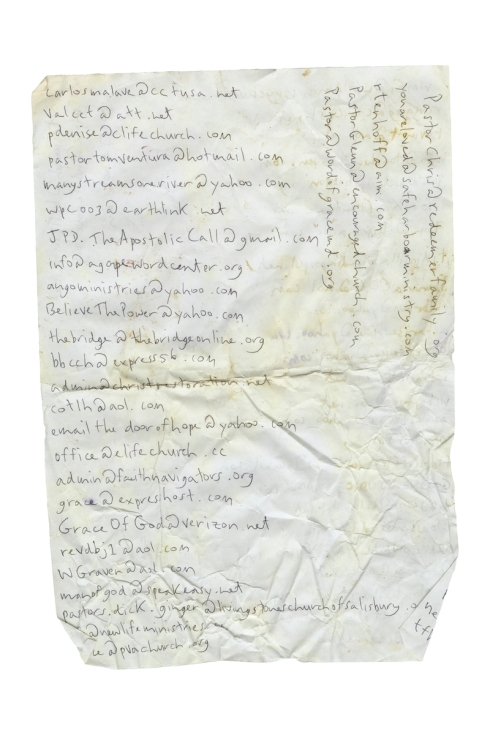
A list of email addresses to reach out to for support after his release. Owen compiled the list using internet access at a public library.
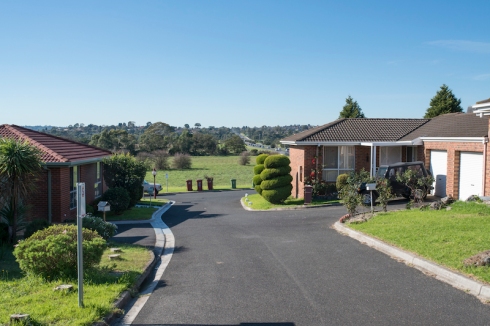
The view down the street from Owen’s mother’s townhouse in a suburb of Melbourne. After four months living in Brisbane, Owen relocated to Melbourne to live with and care for his mother.
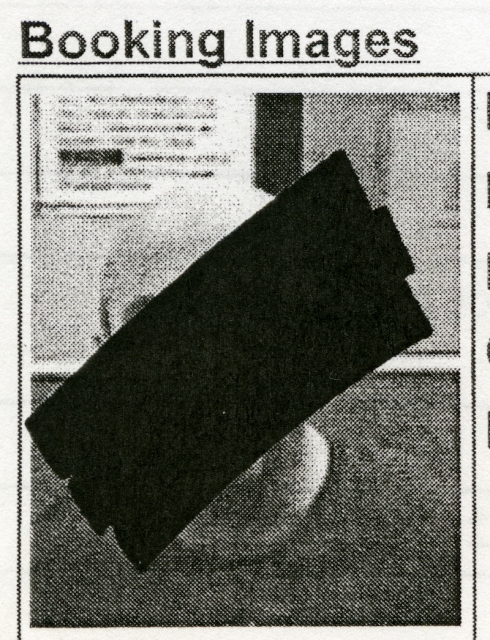
Owen’s booking image provided and partially redacted by the Ministry of Justice.
Why was the mugshot redacted?
C: I’m not sure why the Ministry of Justice decided to redact the image, especially since all of the consent forms and signatures they requested were provided.
In one of our discussions Owen told me that being released after serving a long-term prison sentence is like returning from war in the middle-east with regards to the effect on the person. Your identity is effectively stripped away from you and you become a number. I felt that this redacted image reflected that.
How common is the removal of non-UK citizens from UK society after their release?
O: It’s only relatively recent that lifers have been returned to their country of origin after their sentence. The TERS (Tariff Expired Removal Scheme) agreement began three years ago. Fixed-termers get sent back regularly.
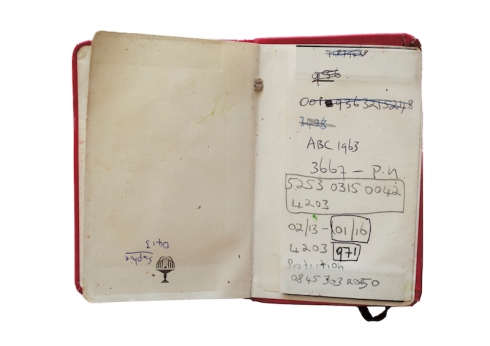
Prison diary and address book.
Owen, did you have any right of appeal?
O: There is an appeal system, but I doubt if a prisoner would have much success with it. I wanted to come back to Australia.
Owen, if you could be anywhere where would it be?
O: At the moment I’m still happily settling into life in Australia. I probably will travel when I get some money together – in Asia or Africa or South America.
Owen, why do you camp?
O: I like the freedom of it. After being locked up for so long I like not having four walls around me.

Owen during a camping trip to the south coast of Victoria. Since his release, Owen has spent a lot of his time outdoors, mainly camping in rural areas of Victoria.
What would you like the world to understand through this project?
O: Good things can always happen.
C: I would like the people to give more consideration to a part of society that is largely ignored.
–
Cory Wright is a photographer based in South East Queensland. Connect with him on Twitter and Instagram.
All images: © Cory Wright

For its seventh and final stop, Prison Obscura will be on show at Newspace Center for Photography in Portland, Oregon from April 1 to May 28.
(Check out official Prison Obscura website and the PP “Prison Obscura” tag for the background and journeying of the exhibition.)
I’ll be at Newspace for the opening next Friday night, April 1, 6–8pm. I’ll be installing Wednesday and Thursday so stop by and say hello.
Also, on the Saturday afternoon I’m moderating a panel titled Can Images Counter Mass Incarceration? with some of my favourite artists and thinkers. Here’s the Facebook event page and see bolded events’ details below.
THE BLURB (AGAIN)
No country incarcerates a higher percentage of its population than the United States. More than 2.2 million people are currently locked up in the U.S.—a number that has more than quadrupled since 1980. But sadly, the lives lived behind bars are all too often invisible to those on the outside. Prison Obscura sheds light on such experiences and the prison-industrial complex as a whole by showcasing rarely seen surveillance, evidentiary, and prisoner-made photographs. The exhibition encourages visitors to ask why tax-paying, prison-funding citizens rarely get the chance to see such images, and what roles such pictures play for those within the system.
Alyse Emdur’s prison visiting room portraits from across the nation and Robert Gumpert’s recorded audio stories from within the San Francisco jail system provide an opportunity to see, read, and listen to subjects in the contexts of their incarceration. Juvenile and adult prisoners in different workshops led by Steve Davis, Mark Strandquist, and Kristen S. Wilkins perform for the camera, reflect on their past, describe their memories, and self-represent through photographs. The exhibition moves between these intimate portrayals of life within the prison system to more expansive views of legal and spatial surveillance in Josh Begley’s manipulation of Google Maps’ API code and Paul Rucker’s animated video. Prison Obscura builds the case that Americans must come face-to-face with these images to grasp the proliferation of the U.S. prison system and to connect with those it confines.
Prison Obscura is made possible with the support of the John B. Hurford ‘60 Center for the Arts and Humanities and Cantor Fitzgerald Gallery at Haverford College, Haverford, PA.
PUBLIC PROGRAMS
In conjunction with the exhibition, Newspace is hosting a series of events related to the prison industrial complex and the role images play in exposing the structures of the U.S. criminal justice system.
OFFSITE Panel discussion: Can Images Counter Mass Incarceration? Saturday April 2, 2-4pm: Panelists Lorenzo Triburgo, Sarah-Jasmine Calvetti and Barry Sanders. Moderated by me. OFFSITE Location: Native American Student and Community Center, Portland State University (710 SW Jackson St). Sponsored by Portland State University Camera Arts Society.
Discussion: Re-Envisioning Justice: What Is Between Reform and Abolition of the Criminal Justice System?: Sunday, April 24, 4-6pm. At Newspace (1632 SE 10th Ave.)
Community Discussion: The Ethics of Photography: Thursday, May 12, 6:30-8pm, organized in collaboration with the Oregon Jewish Museum. At Newspace (1632 SE 10th Ave.)
All public programs are free, open to the public. Please note event location.
CLASSES
Expanding Photography: Discovering the Stories Behind Your Work: May 9 – May 23, 6:30 -9:30 pm | Instructor: Gregory Parra.
Education Lecture Series: The Screen Politics of Public Projections: May 17, 7:00 – 8:30pm | Instructor: Dr. Abigail Susik.
Build Your Own Pinhole Camera: June 5, 12:00-4:00pm | Instructor: Pete Gomena.
INFO + HOURS
Newspace Center for Photography, 1632 SE 10th Ave, Portland, OR 97214
Mon–Thurs 10am-9:30pm; Fri–Sun 10am-6pm
Facebook | Instagram | Tumblr | Twitter | Vine
For press inquiries, contact Newspace Curator Yaelle S. Amir at curator@newspacephoto.org or 503.963.1935.
–
THE IMPORTANCE OF GIVING
Securing help, even for the most simplest things, isn’t guaranteed for lots of returning citizens. I once listened to a talk by Troy Williams, who served 18 years in the California prison system, and he ended by pointing out that the state spent (conservatively) $900,000 keeping him locked up and then one the day of release handed him $200 and waved him off at the prison gate. Anyone can see that there is a sick disproportionate allocation of funds, especially if we’re to believe any argument that prison can improve those subject to it.
Across the United States, picking up the responsibility for care during the crucial post-release days, weeks and months, are volunteer groups. 2,100 miles from San Quentin in Champaign, Illinois one such group FirstFollowers are doing amazing work. Orchestrated by all-volunteer workforce, FirstFollowers is made up of activists and the formerly incarcerated who provide support and guidance to the people getting out of prison, to their loved ones, and the community as a whole.
FirstFollowers is currently seeking $10,000 to continue its invaluable work.
DONATE MONEY AT THE FIRSTFOLLOWERS GOFUNDME PAGE
FirstFollowers are committed to peace-bulding process in the community. Crucially they involve all voices in that. Experienced voices.
“In light of the recent spate of gun violence in Champaign, formerly incarcerated people can play an important role in creating a safe environment in our communities,” says FirstFollowers which opened its doors in March of 2015.
Our program grew out of the struggle to stop a 2012 proposal by our county authorities to spend $30 million on jail construction.
“We argued that the county needed more programs and services for the community, not more incarceration,” say FirstFollowers. “Our efforts paid special attention to the fact that our county was targeting Black people for imprisonment. While only 13% of the population of our county is Black, in September 2015, 71% of the jail population and more than 60% of the parole population was African American. We realized that we needed to stop jail construction but we also needed to provide community-based alternatives. We aimed to make FirstFollowers one of those genuine alternatives.”
–
–
DONATE MONEY AT THE FIRSTFOLLOWERS GOFUNDME PAGE
There are many reasons to donate money. Here’s a few. Here’s what FirstFollowers provides–a safe stigma free environment; peer mentoring; assistance with employment searches; job readiness training; advocacy for individuals with felony convictions; family reunification; and service referrals
“We don’t seek financial assistance for salaries but for our activities, equipment, and direct support for our participants when they need IDs, birth certificates, court transcripts, even clothes for a job interview. We also want to provide short-term stipends for formerly incarcerated folks to engage in community work.
DONATE MONEY AT THE FIRSTFOLLOWERS GOFUNDME PAGE
Contribution will fund:
- Training to formerly incarcerated people and their loved ones in advocacy-we need those impacted by incarceration to speak for themselves.
- Support groups for people with issues of substance abuse, mental health and family reconnection.
- Training in research skills to our participants so that they can carry out a participatory needs assessment among the formerly incarcerated and their loved ones in our communities.
- Transportation for family members to visit loved ones, especially those who are incarcerated but are close to their release date.
DONATE MONEY AT THE FIRSTFOLLOWERS GOFUNDME PAGE
–
For more information, visit the FirstFollowers website. Or contact them via email at firstfollowerscu at gmail.com
Tomorrow evening there’s an intriguing discussion happening at the Mechanics Institute in San Francisco. On the panel for Incarceration and the Path to Reform are author and educator Baz Dreisinger. She is the Academic Director for the Prison-to-College Pipeline program, coordinated by John Jay College, NYC, that offers college courses to incarcerated men. San Francisco District Attorney George Gascón alongside Jacques Verduin of Insight-Out and GRIP, and former inmate and GRIP graduate Terrell Merritt make up the rest of the group.
Can’t wait.
It’s at Wednesday, February 17, 2016 from 6pm onwards.
Mechanics Institute, 57 Post Street, 4th Floor Meeting Room, San Francisco, CA 94104
Call staffer Pam Troy on 415-393-0116 for more info.
Tickets for the public are $15. SIGN UP HERE.
THE BLURB
“Fiscal and physical challenges to our penal systems as well as changing attitudes about prison reform are happening locally, nationally, and internationally. […] See how San Francisco is modeling a new paradigm for rehabilitation and issues of human rights for those incarcerated. With President Obama’s December 18th commutation of 95 non-violent drug offenders to the recent “vote- down” of funding the new jail in San Francisco, there is much to talk about.”
Dr. Baz Dreisinger
 Dresinger journeyed to Jamaica to visit a prison music program, to Singapore to learn about approaches to prisoner reentry, to Australia to grapple with the bottom line of private prisons, to a federal supermax in Brazil to confront the horrors of solitary confinement, and finally to the so-called model prisons of Norway. This jarring and poignant trek invites us to rethink one of America’s most devastating exports, the modern prison system. With Oscar-nominated filmmaker Peter Spirer, Dreisinger produced and wrote the documentaries Black & Blue: Legends of the Hip-Hop Cop, and Rhyme & Punishment. Her book Near Black: White to Black Passing in American Culture was published in 2008 by University of Massachusetts Press.
Jacques Verduin
 Verduin has worked in prisons for 20 years, designing and running innovative rehabilitation programs. He is a subject matter expert on mindfulness, restorative justice, emotional intelligence, and transforming violence. He directs the non-profit “Insight-Out” which helps prisoners and challenged youth create the personal and systemic change to transform violence and suffering into opportunities for learning and healing. The Guiding Rage into Power (GRIP) Program at San Quentin is a year-long transformative program that provides the tools that enable prisoners to “turn the stigma of being a violent offender into a badge of being a non-violent Peacekeeper.” A former inmate and graduate of this program will be on the panel.
Terrell Merritt

Merritt is from Gary, Indiana. After high school he enlisted in the Navy and was stationed in San Diego, CA. After leaving the Navy, he spend 20 years in prison for 2nd degree murder. During that time, he began to soul search and incorporate practices into his life that promote nonviolence. These include nonviolence communication, Zen Buddhism, and the GRIP Program; a yearlong transformational program that he became a facilitator of. On November 10th 2015, he was paroled after serving 20 years and 8 months in prison. He is currently working to reestablish himself into the community and to give back where he can.
George Gascón
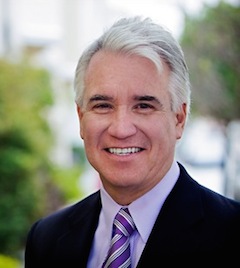
Gascón is the District Attorney for the City and County of San Francisco. He has earned a national reputation as a criminal justice visionary that uses evidence based practices to lower crime and make communities safer. He is the first Latino to hold the office in San Francisco and is the nation’s first police chief to become District Attorney. Looking to find alternatives to incarceration for low-level offenders, DA Gascón created the nation’s first Alternative Sentencing Program to support prosecutors in assessing risk and determine the most appropriate course of action for each case. The goal is to protect victims and the community by addressing offenders’ risk factors in order to break the cycle of crime and reduce recidivism.
DETAILS
February 17, 2016 from 6pm onwards.
Mechanics Institute, 57 Post Street, 4th Floor Meeting Room, San Francisco, CA 94104
Call staffer Pam Troy on 415-393-0116 for more info.
Tickets for the public are $15. SIGN UP HERE.

 Prison Photography