
You are currently browsing the category archive for the ‘Words’ category.
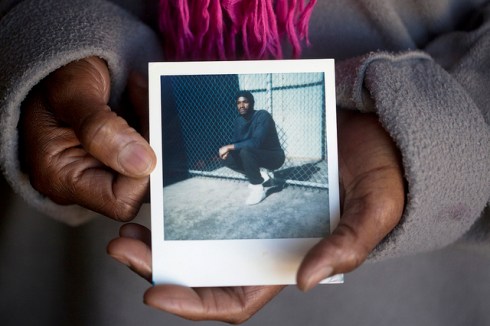
Marie Levin holds a photo of her brother, Ronnie Dewberry, taken at San Quentin State Prison in 1988. Until recently, it was the last photograph he’d had taken. Photo credit: Adithya Sambamurthy/The Center for Investigative Reporting
STARVED OF THEIR OWN IMAGE
We are now into the second week of the California Prisoners Hunger Strike. It is difficult to get firm figures on the number of participating prisoners. The Los Angeles Times reports 30,000; CNN reports 12,000 and Yahoo reports 7,000+.
I’m inclined to trust the figures sourced by Solitary Watch:
The hunger strike began on July 8th with participation of approximately 30,000 people in two-thirds of California’s prisons, as well as several out-of-state facilities holding California prisoners. In the first days of the hunger strike, approximately 3,200 others also refused to attend work or education classes as a form of protest in support of the hunger strike. As of Sunday, there are an estimated 4,487 still on hunger strike.
Still, formidable numbers.
INVISIBLE AND UNPHOTOGRAPHED PEOPLE
Last week, in conjunction with the initiation of the mass peaceful protect, Michael Montgomery for the Center for Investigative Reporting published an excellent article California Prisons’ Photo Ban Leaves Legacy of Blurred Identities about the ban on portrait photographs of prisoners held in solitary confinement.
Accompanying the article is the interactive Solitary Lives feature and a Flickr gallery.
The ban resulted from a tension between what a photograph meant or could mean.
For families, a photograph is a tangible connection to their loved one behind bars, but for staff of the four maximum security prisons that upheld the ban, photographs were potential calling cards — circulated by prison gang leaders — both to advise other members that they’re still in charge and to pass on orders.
The ban was lifted in 2011, following the last California prison hunger strike. Montgomery quotes Sean Kernan, the former Under-Secretary of the CDCR
“I think we were wrong, and I think (that) to this day,” he said. “How right is it to have an offender who is behaving … (and) to not be able to take a photo to send to his loved ones for 20 years?” Kernan directed prison staff to ease the restrictions for inmates who were free of any disciplinary violations.
The ban in the four Californian prisons was extraordinary.
“I have never heard of any other prison system or individual prison in America imposing a long-term ban of this kind,” said David Fathi, director of the American Civil Liberties Union’s National Prison Project.
As I have stated frequently on Prison Photography, prison (visiting-room) portraiture is one of the most prevalent types of American vernacular photography.
Until artists such as Alyse Emdur and David Adler began to draw focus to this disparate, decentralised, emotion-laden, and high-stake vernacular sub-genre, prison portraits were kept in wallets, on mantles and in side tables. There’s tens of millions of them out there.
And yet, for over 20 years, thousands of men in California were not allowed images of themselves. The additional ban of mirrors in solitary units meant that many men often did not see images of themselves for years on end. Again, to quote Montgomery’s article:
“I have asked my husband, ‘Do you even know what you look like?’ And he says, ‘Kind of, sort of,’ ” said Irene Huerta, whose husband, Gabriel, 54, has been detained at Pelican Bay for 23 years.
THE PHOTOGRAPH AS AN OBJECT OF DEPLOYMENT
In the free world, photographs are ubiquitous, easily created, shared and possessed. The fact that these seemingly innocuous objects were caught in the tussle of control between prison authorities and prisoners is astonishing, and speaks to the power struggle (real and imagined) between the kept and the keepers.
Michael Rushford, president of the Criminal Justice Legal Foundation, said easing the restrictions on prisoner photographs raised no major security concerns, so long as inmates had to earn them. “It’s not as if there’s been an epidemic of inmate photos on the street,” he said.
I am not sure how Rushford would measure this, or even it would significantly alter the lives of prisoners, specifically now during the hunger strike, and especially now when proven or alleged gang affiliations have been put aside by prisoners in solidarity for improved conditions for all.
In light of recent art market fetishism, it would seem the primary reason anyone would want to gather prison portraits would be to repeat Harper’s Books’ $45,000 hustle and cash in on the images?
As for the families (following the ban lift) the value of newly acquired images is not in any doubt:
Seeing an image of their incarcerated relative for the first time in years has sparked renewed hope and revived dormant family connections. For others, the photographs are a shocking reminder of the length of time some inmates have been held in isolation.
CENTER FOR INVESTIGATIVE REPORTING LINKS
Michael Montgomery’s California Prisons’ Photo Ban Leaves Legacy of Blurred Identities
Interactive Solitary Lives feature.
A BRIEF NOTE ABOUT THE SOLITARY WATCH WEBSITE
I cannot emphasize enough how important the website Solitary Watch is as a resource. Jean Casella, James Ridgeway, and their team of reporters produce high quality journalism — not only for their website but for other news outlets including The Guardian, Mother Jones, Al Jazeera, Columbia Journalism Review and The Nation.
Solitary Watch is an independent media and advocacy project, funded by grants and donations. It is a project of the Community Futures Collective, a 501(c)(3) non-profit. You can support the project here.
I don’t hesitate to say that Solitary Watch has driven much of the critical and visible public discourse about solitary confinement in U.S. prisons and jails.
As Solitary Watch describes, “Solitary confinement is one of the nation’s most pressing domestic human rights issues — and also one of the most invisible,” which is why I have a vested interest in their work; we’re each interested in making solitary and other egregious aspects of the U.S. prison system more visible.

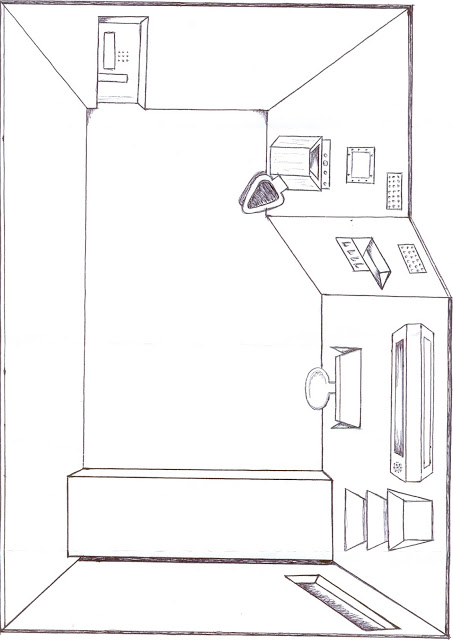
The image above was drawn by Katherine Fontaine, a San Francisco based architect, prison-questioner, friend to all, and book-art-space-collective co-runner.
“There are very few pictures of SHUs. The last drawing that was found at the Freedom Archives in San Francisco was from when Reagan was the Governor of California,” says Fontaine.
With solitary confinement, such a hot news topic, Fontaine was compelled to sketch when she realised there were very few images of solitary cells in circulation.
“I was given the few photos that exist from other similar prisons and a diagram that was used in a previous court case drawn by a prisoner while in an SHU at Pelican Bay. The drawing is what I came up with from the materials I was given,” explains Fontaine who hopes her drawing of a Pelican Bay State Prison Secure Housing Unit (SHU) will be used — in media materials and campaigns — by any organizations protesting solitary confinement.
Fontaine’s commitment to make reliable sketches of prison spaces and apparatus was spurred by a chance encounter with some fellow professionals in an unlikely place. She was among a crowd outside the Central California Women’s Facility protesting overcrowding inside the prison.
Fontaine noticed a person within the crowd with a sign that read ‘Architects Against Overcrowding In Prisons.’ On the back of the sign was www.ADPSR.org. The acronym stands for Architects, Designers and Planners for Social Responsibility. Despite her day job as an architect, ADPSR was not a group with whom she was familiar. Upon reading the statement for the Prison Alternatives Initiative, one of ADPSR’s projects, Fontaine was all-in.
ADPSR state:
“Our prison system is both a devastating moral blight on our society and an overwhelming economic burden on our tax dollars, taking away much needed resources from schools, health care and affordable housing. The prison system is corrupting our society and making us more threatened, rather than protecting us as its proponents claim. It is a system built on fear, racism, and the exploitation of poverty. Our current prison system has no place in a society that aspires to liberty, justice, and equality for all. As architects, we are responsible for one of the most expensive parts of the prison system, the construction of new prison buildings. Almost all of us would rather be using our professional skills to design positive social institutions such as universities or playgrounds, but these institutions lack funding because of spending on prisons. If we would rather design schools and community centers, we must stop building prisons.”
Fontaine’s sketches will regularly appear in Actually People Quarterly, partly to inform as partly as a means to focus her thoughts.
“People need to see them,” she says. “Also it was such a powerful thing for me to draw that SHU cell. I wonder if anyone else can have a similar feeling just by looking at it or if I just feel so changed by it because I drew it. Maybe it is because I’ve spent years of my life drawing, studying, measuring and designing spaces that in actually creating that image I imagined that actual space so much more clearly than I had before? To imagine being an architect and *designing* that space is incomprehensible to me.”
Incidentally, ADPSR was recently featured on the excellent podcast 99% Invisible in an episode called An Architect’s Code, following mainly the activities of Raphael Sperry, ADPSR’s founder.
Below is Fontaine’s sketch of cage used routinely within the California prison system. The cages are sometimes to hold prisoners during transfer between units but, increasingly, used for group *therapy* — an oxymoron if there ever was one.

I’d also like to take this opportunity to share the work of some other determined prison sketchers, some of whom are prisoners.
From the website, Solitary Watch:
One of the most prolific and talented artists in solitary is 60-year-old Thomas Silverstein, who has been in extreme isolation in the federal prison system under a “no human contact” order for going on 30 years. (He describes the experience here.) His artwork appears on this site. It includes meticulously detailed drawings of some of the cells he has occupied, including one pictured below, which is designed (with built-in shower and remote-controlled door to an exercise yard) so that he never has to leave it or encounter anyone at all.

Next is this cell in Ohio, drawn by prisoner Greg Curry.
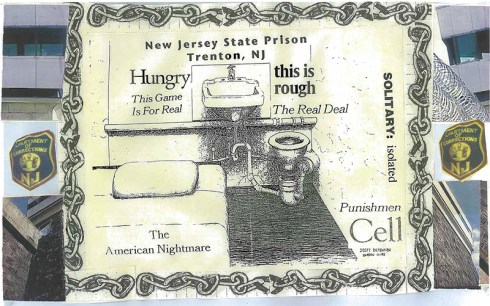
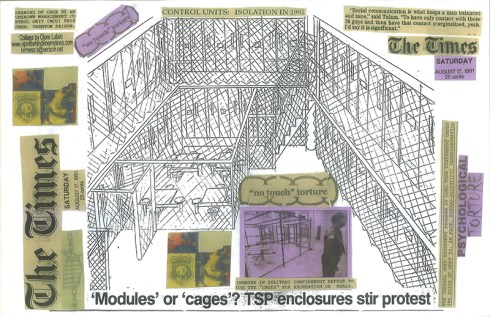
And finally, Ojore Lutalo has made some of the most politically charged prison art I’ve ever seen. Below, an isolation cell, and very below, Control Units, 1992.
When depicting prisons and their abuses there is no hierarchy of medium; sketches, photos, videos and oral testimony conspire to deliver a fuller picture. I will say though that these narrative rich drawings are more powerful than many photographs I come across.

If you’re strolling around the centre of Charlottesville these next few days and peep a red newspaper box, reach inside and grab yourself a copy of the free paper within.
Accompanying his exhibition of Some Other Places We’ve Missed at The Bridge: Progressive Arts Initiative in Charlottesville, artist Mark Strandquist has created eight pages of photos, activist resources and a call to engage.
I have a vested interest in promoting this newspaper. For it, I wrote an editorial about the history of — and imperative of — photographers and artists working in American prisons. It is reproduced in full below.
Even if I wasn’t personally involved, I’d still be singing the praises of Mark’s work – I’ve posted about Some Other Places We’ve Missed before and I am including the work in a prison photography show next year. When Mark and I chatted about the exhibition of Some Other Places We’ve Missed, we got all giddy about the fact that his show is outside of the official LOOK3 program, and yet he is able to grab some mindshare among the throng of photobodies in Charlottesville this week.

© Mark Strandquist. A photograph made of a scene described by an incarcerated male.
ART AND SOCIAL ENGAGEMENT
For the longest time, photojournalism and documentary work has pursued common good, reliable information, hidden stories and social change. At least, that’s the ideal. With guests such as Susan Meiselas and Martha Rosler, and with Koudelka’s exhibit, the LOOK3 schedule looks serious and seriously good.
Mark and I are huge fans of this year’s LOOK3 line up, but LOOK3 remains a big festival where the cucumber martinis flow like wine and big name photographers will hold court in Charlottesville town center. Festivals are about learning, meeting and sometimes brown-nosing … and, for that, we love them. Everyone leaves photography festivals feeling connected and re-energised and that’s how it should be. But, there’s more.
Some Other Places We’ve Missed asks us to think about image-making in slightly different ways. Not everyone can produce a 20 foot tall Nat Geo vinyl banner, but everyone can have the type of intimate conversations on which Some Other Places We’ve Missed is based. Of course, I am biased because Mark is having conversations with American prisoners and I think there’s rehabilitative value in that.
I’ll stop prattling on now and just say if your interest is piqued then you should attend the panel talk More than A Witness – Photography as Social Engagement on June 15, 2pm – 3:30pm. Speakers are David Levi Strauss, Chair of Critical Studies at the School of Visual Arts, Edgar Endress of Floating Lab Collective, Yukiko Yamagata of the Open Society Foundation, and Matthew Slaats, Executive Director of the Bridge. They’ll discuss how art facilitates dialogue and can be used to reach out to new subjects and engage broader audiences. Find out more on Facebook here.
Mark has programmed a busy schedule of events at The Bridge including a poetry reading and discussion between gallery-goers and prisoners via a direct feed from a local jail. Full details on The Bridge website.
[Scroll down for my newspaper editorial.]

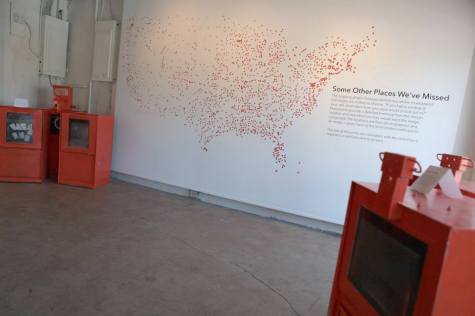
Installation shot of Some Other Places We’ve Missed, opening night at The Bridge, Charlottesville, VA.
EDITORIAL: DRAWING ON MEMORY, WORKSHOP GETS PRISONERS AND PUBLICS THINKING ABOUT PHOTOGRAPHY, STORY AND HIDDEN SPACE
In the 1970s, a purple barge floated up and down the Hudson River in New York state. Once moored, photographers emerged to teach workshops to communities traditionally outside of art circles; hospital patients, rural high-schoolers and — perhaps most remarkably — prisoners. The buoyant vessel with living and gallery spaces was operated by the Floating Foundation of Photography (FFP).
Not all New York State prisons are on the Hudson and so after initial offerings at Sing Sing, FFP ventured inland, eventually delivering photographic arts education in eight prisons. The majority of workshops were facilitated by founder Maggie Sherwood, her son Steve Schoen and a handful of close associates. But, the FFP enjoyed close ties with the New York arts scene and as such invited leading photographers in recent memory to deliver day-long workshops in the prisons – W. Eugene Smith, Arthur Tress, Mary Ellen Mark, Les Krims, Judy Dater, Lisette Model and Lee Witkin to name a few. The FFP mounted exhibitions of “outsider photography” on the anchored barge in Manhattan and in Central Park.
As one browses the images and stories within Some Other Places We’ve Missed, perhaps it is worth bearing in mind the history of arts education — and specifically the role of photography — in the rehabilitation of those locked up within our prisons and jails. The Floating Foundation represents a particular high point in this history; the access into prisons that it negotiated, the pedagogy it employed, and the optimism it eschewed stand out as extraordinary. These days, opportunities for arts education (with strong photographic components) in the prison industrial complex are rare. As such, projects such as Mark Strandquist’s deserve attention.
In the 1980s, mass incarceration began. In the past 35 years, the number of Americans locked up has more than quadrupled. The war on drugs, indeterminate and longer sentencing, broader definitions of criminal behaviour, the decimation of many safety-nets for society’s most vulnerable, and the politics of rhetoric and fear all contributed to the tumorous growth of America’s prisons. Even in states that entered a prison building boom, facilities were soon overcrowded. As costs soared, pressures mounted and efficiencies took priority, both the ability to provide — and belief in — the efficacy of education and arts to help in the rehabilitation of prisoners waned.
States previously provided high school and college education to prisoners as item lines on their budgets. These were scratched from budgets early, and when the Clinton administration revoked prisoners’ right to federally funded Pell Grants in 1994, the message was clear: prisons exist to incapacitate, not to rehabilitate. The majority of college level education provided in state prisons these days is administered by either earnest non-profits, University departments with social justice mandates, and sometimes the two in partnership. Prisons remain legally obliged to enroll prisoners without high-school diplomas into GED programs, but the success of students already alienated by public schooling often hampers success. To speak generally, it is the limited scope of — and limited opportunities for — education in prison that scupper advancement. To wright this ship, a huge shift in political will, informational (media) exchange and tax-payer attitude is required.
Prisoners are lining up to be part of this collective shift of consciousness. “Lucky” prisoners may live in state facilities close to a big city which can draw on volunteers to run programs previously provided by the state. Others find opportunities designed for successful reentry toward the end of their terms. But still, the majority of American prisoners have little to no voice and are for all intents and purposes invisible. Existing creative outlets include law libraries (although not in private prisons), pen-pal programs, and vocational work (prison factories remain because of the immediate profits they create), but these are programs that should exist for all and form merely first rung of the ladders to self-improvement and broadening of the mind.
Some Other Places We’ve Missed brings to us the voices, regrets, dreams and imagination of just a small number of men incarcerated in Richmond County Jail. Mark Strandquist provides us a bridge into their worlds. One needn’t share the political position of an artist to recognize the imperatives of a work or an action; intellectual curiosity and community engagement can saturate the entire political spectrum. Strandquist’s work is sadly exceptional, but it needn’t be. Perhaps, his tenacity is exceptional, but I believe it is within reach of us all. Whenever possible we should be thinking of ways that we can engage with our nation’s prison population. It is a population that has been strategically manipulated to the point of invisibility.
Cameras are a security tool for prison administrations, but in the hands of others are a security hazard. The ability to see, frame and witness life behind bars inherently involves power. In mugshots, in surveillance and in tightly-controlled visiting room digital portraits, prison authorities have a near monopoly on such power. Only rare and serendipitous moments (usually a sympathetic superintendent) give rise to an artist being permitted to use a camera in prison space — Robert Gumpert, Kristen Wilkins, Jenn Ackerman and Jeff Barnet-Winsby are a few examples.
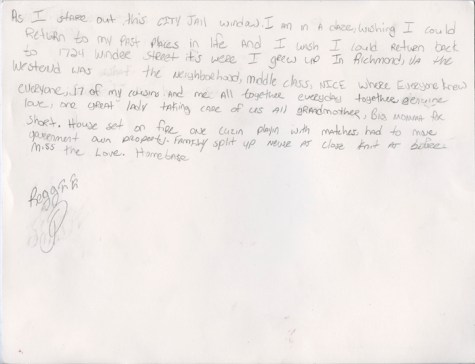
Strandquist navigated this potential barrier by conducting a photography workshop without any introduction of cameras into the classroom. His simple question, “If you had a window in your cell, what place from your past would it look out to?” acted as proxy to any release of the shutter. He asked students to think photographically. While the images are made by Strandquist beyond the prison walls, the essential discussions about memory, self-reflection, the power of photography and the comfort of the image all inform the project.
Through Strandquist’s photographs, we the public, are given an opportunity to connect with the incarcerated; their imagined windows become, momentarily, our window into their lives. But the 1/125th of a second needed to make a photograph is a perverse fraction of the months and years many spend imprisoned. Are the photographs enough? On their own, probably not. But the collaborative and educational core to the project is considerable. As audience, we should employ the same amount of imagination as Strandquist’s students and consider similar ways we can engage with incarcerated persons. There is every reason to think Strandquist’s methodology can be replicated in prisons and jails across the nation. With 2.3 million men, women and children behind bars Some Other Places We’ve Missed should also be a prompt for us to meditate on the millions of sights and experiences in American prisons that we never witness.

“The neighborhood was middle class, nice, where everyone knew everyone. One great lady taking care of us all – grandmother; Big Momma for short. The house set on fire when one cousin playing with matches. Had to move into government owned property. Family split up. Never as close as before. Miss the love. Home base.”
BIOGRAPHY
Mark Strandquist is a multi-media artist and curator based in Richmond, VA, who creates work that incorporates viewers as direct participants, features histories that are typically distorted or ignored, and blurs the boundary between artistic practice and social engagement. His work has been featured in various film festivals and independent galleries as well as a current exhibit at the Art Museum of Americas in Washington, DC. He is currently working on a BFA at Virginia Commonwealth University. He has a Tumblr.

14/38 (Not The Man I Once Was) © Amy Elkins, from the series Black Is The Day, Black Is The Night
Cruel and Unusual, the 2012 exhibition of photographs from prisons, co-curated by Hester Keijser and I is on the move.
Originally commissioned and debuted at Noorderlicht in the Netherlands [ 1, 2 & 3 ], Cruel and Unusual has since been to Amsterdam and Photoville in New York [ 1, 2 & 3 ].
In 2013, continuing its journey, Cruel and Unusual will travel to Sydney, Australia for the Reportage Photography Festival, May 24th – June 13th. It was selected by Photoville as one of three exhibits. To be shown alongside Russell Frederick’s Dying Breed: Photos of Bedford Stuyvesant and Bruce Gilden/Magnum Foundation’s No Place Like Home: Foreclosures in America.
As one presentation ends, another begins. Cruel and Unusual travels to the Sirius Art Center in Cobh, Ireland. On view from June 13th – July 22nd. Hester will be doing a talk at the reception on June 22nd at 2pm.
I’m really happy to see the exhibition live on, and grateful to those who are making it happen.
Special thanks to Peg Amison at Sirius Arts Center, to Sam Barzilay at Photoville, Olaf and the team at Noorderlicht for their ongoing support.

–
UPDATE, 05/14/2013: Harpers Books confirmed that the collection was bought by an individual at Paris Photo LA.
–
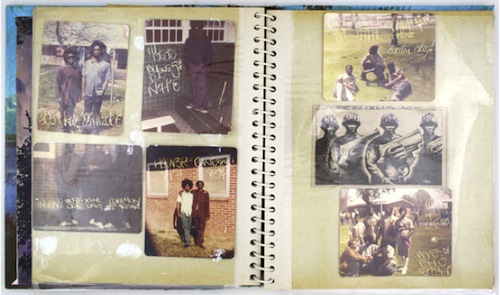
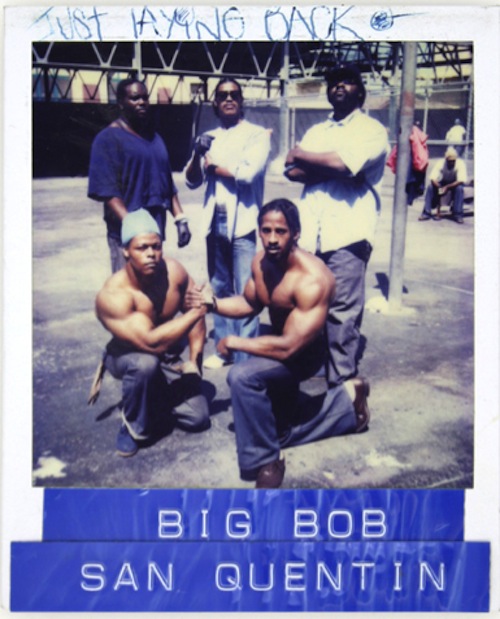
At Paris Photo: Los Angeles, this week, a collection of California prison polaroids were on display and up for sale. The asking price? $45,000.
The price-tag is remarkable, but so too is the collection’s journey from street fair obscurity to the prestigious international art fair. It is a journey that took only two years.
The seller at Paris Photo LA, Harper’s Books named the anonymous and previously unheard-of collection The Los Angeles Gang and Prison Photo Archive. Harper’s has since removed the item from its website, but you can view a cached version here. The removal of the item leads me too presume that it has sold. Whether that is the case or not, my intent here is not to speculate on the current price but on the trail of sales that landed the vernacular prison photos in a glass case for the eyes and consideration of the photo art world.

The Los Angeles Gang and Prison Photo Archive on display at Paris Photo LA in April, 2013.
FROM OBSCURITY TO COVETED FINE ART COMMODITY
In Spring 2012, I walked into Ampersand Gallery and Fine Books in NE Portland and introduced myself to owner Myles Haselhorst. Soon after hearing my interest in prison photographs, he mentioned a collection of prison polaroids from California he had recently acquired.
You guessed it. The same collection. Where did Myles acquire it and how did it get to Paris Photo LA?
“I bought the collection from a postcard dealer at the Portland Postcard Show, which at the time was in a gymnasium at the Oregon Army National Guard on NE 33rd,” says Haselhorst of the purchase in February, 2011.
As the postcard dealer trades at shows up and down the west coast, Haselhorst presumes that dealer had picked up the collection in Southern California.
Haselhorst paid a low four figure sum for the collection – which includes two photo albums and numerous loose snapshots totaling over 400 images.
“I thought the collection was both culturally and monetarily valuable,” says Haselhorst. “At the time, individual photos like these were selling on eBay for as much as $30 each, often times more. I bought them with the intention of possibly publishing a book or making an exhibition of some kind.”
Indeed, Haselhorst and I discussed sitting down with the polaroids, leafing through them, and beginning research. As I have noted before, prison polaroids are emerging online. I suspect this reflects a fraction of a fledgling market for contemporary prison snapshots. Not all dealers bother – or need to bother – scanning their sale items.
Haselhorst and I were busy with other ventures and never made the appointment to look over the material.
“In the end, I didn’t really know what I could add to the story,” says Haselhorst. “And, I didn’t want to exploit the images by publishing them.”
Another typical and lucrative way to exploit the images would have been to break up the collection and sell them as single lots through eBay or at fairs, but Haselhorst always thought more of the collection then the valuation he had estimated.
In January 2013, Haselhorst sold the collection in one lot to another Portland dealer, oddly enough, at the Printed Matter LA Art Book Fair.
“Ultimately, after sitting on them for more than two years, I decided they would be a perfect fit for the fair, not only because it was in LA, but also because the fair offers an unmatched cross section of visual printed matter. It was hard putting a price on the collection, but I sold them for a number well below the $45,000 mark,” he says.
Haselhorst made double the amount that he’d paid for them.
The second dealer, who purchased them from Haselhorst, quickly flipped the collection and sold it at the San Francisco Antiquarian Book Fair for an undisclosed number. The third buyer, also a dealer, had them priced at $25,000 at the recent New York Antiquarian Book Fair.
From these figures, we should estimate that Harper’s likely paid around $20,000 for the collection.
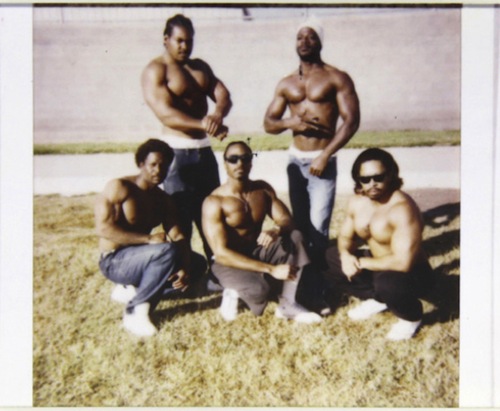


Harper’s Books’ brief description (and interpretation) of the collection reads:
Taken between 1977 and 1993. By far the largest vernacular archive of its kind we’ve seen, valuable for the insight it provides into Los Angeles gang, prison, and rap cultures. The first photo album contains 96 Polaroid photographs, many of which have been tagged (some in ink, others with the tag etched directly into the emulsion) by a wide swath of Los Angeles gang members. Most of the photos are of prisoners, with the majority of subjects flashing gang signs.
[…]
The second album has 44 photos and images from car magazines appropriated to make endpapers; the “frontispiece” image is of a late 30s-early 40s African-American woman, apparently the album-creator’s mother, captioned “Moms No. 1. With a Bullet for All Seasons.”
[…]
In addition, 170 loose color snapshots and 100 loose color Polaroids dating from 1977 through the early 1990s.
In my opinion, the little distinction Harper’s makes between gang culture and rap music culture is offensive. The two are not synonymous. This is an important and larger discussion, but not one to follow here in this article.
HOW SIGNIFICANT A COLLECTION IS THIS?
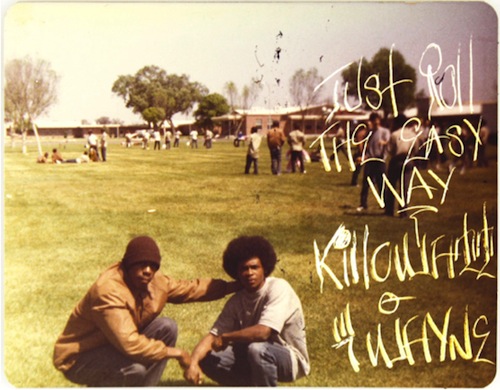
Harper’s is right on one thing. The newly named ‘Los Angeles Gang and Prison Photo Archive’ is a unique collection. Never before have I seen a collection this large. Visually, the text etched directly into the emulsion is a captivating feature of many of the polaroids.
We have seen plenty of vernacular prison photographs from the 19th and early to mid 20th century hit the market. Recently, a collection of 710 mugshots from the San Francisco Police Department made in the 1920’s sold twice within short-shrift. First for $2,150 in Portland, OR and then for $31,000 in New York just four months later! At the time of the sale, AntiqueTrader.com suggested it “may [have] set new record for album of vernacular photography.”
As a quick aside, and for the purposes of thinking out loud, might it be that polaroids that reference Southern California African American prison culture are – in the eyes of collectors and cultural-speculators – as exotic, distant and mysterious as sepia mugshots of last century? How does thirty years differ to one hundred when it comes to mythologising marginalised peoples? Does the elevation of gang ephemera from the gutter to traded high art mean anything? I argue, the market has found a ripe and right time to romanticise the mid-eighties and in particular real-life figures from the era that resemble the stereotypes of popular culture. It is in some ways a distasteful exploitation of people after-the-fact. Perhaps?



WHERE DOES THE $45,000 PRICE-TAG COME FROM?
Just because the so-called ‘Los Angeles Gang and Prison Photo Archive’ is rare, doesn’t mean similar collections do not exist, it may just mean they have not hit the market. This is, I argue, because no market exists … until now.
If the price tag seems crazy, it’s because it is. But consider this: one of the main guiding factors for valuations of art is previous sales of similar items. However, in the case of prison polaroids, there is no real discernible market. Harper’s is making the market, so they can name their price.
“All in all, it’s pretty crazy,” says Haselhorst, “especially when you think about how I bought it here in Portland over on 33rd, just a few miles from our gallery.”
All these details probably make up only the second chapter of this object’s biography. The first chapter was their making and ownership by the people in the photographs. Later chapters will be many. Time will tell whether later chapters will be attached to astronomical figures.
Harper’s suggests that rich “narrative arcs might be uncovered by careful research.” I agree. And these are importatn chapters to be written too.
I hope that more of these types of images with their narratives will emerge. If these types of vernacular prison images are to command larger and larger figures in the future, I hope that those who made them and are depiction therein make the sales and make the cash.


As it stands the speculation and rapid price increases, can be interpreted as easily as crass appropriation as it can connoisseurship. If these images deserve a $45,000 price tag, they deserve a vast amount of research to uncover the stories behind them. Who knows if the (presumed) new owner has the intent or access to the research resources required?
Along that same vein, here we identify a difference between the art market and the preservationists; between free trade capitalism and the efforts of museums, historians and academics; between those that trade rare items and those that are best equipped to do the research on rare items.
Whether speculative or accurate, the $45,000 price is way beyond the reach of museums. Photography and art dealers who are limber by comparison to large, immobile museums are working the front lines of preservation.
“Some might say that selling [images such as these] is exploitation, but a dealer’s willingness to monotize something like this is one form of cultural preservation,” argues Haselhorst. “If I had not been in a position to both see the collection’s significance and commodify it, albeit well below the final $45,000 mark, these photographs could have easily ended up in the trash.”
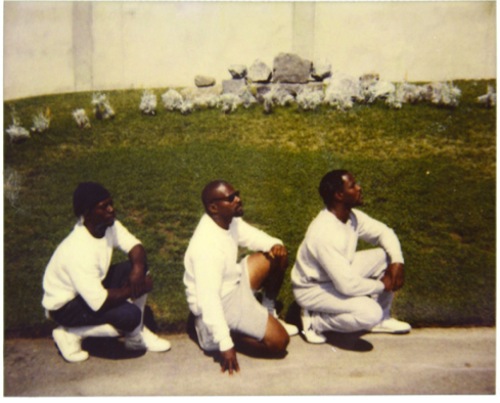

Loose Polaroids from the Los Angeles Gang and Prison Photo Archive as displayed by Harper’s Books at Paris Photo LA, Los Angeles, April, 2013.

A cover to one of the two albums that make up the Los Angeles Gang and Prison Photo Archive.

Found photo of an unknown prison cell.
Last week, I was interviewed twice – firstly, for DVAFOTO and secondly, for HERE BE MONSTERS – about Prison Photography On The Road and my activities since.
The DVAFOTO interview opens with my account of my arrest and 9 hours in jail in late 2011. The HBM podcast is about a workshop I delivered in Sing Sing State Prison, New York.
It may be ironic that I’d get locked-up during a research trip that is questioning incarceration, but it’s not funny and it’s no badge of honour. My actions were foolhardy and the police officer’s actions were over-zealous.
I’ve been thinking beyond what I think about the experience (It was stupid, bureaucratic and inconvenient), and more about how I think of the experience (What insight did I gain? What interactions did I have? Who did I meet?)
Inside the release-tank were about 15 men. They were there for different reasons. One young man faced a significant bail amount for a significant possession offense while another was brought in for cycling drunk in the wrong direction of the cycle path on a quiet road. Some men were in for DUI’s and in some cases not their first DUI. Two or three slept through the hours. Others were quiet and some told stories. The younger ones were more talkative and boastful. Several tried using the phone but only one succeeded. When they found out I was in for peeing on a tree and not answering questions they thought it was lame. Lame offense, lame arrest.
A tray of peanut butter sandwiches was brought in, but not enough. Some jumped on them, others weren’t interested. I think one person got two sandwiches.
Of the men with DUIs, I had little sympathy. They didn’t seem to acknowledge that their actions were potentially lethal. For a couple of them, cash-fines, points on their licenses and driving bans didn’t seem to be much deterrent.
A few men seemed contrite. Others seemed beaten down with either addiction or repeated arrogance.
I had huge sympathy for the drunk cyclist. Maybe in this fifties. Grey hair. He thought he was getting out until the administration realised he was a parolee. The bike-ride proved a violation and he was to be automatically rearrested and jailed for a fixed term. He had a job and children. Because of a night of excess, he was to lose those things again. Sure, his behaviour could have been better, but I think the authority’s response was of excess.
I didn’t ask what they did and they didn’t ask me. It was a small space. It was very dirty but not quite filthy. We only moved our place when others left and they did so in groups of 3 and 4 throughout the hours.
Part of me wishes I’d taken the opportunity to ask some questions, tap some opinions (I may have met a great conversationalist who’d improve my thinking as much as I hoped I might improve his). The other part of me knows only an intrusive nerd would be ask out-of-the-blue questions about personal circumstance and attitudes; especially in a temporarily-occupied cell at an unpredictable time.
No clocks.
Two weeks later: No court appearance. No charges brought.
Why is this relevant? The arrest and dismissal of charges — actually, the incomplete documentation of the arrest and dismissal — almost jeopardised my visit to Sing Sing to carry out a workshop with attentive, challenging, respectful and curious students of the education program there.
An arrest will always feature on a record, whether or not a conviction is brought, so-told me a law enforcement employee over the phone. New York Dept. Of Corrections which administers Sing Sing knew I’d been arrested but the information ceased there. I had to scramble for paperwork (that had not been given to me) to prove I had no criminal record. I wonder how much inefficiency and potential mistakes contribute to unfair and/or heightened levels of control. Frustration must be infinite in the prison industrial complex.
All in all, I’m glad I was able to teach and learn in Sing Sing and doubly happy that Jeff Emtman was able to craft a fine podcast splicing together audio of prisoners speaking, myself speaking, music and sound. Jeff conceived of the podcast titled The Other One Percent, to broadly challenge listeners to think about prisons and solutions.
The class, as a whole, discussed many images but specifically in the HBM audio, Robert Rose, Dennis Martinez, Deshawn Smalls and Jermaine Archer talk about these six images.
The first image mentioned is the one below by Brian Moss …

“Fear, I think people would think fear,” says Sing Sing prisoner, Robert Rose. “They can’t see what goes on in here, just as we can’t see much of what goes on out there.”
… then the three below by Alyse Emdur …
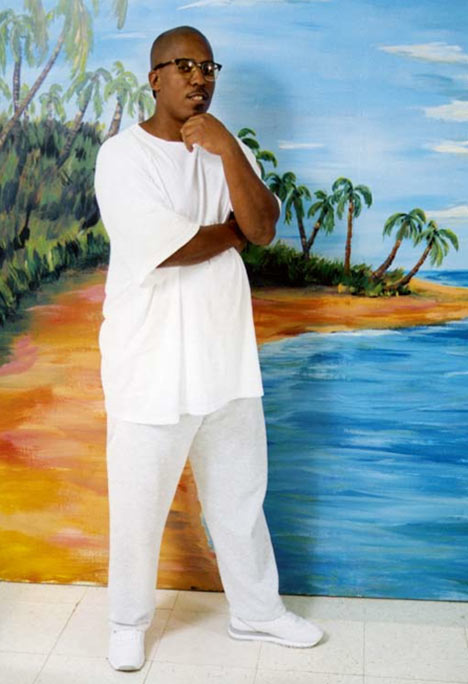

“Something needs to be said about the families who also do time. They are part of the narrative of mass incarceration, but they’re not talked about. They end up carrying the burden,” says Deshawn Smalls, Sing Sing prisoner.

… and finally, the two images below by Richard Ross of juvenile facilities.
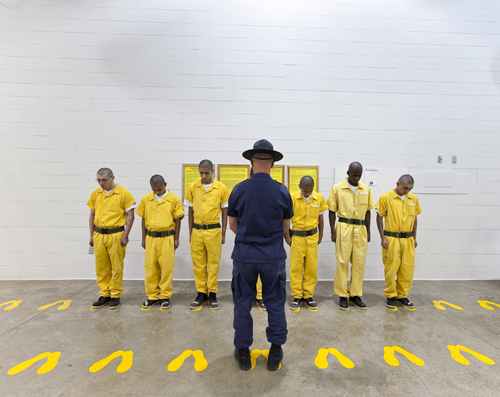
Sing Sing prisoner, Jeremy says, “You may have a man who refused [to adhere to regulations] and this is him in this picture. You probably won’t see the man at first, but he is there.”

HERE BE MONSTERS (HBM) is a podcast audio series about fear and the unknown, by Jeff Emtman, a 2012 Soundcloud Community Fellow.
HBM has previously covered Juggalo culture; placenta medicine; train-hopping; the disillusion and resignation of a favored NPR correspondent; a children’s book about a hallucinogenic trip; and the mind-made images created by the human brain when the body and the eyes experience total darkness – a condition known as ‘Prisoners Cinema.’
I like what Jeff is doing. I’m happy to share my experiences with him.
If you’re still interested in what I’m up to, I cover my immediate plans in the DVAFOTO interview. We also talk about what bloggers can do and do do.
LINKS
The Other One Percent (Here Be Monsters podcast)
Interview: Pete Brook On The Road (DVAFOTO)

© Mark Murrmann, from the series, Invitation To A Hanging.
Two very potent articles published in Guernica Magazine have impressed recently.
First up, Ann Neumann details the heavy-handed force-feeding procedures by prison staff in response to the longest ongoing hunger strike in America.
The Longest Hunger Strike: American courts recognize rights to refuse life-saving treatment. So why won’t the State of Connecticut let William Coleman die?
“Staff turned off the video camera typically used to record medical procedures. They strapped Coleman down at “four points” with seatbelt-like “therapeutic” restraints. Edward Blanchette, the internist and prison medical director at the time, pushed a thick, flexible tube up Coleman’s right nostril. Rubber scraped against cartilage and bone and drew blood. Coleman howled. As the tube snaked into his throat, it kinked, bringing the force of insertion onto the sharp edges of the bent tube. They thought he was resisting so they secured a wide mesh strap over his shoulders to keep him from moving. A nurse held his head. Blanchette finally realized that the tube had kinked and pulled it back out. He pushed a second tube up Coleman’s nose, down his throat, and into his stomach. Blanchette filled the tube with vanilla Ensure. Coleman’s nose bled. He gagged constantly against the tube. He puked. As they led him back to his cell, the cuffs of Coleman’s gray sweatshirt were soaked with snot, saliva, vomit, and blood.”
““I have been tortured,” he would say later. And it was enough to make Coleman start drinking fluids again. For a while. When he stopped a few months later, the prison force-fed him again, and twelve more times over the next two years. By last year they could no longer use Coleman’s right nostril. A broken nose in his youth and repeated insertion of the tube have made it too sensitive.”
– – – – – – – – – – – – –
Secondly, S.J. Culver writes about his discomfort visiting Alcatraz, discussing the problems that plague all sites of dark tourism.
Escape to Alcatraz: Notes on prison tourism.
“Alcatraz Island, understandably, does not bill itself as a place to spend twenty-eight dollars to get really depressed about a country’s piss-poor priorities regarding human rights. […] I begin to think that, if the point of an authentic tourism experience (if such a thing exists) is to understand another condition closely, the Alcatraz cellhouse tour fails. The punishing repetitiveness of incarceration is utterly absent in the carefully paced rise and fall of the yarns on the recorded tour. Worse, there’s no mention of how the Alcatraz cellblock, with its dioramas meticulously re-creating midcentury prison life, might resemble or not resemble a contemporary working U.S. prison. Plenty of the visitors around me seem to think they are witnessing “real” incarceration. I sense my initial impression had more truth than I realized; what we’re taking in is closer to a film set than to county lockup.”
The gulf between the realities of prison life and museum prison narratives are sometimes more pronounced than the differences between the realities of prison life and photographs of prisons in the media.
– – – – – – – – – – – – – – – – – – – – – – – – – – – – –
While we’re on the topic of prison museums, a mention of Mark Murrmann‘s photographs of Invitation To A Hanging is long overdue. You might know Murrmann as the kick-ass photographer of punk. He is also the very kind and engaged photo editor at Mother Jones.
‘Prison museums?’ I hear you say. There’s more than you think.
Prison museums and dark tourism on Prison Photography
19th Century Museum Prison Ships
Roger Cremers: Auschwitz Tourist Photography
Daniel and Geo Fuchs’ STASI – Secret Rooms
Steve Davis visits the Old Montana Prison
Hohenschönhausen, Berlin: Stasi Prison Polaroids
Philipp Lohöfener at the Stasi Prison Museum, Berlin
San Pedro Prison, Bolivia: As the Tourists, Dollars and Snapshots End the Riots Begin
– – – – – – – – – – – – – – – – – – – – – – – – – – – – –
Thanks to Bob for the tip.

Barack Obama is TIME’s Person Of The Year. The accolade is less interesting than Obama’s words in the TIME interview. The President of the United States talks about criminal justice and prison reform. Obama says,
“There’s a big chunk of that prison population, a great huge chunk of our criminal-justice system, that is involved in nonviolent crimes. I think we have to figure out what are we doing right to make sure that that downward trend in violence continues, but also, there are millions of lives out there that are being destroyed or distorted because we haven’t fully thought through our process.”
Granted it takes until the fifth page (of five) until we get to criminal justice issues. But, still. I’m going to say ‘wow’.
In November, I half-wrote a blog post about the complete absence of talk about criminal justice policy during the presidential debates. It never published; the details were more depressing than the simple fact. These words by Obama in some way make up for that. Watch this space. Watch Obama’s team.
via Prison Policy Initiative.

 Prison Photography