Dana Ullman, a Brooklyn-based photographer, has in recent years traveled back-and-forth to California; to Los Angeles’ Skid Row, to San Francisco’s Tenderloin, and to the San Joaquin Valley. The series’ title Another Kind Of Prison references the fact that many hardships of prison continue post-release and, furthermore, new challenges emerge. Ullman followed several women as they left prison and readjusted to life on the outside. For Ullman, the choice to go to California was logical.

“California is home to the world’s two largest women prisons and has an annual corrections budget of 10 billion dollars, the highest in the country, yet has limited reentry programs,” she says. “In California, there are about 12,000 women on parole. Unprepared once on parole, without money, housing or resources, institutionalized and isolated, these women find it difficult to regain hold of their lives.”

Over the past 15 years, the number of incarcerated women in prison increased by 203%, as compared to 77% for men. With such a rapid increase in prison populations, services within prisons have inevitably suffered. Ullman reports a lack of training, preparation and rehabilitation for the women she photographed.

Ullman is also keen to emphasize the common factors particular to female prisoners.

“62% of women in prison have children under 18. Many suffer from mental illness and have histories of sexual and physical abuse – 73% of women in prison have symptoms or are diagnosed with a mental illness compared to 55% of men in prison. 65% of women in state prisons are incarcerated for nonviolent drug, property, or public order offenses. Nearly one in three reported committing their offense to support a drug addiction. Many are battered women serving time for crimes related to their abuse,” Ullman writes.

But it’s not all doom and gloom. Ullman wants to communicate the strength of the women who – at a particularly difficult junctures in life – have kindly let her into their lives.

“While some women have had difficult transitions, others have become inspirational community leaders – I want to show both sides in an effort to break stigma associated with incarceration.”

Dana Ullman and I share a belief that prisons are increasingly defining our society and economy.

Another Kind Of Prison is more important then ever in exploring new strategies to better address the complex needs of present and former women prisoners who are often left out of the conversation,” says Ullman. “These stories, the needs and dreams of each woman in their own voice, illuminate the ‘revolving door’ created by poor public policies and lives fragmented by ignorance, poverty and by years, even lifetimes, of abuse. They will also help the public understand who these women are.”

Scroll down for a brief Q&A and a dozen more images. All images and captions by Dana Ullman.

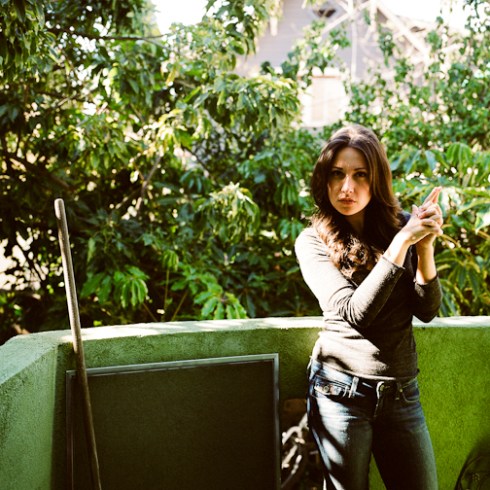
Top image: LaKeisha Burton, 38, a poet and reentry advocate, was convicted as an adult at the age of 15. Ms. Burton served 17 and a half years in prison for shooting a gun into a crowd at the age of 15. She was convicted as an adult for attempted murder and received life plus 9 years. No one was killed or injured. The victim (with whom LaKeisha reconciled while both were serving time in prison), who killed someone, was released from CIW after 9 years. LaKeisha’s story represents the beginning of the disturbing increase in juveniles being tried as adults when many are completely capable of rehabilitation.

Above: On any given day women are paroled in California with a box of personal items, $200 or less in “gate money” and a bus ticket to Skid Row. Unprepared once out on parole, with no income, housing or resources, institutionalized and isolated, many women find it difficult to regain hold of their lives independently.

Q & A

Prison Photography (PP): Clearly the success of a former-prisoner reentering society has a lot to do with their experience while locked up, but I feel in the past – for most people – dialogue about prison reform issues have been lumped in with dialogues about re-entry issues. That is to the detriment of both. It does seem though that, recently, re-entry has been recognised as its own vital step with its own set of issues to be explored. I’m thinking here of Convictions, Gabriela Bulisova’s excellent work in Washington D.C. and the forthcoming VII Photo’s documentary project and partnership with Think Outside The Cell.

Dana Ullman (DU): I am aware, too, of the increased focus on reentry [in photography] that really wasn’t there a few years ago. It is a difficult, complex and fragile issue to document because there are so many factors that lead to former prisoners’ success and failure, especially depending on where they live.

I am really happy to see Another Kind Of Prison getting some light because reentry is where one sees the emergence of all the issues that were not addressed while serving time, the societal factors that underline much of the mass incarceration today – sheer poverty, histories of abuse, racism and mental health. Once men and women are locked up and out of society, they are simplistically labeled “criminals” and the stigmas attached to poverty, abuse, race, mental health and crime are once again enforced.

PP: What are your hopes for the work?

DU: I envision, with some support, that Another Kind Of Prison will travel as an exhibition in community spaces such as libraries or ideally in county jails/state prisons where so many of these women (with very little support) are planning their release. There is one woman I interviewed who had no plan for even a place to sleep the night she got out. It was a random TV show featuring a transitional house that she saw one night, not her parole officer or a reentry prep class, that connected her to where she is now living. Women outside can really speak to those inside about their experiences. I have been making audio recordings of each woman’s story. I want the project to create a forum for discussion, rather than merely point out the problem.

PP: What’s next?

DU: I am not done with the project by any stretch. Documentary photography is tricky (and I am not a master of it by any means). I am following several, very fragile lives over time and waiting patiently for that “visual” moment that doesn’t always come. There is also so so much more I could do with some kind of funding, but that has been difficult, so I have to work with what I can. So for now, I hope to increase awareness of this experience shared by thousands of women in the USA with the general public and keeping plugging away at it making the work stronger.

In San Francisco, I was working very closely with the California Coalition of Women Prisoners who have used my work to support their own causes. I was very happy about that because the CCWP do a lot of direct services and support for these women. In New York, I am expanding the project to look a young 28-year-old upstate woman’s reentry process after being incarcerated at the age of 14 to try and get a younger person’s perspective.

I am going to Uganda this Fall where I will be working with the organization African Prisons Project documenting women in prison. I’ll also be collecting stories of people incarcerated and indefinitely-detained for homosexuality (for which the highest penalty is death). My work is quite capable of being a cross-cultural look at women and prison.

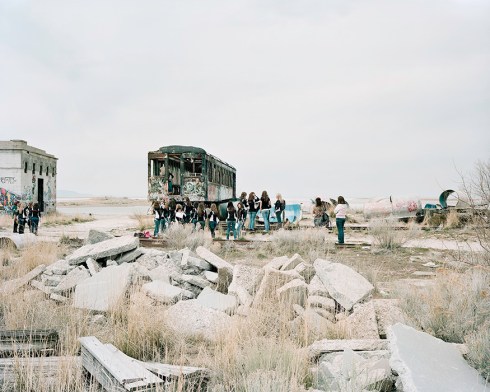
Central California Women’s Facility in Chowchilla, California is one of two of the largest women’s prisons in the world; the second, Valley State Prison, is directly across the street.
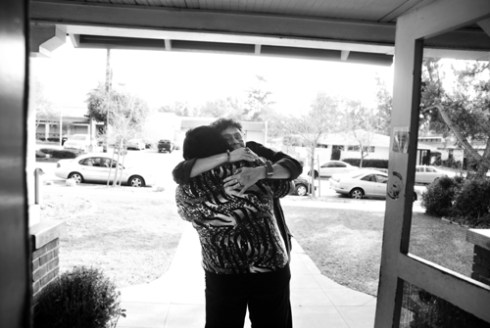
Mary Shields embraces a long-time friend and advocate one week after being released from Central California Women’s Facility. Mary served 19 years for a crime related to domestic violence.

Mary Shields a week after her release from Central California Women’s Facility laughs with a friend after she had trouble understanding how to use a cell phone, which were not widely used twenty years ago.

LaKeisha Burton performs a spoken word piece at Chuco’s Justice Center, which serves as a youth and community space in Inglewood, California. Today, LaKeisha shares her story through spoken word performances and is dedicated to working with at-risk youth susceptible to gangs and the same injustices as she once experienced.

LaKeisha watches a youth group perform at Chuco’s Justice Center in Los Angeles, California. With her infectious optimism and self-determination, LaKeisha Burton displays almost nothing of her past; she lives, works and dates, as any women like her. Yet, these things are exceptional for someone who had lost, some might say had stolen, nearly two decades of the most developmental period in one’s life and with very little preparation thrust out into society. Ms. Burton says when she was released it was as if she were still 15 going on 16.

In the United States over 1.5 million children have a parent who is incarcerated.* 75% of women in prison are mothers and over half have children under the age of 18. Many children suffer lasting emotional effects of a parent’s incarceration, which can affect all areas as they develop into adults.
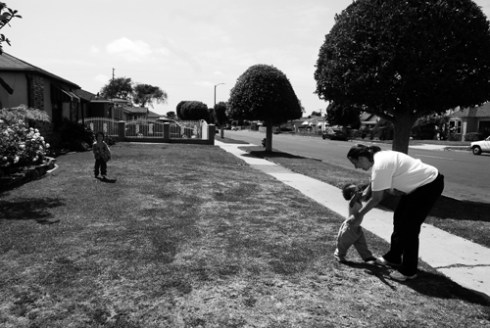
After cycling in and out of jail for crimes related to substance abuse, Jean Waldroup, 39, has found “home” at A New Way of Life, a transitional home for formerly incarcerated women that emphasizes keeping mothers and children together. For the last six months, Jean has maintained both her sobriety and role as mother to her son and daughter. Jean is the primary parent and she maintains a relationship with the children’s father.

A New Way of Life purchases homes in residential neighborhoods, giving a quieter, less institutional environment for families to rebuild relationships that may show signs of wear and tear after experiencing incarceration. Community-based organizations like A New Way of Life operate mostly under the radar with few resources and little public recognition despite their critical role in offering rehabilitation, family reunification and successful reentry.

Following her release, and to give her life structure, Molly volunteers to make lunch for clients at the behavioral health clinic she attends in San Francisco. Molly stills battles with drug addiction.
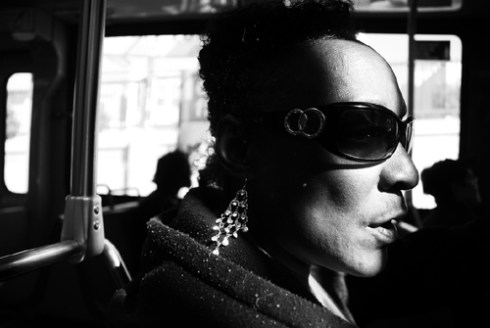
Molly on the bus. To avoid the caustic environment bubbling outside her building, Molly will ride Muni lines between Bayview-Hunter’s Point and Downtown San Francisco for hours. She tends to hide from nouns, that is people, places, and things. Molly’s mental health and substance abuse maintain instability and isolation in her life, some days are good, others hard.

A friend embraces Molly at a local community center.

Molly’s room at the Empress Hotel in San Francisco’s Tenderloin district. The first stable living she has had since the cycle of incarceration began in her life.

– – – –

*The advocacy group Children of Promise estimates the number of U.S. children with incarcerated parents at 2.7 million.

– – – –

DANA ULLMAN

Dana Ullman grew up in Portland, Oregon. She studied photojournalism at the Danish School of Journalism and holds a B.A. in Journalism from San Francisco State University. Dana currently lives in New York City photographing assignments and personal projects.

A New Way of Life Reentry Project is a non-profit organization in South Central Los Angeles with a core mission to help women and girls break the cycle of entrapment in the criminal justice system and lead healthy and satisfying lives.

California Coalition for Women Prisoners (CCWP) is a grassroots social justice organization, with members inside and outside prison, that challenges the institutional violence imposed on women, transgender people, and communities of color by the prison industrial complex. CCWP prioritizes the leadership of the people, families, and communities most impacted in building this movement.

The African Prisons Project (APP) is a group of people passionately committed to improving access to healthcare, education, justice and community reintegration for male, female and juvenile prisoners in Africa.

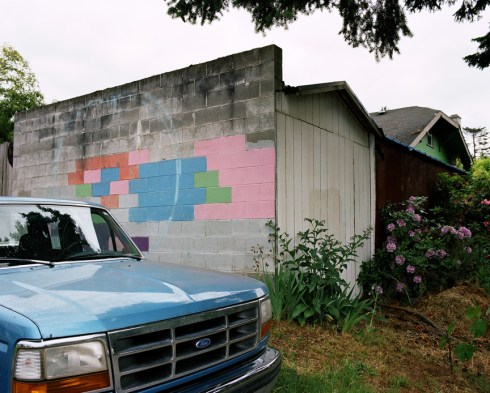
Continuing Eye on PDX, my weekly series about Portland-based photographers, I speak with Lisa Gidley. Featured here are photographs from across her many portfolios.

Prison Photography: How do you characterise the PDX photo scene?

Lisa Gidley: I only know some of the people doing photography in Portland. I know the folks in the photo groups Lightleak and the Portland Grid Project. Even in these groups, we all have different aesthetics and approaches – analog/digital, B&W/color, portraits/other scenes. What we have got in common is that we usually capture recognizable pieces of the real world.

Although I love lots of postmodern art, photography that’s been obviously Photoshopped isn’t my thing. I feel a pretty strong allegiance to the more realistic and unfiltered style of photography, and I’ve got excellent company in Lightleak and Grid. Plus, they’re all cool people and talented photographers who keep me on my toes. Our regular photo meetings motivate me to make some decent work each month, since I know they’ll all be bringing some terrific prints. It’s great to have a photo community that spurs you to keep shooting. Like sharks with cameras: shoot or die.

PP: An Instax photograph of yours was featured atop Joerg Colberg’s recent piece The Single Photograph. You’ve been using this “Polaroid equivalent” for some time and I’ve witnessed the joy of Faulkner Short, Blake Andrews, yourself and others when using this instant-film camera. You’re involved with instaxgratification, a Tumblr of Instax photos by Blake, Faulkner, yourself and others. What’s with the Instax Camera craze?
LG: I think the appeal is similar to that of genuine old Polaroids. Especially in this digital age, there’s a thrill to immediately having a cool little physical object that doesn’t exist anywhere else (at least until you scan it). Once you’ve taken a shot, that’s it: no cropping or color balancing or special effects added after the fact. That finality is nice. The prints are compelling to look at and to handle — they’re proportioned well and have a satisfying heft. Plus, the Fuji lenses are sharp, the color saturation’s good, and from what I can tell, the prints are fairly long-lasting. It’s a fun system.

PP: Why do you make photos?

LG: It’s a compulsion! I love looking at all sorts of photographs, and I love the challenge of trying to make photos I’d like to look at myself. With the type of photography I usually do — where I rove around different places and shoot whatever interesting scenes I come across — the main appeal is the thrill of the hunt. It’s fun to wander with a camera with no idea of what I’ll find, if anything. I typically shoot on film so it’s a few days of anticipation before I know if I’ve captured anything decent. Getting the developed film back is the best thing. After that, it’s also satisfying to make prints and share the images online and otherwise try to get my photos out into the world, but those activities are secondary to the process of shooting. I’m usually antsy to get back out again. There’s always something else to photograph.

PHOTOS OF NORWAY’S PRISONS: CONTEXT

Almost without exception, photographs of prisons in Norway featured in international media over the past two years have appeared below a headline featuring the word “luxury” or in simplified articles about the relative comfort of Norwegian prisons. The implication? That no criminals should live in safe, clean, environments and that rehabilitation is folly at best and an insulting waste of taxpayers money at worst.

I’d like to recommend a different take. Six of Fin Serck-Hanssen‘s photographs from Normalising Judgement appear throughout this post.

Serck-Hannsen’s view is neither expressly bleak nor expressly sugary. These drab prisons are nothing to get overly-emotive about and as such probably reflect fairly the predictable life in highly-managed institutions that try to redirect the most antisocial adult behaviours. As you click through to the links included herein, please refer back to Serck-Hanssen’s Normalising Judgement to challenge the “rosy” picture that may have been painted of Norway’s prisons in international media.

Completed in 2008, Serck-Hanssen’s Normalising Judgement pre-dates Breivik’s massacre. The Norwegian Ministry of Justice and Public Security was drafting a white paper, and invited Serck-Hanssen to document multiple prisons. As long as privacy was safeguarded and security was not put at risk, Serck-Hanssen was able to work freely throughout the prisons.

Serck-Hanssen told Mono blog, “In my view, Norwegians in general have the idea that prisons are very human institutions. I wanted to find out how much truth there was in this assumption.”

BREIVIK, MEDIA, ATTITUDES AT HOME AND ABROAD

When mass-murderer Anders Breivik was sentenced to 21 years in prison by a Norwegian court, it wasn’t at all clear to me how the verdict related to my efforts here at Prison Photography. The court ruled he was sane, yet I am quite happy to describe his ideas as repulsive and his actions as deranged. His offensive gestures and attitudes played out in the court reflected his right-wing islamophobic motives for the murder of 77 innocents on Utoya Island in July 2011.

Breivik has entered the select company of infamous and clearly unhinged murderers that history unfortunately seems to remember. Here at Prison Photography, my concerns are for the majority of American prisoners who are non-violent, poorly-educated, warehoused and given few opportunities to rehabilitate should they find themselves subject to the unusually long sentences the U.S. hands down. Breivik has zero in common with these men, women and children.

Somewhat surprisingly, there is commentary that is spurred by ideas and images about Breivik’s case and that relates to American prisons. Said commentary revolves around the issue of prison conditions. Namely, it centres on the divergent expectations of people in different nations on conditions for convicted criminals.

Even preceding Breivik’s horrendous crimes, there was a characterisation of Norwegian prisons as being “luxury” (the same characterisation/accusation has been aimed at the prisons of other European nations – Austria springs to mind). Sometimes, the term “humane” was used; a welcome alternative given that the term “luxury” often carries an inferred suspicion and jealousy.

In the week following the Utoya Island massacre, innumerable news sources ran stories about how Breivik would potentially serve his sentence in a “cushy” or “super-lux” or, closer to the truth, “progressive” prison.

As it is the highest security facility in the country, it was understandable that international media assumed that Breivik would be held in Norway’s recently constructed (2010) Halden Fengsel Prison. He is actually being held in Ila Prison, near Oslo (details; 14 photos; and the psychology of solitary).

CIVILITY OF PROCESS: CIVILITY OF PRISONS

Repeated slideshows often feigned dismay and disgust, or intended to stoke up anger. But it was an anger engineered for international audiences, not Norwegians. Norway was busy mourning, getting to grips with introspection and formalising the logistics to carry out one of the most high profile cases in its legal history. This isn’t to say that Norwegians didn’t feel anger, but they also knew they had to meet Breivik’s unparalleled assault with a dignified and civil response.

In the U.S., a country that routinely hands down the death penalty and Life Without Parole, Breivik’s sentence of 21 years seems comparatively tiny, even foolish.* Most American citizens would balk at the notion. And yet, when the verdict was passed, most Norwegian celebrated the fact that Norwegian law had handed down it’s most severe punishment and that the civility of the judicial system had remained in tact throughout despite the extreme heinous nature of Breivik’s crime (I only consumed news-stories on this event in the UK, so narratives may have differed elsewhere).

If societies are to learn and move forward from such horrendous events then they need something to rally around. In Norway, the humane and sensible legal system, in the response to acts of utter criminality, was an obvious ‘something.’ Americans can never rally around the death of someone sentenced to execution. Even in non-capital offenses, how proud can any U.S. citizen be of a legal system that has sentenced tens of millions to broken prison systems and is responsible for 2.3 million prisoners on any given day?

Prison (or the electric chair) shouldn’t be considered the final chapter. Prison should be considered an early chapter toward mending a broken individual and society’s shortcomings that led a given individual to transgress. Prison conditions are key in successfully rehabilitating individuals and successfully relieving society of future crime and the associated financial costs.

Dylan Matthews explains on the Washington Post’s Wonk Blog that Making prison worse doesn’t reduce crime. It increases it:

It turns out there’s a pretty extensive literature on the effects of harsh prison conditions. One finding that is growing more and more accepted is that harsh sentences, if anything, increase recidivism. […] Gerald Gaes and Scott Camp found that higher security levels increase recidivism by about 31 percent. Lawrence Bench and Terry Allen randomly assigned prisoners to medium and maximum security sectors of a prison and found that prisoners in maximum security were no less likely to commit in-prison offenses. […] Geographic isolation increases recidivism. A study from Rafael Di Tella and  Ernesto Schargrodsky found that people who are sentenced to house arrest with ankle monitors reoffend at a much lower rate than those sentence to traditional prison. And a wide array of studies have found that in-prison education programs reduce recidivism while improving quality of life. The findings on the effects of prison conditions on recidivism, in short, are a matter of scholarly consensus.

No prison is a cake walk. All prisoners deserve to be safe. I’d argue all prisoners should be as meaningfully engaged in rehabilitative activities and subject to civil attitudes as is possible. But, I also understand why the idea of retribution for some extends to a desire to see prisoners wallow in poor conditions. I hope I’ve made the case here that Norwegian prison are not luxury and that furthermore shouldn’t be the exception. Better prison conditions means less crime in the future. Better prison conditions means improved individuals.

* The maximum sentence possible under Norwegian law is 21 years, although in special circumstances, and Breivik’s certainly one, judges may extend the sentence as it nears an end.

– – –

All images Fin Serck-Hanssen. Get the book Normalizing Judgement here. Via here & now mono blog. Thanks to Robert Gumpert for the tip.

I first saw Julie Verdini‘s work in last month’s show DIALOGUEat Newspace curated by Laura Moya. On opening night, her print had a little red dot placed beneath it so Julie was grinning. Continuing my informal series, Eye on PDX, I asked Julie a few questions about her work.

What are better, humans or trees?

Trees are unrivaled in their ability to be silent and still. Without staring at a screen or being caught in deep R.E.M. sleep, humans have difficulty remaining aware and immobile. Trees’ receptivity make them a welcomed ally for an artist; they mirror creative energy and I find them to be great company.

Humans however, are far superior at moving, having distinct personalities and drinking spirits.

What are your influences?

The landscape influences me mostly. I definitely pay tribute to the new topographic movement and William Jenkins‘ idea of “stylistic anonymity.” I think its interesting that when this type of work was initially shown, many devalued its artistic merit. I appreciate how freeing the medium from stylistic implications allows for subtlety and historical perspective. I find nature to be so visually dramatic, photographically speaking, that I just try to get out of its way.

The habit of documenting typologies has always been inherent to my photography practice. Bernd and Hilla Becher are fine tuned examples of this technique mastered. Finding patterns and making connections exercises your visual thinking in such a playful way; it’s like being four years old perpetually. I appreciate how typologies can starkly document yet carry a whole set of theoretical implications about the human race.

I am influenced by Werner Herzog in part because my background is film-making. With environmental consciousness on the rise we frequently see portrayals of nature as victim to human destruction. Herzog speaks so bluntly about the vileness, disorder, chaos and “overwhelming murder” within nature during his time in the Amazon. The idea that nature is an unstoppable force that will prevail, long after our species has perished is one I find my camera seeking. I think that when you work with the landscape their is always a dialogue of the destroyer versus the destroyed. I find that some of my images speak critically of man’s relationship to nature while others come across as symbiotic or even idealistic. So the narrative comes from the environment itself, from each situation.

How do you characterize the photo scene in Portland?

Interested and open. Having lived here many years, the town is small enough to recognize names and faces. My personal experience points to the opportunities for education (Newspace, NCP, ASMP). But, my view could be slanted since I teach and am constantly thinking and talking about photography in an educational context.

Fine art opportunities exist here for certain (albeit through a very limited amount of top-notch organizations and galleries).  However, I often feel I operate as a satellite and only occasionally cross paths with other fine art photographers. I would be interested to see opportunities for community growth beyond classes and occasional shows. However, I may not be the best person to asses the pulse of any social scene — after all, I am most often found in a cluster of trees rather than a crowd of humans.

– – – – – – – – – – –

Eye on PDX is a continuing, weekly series that features images and brief statements by photographers currently living in Portland, OR.

Zachary Allen moved to Portland more recently than I, which is recent indeed. I knew of his work and I was aware he had studied with Ian Van Coller in Bozeman, Montana, and that Zachary had also assisted Ian in South Africa in 2010. When I found out he was here in PDX I didn’t hesitate to contact him and grab a coffee.

In some ways, Zachary’s work is difficult to feature because much of his work is in-process; he stresses that Roseland (my personal favourite of his portfolios) is a twenty year project! Roseland is about land-use and residential planning in Virginia.

Still, I asked Zachary to pull together some images and pen a quote to introduce himself to the Portland photo scene.

Zachary:

“Over the last couple of years I’ve been making photographs documenting my trips into the landscape. I’ve been attempting to stay away from a strict theme based project, which seems like the only acceptable form of photography these days. I kinda ended up with a bunch of mini projects at the end of three years. These mini projects explore several themes, such as nests, town relocations, and the intersection of nature and human influence, but the main thread has been the idea of being a “photographer” in the field. I’m interested in how we as photographers approach the landscape and interact with it. The photos from In The Field explore both my personal outings into the landscape and trips I have accompanied other photographers on. I think there is something really interesting when several people go out into the field just to have a look.”

Zachary Allen is a photographer, printmaker, and educator currently based in Portland, OR. He can be contacted on zachary@zacharysallen.com. Follow his work: Twitter,  Book Experiments, and Broken Spine, a Tumblr exploring artists’ books.

– – – – – – – – – – –

Eye on PDX is a continuing, weekly series that features images and brief statements by photographers currently living in Portland, OR.

UPDATED: SEPT 4TH 2012. 9AM BST

A week after this blog post went to press, the Prison Reform Trust reported that 77 of the 131 prisons in England and Wales held more inmates than stated capacity.

London’s HMP Wandsworth, which is one of the the three prisons in Elphick’s photographs, is the seventh most overcrowded prison in the UK with 1,191 men being held in a facility only designed for 730 men. Wandsworth operates at 163% capacity.

In total, UK prisons hold 7,300 persons more than they were designed for.

– – – – – –

Hugh Elphick is a young British photographer who, in early 2011, took a cool and curious look at London prisons for his undergraduate photography BFA. The series is Inside.

“I wanted to produce images which intrigued more than shocked,” says Elphick. “I discovered how much prisons actually blend into their surroundings and used this blurring the boundaries, with some of the angles I shot.”

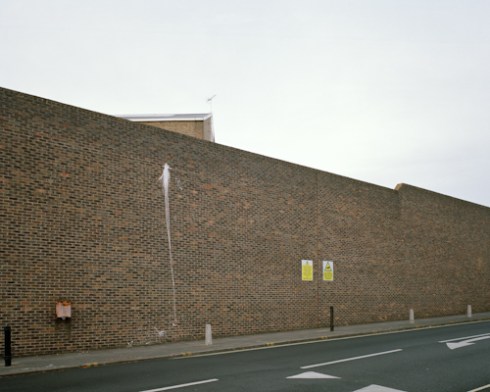
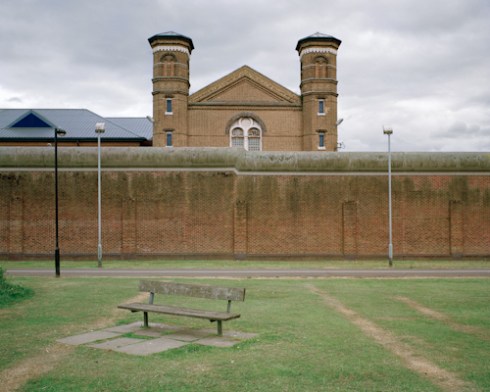
In the series of six photos, Elphick shows us the red-brick exteriors of three prisons – Pentonville, Wandsworth and Wormwood Scrubs. Elphick was working close to Wormwood Scrubs and began to wonder about human rights, the acceptability of the prison system, and if prisons work.

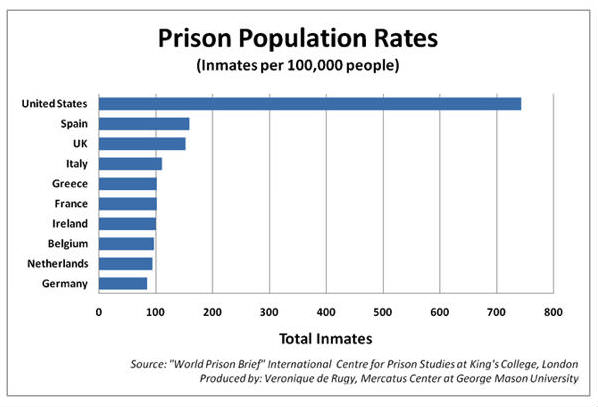
“In England, it is not a commonly known fact [that the UK has the second highest rate of incarceration after the U.S. among industrialised nations] and that it is not something that most people worry about,” says Elphick. “It could be argued that there is more concern that prison sentences are not long enough or that there are moral disparities in sentencing. However, this is not to say that there are not a large proportion of people who see the wider picture.”

Elphick’s focus specifically is about the age of these *famous* Victorian prisons. The Victorian era is steeped in imagery of inequality, squalor and hardship for the working classes. For Elphick, there are points of comparison between the class-stratified 19th century and the inequalities of the modern era and especially today in a time of austerity and cuts in services.

“Victorian architecture offers an allegoric association with harsh systems and possibly with periods such as the late 70 early 80’s economic downturn. Such institutional auras, I believe, explore some of the dilemmas and imbalances of our society,” says Elphick. “These prisons show how little progression there has been in the prison system due to confused government policies.”

Much like the approach of German photographer Christiane Feser, Elphick’s interest is in how these large, alien institutions interact visually with nearby residential communities. Unlike in the U.S., the economic fortunes of the nearby communities in the UK are not tied directly to or dependent upon the operation of a prison. These UK prisons are part of the urban puzzle but quite opposite to the prison-towns of central Wyoming or eastern Washington, which come to rely on jobs as traditional agriculture and industry wane. There is not the same attrition and competition in the job market in central London. Prisons in the UK are not perceived of as big business, partly because by comparison to the bloated U.S. prison system, it isn’t.

In fact, Elphick argues that prisons have almost become mundane in UK cities. He writes in his artist statement:

“The fragmentary nature of London’s development, and its destruction in WW2, have meant a breadth of architectural forms have spread into areas surrounding the prisons. The prisons no longer stand as the monolithic symbols of suffering they once did, and have melted into the architecture of our city. They are taken for granted, dismissed”

This is a peculiar paradox to deal with in images; subjects hidden in plain sight.

“I set out to make a graphic and symmetrical set of images and fortunately there were features which allowed me to do this and at the same time inject some curiosity such as the splash of paint, bench or repaired hole,” says Elphick. “The walls are rigid and literal boundaries which can be translated metaphorically and ironically in many ways to question the justice system and inequalities in society.”

– – – –

Inside was exhibited in the three-person show Behind Bars at One & A Half Gallery, London in September, 2011.

© Julia Ziegler-Haynes

There are many photography projects that image the last meals of America’s executed. Here’s the pile. Here’s Julia Ziegler-Haynes’ photographs.

Thanks to David Naugle for the tip.

‘Steph’ © Tony Foushe

There’s two things I hope you’ll carry away from this post. Firstly, the importance of Live Through This a photo series resulting from a-two year collaboration between Tony Fouhse and Stephanie. Secondly, that Tony has established  Straylight Press to get limited-edition books and zines in the hands of photo-lovers. Live Through This is Straylight’s first publication.

To regular readers, Tony Fouhse will not be a new name. I’ve always admired Tony’s honest, weekly updates about his ongoing work, emotions and process. In my capacity as a Wired.com blogger, I recommended his blog drool as a top read.

LIVE THROUGH THIS

Four years ago, Tony began shooting USER, portraits of crack and heroin addicts on a single Ottawa city block. During that time, he met Stephanie, noticed something different about her, and asked, “Is there anything I can do to help?” She said she wanted help getting clean.

From that point it’s a long story of great-strides, trauma, dope sickness, humour, sunlight and friendship. Often photographers may distance themselves from the world by saying they’re mere observers. In the case of photojournalism, so-called objectivity sometimes excuses camera-persons from getting involved in even small practical ways to help those they photograph.

Tony is not a photojournalist and he is no hero either; he’s a guy that offered to help someone whose needs were greater than most. If you want to venture into the drool archives, Tony has told the story in great detail. Alternatively, Tony wrote a five-part series about his and Steph’s journey for the ever-excellent NPAC blog [one, two, three, four, five].

In December, Steph had a wobble and ended up in jail. In January, when I read Steph’s words about her court hearing it was clear that Tony has had a life-changing effect on her life:

When I went to Halifax I sat in front of the judge and the crown was asking for 4-6 months and my lawyer asked for probation and sure enough I got it. Then, when I went to Pictou courts my lawyer asked for 6 months house arrest and he got it too […] if it wasn’t for my lawyer in Halifax I would of been fucked.

 He fought for me to do house arrest because I did so much in the last year, like, he brought up how when I lived in Ottawa I met this man named Tony Fouhse was gonna help me get into a rehab called the R.O Royal Ottawa but I never came to the rehab because I ended up growing a cyst on my brain and how Tony ended up helping me ween from using Heroin to 1 4mg dillie (Dilaudid) a day and sent me home to my family where I could sober up and become a clean mom and we did a project of my life on the street.

It’s a bit embarrassing it’s taken me six months to share my wonder. As well as being photo-rich, Steph and Tony’s journey is a really compelling story. Live Through This is one of the most interesting photography projects I’ve followed in recent years.

STRAYLIGHT PRESS

Live Through This is all the more impressive because Tony and Steph have taken it upon themselves to promote, produce and distribute it. Tony describes Straylight Press as a “vehicle to produce and disseminate printed photo matter.”

Future projects include the unflinching work of Scot Sothern and Brett Gundlock’s Prisoners (which I saluted in the past) so it is exciting times. The idea is that the success of one project feeds the next, so if enough copies of Live Through This sell then profits go into producing the next photographer’s book. It’s a pre-sales fundraising model. In addition, Straylight zines are fairly inexpensive and the intent is to produce 3 or 4 each year.

“Straylight is kind of like a Kickstarter, but with more long-term commitment to projects that aren’t just my own,” says Tony. “Kickstarter projects, while a good and interesting idea, seem to me to be too much about the individual. Not that I have anything against that, after all, you need an ego to be a photographer. But …”

Last month, Tony talked with the Ottawa Citizen about Straylight: Tony Fouhse opens photo-book publishing house – and web gurus be damned.

Tony is flogging prints, books and workshops to raise money for Straylight projects.

Understandably, Tony is shifting his energies from his personal blog drool to the Straylight blog. Straylight is also on Facebook.

Good stuff.

EMAIL

prisonphotography [at] gmail [dot] com

Prison Photography Archives

Post Categories