
You are currently browsing the tag archive for the ‘Photography’ tag.
In photography Cornell Capa has huge renown. In prisons, Attica has a huge renown. It is therefore, expected that I’d transcribe Capa’s testimony to the McKay Commission (New York State Special Commission on Attica) Hearings.
After the text I shall offer my opinion.
TEXT
Cornell Capa: I was asked eventually by Arthur [Liman, Counsel] if I would want to look at Attica for the reasons that he mentioned, that photography and a photographer may have something to contribute …
As a human being and a photographer, my personal and professional and civic feeling was to look into it and – as my professional life is involved in understanding human condition – try to perceive what it is all about.
I think photography can serve a most useful role in an investigation and that’s exactly what I consented to do.
I [have] submitted 26 photographs which I will be showing to the commission and I have submitted equally a very short written statement and captions for the photographs.
I would like to really just read my written statement and following that as the photographs go by, I will do the captioning job for them.
At Attica: A Photographic Report.
Recently I spent three days at Attica, having been asked by the McKay commission to take a look at the institution and bring back my visual report.
During the visits to Attica I was, at all times, accompanied by a correction officer and a member of the Commission staff; all persons recognizable in these photographs consented to be photographed.
My photographs and their captions constitute my report for the commission. There is just a little more to add.
A feeling of nervous expectation seems to pervade Attica. Everybody is waiting the result of the work of the Commission’s investigations on the causes of the explosion which occurred there six months ago, and their recommendations for the future avoidance of such a tragedy in the future. Both sides, inmates and guards expect some new things to evolve from the findings – some kind of miracle which will transform the institution into a place where the Biblical lion and lamb will better live together peacefully.
The only hitch: each side has its very own view of the meaning of peaceful and better coexistence, and how to achieve it.
From the outside, Attica situated in the rolling farmland in western New York, has a Disneyland-like appearance, especially at night.
Attica’s inmates are all locked in their cells from approximately 5pm until 7am the next morning. Officers on the night shift make lonely rounds checking the count six times a night.
All movement in Attica is limited by locks. At night the duty officer must carry with him all the keys he will need on his nightly round of inspection
Confined to their 4 x 9 cells, inmates may talk to one another across the cellblocks and play music instruments until 8pm.
Locked in a cell a mirror is an inmates eyes to the rest of his gallery, and whenever something happens, the mirrors appear as if on cue.
After 8pm talking and noise are not permitted. There is little to do until lights out at 11pm except read, write letters or listen to one of the three channels of the prison radio which plays music, sports and the audio portion of TV shows.
In E Block, Attica’s medium security prison with the maximum-security walls, a small group of inmates in special programs are permitted to remain at night in the blocks day room to watch television, play cards or talk.
Corrections officers on the day shift leave homes in the town of Attica and surrounding communities and report for roll calls at 7am, 9.20am, 3pm and 11pm to receive their assignments.
These are the guns and smoke parts etc, what [sic] they keep in the armory for emergency use only.
These are the keys, which they use, the whole system is based on keys. This is just a very small selection of all the keys that open all the doors in Attica
On signal the cells open and inmates in each company line up in two’s to be escorted down one of the endless corridors to the mess hall for breakfast
In his daily movements throughout the institution, an inmate must pass through several times through ‘Times Square’ where the corridors leading from the four main cell blocks converge and gates point in four directions.
Many inmates spend up to five hours a day working in one of the prison industries, the largest of which is a large metal shop, where inmates build steel cabinets and office furniture for state institutions.
For a few hours each day, inmates are allowed to go into their cellblock’s yard for outdoor recreation
The sports facilities, always limited, have been even more curtailed since September. For most inmates the yard means walking around and around or standing around.
The only opportunity for most inmates to watch TV is outside in the yard. Due to the winter climate and the meager daytime TV schedules, few are interested.
While some are out in the yard, others return to their cellblocks. In some areas there are improvised meeting rooms where a few inmates can pursue simple hobbies and handicrafts.
For the rest it is back to the cells to pass the hours until supper. The site of disembodied hands outside the bars playing cards is not unusual here.
Some play chess but the opponent remains unseen.
There is so much idle time; one of the most common activities is preparing legal paper for appeals and writs.
9.30 to 3.30 every day are visiting hours. Those inmates whose families live nearby or who can afford the long journey to Attica may receive a visit. Visits take place in a large room, under the watch of officers and a wire screen separates the inmates from his visitor.
An inmate’s personal touch, often his own creation, is the difference between one cell and another.
One of the statewide changes since the riot is the creation of inmate liaison committees at each institution.
The committee at Attica was elected last month, has adopted a constitution and has begun the task of drawing up projected reforms.
Although life at Attica is again becoming routine, grim reminders of what happened there are everywhere.
This is the round State Shop in damaged condition beyond repair.
Two of the cells blocks were destroyed beyond repair and are still unoccupied. D Block yard on which the eyes of the world were focused for four days last September is deserted now. The trench is filled in but remains visible like a scar reminding one of the great illness which fell upon Attica seven months ago.
[END]
_____________________________________________________
Capa’s review is a rather bland description of everyday life in the prison. This comes as quite a disappointment; I had expected a rousing polemic against the unsuitable conditions of mammoth prisons and their effect on the will of man.
These words seem particularly tame when one considers the magnitude, violence and precendence Attica has in the history of prison resistance. The words are detached from the extremely graphic photographs [WARNING] documenting the riot and its bloody remnants. Capa’s words are the epitome of obsolescence.
Attica was a disaster.
Capa’s words fall short of the strength needed to describe the institution six months on from disaster.
I encourage you all to browse Attica Revisited an encyclopaedic resource of official papers, oral history video and photography.
In October, I posted an image of Orleans Parish Prison inmates guarded on a New Orleans Bridge following a problematic evacuation. It was within a meandering article charting a chain of discoveries beginning with Arnold Genthe and ending with Pay-As-You-Stay jails in Los Angeles.
My conclusion then remains the same now: Katrina dealt with the poor in the same way a American society and markets have for the past 30 years; it picked them up, took them wherever it was heading on its disastrous path and spewed them out the back with nothing … and likely closer to death.

O.P.P. Inmates guarded on New Orleans overpass following Hurricane Katrina. Credit: David A. Phillip/AP
In February, an assistant producer working on David Simon’s new project Treme got in touch with me to source the above image. (So, expect some Orleans Parish Prison related plot line!)
In response, I spent hours trying to hunt down my original source. FAIL. I found other images like it belonging to David A Phillip/A.P. and so, it is he I credit. I am 99% certain.
I have talked before about prisoners as waste, and this image is a convergence on that thought. Both people and trash have been herded into their corner; trash checked by freeway wall and current, people by armed guard.
This image bristled for some time during which I read reports on rivers full of trash and Charles Moore’s TEDtalk about the Great Pacific Garbage Patch.
Then, add hero David Simon telling Bill Moyers that the reason America has never solved the chronic poverty in cities because America’s economy (no longer manufacturing based) does not need 10-15% of it’s population and labour pool. America has turned people into excess.
It begins to get depressing and heavy.

© Megan Martin 2009 http://www.meganmartinphoto.com
Add to this the fact I f*#kin’ hate those stupid-pearlescent-pearly-plastic-pearls-destined-to-choke-a-fish and it was all starting to get back to a dirty, sad, wasted and wasteful place.
Collapse.
I’ve never been to New Orleans’ Mardi Gras. Large celebrations unnerve me and the party – as legendary as it is – remains on my “to avoid list”.
I searched for the image that had bedded like sediment at the foot of my brain stem. Any trash image of the Mardi Gras aftermath was to serve the purpose, but when Flickr presented Megan Martin’s photo it was like string of predetermined conscience came home to fester.
The compositional mirror of these two images just polished my obsession with the unsustainability of most things. Processes have products and by-products. By-products are shipped to Asia to pollute its children or trampled into our unsustainable soils.
Louisiana has the largest number of prisoners per capita in the United States. Fiscally, Louisiana prisons must be feeling the pinch as much as any other state?
It appears a society’s self-made problems – when they are big – won’t even be washed away by a 100year storm. Let’s stop filling prisons like we fill landfill. Prisoners and their rights cannot be ignored. Prisons are unsustainable.
For a full account of the disastrous evacuation of New Orleans prisoners during Katrina watch Prisoners of Katrina by the BBC.
See Megan Martin’s photos here.

Prison Chess Portrait #14. Oliver Fluck
Oliver Fluck’s series of Prisoner Chess Portraits is an interesting counterpoint to other prisoner portraiture. It is unfussy, neutral, quiet. Fluck is experimenting with the figure and I would like to see him in the future settle with a preferred vantage point in relation to his sitter. For example, I like the portraits of the Prison Chess Champ and of Christopher Serrone. Fluck is headed in the right direction.
Prison Chess Portrait #14 (above) is a very strong shot also taking advantage of particularly high contrast light conditions.
Is photographing stationary silent chess-playing sitters simple or difficult? On the one hand, the sitter is still for you, but on the other, it’s difficult to spark rapport with a man concentrating on the game.
Text with Image
An integral part of the project is Fluck’s drafted questionnaire which secured answers to standard questions from as many competitors as possible.
Inmate quotes such as, “Having been incarcerated since age 15 and never getting out, it is helpful and healthy to know that not all of society lacks interest or willingness to become productively involved” keep reality checked. As do sobering statistics such as 50+ years or 66-year prison-terms.
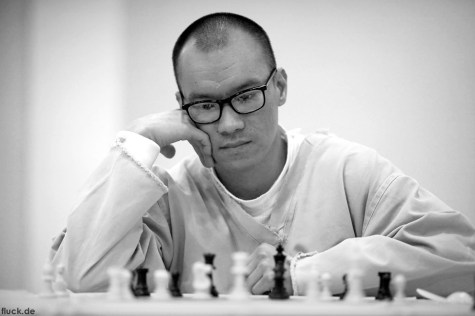
J. Zhu. Oliver Fluck

Christopher Serrone. Oliver Fluck
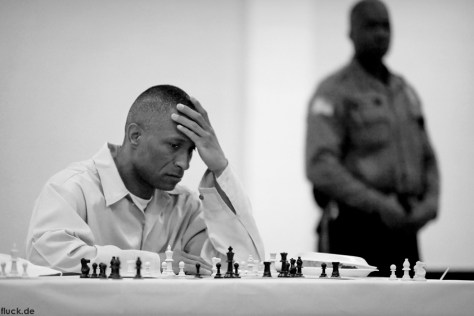
Prison Chess Champ. Oliver Fluck
Q&A with Oliver Fluck
How and why you came to this topic?
I enjoy playing chess, which is why I’m in touch with the local university chess club here in Princeton. The students got the opportunity to play against inmates of a maximum security prison, and when I heard about it, I proposed to photograph the event and volunteer as a driver for the students.
What are your hopes for the project as a whole?
Very frankly, from a photographer’s point of view, I would like to see it exhibited, and provoke some thought.
What is your message with the portraits?
I can talk about one thing that I am not trying to do: I’m not trying to propagate any kind of standpoint about how one should deal with criminals, and whether or not they should have the right to enjoy chess. I’m like most other viewers, I stumbled upon this project and got curious … Curious on an unprejudiced level from human to human. Start from there if you are looking for a message.
Anything else that you’d like to add and feel is important.
I would like to thank John Marshall for this experience, and David Wang for constructive feedback regarding the prisoner questionnaire.
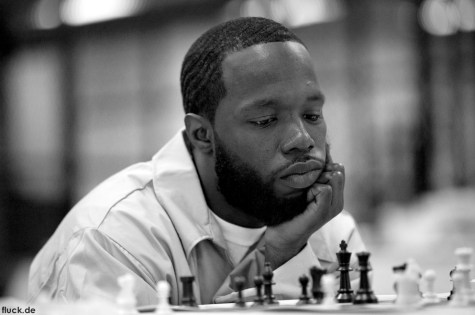
Competitor with Unknown Name. Oliver Fluck

Prison Chess Portrait #4. Oliver Fluck
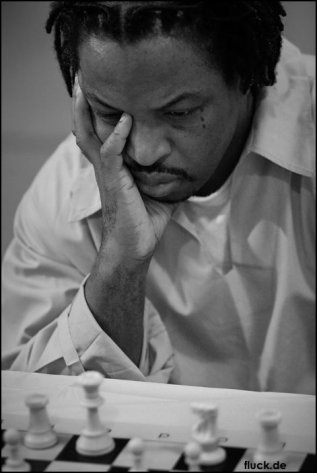
Prison Chess Portrait # 21. Oliver Fluck
Original Links to portraits 1, 2, 3, 4, 5, 6 and 7.
Oliver Fluck’s Flickr
Watch this youtube clip of a local news report from the prison during the tournament.
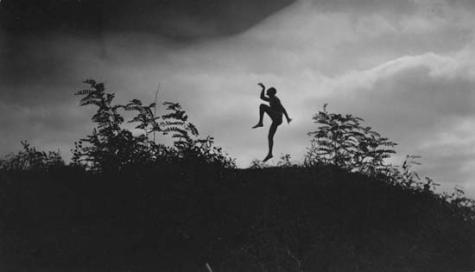
The Dancing Faun. 1919. AFP Photo/Andre Kertesz/National Gallery of Art
A few weeks ago I promoted a David Bauman slideshow documenting the San Quentin Giants. The anchor image to Bauman’s multimedia project was an image of a silhouetted pitcher mid-throw (below). Photographer David Simonton pointed out the image’s likeness to André Kertész’s well-known Dancing Faun.
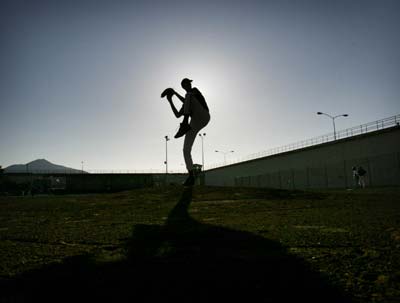
Pitcher for San Quentin Giants. Credit: David Bauman/PE.com

Germany; Indoor Pool "Tropical Islands" in Berlin Brandenburg; Tourist watching the evening show. © Reiner Riedler / Anzenberger
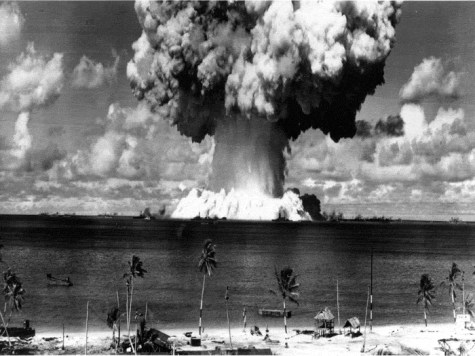
Nuclear Test on Bikini Atoll
Lenscratch was right to single out the work of Reiner Riedler from the 50 chosen artists of Critical Mass at Photolucida, Portland, Oregon.
The search for the authentic undertaken by the tourists of Fake Holidays creates paradoxically inauthentic (“anti-authentic”) spaces. Invariably, engagement with these theatre-sets of leisure is as spectator. Of the audience, the spectacle requires passive acceptance and, to some degree, a surrendering of their self identities as agents of change.
Many of Riedler’s images are caustic in their humour but others are flat out depressing. “Tropical Islands” reminded me of the images of 50’s movie-goers in 3-D glasses; fun at the time but now cut into apocalyptic montages of human division, destruction and powerlessness.
Riedler’s image suggest little progression since the late colonial exploitations of Europe in the South Pacific. It is as if he turned the camera 180 degrees on its tripod, eradicated half a century, added colour and caught the masses still gawping.
Furthermore, “Tropical Islands” can be read as a simulation of the defacement of human existence. The fake plastic trees, sealed dome architectural skin and industrial spotlights have me imagining these people kicking back on their loungers as a nuclear winter takes hold outside their chlorinated, hemispherical world. It is as if the only method of survival in this radioactive-proof conch is to relive (in full surround-sound) the astounding beauty of the awesome act that drove them to their hermetically sealed lives.
Also, while we are on the topic of nuclear holocaust, you should listen to Nitin Sawhney’s Beyond Skin.
Today, The Exposure Project highlighted the work of Daniel & Geo Fuchs’ STASI – Secret Rooms describing it as “an exploration of the now outmoded interrogation rooms and detention centres of the East German Secret Police.”
No matter how outmoded, the depictions are chilling.

© Daniel & Geo Fuchs. From the series "STASI - Secret Rooms"
Daniel & Geo Fuchs’ STASI – Secret Rooms is featured in the latest Aperture accompanied by a Matthias Harder essay laying out the nature of Germans’ handling of memory and narrative. The architectural remnants of the era are interwoven with the national dialogue.
“The rehabilitation of the East German justice (or injustice) system and its surveillance apparatus continues; the remaining Stasi files and methodically recorded wire-tapping logs are now available to the public.”
“With this series Daniel and Geo Fuchs have rubbed salt onto an open sore of recent German history while simultaneously contributing to its articulation and healing.”
Author’s note. Prison Photography has been interested in HohenSchonhausen prior, promoting the work of the still unknown Lars.blumen
If you search “Prison Photography” on Twitter you’ll get nowt back. That’s because I use an inverted version of my pseudo-faux-baptismal avatar, brookpete.

In truth, you’d all be better spending time with Brian Solis’ latest tussle divining Twitter’s worth than following my twits, twats and tweets.
Of all the accounts, of all the testimonies, of all the confused interactions, bumbling application of draconian laws – THIS ONE takes the biscuit.

Hammersmith Police Station. Photo Credit: George. http://picasaweb.google.com/george.sapnatech/GeorgeeeeUKTrip04#5124127843534510386
Edward Denison was photographing the Hammersmith Police Station for a book about McMorran & Whitby, one in a series about post-war British architects jointed supported by the Royal Institute of British Architects, The Twentieth Century Society and English Heritage. Denison knew the law:
The laws of this free and democratic country permit members of the public to photograph any building, as long as the photographer is standing on a public right of way when taking the photograph. I know this because a very professional and courteous member of the City of London Police explained it to me when I was photographing its headquarters at 37 Wood Street (completed in 1966) and the extension to the Central Criminal Courts on Old Bailey (completed in 1972), both designed by the architectural firm McMorran & Whitby.
He was also conscious of others’ needs for explanation:
Although I am not legally obliged to do so, as a matter of courtesy I always (if possible) seek to explain what I am doing to the occupants of any building I am photographing before I leave. At Hammersmith, I went to the reception located inside the public entrance, to be met by two quizzical officers.
Denison goes on to explain that the officers told him he couldn’t photograph. He told them he could and they acquiesced with the retort “For now.” Shortly before leaving Denison crossed the road to take a picture of an architectural detail. At this point two officers ran down the street, commanding him to cease photographing and then detained him for 45 minutes despite his full credentials, letters of recommendation and helpful explanation of his project and sponsors. Only after word was received that his name wasn’t on the suspected terroist list was he free to leave, albeit with a completed 5090(X) form.

Busted! Credit: Phil Clements. An example of a 5090(X) form. http://www.flickr.com/photos/71492355@N00/3151511295/in/pool-police_form_5090x/
A little irony is that the architect, McMorran, is Denison’s grandfather. Denison already had architectural plans and elevations in his possession. He knew the building better than any officer inside! Denison is as exasperated as the rest of us with a robotic police force that acts upon its role play training and not the evidence at hand in a particular situation:
But do the police really need to be trained to recognise that in the age of the mobile-phone camera (or indeed Google Earth), a man with a camera, a wide-angle lens and a fold-up bicycle openly taking photographs of a police station makes an unlikely suspect?
From reading Denison’s account, it seems he (like many others) needed to experience harassment to fully comprehend the erosion of civil liberties in the UK; to crystalise the meaning and consequences of the Prevention of Terrorism Act upon the average citizen.
Denison ends with a statement that brings home the difference between his innocuous activities and those of the past:
Real terrorists do what the Irish Republican Army did to McMorran & Whitby’s Central Criminal Court on 8 March 1973, only months after it had been opened – detonate a massive car-bomb right outside what John Betjeman called this “splendid fortress of the law”. The building survived intact. Donald McMorran had designed Hammersmith Police Station to withstand aerial bombardment, in anticipation of another kind of war.

Hammersmith Police Station, together with the plans already in Edward Denison's possession
In the past Hammersmith Police Station has veered from proactive engagement to utter neglect of the public. With officers on the street inconsistently enacting ludicrous law, it seems the Metropolitan police force – as a whole – is as schizophrenic.
___________________________________________________
For fun, you can view a 5090(X) forms Set at Flickr.

 Prison Photography