
You are currently browsing the yearly archive for 2013.

A single wall representing the meals of men and women executed in Texas, part of Julie Green’s The Last Supper: 500 Plates exhibited at Marylhurst University, Oregon (April 16 – May 17, 2013). Photo: Pete Brook.
In The Make — a new(ish) website that celebrates artists in their crafty environments with dedicated studio visits and conversations — has a smashing feature on my friend and fellow Oregonian Julie Green. It sure beats the 2011 write-up of my visit to Julie’s studio!
I’ve been thinking a lot about productivity and it’s obstacles recently and I think Julie maintains an incredible output. Part of that is the security of teaching for her but mostly it is passion and commitment to connections and getting the work seen. What use is studio time if the products are not then widely shared?
Julie’s The Last Supper which is now 552 plates deep, is broad and grasps solidly the size of the issue it takes on. Bravo to Julie for leveraging the agency she has as an artist.
Pop over to In The Make and read what makes Julie tick. Here’s a snippet:
Shipping and installation of fragile ceramics is quite an undertaking. I am looking for a library or a university or a museum- in Texas would be great—to donate the project on a ten-year loan. The Last Supper is not for sale.
I plan to continue adding fifty plates a year until capital punishment is abolished. A poet asked if I ever get tired of painting lumpy blue food. No, I don’t.
Oklahoma has higher per capita executions than Texas. I taught there, and that is how I came to read final meal requests in the morning paper. Requests provide clues on region, race, and economic background.
Why is this important? It is because the death penalty is applied unequally depending on the race of the defendant and the victim, not to mention access to adequate counsel, jury bias, prosecutorial misconduct and a whole plethora of factors that make wrongful convictions too frequent to dismiss. End the death penalty and we’ll end the murder of innocent people. As Bryan Stevenson brilliantly puts it, the question isn’t so much does a person deserve to die, it is do we deserve to kill?
ELSEWHERES
I’ve previously talked about Julie’s work here, here and here.
Coincidentally, I edited a story for Wired about the work of Klea McKenna who is editor of In The Make. Check out Crumpled and Abused Photo Paper Makes for New Landscape Photography

San Pedro Prison in La Paz, Bolivia is a singular type of prison. It accepts tourists. It also attracts professional photographers. For me, the story of San Pedro has always been the sporadic schedules of guided tours within the prison. First they are on, then they are off.
The very existence of images made by free-wheeling tourists tells us a lot more about the administration’s attitude to security, social priorities and moneymaking than the visit of any single photographer. One might presume that a professional photographer’s visit would be a rare thing … if it wasn’t for the thousands of photographs made by amateurs.
Still, I like very much a few of Giovanni Cobianchi‘s portraits in his San Pedro Limbo series.

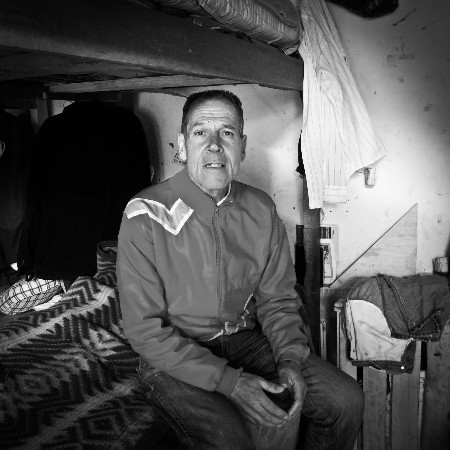
If these images from San Pedro interest you, consider looking at Toby BInder’s work I featured earlier this year in Photos of Infamous Bolivian Prison Go Beyond Common Tourist Snaps
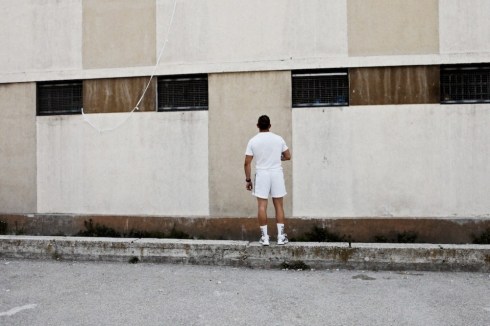
Prison by Christophe Negrel is shot in French prisons and focuses on the physical regimes kept by prisoners. Some great studies of moment in the portfolio.

When friends call and ask if you’d like to mount a show in a brewery, there’s only one answer.
University Beyond Bars was putting on a prison art fundraiser at Machine House Brewery in Georgetown, Seattle. I was invited to curate some prison photography. I selected five photographers from Washington State that have made work in Washington State prisons and juvenile detention centers.
The only issue with the space was that IT IS A BREWERY. A beer-making space is set up for a different type of cultures.
The UBB students’ prison art (paintings and illustrations) went up front of house. The space for the photographs was the warehouse. Upon arrival on Friday afternoon, the ground floor and mezzanine boasted fork lift truck, pallets of malt and barley, industrial fridges, old lockers, busted furniture, spare fixtures, lamps, chairs, bikes and other inconvenient objects.
So I went to work. And I loved it. Painting and drilling is a nice tonic to desk-laptopping.
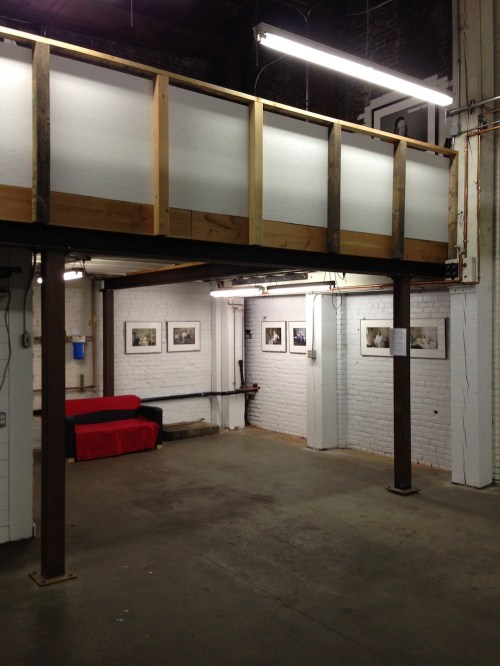
This is pretty much what the space looked like when we finished. (Note the clear floorspace.) When I say we, I mean me and some amazing peeps who swept, nailed, primed, sweat and hung prints and frames. Big thanks to Bill the Brewer, UBB‘s very own Stacey Reeh, and Joe.
Uber-thanks to Bettina Hansen who went without a shower and worked right through until the doors opened on Saturday night to get everything spiffy.

Here’s Cheryl Hanna-Truscott’s work Protective Custody.

These are the first two prints of 16 in Cheryl’s series.

Three of the five photographers’ work was mounted straight onto boards that doubled as screens to hide all the junk alongside the walk-in refrigerator.
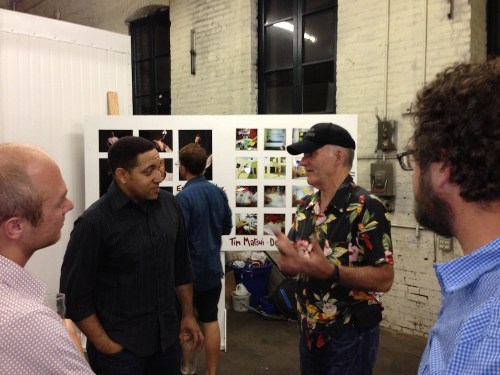
That beard on the right is Matt Mills McKnight.
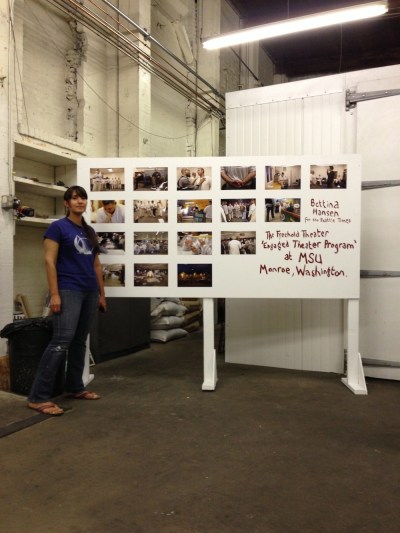
Bettina sporting the DIY-casual fashions, next to the photographs she made for the Seattle Times of The Freehold Theater’s Engaged Theater Program at MSU, Monroe, Washington.
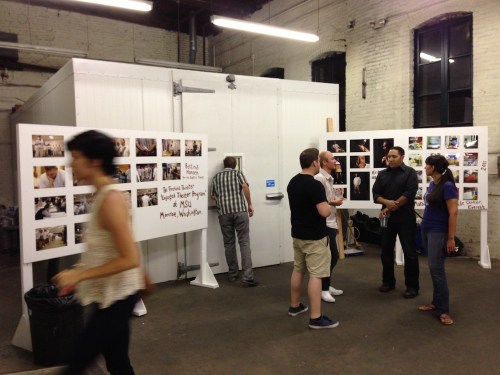
Steve Davis peeking into the walk-in.
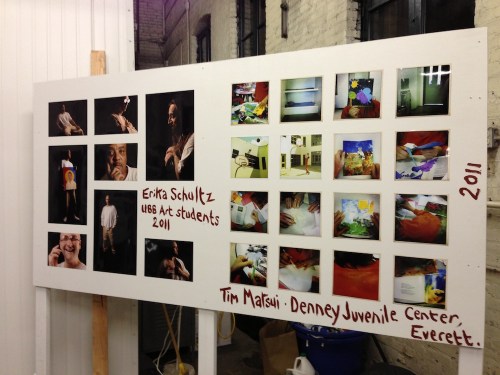
Erika Schultz and Tim Matsui.
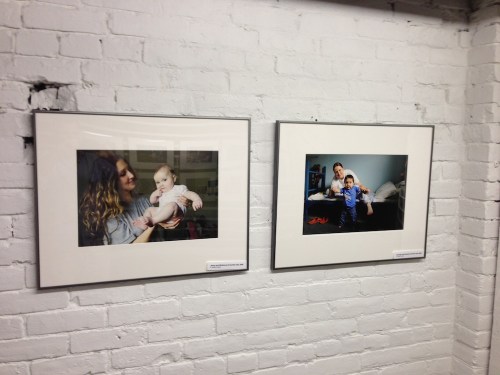
More of Cheryl‘s.

Intern Sam, Kat and I.
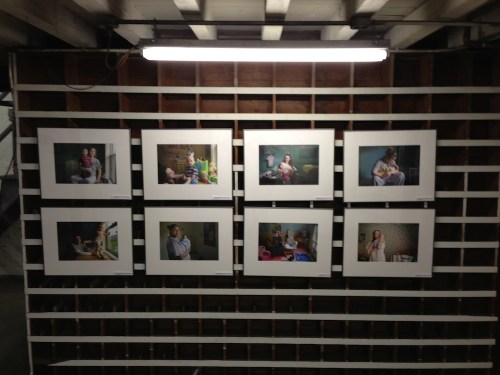
Images 9-16 of Cheryl’s work.
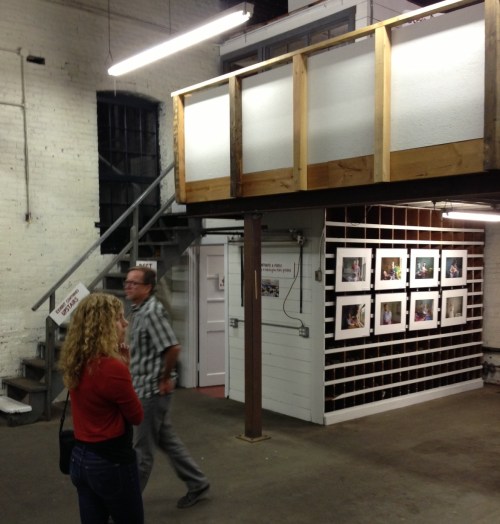
I even painted the bathroom door.

Signs were made. Bottom steps were marked.

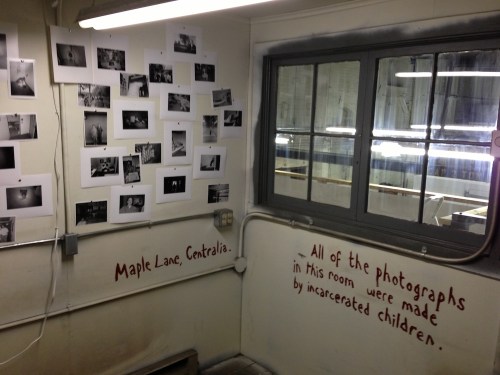
On Thursday, Steve Davis had given me some work prints to look over for a future project we are planning. They images were made by boys at Maple Lane juvenile detention center and have never been published. Strong, haunting and expressive. I decided to tack them up on a single wall in the old, emptied-out machine-house office.

Looking in to the office from the gantry at the top of the stairs.
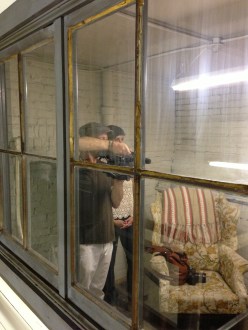

UBB co-founder, Gary Idleburg, speaks to a video crew making a piece about perceptions of prisoners and the importance of art as communication.
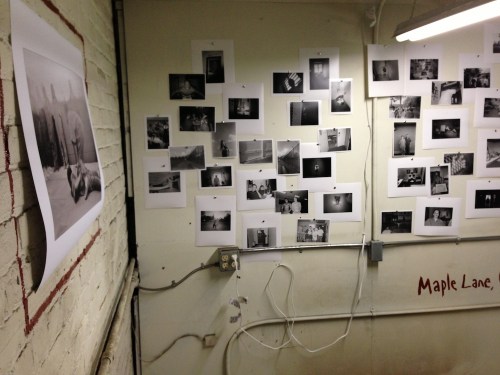
One large print from Remann Hall (left) and work prints made by boys incarcerated at Maple Lane, Centralia, WA in the early 2000s.
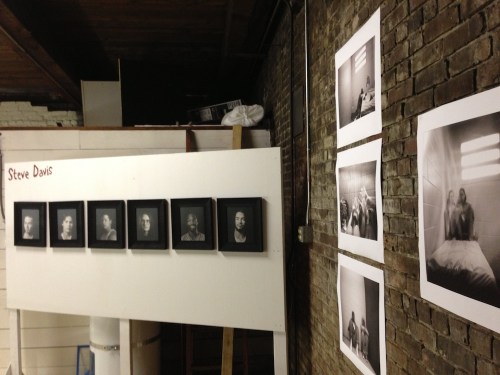
On the mezzanine level, six portraits from 1998 by Steve Davis.

Large prints of pinhole photographs made by the girls of Remann Hall, Tacoma, WA.

A frame …

… for a frame.

The fluorescent lights were actually pretty good for showing off the work.
Portraits & Pixels: Photography in Washington State Prisons remains open for three more weekends. Until August 10th. The brewery is only open Friday 3-7pm, and Saturday and Sundays 12-7pm.
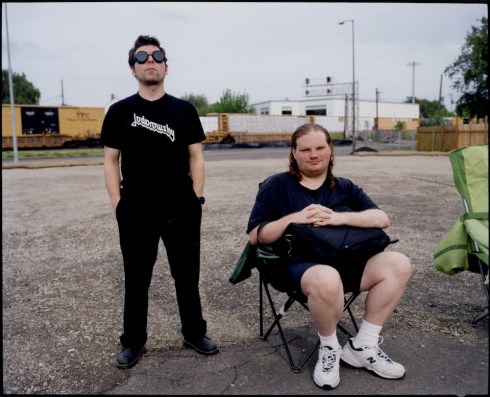
Bryan Wolf, “Eclipse watchers” (Grid M9).
On Saturday, my article The Grid Project: A Photo-Survey of Portland was published in The Oregonian. It was my first ever piece for The Oregonian, a paper which was founded in 1850 and predates official Oregon statehood which came about in 1859.
I wrote: “In 1995, Christopher Rauschenberg assembled a team of a dozen photography enthusiasts. Together, they sliced up a AAA map of Portland into square mile segments and resolved to hit the streets of each corresponding square and photograph, once a month, until no more squares remained. By 2004, they had documented all 89 squares within the city limits. At that time, the only thing to do was to start over. In September of this year, the Grid Project will complete its second full photo-survey of the Rose City.”
I wrote the article because The Grid Project is raising Kickstarter cash to replace its old, limited-function website with a new-spangly site with full on search, more images and happy-wide-eyed-users. With four days to go, just over $600 more is needed, so it looks like it’s going to make it.
When I arrived in Portland 18 months ago, folks at the Grid Project were some of the first I wanted to meet. Even though I don’t shoot photographs they let me join them for a meeting and look over images. Many of the Gridders are now friends.
The Grid Project is amazing. Here’s why:
1. It’s all about community.
2. It’s done for the love of photography; no one’s getting paid.
3 It’s a simple premise, but collectively 20 or so photographers have documented a changing Portland over nearly two decades. The estimated 40,000 images they’ve made is an incredible resource.
4. The Portland Grid Project invented the formula. The methodology has since been repeated around the globe in towns and cities such as Bradford, England; Toronto, Canada; Vancouver, WA; Victoria, BC; Rome, Italy; Providence, RI; Eugene, OR; Central Oregon; Napa Valley, CA; Philadelphia, PA; Forest Grove OR and Santa Fe, NM.
If you fancy a fancy print you should throw some money in the pot. Here’s some fine Grid Project images to stroke your eyeballs

Ann Kendellen, Pendleton Park, SW 53rd and Iowa, January 2011 (Grid N6).
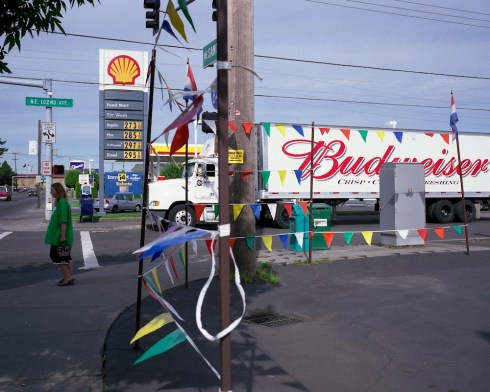
BlakeAndrews, 2007, (Grid J12).
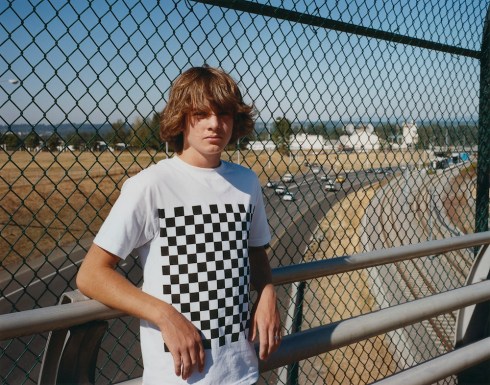
Bruce Hall, Kid on the Sandy Blvd overpass for the 205 freeway, (Grid J12).

Carole Glauber. “Frankie’s Franks” SE 82nd, 2011.

Christopher Rauschenberg, SE 15th Avenue, 2008 (Grid L9).
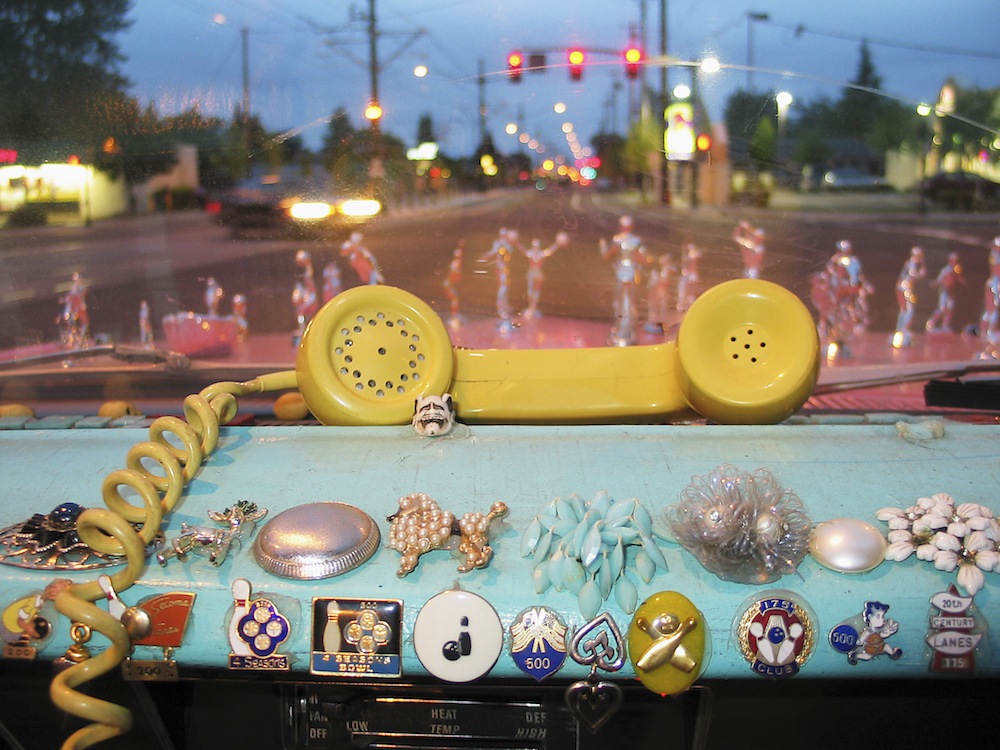
David Potter. “Inside of Marci MacFarlane’s car” North Interstate Avenue and Going Street, May 29th, 2005 (Grid J8).

Lisa Gidley. NE 42nd Avenue near Sumner Street, September 2011.

Nancy Butler, “Untitled” (Grid N9).
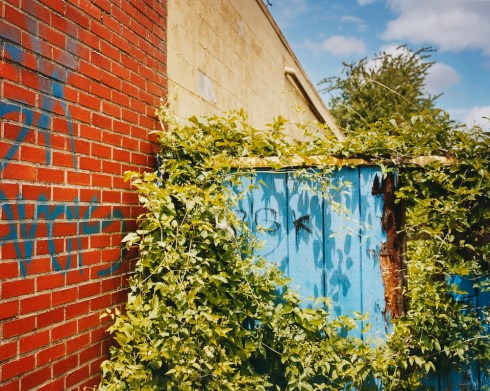
Bruce Hall, Off NE Fremont, (Grid K11).
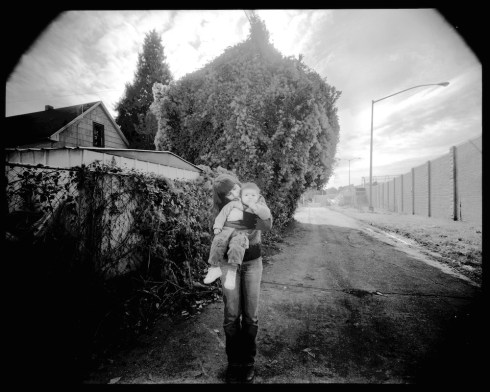
Mark Barnes, “Jessie”

Mark Barnes, “Foster Rd”
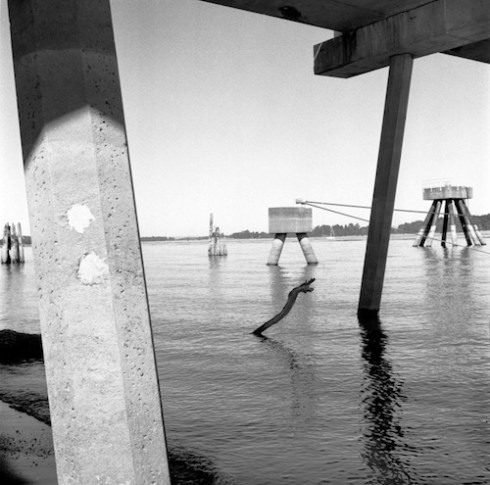
Rich Rollins
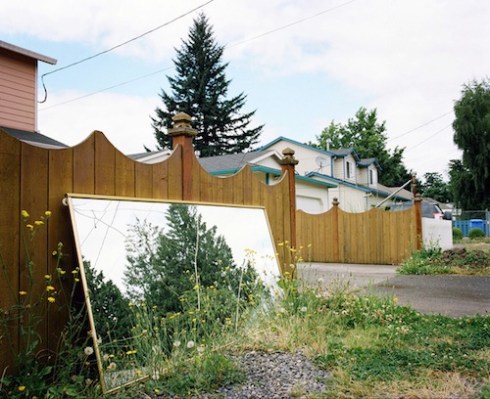
Lisa Gidley

Ann Kendellen
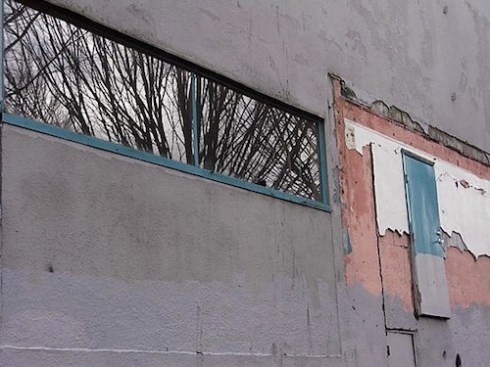
Ann Kendellen

Faulkner Short

Barbara Gilson

Alexis Pike
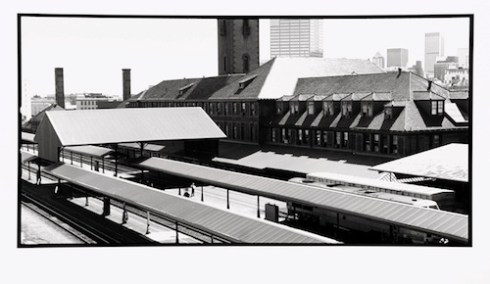
Patrick Stearns (one image in a set of three) (Grid K8, 04/99).

David Potter, (M14, August 2000).

George Kelly
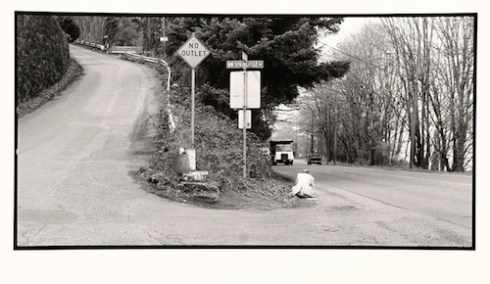
Patrick Stearns (one image in a set of three) (Grid G4, 04/00)

Faulkner Short
Eye On PDX is an ongoing series of profiles of photographers based in Portland, Oregon. See past Eye On PDX profiles here and here.

Student of Univeristy Beyond Bars, Monroe Correctional Complex, 2011 © Erika Schultz
IF YOU ARE IN SEATTLE …
Opening on Saturday, 20th July is Prison Art an art auction fundraiser for University Beyond Bars (UBB), the prison education I worked with from 2009-2011.
Accompanying Prison Art is a photography component I was invited to curate. Titled Portraits and Pixels: Photography in Washington State Prisons the exhibition features five photographers working in Washington State and making images of Washington State lockdowns.
AND IT’S IN A BREWERY!
ART BEYOND BARS
At Washington State Reformatory, students in a Studio Art class, sponsored by the nonprofit organization University Beyond Bars and led by long-term prisoner-artist Gary Thomas, have created oil, acrylic, and gouache paintings as well as pencil and ink drawings in styles that range from the political to the retro, from the kitsch to the abstract.
You can see a local KING 5 newschannel spot on Gary and the class, here. (Turn the sound down to avoid the over-zealous sound-editing use of cliche clanging doors and locks!)
80 pieces feature in the Prison Art show ranging from nearly pocket-sized to large triptych paintings. All are for sale and proceeds go toward paying for the college education of UBB students. The silent auction lasts two weeks.
‘Portraits and Pixels: Photography in Washington State Prisons’
Young mothers, critical thinkers and children making powerful art may not be the first types of people we’d expect to find behind bars, but Portraits and Pixels challenges our notions of who is behind bars in the Evergreen State.
Portraits and Pixels: Photography in Washington State Prisons brings together images by five established local photographers to provide an overview of arts, rehabilitation and security in Washington State’s lockdowns.
Bettina Hansen, a Seattle Times photojournalist since 2012, photographed the theater productions at Monroe Correctional Complex. In 2011, Erika Schultz, also of the Seattle Times, volunteered her skills and made portraits of students in the UBB art program at Monroe. Tim Matsui, a Seattle-based multimedia journalist, casts a light on the Youth Art Program at the Denney Juvenile Detention Center in Everett. In the early 2000s, Steve Davis led workshops in four Washington State juvenile detention centers producing pinhole camera photographs and narrative-rich images with the children. Davis also made formal portraits of the boys and girls. Nurse-midwife, Cheryl Hanna-Truscott has made dignified and quiet double-portraits of incarcerated mothers with their newborns at the Residential Parenting Program at the Washington Corrections Center for Women in Gig Harbor. The pioneering program is nationally recognized for its commitment to maintain ties between mother and baby by means of rigorous administration, family and volunteer efforts.
The exhibition will be open to the public from July 21 until August 10 during the brewery hours: Fri-Sun 3-7 pm.
OPENING NIGHT, July 20th, 7:30 – 10 pm
Prison Art is hosted by Machine House Brewery, at 5840 Airport Way S in Georgetown, just south of Seattle.
Tickets are available here. Tickets are $15 each, or two for $25.
There will be live music by singer-songwriter Lori Dreier, cellist Ed Tellman, and keyboard artist and former prisoner Dan Pens.
Facebook event page here.
IMAGES

© Steve Davis
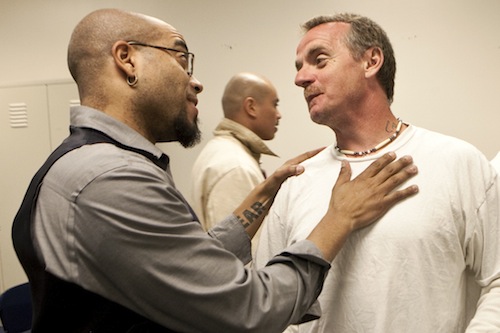
Daemond Arrindell, teaching artist for Freehold Theatre’s Engaged Theatre program, gives words of encouragement to inmate Ted Cherry after a rehearsal at Monroe Correctional Complex April 17, 2013. “They are the most appreciative population we’ve ever worked with,” said Arrindell, who is a local poet and community organizer known for running various writing and performance workshops and the Seattle Poetry Slam. “They recognize what limited opportunities they have.” © Bettina Hansen/Seattle Times
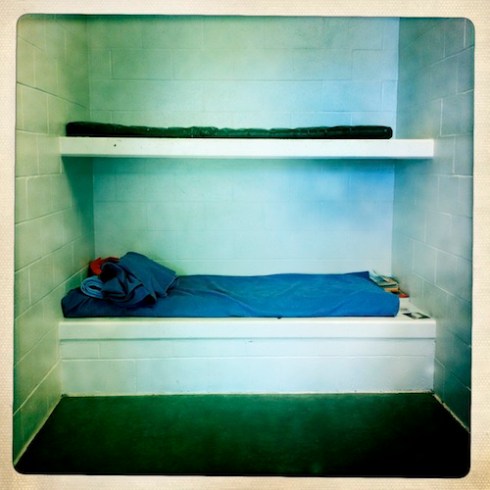
Cell Denney Juvenile Detention Center in Everett. © Tim Matsui

Mother and child in the Residential Parenting Program at the Washington Corrections Center for Women. © Cheryl Hanna-Truscott

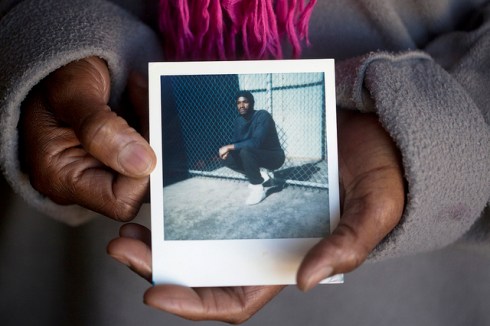
Marie Levin holds a photo of her brother, Ronnie Dewberry, taken at San Quentin State Prison in 1988. Until recently, it was the last photograph he’d had taken. Photo credit: Adithya Sambamurthy/The Center for Investigative Reporting
STARVED OF THEIR OWN IMAGE
We are now into the second week of the California Prisoners Hunger Strike. It is difficult to get firm figures on the number of participating prisoners. The Los Angeles Times reports 30,000; CNN reports 12,000 and Yahoo reports 7,000+.
I’m inclined to trust the figures sourced by Solitary Watch:
The hunger strike began on July 8th with participation of approximately 30,000 people in two-thirds of California’s prisons, as well as several out-of-state facilities holding California prisoners. In the first days of the hunger strike, approximately 3,200 others also refused to attend work or education classes as a form of protest in support of the hunger strike. As of Sunday, there are an estimated 4,487 still on hunger strike.
Still, formidable numbers.
INVISIBLE AND UNPHOTOGRAPHED PEOPLE
Last week, in conjunction with the initiation of the mass peaceful protect, Michael Montgomery for the Center for Investigative Reporting published an excellent article California Prisons’ Photo Ban Leaves Legacy of Blurred Identities about the ban on portrait photographs of prisoners held in solitary confinement.
Accompanying the article is the interactive Solitary Lives feature and a Flickr gallery.
The ban resulted from a tension between what a photograph meant or could mean.
For families, a photograph is a tangible connection to their loved one behind bars, but for staff of the four maximum security prisons that upheld the ban, photographs were potential calling cards — circulated by prison gang leaders — both to advise other members that they’re still in charge and to pass on orders.
The ban was lifted in 2011, following the last California prison hunger strike. Montgomery quotes Sean Kernan, the former Under-Secretary of the CDCR
“I think we were wrong, and I think (that) to this day,” he said. “How right is it to have an offender who is behaving … (and) to not be able to take a photo to send to his loved ones for 20 years?” Kernan directed prison staff to ease the restrictions for inmates who were free of any disciplinary violations.
The ban in the four Californian prisons was extraordinary.
“I have never heard of any other prison system or individual prison in America imposing a long-term ban of this kind,” said David Fathi, director of the American Civil Liberties Union’s National Prison Project.
As I have stated frequently on Prison Photography, prison (visiting-room) portraiture is one of the most prevalent types of American vernacular photography.
Until artists such as Alyse Emdur and David Adler began to draw focus to this disparate, decentralised, emotion-laden, and high-stake vernacular sub-genre, prison portraits were kept in wallets, on mantles and in side tables. There’s tens of millions of them out there.
And yet, for over 20 years, thousands of men in California were not allowed images of themselves. The additional ban of mirrors in solitary units meant that many men often did not see images of themselves for years on end. Again, to quote Montgomery’s article:
“I have asked my husband, ‘Do you even know what you look like?’ And he says, ‘Kind of, sort of,’ ” said Irene Huerta, whose husband, Gabriel, 54, has been detained at Pelican Bay for 23 years.
THE PHOTOGRAPH AS AN OBJECT OF DEPLOYMENT
In the free world, photographs are ubiquitous, easily created, shared and possessed. The fact that these seemingly innocuous objects were caught in the tussle of control between prison authorities and prisoners is astonishing, and speaks to the power struggle (real and imagined) between the kept and the keepers.
Michael Rushford, president of the Criminal Justice Legal Foundation, said easing the restrictions on prisoner photographs raised no major security concerns, so long as inmates had to earn them. “It’s not as if there’s been an epidemic of inmate photos on the street,” he said.
I am not sure how Rushford would measure this, or even it would significantly alter the lives of prisoners, specifically now during the hunger strike, and especially now when proven or alleged gang affiliations have been put aside by prisoners in solidarity for improved conditions for all.
In light of recent art market fetishism, it would seem the primary reason anyone would want to gather prison portraits would be to repeat Harper’s Books’ $45,000 hustle and cash in on the images?
As for the families (following the ban lift) the value of newly acquired images is not in any doubt:
Seeing an image of their incarcerated relative for the first time in years has sparked renewed hope and revived dormant family connections. For others, the photographs are a shocking reminder of the length of time some inmates have been held in isolation.
CENTER FOR INVESTIGATIVE REPORTING LINKS
Michael Montgomery’s California Prisons’ Photo Ban Leaves Legacy of Blurred Identities
Interactive Solitary Lives feature.
A BRIEF NOTE ABOUT THE SOLITARY WATCH WEBSITE
I cannot emphasize enough how important the website Solitary Watch is as a resource. Jean Casella, James Ridgeway, and their team of reporters produce high quality journalism — not only for their website but for other news outlets including The Guardian, Mother Jones, Al Jazeera, Columbia Journalism Review and The Nation.
Solitary Watch is an independent media and advocacy project, funded by grants and donations. It is a project of the Community Futures Collective, a 501(c)(3) non-profit. You can support the project here.
I don’t hesitate to say that Solitary Watch has driven much of the critical and visible public discourse about solitary confinement in U.S. prisons and jails.
As Solitary Watch describes, “Solitary confinement is one of the nation’s most pressing domestic human rights issues — and also one of the most invisible,” which is why I have a vested interest in their work; we’re each interested in making solitary and other egregious aspects of the U.S. prison system more visible.

Prisoner Ustinova (2005)
Olga Chagaoutdinova‘s The Zone/Prisoners (2005 – 2007) is a series of psychological portraits taken in a women’s prison in the far eastern reaches of Russia.
“The intent of the project was to observe human existence in a panoptic and punishing environment,” says Chagaoutdinova. “Extended interviews with the prisoners allowed me to investigate the notion of personal identity, virtually extinguished under the pressure and rules of the penal system. Gender issues and the official suppression of sexuality within the penitentiary system constituted a further aspect of my study.”

 Prison Photography