
You are currently browsing the category archive for the ‘Fine Art’ category.
Klavdij Sluban and Jim Casper of LensCulture talked about Klavdij’s photography workshops in juvenile prisons across the world.
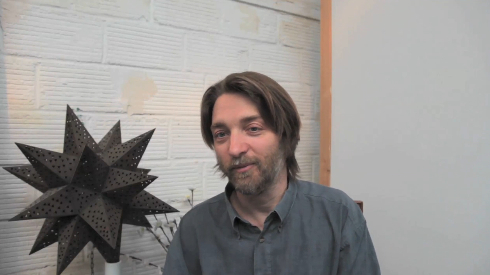
Early in the interview, Klavdij discloses his personal sadness that prisons exist. This emotion may be raw but it is not naive; Klavdij is balanced and realistic about what he can achieve with a camera in these specific distopias. He also says in seven words what I established this blog to say “Jails are a world to be discovered.”
He went to the prisons not as photographer, but as a concerned citizen. He realised if he were to go inside it would need to be with some reciprocity … so he took cameras and used them.
In terms of engagement and commitment to a population – the youth prison population of the world – Klavdij Sluban could and should be considered a ‘Concerned Photographer’. He deserves that loaded epithet.
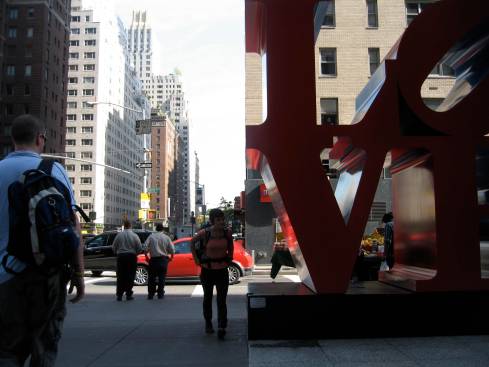
Had a fun time in New York last week. Stayed with Jack and Marisa. Below is not Jack. Below is Chris by Jack.
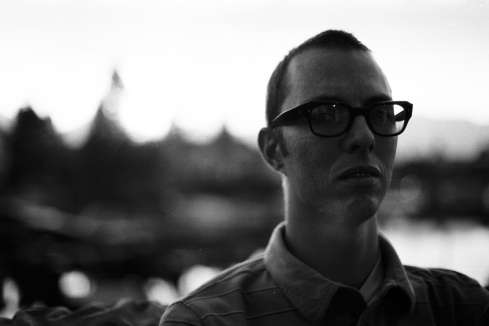
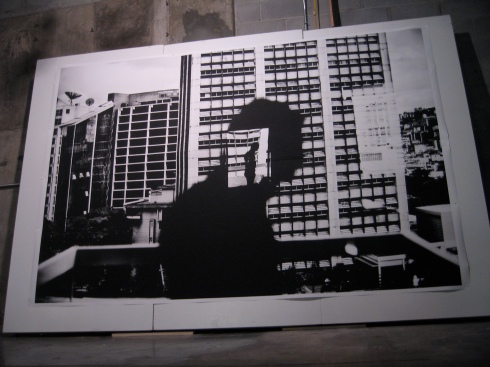
We went to Christopher Anderson’s book launch for Capitolio. It was great to see it after recent reviews, heated debates (check out comments) questions and wot not. I don’t think the selection of the images was the best.
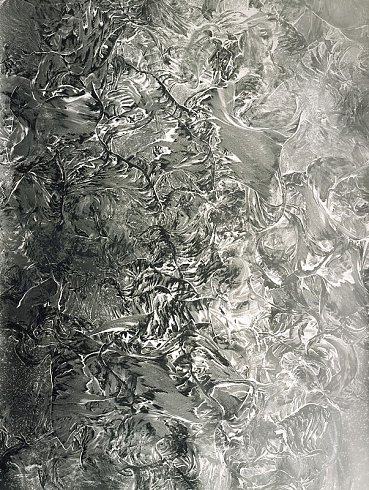
At the Metropolitan, Surface Tension: Photographs from the Permanent Collection was a pleasant whimsy into some mesmerizing works, notably Adam Fuss’ UNTITLED (1997) made by the metronome shimmers of snakes upon black dust upon white dust. Image Source: Cheim & Read
The Met’s photography department was putting together the final touches on Robert Frank’s The Americans which opened this week. It was all hands to the pump as evidenced by besuited Malcolm Daniel – who I spied carrying large, heavy object (post?) behind a partition and into the exhibition space.
Egg and Cheese Bagel.
Over at the Museum of Modern Art, I was pleased to see Russell Lee‘s work Bulletin Board in Post Office Showing a Large Collection of “Wanted Men” Signs, Ames, Iowa (1936). Who doesn’t love a mug shot?


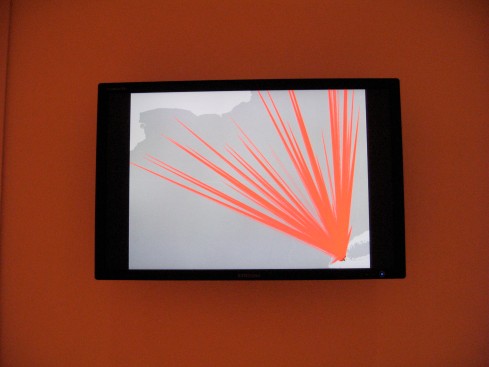
Bringing the practice of mapping of transgressions into the 21st century, the Spatial Design Lab from the Graduate School of Architecture, Planning and Preservation at Columbia University exhibited its Million Dollar Blocks Project (2006).

On Monday night I sat with Andrew Lichtenstein. We talked. Andrew recommended Brennan Linsley‘s work and was quite emphatic about the book ‘Concrete Mama‘. He also spoke highly of Max Kenner and the work at the Bard Prison Initiative
Tuesday, I met Emiliano Granado. We were first in contact over his San Quentin Giants pictures. We talked about many things including Trevor Paglen, Argentina, the Burke Gilman, and the Horticultural Society of New York, which recently lost Barbara Margolis who was an inspiring leader. Emiliano recommended Alessandra Sanguinetti‘s work.
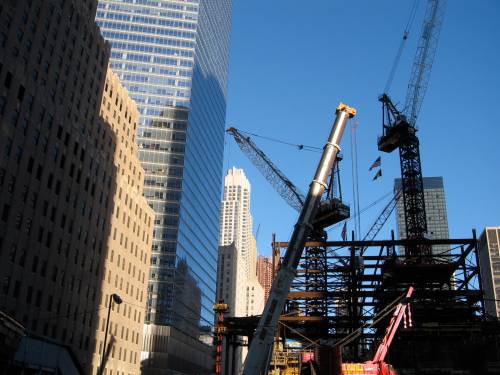
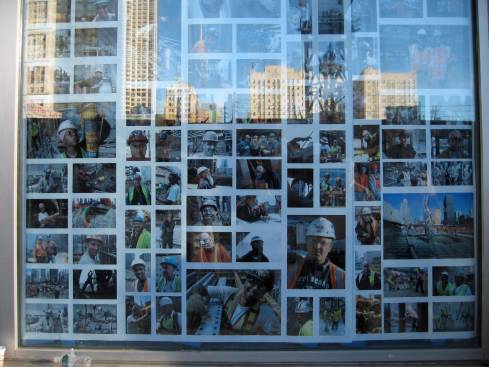
On Sunday, I’d been at the WTC construction site. There was some portraiture on display in a window. The space behind the window was closed but would usually be open. The photographs were easy on the eye.
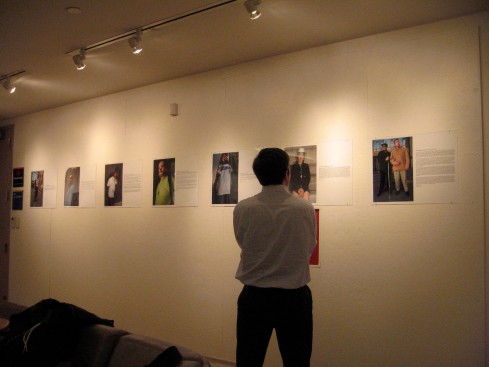
On my last night I checked out Steven Hirsch’s Courthouse Confessions.
That’s Matt Kelley looking at Steven’s work. He’s coordinator for Change.org Criminal Justice, online communications for the Innocence Project and all together nice bloke. Matt’s double identity is twittered and can be followed here and here.
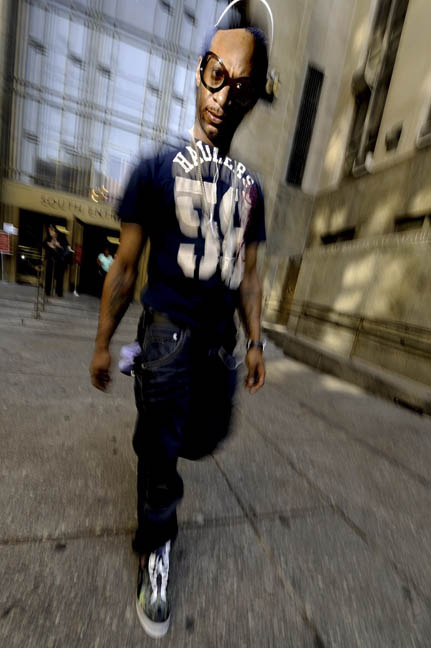
Hirsch takes street portraits of folk going to court, secures (in some ironic twist) a non-binding statement and then transcribes it verbatim to go with the portrait. Constantly moving the camera, Hirsch uses hard flash and distorted angles/zoom to depict these individuals as shape shifters; as anomalies. The fact Hirsch’s subjects (in most cases) seem alien to the logic of the courts – that any lessons arising from their cases are unlikely to effect sentencing laws in the future – should but be a source of disquiet for us as an audience.
One last thing. On Saturday, I saw John Baldessari sat outside a Grennwich Village coffeehouse, but I bottled saying anything. I’ve learnt that famous people abound in Manhattan and you see ’em everywhere.
Thanks to everyone who altered their orbits a little to coincide with mine.
This post is to salve the disappointment of thousands of visitors to Prison Photography that are tempted by the post titled View Inside Guantanamo: Video only to find that the Guardian’s rights to the three minute “tour” video have expired.

There exists a bristling irony in the Guardian’s curt and formal explanation of circumstance: the erasure of evidence based upon ‘rights’ pertaining to the command is an insulting reminder of the powerlessness of detainees whose lives are manipulated at will.
Paradoxically, in this case, it is the denied party that is the apologist for the US military’s enforced expiration and unavailability of material. It seems the controlled release of this footage has been trumped by its controlled withdrawal.

As a worthy (and non-governmental) alternative, Magnum offers Paolo Pellegrin’s 11 minute slideshow ‘Guantanamo‘. There are a few interesting things about this piece none of which are the actual photographs. The prints are steeped in morbid detachment and the unsurprising truth that the photographer was also controlled throughout this military prison.
The slideshow’s early description of Guantanamo as a small American town is sinister; the edited audio interviews of former UK detainees, family members, detainee lawyer and psychologist are very successful. The follow-up portraits of former detainees that Pellegrin later completed in Afghanistan are very strong.


All photos copyright of Paolo Pellegrin/Magnum Photos
Please, refer to my earlier post, for a comprehensive directory of photographic resources for Guantanamo including Bruce Gilden’s subtle flash-bulb mockery of Guantanamo’s rank and file. (Search within Magnum archives as deep-linking is impossible).
An argument to say that a cheap photo print economy obscures the good and the bad.
This week’s discussion between Jörg Colberg at Conscientious and Paddy Johnson at ArtFagCity about the culture of “Cheap” relates directly to last weeks concerns (and rightful criticisms) about Chris Anderson’s futurescape ecology of the “Free”.
Anderson took the nature of our ever-connected world and (disposable) media, extrapolated it, stretched it some, and applied it to future practices of production, “Every industry that goes digital eventually becomes free”. This is quite an obnoxious notion as human creativity is not broadband, but let’s move on.
I trust none of us reading here would dispute the utility of product created on ones own time and dime to be dangled in front of an audience. Self-promotion will always be with us. But ‘Free’ production as practice is short-term tactic not long term strategy. ‘Free’ is a philosophy rooted in a culture of the intern and the society of high personal-risk. As one photographer noted, “My free assignments have only ever led to more free assignments.” [I’d be happy to find that source again, help? APE maybe?]
Lower priced prints present as many dangers as ‘free’ for the artist, particularly the emerging photographer. There is a legitimate worry that creators will suffer an infrastructure unable to support photography as a profession.
Jörg is worried about several things (correct me if I’m wrong, Jörg):
a) our collective acceptance of cheap prints
b) the reality of “Cheap”, now, that few of us have digested
c) the limited discussion of cheap and its obstruction to other (more pressing) discourse
I contend that some of the angles to tackle this discussion are not only undigested but unsaid.
I say that there’s a lot of bad photography masquerading as fine art today – and that our acceptance of low price economics for photography lays down the perfect conditions for bad art to skulk in and nest among finer company.
Are some echelons of the fine art photo industry polishing turds?
To leave photographers or organizations dealing in knockdown pricing unnamed is diplomatic but we shouldn’t assume it is necessary. I think we can still acknowledge these parties and still ask, as Jörg did, “Is this [low pricing] good for the artist?”
Paddy Johnson named 20×200. Personally, I think 20×200’s curatorial eye is disciplined and the work put into establishing the model for “art for everyone” is nothing short of miraculous. But what follows 20×200?
What pricing terrain is developing? Jörg asks, “What is good for the artist?” Firstly, awareness and readiness. The artist must be privy to the lay of the land to navigate it, right?
Photography, unenviably, dominates the turf of mass reproduction.
Whether we like it or not “art photography” takes many forms, many of which can be of poor quality, lazy and/or lacking purpose or message. So whilst, we can talk about Gurskys and Richters there are a billion framed and unframed prints at every price level between they and the box of photos at the local thrift store.
It is true low prices can call into question an artist’s status and consequently hinder his or her progression. What hasn’t been said is that sometimes low prices are an accurate reflection of the quality of work – or it’s worth as a material (reproducible/reproduced) object.
I think of shit digital photography as the cultural replacement for the wall coverage of the three ceramic ducks & painting of dogs playing cards. Everyday, photographic prints are more available than the day before.
When we say photography is democratic, we mean it is common.
In purely descriptive terms, photography as rare commodity is oxymoronic. In art terms, photography as rare commodity is much, much more than the mere product – it is a support network, a dance of semantics, limited edition runs, a strong backbone of theory packaged for the prevailing culture; it is an earned CV, patronage, mindshare and a lot of hard work.
Depressingly, few of these things are solely in the control of the photographer … and this is why I think Jörg began the discussion … because the price is should be in the control of the photographer.
Cheap prints should not be too much of a concern; all photographers have the prerogative to start at any price stratum. The treacherous route to career-supporting prices is more of a concern. Success on this route is, unfortunately, not solely based on the quality of work but also on the dance of self-promotion around it.
Photographers need to be objective to the point of outer body experience. More than being able to hear their photography is not working (selling), they need to be able to see it and be able to tell themselves.
This is coming from a belief that the world owes an artist naught. I personally believe a self-respecting artist/photographer should be ultimately responsible for their work and the issues (prices) surrounding (on) it.
Work that is priced low because it deserves to be, will remain so and the artist will need to find a new career. Work that is priced low because it’s the first time on the shelf – but is good – will not stay low priced for long.
In the same way I believe photographers should be responsible for their work, so too should buyers be for their purchases. I can’t imagine that $20 prints have affected the sales of Winnogrands at auction. I do suppose $20 prints have created a bottom tier market for photographers and buyers to thrash it out in.
When we say we are scared of low prices, are we in fact saying we are scared of a drop (perceived/real) in standards?
It is true that we should all live with good art, but it is our discernment that decides what is good or not. If enough buyers support an artist through purchases and both parties are happy then so be it. As Ian Aleksander Adams put it, “The real question about cost should only be ‘Is it enough to support the artist?'”
Jörg openly admittedly to leaving something out of his first post, only to gratefully reconcile his contentions after Paddy Johnson’s post;
We all know what we like, and we all know what we are willing to pay in time, words, cheer or cashmoney. The industry doesn’t impose itself entirely – it is a two way street and we create the conditions of the industry too.
Perhaps we should stop looking at price tags, and more the number of prints churned out? Have we simply filled the gap between rarefied fine art and ‘Free’ with sheer ‘Cheap’ quantity?
Quality, not quantity, abides.
Blake Andrews, as if on cue, offers this laudable example,
Of course another issue here is the conflagration of art/documentary/editorial/press/enthusiast photography. We’d all make different arguments for the survival of certain proclivities within the photographic medium.
What I find irritating is the continuing bleating from photojournalists about the death of old (newsprint) media* when simultaneously they have dozens other new media avenues to explore and exploit.
We can’t have it both ways. Everything is quicker: production, promotion, sales and prices. In this breakneck atmosphere it makes perfect sense that photographers would (gamble) sell their prints at cheap prices – in order to rally support for their work long term.
Is it heresy to think of cheap prints as supplemental material to ones main art? This seems to be the way the discussion may be headed. Whether a print is framed or in a book is somewhat irrelevant if both (one presumes) are priced to sell – and hence – promote.
If we choose to take the other tack, bemoan any discussion on price and talk only of art as experiential then we return to issue of monetary privilege anyway. Not all art can be met/seen first hand. Leah Sandals challenges Paddy Johnson’s argument and asks us to think beyond the rarefied print hanging in a gallery;
The digital manufacture of photographic stuff is embedded within a digital culture of 1s and 0s that has generally benefited art consumers. It should benefit art producers if they’re honest about the modes of photographic production, hold their work accountable and identify & outlast the turds.
__________________________________________________________
*Assumptions that the loss of large papers will mean the loss of investigative (photo)journalism may be valid but by no means certain. I fear for the corporatization of media, but all other evidence suggests new media provides non-authoritarian comment. That said, we should worry about who controls the networks for new media and how malevolent they may become. But given that both old and new media are driven by advertisement revenue aren’t concerns of major media polluted by commercial interest likely to remain in status quo?
This is the first part of a two part interview. Part two was published on published Thursday, 23rd July, 2009.
– – – – –

You already know the work of Steve Davis, you just don’t know it. Prison Photography‘s most popular post was that of pinhole photographs made by the young ladies of Remann Hall, Tacoma. Steve Davis conceived of and led the workshop.
Concurrent to workshops, Steve worked on his own project, Captured Youth (1997 – 2005) turning his lens on the juvenile offenders and institutions within Washington State. Steve’s introduction to the Captured Youth book reads, “What are officially referred to as “schools” are, in fact, youth correctional facilities – jails for juniors. It’s a world kept secret from the general public, but there are no secrets inside. Everyone is watched.”
Steve and I sat down to talk about the circumstances of the workshops and portraits, the involvement of – and benefit to – the teens, the atmosphere in the facilities and how the practice of photography manifests in sites of incarceration.
___________________________________________________________
Prison Photography: Steve, you photographed in four institutions in total?
Steve Davis: Yes, Maple Lane, Green Hill School, Oakridge and Remann Hall.
PP: How did you pick those?
SD: I fell into it years ago. It was fairly unintentional. I was doing PR photography for an [non-profit] organization called The Experimental Gallery that was trying to bring in art teachers on residencies into juvenile facilities. It came up they were interested in maybe having a photography workshop. I said it was something I was interested in.
And, nothing happened for a couple of years, but then I got a phone call and they asked if I’d like to teach the kids photography and double up as a photographer for their publications.
I thought about it and I asked if I could do something different. I wanted to slow the process down and bring in a large 8×10 camera. I just wanted to do portraits; focus on who the kids were without all the trappings, bars, etcetera that go along with images of young offenders.
So, I went in and worked with the kids [within a photographic workshop format] and then organized outside of that to take in the large camera.
Essentially, I was working under the umbrella of The Experimental Gallery, which had a grant, so I could only be there when they said I could be there. And when they were done and the grant was over, I had no more access.

Beginnings
SD: It started in 1997 at Maple Lane, then later the Green Hill School and Remann Hall. Each of those placements was under the direction of Susan Warner and The Experimental Gallery. Susan is now the Director of Education at Tacoma Museum of Glass. Between time, Susan had a job at the Children’s Museum in Seattle and they supported her doing this and she continued through them. And likewise, since she has worked at Tacoma Museum of Glass they have supported her as well. So the name has always been the same.
Lastly, at Oakridge – that was all my own work, with anyone’s sponsorship.
PP: You returned to Oakridge and the project in 2005. Why did you decide to return?
SD: Well, at the time the project didn’t seem resolved. I wanted to do something a little different. Oakridge is a transitional facility so they are not so much under lock and key, they are allowed to wear their own clothes and they have day jobs. That is where they reside just prior to release.
Soon after [Oakridge] I felt like I was getting to the point where I was taking the same picture.
PP: How did you respond to that?
SD: I tried contacting other facilities. I really wanted to get in to Clallam Bay, which is an adult institution but has a juvenile facility. It is really hidden from the public. But none of that panned out.
Overall, my interest with portraits has pretty much been about people who are controlled and lack all sorts of freedoms. I haven’t only focused on prison; I did a lot of work at an institution for the mentally disabled.
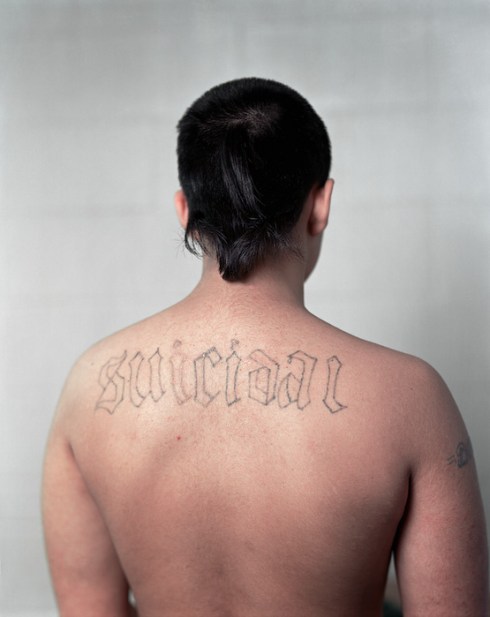
PP: What’s the attraction to these types of subjects?
SD: When I got into the work, I fell in with these mini societies with their own economies and their own rules and they’re all over the place. They are thoroughly hidden by intention from the public – who have no interest in examining it. It doesn’t benefit the public to do that.
I found these places intriguing partly because once you are there in the middle of it, the people you come across, they’re linked together by reasons that are not of their own choice. It’s not the type of community where people have something in common so they create their own economies. They are like dogs in a pound. They might be friends, they might not, but they share common concerns.
I was interested in trying to zero in on these people as individuals with personalities and hopefully open up a lot of questions with the viewer. That s all I wanted to do. I wasn’t trying to reach conclusions or force anything down anybody’s throat. I am just trying to acknowledge that this is 20 miles from home.
All these [sites of incarceration] have names that sound like country clubs! You’d never know that Maple Lane was anything but a nice street or golf club. When you drive past, it is a beautiful place, but you won’t see a kid outside. It looks good from the road, but it is not a place you can walk around.
When I did workshops, they’d love it if I walked them over to the fence; they’d never been! Just little things like that were huge thrills to them.
PP: So the youth were always willing participants?
SD: The first residency at Maple Lane was the best organized. The kids were engaged – some were working with painting and music. The goal was to create a mixed media large exhibition that would go into the high schools of King County, and other areas that had a lot of at-risk youth.
So the kids [inmates] would present the information of their own lives. The message was for the exhibition was generally “You don’t want this”. The young prisoners understood that and got behind it.
Method
PP: Tell us about your portrait work. How much direction did you give the boys as sitters?
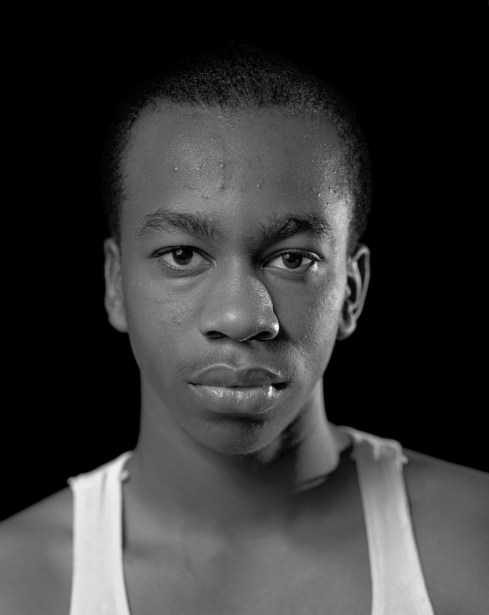
SD: Well, they knew the reason why I was there. And all they knew was that their portraits were to go into a catalog. In all, three catalogs were produced. They knew the photos would be published and shown. Other than that, the motivation from these kids to have their picture taken was overwhelming.
I did go in with a bit of theater. I had a large camera, I had lights and I had an assistant. So they were just begging to get their picture taken. It wasn’t hard at all. Direction was minimal. I’d ask them to turn their head or look into or away from the camera. Because I was shooting 8×10 on a limited budget, I’d take a limited numbers of pictures of each person, maybe 2 or 3, and then they were gone.
PP: The personalities of these kids comes through very strong. Are these images an accurate reflection of the individuals in the group?
SD: Yes, each photograph is one accurate reflection. Many of the sitters look very somber, but in fact they’d be laughing their heads off a lot of the time.
Some of the portraits I feel stronger about than others. There are some portraits I don’t have a particular connection with and there’s other I really love. Kids that really struck a chord with me, part of it was the experience of them sitting with me, knowing their character.

PP: Can you talk about a few of them?
SD: This guy. The nicest guy in the world. Total white racist. Had as many black friends as white, but he was basically raised to be a white racist. Once you got to know him you fell into that world, his world. He got along with everybody, but if you asked him he would’ve told you what his views were. I shot a lot of him, indoors and outdoors, more complicated environments.
PP: This portrait?
SD: I like that one. I don’t know if it’s the picture or the kid. But out of all the time I was there, he was the only one where the staff said, “He should not be here.” He was a Mexican who got busted for being a drugs mule from Mexico. Apparently, some rivals burnt his house down. He couldn’t or wouldn’t speak English. He was scared and totally out of his element. But over about three months he started playing the role of the tough guy and you saw this transition. He was becoming what he was assumed to be to begin with. Becoming a hard guy – it was sad.

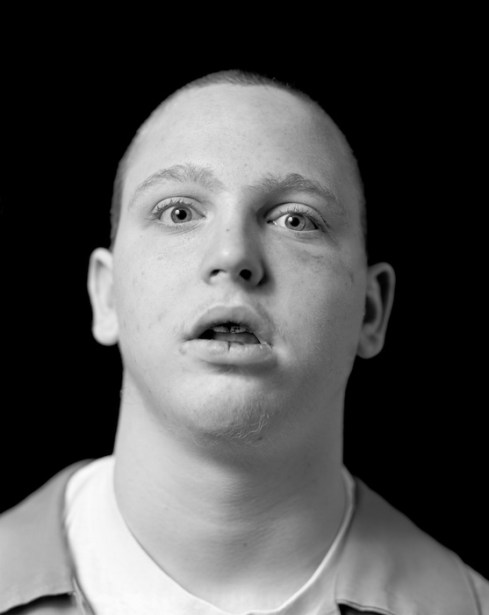
PP: And this guy?
SD: This was in the psychiatric ward and they were all seriously medicated. This kid here was heavily medicated. He’s got blood on his teeth.
PP: Explain the blood.
SD: He told me he was in a fight the day before and he was walking around like this. Maybe he was continuing to bleed.
PP: Did he always have that look?
SD: Probably not. I didn’t really know this kid. But when I saw him I really wanted to photograph him. I was never demanding, but he was the only one I had to cajole. I said “If you want to make a dent, let me take your picture.” He said okay. That was just his gaze. I really thought his look was gripping. And there was a whole wing of them.
PP: Was it a common attitude among the juveniles, that they knew they were medicated and they knew they didn’t want to present themselves as such to the camera?
SD: He was the only one. I only took two pictures in the psychiatric ward.

PP: And this young man?
SD: He was the only other one I photographed on this wing and he was fine with it. A couple of years later when I was working at Green Hill, I was showing the staff my work and they recognized him and told me he’d got out and was later murdered on the street. He was involved in a knife fight.
PP: This one may stick with viewers but maybe for the wrong reasons? This is your only image where the sitter comes across as full of attitude, possibly angry?
SD: Yeah, he’s got a smirk. This picture never struck me as much as others, but many people have commented. I just never really connected with the portrait.

SD: One thing I learnt from putting the work out is that people respond to these portraits for their own reasons. A lot of the reasons have nothing to do with prison justice. Some of them like pictures of handsome young boys; they like to see beautiful people, or vulnerable people, whatever. That started to blow my mind after a while.
But on the other hand, I don’t want to force people into thinking that these portraits should be considered in one particular context. Just, here they are. Portraits are really charged that way.
PP: My wife’s favourite is the kid blowing gum. What was that scenario?
SD: He was the nicest kids. He was overweight. He had a massive pack of bubble gum and it was in Oakridge, so he was on work release during the day. He seemed like a nice kid and so I asked “could you blow a bubble”. He did. I like that picture precisely because he looks as if he doesn’t belong.

SD: But more than the portraits, the pinhole photographs from Remann Hall are my favorites.
___________________________________________________________
Please return on Thursday, 23rd July to read Part Two of this Interview.

Cornell Capa, to some extent, lived in the shadow of his older brother Robert. I guess, it is easy for complacent men to adore the still and fallen martyr than to keep apace with a passionate and piqued practitioner. Cornell’s and Robert’s legends are one; Cornell ceaselessly fought his brother’s corner authenticity debate surrounding The Falling Soldier.
Cornell’s indebtedness to his brother was fateful and self-imposed:
Disappointingly, it is only in extended surveys of Cornell Capa’s career that mention of his fifties photojournalism in Central and Southern America arises. Otherwise, Cornell is celebrated for his political journalism and particularly his campaign coverage of Adlai E. Stevenson, Jack and Bobby Kennedy. Cornell’s photographs from Latin America are often neglected, even demoted.

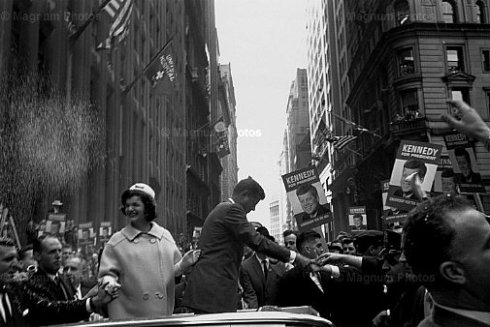
The Kennedys were the foci of American progressive attitudes, and so, in the sixties, Cornell documented the concerned politician. Cornell was (not in a negative way) passive and the sixties were not formative. It was in the fifties that he actively worked to define the persona, the ideal: ‘The Concerned Photographer’.
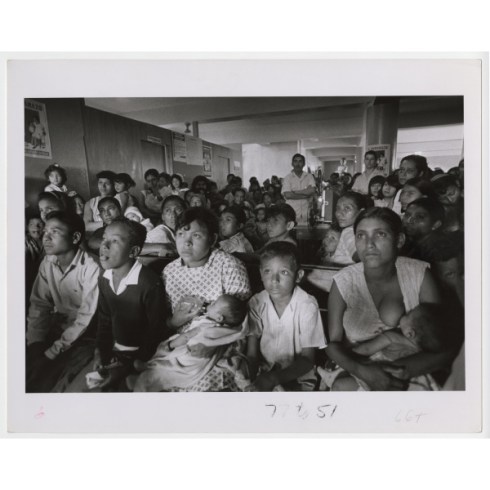
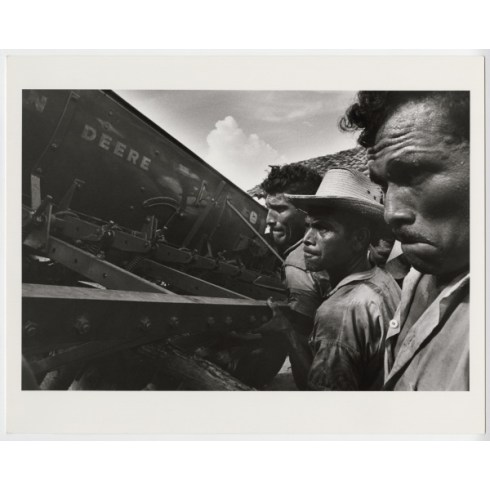
Cornell’s work in Latin America:
In 1956, Cornell was in Nicaragua reporting on the assassination of President Anastasio Somoza García. Somoza was shot by a young Nicaraguan poet; the murder only disrupting slightly the Somoza dynasty that lasted until the revolution of 1979 (that’s where Susan Meiselas picks up).
In the aftermath of the assassination over 1,000 “dissidents” were rounded up. The murder was used as an excuse and means to suppress many, despite the act being that of one man.


I have no knowledge of what happened to these men after Cornell photographed them and I am sure you haven’t the patience for speculative-art-historio-speak.
I do wonder … if having witnessed revolution, early democracies, military juntas, coups, communism, social movements, grand narratives and oppression in various forms, if Cornell picked his subjects with discernment back in the United States.
As early as 1954 Cornell was working on a story for Life about the education of developmentally disabled children and young adults. Up and to that point in time, the subject had been regarded by most American magazines as taboo. The feature was a breakthrough.
In 1966, in memorial to his brother, Robert, and out of his “professed growing anxiety about the diminishing relevance of photojournalism in light of the increasing presence of film footage on television news” Cornell founded the Fund for Concerned Photography. In 1974, this ideal found a bricks and mortar home on 5th Ave & 94th Street in New York: The International Center for Photography.

This institutional limbo that eventually gave rise to one of the world’s most important photography organisations was not a quiet period for Cornell. In 1972, he was commissioned to Attica, NY, to document visually the conditions of the prison. Capa presented his evidence to the McKay report (PDF, Part 1, pages 8-14) the body investigating the cause of the unrest. Cornell narrates his personal observations while showing his photographs to the commission.


At a time when, the photojournalist community seems to have crises of confidence and purpose at an alarming rate, it would be wise to embrace his spirit in full recognition his slow accumulation of remarkable accomplishments.
Rest In Peace, Cornell.

PHOTO CREDITS.
Robert F. Kennedy campaigning in Elmira, New York, September 1964. Accession#: CI.9685
New York City. 1960. Senator John F. KENNEDY and his wife, Jackie, campaigning for the presidency. NYC19480 (CAC1960014 W00020/XX). Copyright Cornell Capa C/Magnum Photos
Three men pushing John Deere machine, Honduras, 1970-73. Accession#: CI.3746
Watching family planning instructional film at Las Crucitas clinic, Tegucigalpa, Honduras], 1970-73. Accession#: CI.8544
Political dissidents arrested after the assassination of Nicaraguan dictator, Anastasio Somoza, Managua, Nicaragua, September 1956. The LIFE Magazine Collection. Accession#: 2009.20.13
NICARAGUA. Managua. 1956. Some of the one thousand political dissidents who were arrested after the assassination of Nicaraguan dictator Anastasio Somoza. NYC19539 (CAC1956012 W00004/09). Copyright Cornell Capa/Magnum Photos
Prisoners escorted from one area to another, Attica Correctional Facility, Attica, New York, March 1972 (printed 2008). Accession#: CI.9693
Two men walking around prison courtyard, Attica Correctional Facility, Attica, New York, March 1972. Accession#: CI.9689
Inmates playing chess from prison cells, Attica Correctional Facility, Attica, New York, March 1972. Accession#: CI.9688
Man on scooter carrying coffin, northeastern Brazil, 1962. Accession#: CI.8921
All photos courtesy of The Robert Capa and Cornell Capa Archive, Promised Gift of Cornell Capa, International Center of Photography. (Except for ‘The Concerned Photographer’ book cover; the Jack Kennedy photograph; & the second Nicaragua prison photograph.)
“The Gay Essay is comparable in magnitude to Robert Frank’s ‘The Americans’…the exhibit in its entirety is amazingly strong. And for the most part the photographs are singularly beautiful in execution.”
San Francisco Art Week, 1973

Sun Reflections on Wave, Zuma Beach, CA, 2000. Anthony Friedkin. Photography - Silver Print. 16 x 20 inches.
This weekend is Pride and today (Sunday) the 40th anniversary of the Stonewall Riots; an event generally regarded as the beginning of the modern gay rights movement. To mark the occasion DRKRM Gallery in Los Angeles is exhibiting Anthony Friedkin’s Gay, A Photographic Essay 1969 – 1972.
Friedkin isn’t your run of the mill photographer. He’d likely balk at the top-heavy marketing necessary by the individual photographer to survive in today’s game. He doesn’t seem to have searched out publicity or reviews and never chased the recognition of the fine art world. There’s next to nothing written about him on the internet which supports my theory that he is of a different generation and different ethos.
He is a name not commonly known. This, of course, is our loss and not his.

Woman by the Pool, Beverly Hills Hotel, CA, 1975. Anthony Friedkin. Photography - Silver Gelatin Print. 16 x 20 inches

Dan, Male prostitute, San Fernando Valley. Anthony Friedkin. 1972
Friedkin is as “California” as Henry Wessel. He is as culturally vital to the West Coast gay communities as Leigh Bowery was to London’s. Friedkin’s fascination with the couture and characters of subculture in the American West is on a par with that of Richard Avedon.
Friedkin was a one man Hamburger Eyes long before the zygote of Hamburger Eyes’ uncowed lens fell down the photo community fallopian tube.
Friedkin’s projects include The Gay Essay done in San Francisco and Los Angeles in 1969 and 1970; The Beverly Hills Essay shot in 1975; The Hollywood Series began in 1978 continues to this day; and The Ocean-Surfing Essay which explores Friedkin’s intimate, intensely personal relationship with the surf and waves. For most of his life he has been photographing Los Angeles creating an unparalleled body of work informed by his love of the diverse conurbation.
Of all his major photographic series, only one documents life outside the Golden State (New York City Brothels).
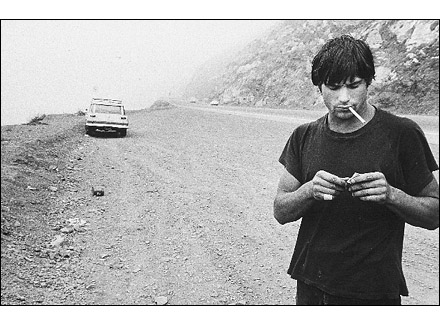
Clockwork Malibu, Rick Dano on the Highway, Malibu, CA. Anthony Friedkin. 1977. Photography - Silver Print. 16 x 20 inches

Debbie with her Head in the Sand, Venice, CA. Anthony Friedkin. 1980. Silver Print. 11 x 14 inches
Prison Photography is particularly interested in Friedkin’s photographic record of California Prisons and their inmates. The only image I have to present here is Four Convicts, Folsom Prison, CA (1991) [bottom].
California Prisons includes sensitive portrait shots of incarcerated teenagers, as well as the many typical representations of machismo and gang affiliated men.
I do not know if the series includes photographs of female prisoners, but this and many other unanswered questions now await a curious future…
I’d be very interested to hear from readers who’ve attended exhibition of the work and have any lasting impressions.

Android Sisters, Universal Studios, Hollywood, CA. Anthony Friedkin. 1978. Silver Print.

Jaws, Universal Studios, Hollywood, CA. Anthony Friedkin. 1978. Photograph. Silver Print.
It is Friedkin’s devotion to the unexpected that distinguishes his work. He disarms the extraordinary and educates his audience. Friedkin presents outlying cultures without a second thought; he surrounded himself with these people and paid them total respect.
As objective as the camera can be, it was so when in Friedkin’s hands and directed at people. Particularly, in documenting Gay culture, Friedkin was never reductive; he photographed the ‘wide-ranging composite … young hustlers, drag queens, transsexuals, San Francisco entertainers; a Gay Liberation parade in Hollywood; two lesbian women very much in love; effeminate boys growing up in an environment of machismo and the religious subculture typical of East Los Angeles.’

Four Convicts, Folsom Prison, CA. Anthony Friedkin. 1991. Silver Print. 16 x 20 inches.
Friedkin’s close tie to California, and especially Los Angeles, is conspicuous in his work as a still photographer for the movie industry. He makes the distinction himself between the circles of Hollywood and the tradition gallery circuit as evidenced by his use of ‘Tony’ Friedkin for movie credit-lines. Work on Crips and Bloods: Made in America and an appearance as himself in Dog Town & Z-Boys tie Friedkin indelibly to the California cultures of today and yesteryear.
Anthony Friedkin has over forty years experience as a professional photographer. He started out as a photojournalist working as a stringer for Magnum photos in Los Angeles. For the past twenty-five years Anthony Friedkin has lived and worked out of his apartment studio in Santa Monica. Currently, he is preparing a book of his Ocean-Wave photographs. Friedkin’s photographs are included in major Museum collections including the Museum of Modern Art, the Los Angeles County Museum of Art, San Francisco MoMA and The J. Paul Getty Museum. His work has been published in Japan, Russia, Europe, in many Fine Art publications in America and in magazines such as Rolling Stone, Newsweek, French Zoom and Malibu Magazine. For a full resume click here.

Granada (Amache) Relocation Camp, Foundations, Prowers, Colorado © Masumi Hayashi. Panoramic photo collage with Fuji Crystal Archive prints, 1997. Size: 23" x 31"
Masumi Hayashi visited every permanent site of Japanese American internment; such was her dedication to its historical truth and visual legacy. I’d like to pay tribute to Hayashi’s artistic rigour, the project and above all her life.
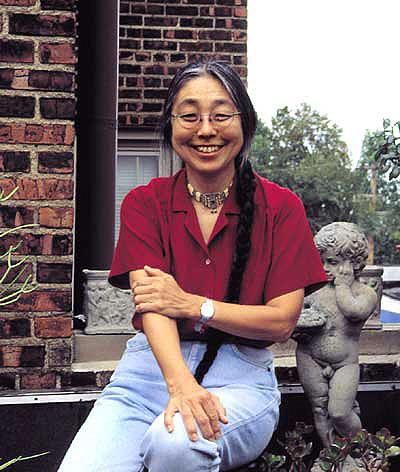
Masumi Hayashi 1945 - 2006
This post is not only a celebration of meaningful photography but also of a life cut short in tragic circumstances.
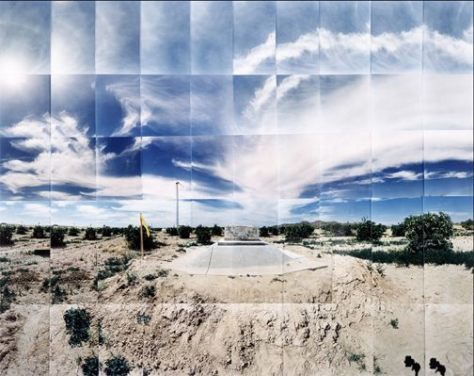
Gila River Relocation Camp, Dog Grave, Gila River, Arizona © Masumi Hayashi. Panoramic photo collage with Fuji Crystal Archive prints, 1995. Size: 38" x 31"
Prison Photography has needed to limit itself in discussion, so rich and extensive was Hayashi’s oeuvre. I recommend that you spend a long time meditating her Prison series, Salt Mine series and a spectacular EPA Superfund Sites series.
Let us focus, for now, on the issue at hand – Japanese American Internment.
Professor Hayashi photographed all 10 internment camps on American soil. She also documented the 4 Canadian internment sites. It was a subject close to her heart — she was born at the Gila River Relocation camp in Arizona in 1945.
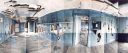
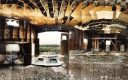
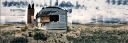
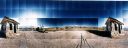
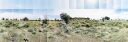
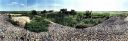
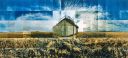
In most cases, Hayashi photographed a full 360 degrees. The gradient of exposure in her photo montages and her extruded viewpoint lent visual richness, height and vertigo to otherwise mundane landscapes. Hayashi’s indelible presence in the works is a reminder of the former human presence in inhumane environments.

Gila River Relocation Camp, Monument, Gila River, Arizona © Masumi Hayashi. Panoramic photo collage with Fuji Crystal Archive prints, 1995. Size: 31" x 75"

Gila River Relocation Camp, Foundations, Gila River, Arizona © Masumi Hayashi. Panoramic photo collage with Fuji Crystal Archive prints, 1990. Size: 22" x 56"

Topaz Relocation Camp, Foundations, Delta, Utah © Masumi Hayashi. Panoramic photo collage with Fuji Crystal Archive prints, 1995. Size: 31" x 72"
Hayashi’s composite tactic solves the problematic banality of many of the sites. She describes here and here that many of the sites as barren and sun bleached (Manzanar, CA has been well-preserved as a memorial and state park, but it is the exception). The most common denominator among the sites was the concrete sewage system. The large peripheral tanks always remained long after the sheds and tended plots had decayed. A brick structure was a treat, and wooden barns, anomalies.
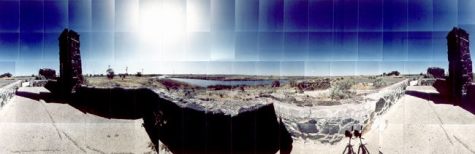
Minidoka Relocation Camp, Visitors Waiting Room, Minidoka, Idaho © Masumi Hayashi. Panoramic photo collage with Fuji Crystal Archive prints, 1992. Size: 27" x 70"
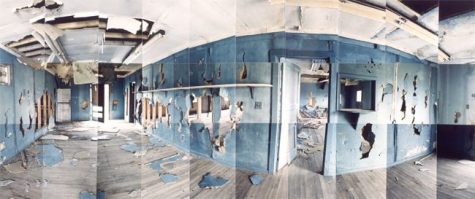
Heart Mountain Relocation Camp, Blue Room, Park, Wyoming © Masumi Hayashi. Panoramic photo collage with Fuji Crystal Archive prints, 1995. Size: 23" x 45"
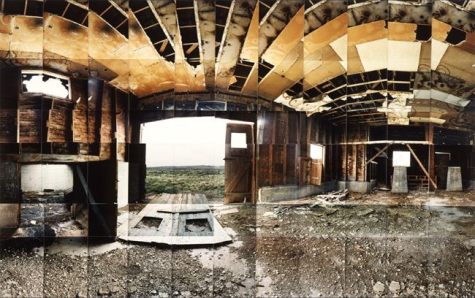
Heart Mountain Relocation Camp, Interior, Park, Wyoming © Masumi Hayashi. Panoramic photo collage with Fuji Crystal Archive prints, 1995. Size: 31" x 42"
Hayashi’s endeavours cannot be underestimated. As Candida Hofer noted;
and
For those of you sitting there thinking, “Oh, yeah, I could take a bunch of little pictures of something too.” No, you couldn’t. Not like this. Her style is built on solid conventional photographic methods (each picture must itself be a very good picture).
Extraordinary.

Heart Mountain Relocation Camp, Hospital, Park, Wyoming © Masumi Hayashi. Panoramic photo collage with Fuji Crystal Archive prints, 1995. Size: 32" x 70"
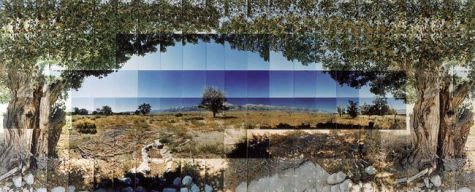
Manzanar Relocation Camp, Tree View, Inyo, California © Masumi Hayashi. Panoramic photo collage withFuji Crystal Archive prints, 1995. Size: 27" x 63"

Manzanar Relocation Camp, Monument (Version 1), Inyo, California © Masumi Hayashi. Panoramic photo collage with Fuji Crystal Archive prints, 1995. Size: 20" x 30"
In addition to her photographic work, Hayashi conducted audio interviews of former internees to develop a complete sense of experience across the American internment archipelago.

Manzanar Relocation Camp, Guard Gates, Inyo, California © Masumi Hayashi. Panoramic photo collage with Fuji Crystal Archive prints, 1992. Size: 27" x 65"

Granada (Amache) Relocation Camp, Water Tank, Prowers, Colorado © Masumi Hayashi. Panoramic photo collage with Fuji Crystal Archive prints, 1997. Size: 23" x 31"
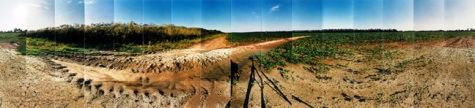
Jerome Relocation Camp, Farm, Drew & Chicot, Arkansas © Masumi Hayashi. Panoramic photo collage with Fuji Crystal Archive prints, 1995. Size: 22" x 59"
In August 2006, Hayashi along with her neighbour John Jackson, knocked at the door of the apartment of another neighbour Jacob Cifelli to complain oncemore about his high volume music. It was the last of many noise complaints. Cifelli shot them both to death in the stairwell.
The story has added tragedy as Hayashi had recently reunited with her biological daughter, Lisa Takata, after 39 years of estrangement. Hayashi gave Takata up for adoption within a few days after her birth in the midst of the Watts Riots in 1965.
Photographer, artist and fellow Cleveland resident, Norm Roulet summed up the loss of Hayashi;
Rest in peace, indeed.
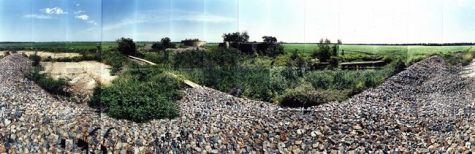
Jerome Relocation Camp, Sewer, Drew & Chicot, Arkansas © Masumi Hayashi. Panoramic photo collage with Fuji Crystal Archive prints, 1995. Size: 23" x 55"
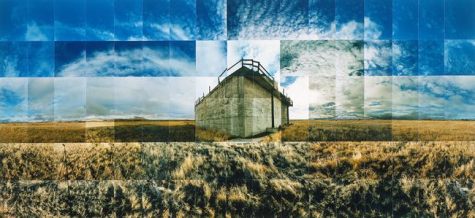
Tule Lake Relocation Camp, Sewer, Tulelake, California © Masumi Hayashi. Panoramic photo collage with Fuji Crystal Archive prints, 1996. Size: 32" x 59"

Poston lll Relocation Camp, Sewer, Yuma, Arizona © Masumi Hayashi. Panoramic photo collage with Fuji Crystal Archive prints, 1997. Size: 26" x 63"
Masumi Hayashi’s work has been exhibited in internationally respected museums and galleries, including the International Center for Photography in New York, the L.A. County Art Museum, the Japanese American National Museum (L.A.), the Tokyo Museum of Photography, the Ludwig Museum of Art in Germany, and the Victoria and Albert Museum of Photography in London, England. In 2003, she had a retrospective one-person exhibit at the Japanese American National Museum in Los Angeles. Professor Hayashi taught photography for 24 years at Cleveland State University, Ohio.
Gallery with pop-out full size images






-

- Masumi Hayashi 1945 – 2006
Thanks to Matt Kelley at Criminal Justice Change.org for alerting me to Hayashi’s work.

 Prison Photography